
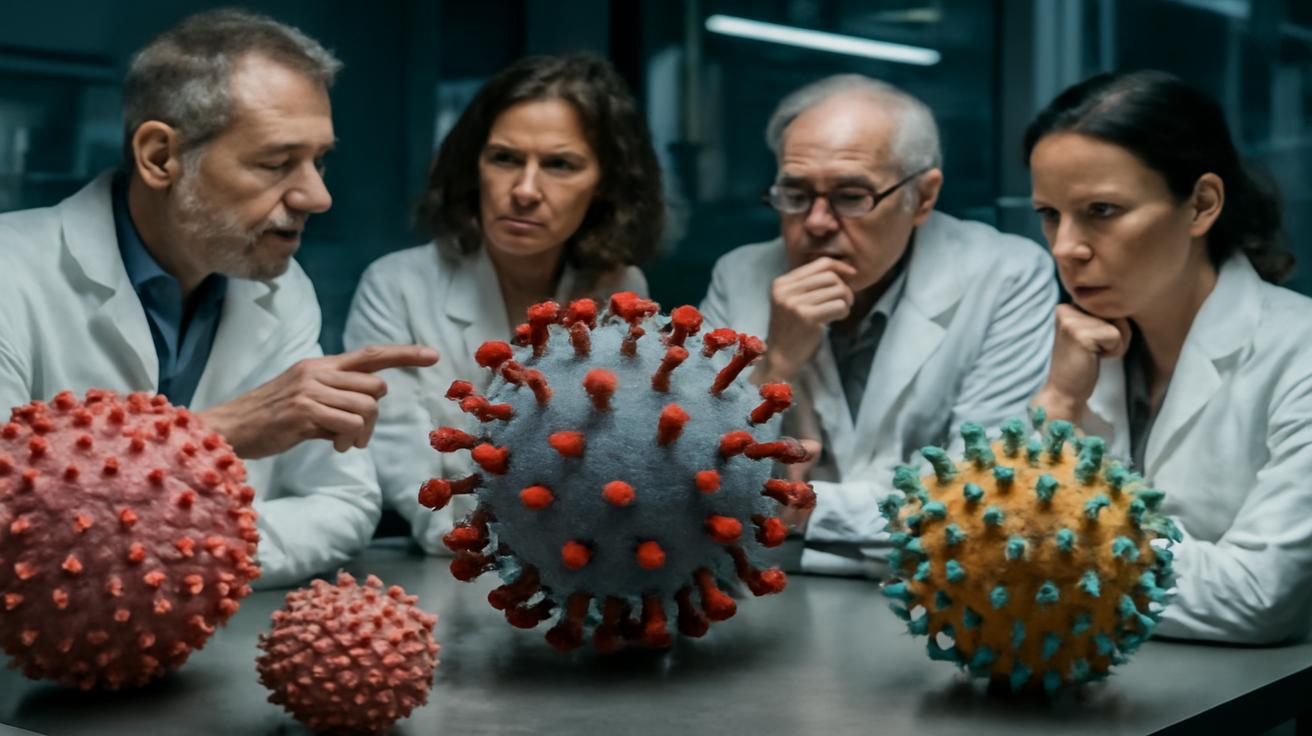
The first time you see a virus, really see it, is usually not with your eyes but with your imagination. There it is in the textbook: a tiny geometric shape, sketched in blues and grays, like a minimalist logo for some futuristic tech company. No teeth. No claws. No expression. Just angles, curves, and a bit of protein wrapped around a thread of something that looks suspiciously like code. This, you’re told, is what shut down the world in 2020. This is what gives children measles, what fills winter with coughing and fever, what hijacks airplanes and hospital wards and late-night news. And somehow, we are still not sure if it’s alive.
The Day the World Met an Invisible Code
There’s a particular morning you might remember: streets strangely quiet, supermarket shelves stripped of toilet paper and pasta, the air buzzing with a fear you couldn’t see but somehow felt on your skin. News anchors talked about “the virus” in the same breathless tone once reserved for wars and hurricanes. Coronavirus. SARS-CoV-2. A name that rolled uneasily off the tongue, too long to be a monster, too short to feel like a story.
Yet behind the charts, the masks, and the lockdowns, the culprit was not a beast or a villain. It was something far stranger: a microscopic parcel of information, a snippet of genetic code inside a shell of protein and fat, drifting from person to person on the warm breath of conversation, the invisible mist of a cough.
In the same microbial underworld, influenza did its yearly rounds—polite in comparison, almost familiar, like an unwelcome uncle who always shows up uninvited each winter. And further back in our collective memory, measles lurked: the wildly contagious childhood disease that once swept through communities in roaring waves of fever and rash. Three very different stories, one bizarre common thread—each is powered by an entity so small, so simple, that biologists can’t even agree if it deserves to be called “alive.”
Think about that for a moment: the most disruptive agents of modern life are not monsters, not demons, not even cells. They’re mindless, invisible fragments of code-like matter, utterly indifferent to our suffering. And yet, they’ve rewritten our history, our bodies, and our sense of safety.
What Does a Virus Look Like Up Close?
If your eyes were powerful enough to zoom down to the nanometer scale, the world of viruses would appear almost architectural. There’s a cold, mathematical elegance to them. Influenza, for instance, resembles a tiny spiky sphere—its surface studded with proteins like bristles, looking vaguely like a dandelion seed head. Coronavirus is similar but crowned by a ring of spike proteins, a halo that gave coronaviruses their royal name long before COVID turned it infamous.
Measles, the old troublemaker, hides behind a more subtle disguise, its spherical shape adorned with its own set of surface proteins—molecular keys searching blindly for locks on our cells. Each virus type carries its own genetic recipe—RNA or DNA—rolled up and packaged like a tightly wound manual.
Now imagine holding one of these in your hand—except you can’t, not really. Individually, viruses are too tiny to feel, too light to weigh, too simple to think. They don’t eat. They don’t drink. They don’t breathe. They just exist, like drifting instructions waiting for a machine.
Code Without Consciousness
At the heart of each virus is a string of genetic material: a set of instructions written in the same biological alphabet used by every living thing on Earth. It’s like discovering that the burglar’s toolkit is made from the same metal as your house keys. Coronaviruses, influenza, measles—all of them carry RNA, a cousin of DNA, a kind of biological script that tells a cell what proteins to build.
But unlike your own cells, which carefully orchestrate thousands of processes every second to keep you alive, a virus is brutally single-minded. Its RNA doesn’t tell a whole organism how to grow and repair and think. It contains just enough information to hack a cell, replicate itself, and escape. If DNA is the grand library of life, a virus’s genome is more like a sticky note with a single, ruthless command: Make more of me.
That’s the strange thrill of thinking about viruses. They’re not monsters in the fantasy sense; they’re closer to runaway computer scripts, tiny loops of self-copying instructions that only “run” when they invade the right hardware—your cells.
Hijacking the Cell: How the Trick Works
To a virus, you are not a person; you are architecture and machinery. Lungs are not for breathing, they are for entry. Throats are not for talking, they are for transmission. Your immune system is not your guardian, it is an obstacle course.
Here’s the general heist plan, whether we’re talking about coronavirus, influenza, or measles:
- Find the right door. Each virus has proteins that act like keys looking for compatible locks on your cells. For SARS-CoV-2, that “lock” is a receptor called ACE2. Measles prefers receptors on immune cells and cells in the respiratory tract. Influenza goes for receptors in the nose, throat, and lungs.
- Slip inside. Once the virus binds to its receptor, it tricks the cell into pulling it inside—like a Trojan horse invited through the gates.
- Unpack the code. The viral shell falls apart, releasing the genetic code into the cell’s interior.
- Hijack the machinery. The cell’s ribosomes—the tiny factories that usually make your proteins—are forced to read the viral instructions instead.
- Self-assembly line. New viral parts are made in bulk: shells, proteins, copies of the genetic script. They assemble like cars on a conveyer belt.
- Break out. New viruses exit the cell—sometimes quietly, sometimes by bursting it open—and set off to repeat the process in neighboring cells.
The cell never raises its hand to consent. It doesn’t “decide” to help. It’s simply following instructions, as obedient to the virus’s code as to its own.
Different Viruses, Different Stories
While the strategy is similar, each virus tells its own story in the body:
| Virus | Typical Target | Main Symptoms | How It Spreads |
|---|---|---|---|
| SARS-CoV-2 (Coronavirus) | Respiratory & other cells with ACE2 receptors | Fever, cough, fatigue, loss of taste/smell, breathing issues | Respiratory droplets, aerosols, close contact |
| Influenza (Flu) | Cells lining nose, throat, lungs | Fever, body aches, sore throat, cough | Respiratory droplets, contaminated surfaces |
| Measles Virus | Immune cells & respiratory tract | High fever, rash, cough, runny nose, red eyes | Highly contagious airborne particles |
Measles is so wildly contagious that, in an unvaccinated community, one sick child can trigger chains of infection that sweep through schools, playgrounds, and households with frightening speed. Influenza, with its habit of shapeshifting year after year, slips past our immune memory like a con artist in a new disguise. And coronavirus—new to most immune systems—triggered a global wave of illness that revealed just how interconnected and vulnerable we really are.
Are Viruses Alive or Not?
Here’s where things get truly weird. We are used to categories, to neat labels. A rock is not alive. A cat is alive. A tree is alive. A chair is not. Simple, right? Then you meet a virus—the code-fragment that shut down airports and filled ICUs—and the ground shifts beneath your feet.
Biologists usually describe life with a few core criteria. Living things tend to:
- Have cells
- Use energy
- Maintain internal balance
- Respond to their environment
- Reproduce on their own
- Evolve over generations
Viruses fail at several of these. They have no cells. They don’t metabolize or use energy on their own. They can’t reproduce by themselves; they must invade a host cell and exploit its machinery. If you isolate a virus on a glass slide, it doesn’t wriggle, divide, or grow. It just sits there, inert, like dust.
The Borderland Between Life and Nonlife
And yet, viruses check some of the other boxes with unsettling elegance. They evolve, fast. SARS-CoV-2 spun off new variants with different behaviors. Influenza drifts and shifts so much that vaccines must be updated regularly. Measles, once nearly eradicated in some countries, roared back where vaccination rates dropped, the same old virus finding new ground as human behavior changed.
Viruses also carry genetic information, the same language written in A, U, C, and G (for RNA viruses) that cells use. That’s not a trivial overlap; it suggests deep evolutionary roots. Some scientists suspect that viruses are leftovers from an ancient world of free-floating genetic elements, ancestors or cousins of the first living cells. Others think they broke away from cells long after life began, rogue genetic parasites stripped down to the bare minimum necessary for replication.
So are they alive? Some biologists say no: viruses are obligate parasites, more like biochemical machines or “mobile genes” than true organisms. Others argue that we should stretch our concept of life to include them, pointing out that a virus inside a cell is part of a dynamic, evolving system that meets many of life’s criteria—just distributed between virus and host.
In the end, the debate is less about the virus changing and more about us wrestling with our definitions. The universe, it turns out, doesn’t care how we draw our lines. That indifference may be the most humbling part of all.
How Invisible Code Reshapes Human Lives
If this all remained a microscopic curiosity, it would be an entertaining puzzle for biologists and philosophers. But the effects of these code-fragments radiate outward through almost every part of human life.
Coronavirus rearranged our routines overnight. Offices emptied. Family gatherings were postponed, or moved onto glowing screens. The vocabulary of everyday life expanded to include “PCR tests,” “viral load,” and “R-numbers.” We learned to count distance in meters and risk in conversations per day. A strand of RNA wrapped in protein became the quiet architect of social distancing, closed borders, and late-night anxiety.
Influenza has been reshaping human history for centuries. The 1918 flu pandemic killed tens of millions and left ghostly fingerprints on art, politics, and public health systems. Every winter since, the seasonal flu keeps pressing its small annual tax on human bodies and health systems—missed days of work, crowded clinics, quiet funerals.
Measles, for all its reputation as a “childhood illness,” is no gentle rite of passage. Before vaccines, it caused blindness, brain damage, and death in heartbreaking numbers. Even today, outbreaks still flare wherever vaccination coverage slips, especially in communities weighed down by poverty, conflict, or misinformation.
It’s hard to reconcile all this with the idea that the culprits are not even properly alive. But maybe that’s the wrong way to look at it. Maybe the power of viruses isn’t in what they are, but in how perfectly they exploit what we are—our cells, our social habits, our vulnerabilities, our closeness.
Our New Tools: Fighting Code with Code
When the first COVID vaccines appeared, something quietly revolutionary happened. For the first time, billions of people rolled up their sleeves to receive not a weakened virus or a fragment of one, but a tiny strand of synthetic RNA—a message. It slipped into our cells, delivered a short instruction manual for making a harmless piece of the virus, and then disappeared. Our immune system read that script, practiced its response, and stored the memory away.
We fought viral code with our own code.
This idea had been brewing for years, but the pandemic threw it into fast-forward. Suddenly, the same logic that made viruses so effective—compact information, efficient delivery, precise targeting—was turned back against them. Vaccines for influenza, for other diseases, and even for some cancers are now exploring similar tools.
There’s something almost poetic in that reversal. The very language viruses use to hijack us is being repurposed to protect us.
Living with the Uncertain
Maybe the strangest lesson of coronavirus, influenza, and measles is this: we share our world not just with animals and plants and bacteria, but with clouds of half-life, semi-life, borderland-life. Every breath carries the possibility of these fragments—proteins, membranes, and little loops of nucleic acid—drifting past us, into us, through us.
The revelation is not new in scientific terms. We’ve known about viruses for more than a century. We’ve watched them under electron microscopes, sequenced their genomes, built vaccines and antiviral drugs. But COVID-19 forced the entire planet to confront this microscopic reality as a lived experience, not just as a line in a biology textbook.
We now live in a world that has felt, viscerally, what it means to be connected by the air we share. We’ve seen how quickly an outbreak in one city can shape the lives of people halfway across the globe. We’ve also seen how science, at its best, can decode the problem—capturing a new virus’s genome in days, designing vaccines in months, translating molecular diagrams into protection for millions.
And still the philosophical question lingers in the background, almost mocking us: are these disruptive forces even alive? Or are they just bits of wandering, indifferent code that use our living bodies as temporary scaffolding?
Perhaps the answer doesn’t change our practical reality. We still wash our hands, still vaccinate our children, still stay home when we’re sick. We still grieve our losses and celebrate the recoveries. The line between life and nonlife may be blurrier than we once believed, but the consequences are all too real.
In the end, thinking about viruses is like staring at the edge of a map where the colors fade and the legend goes silent. On one side: the familiar terrain of cells and organs, animals and forests, the bustling comfort of clearly living things. On the other: these strange, crystalline instructions drifting in the dark, waiting for a host, ready to write themselves into our stories once again.
FAQ
Are viruses actually alive?
Scientists disagree. Viruses cannot reproduce or use energy on their own, which makes many researchers classify them as nonliving. However, they do carry genetic material and evolve rapidly, which are traits of living things. They exist in a gray zone between life and nonlife.
How do coronavirus, influenza, and measles differ?
All three are RNA viruses, but they target cells differently and cause distinct diseases. Coronavirus (like SARS-CoV-2) mainly affects the respiratory system and can impact multiple organs. Influenza attacks cells in the nose, throat, and lungs, causing seasonal flu. Measles targets immune and respiratory cells, leading to high fever, rash, and potentially serious complications.
How do viruses spread from person to person?
Most respiratory viruses spread through tiny droplets or aerosols released when people breathe, talk, cough, or sneeze. Some viruses, like measles, can linger in the air for longer and travel farther, making them extremely contagious. Contaminated surfaces and close physical contact can also play a role.
Why are vaccines so important for viral diseases?
Vaccines train the immune system to recognize a virus before you encounter the real thing. They prepare your body to respond faster and more effectively, greatly reducing the risk of severe illness, complications, or death. For diseases like measles and influenza, widespread vaccination also helps protect vulnerable people who cannot be vaccinated.
Can we ever completely eliminate viruses?
In a few cases, yes—smallpox was eradicated through global vaccination. But most viruses are much harder to eliminate because they spread quickly, mutate, or have animal reservoirs. Realistically, the goal is to control and reduce harm, not always total eradication. Living with viruses safely means combining science, public health measures, and informed personal choices.







Leave a Comment