
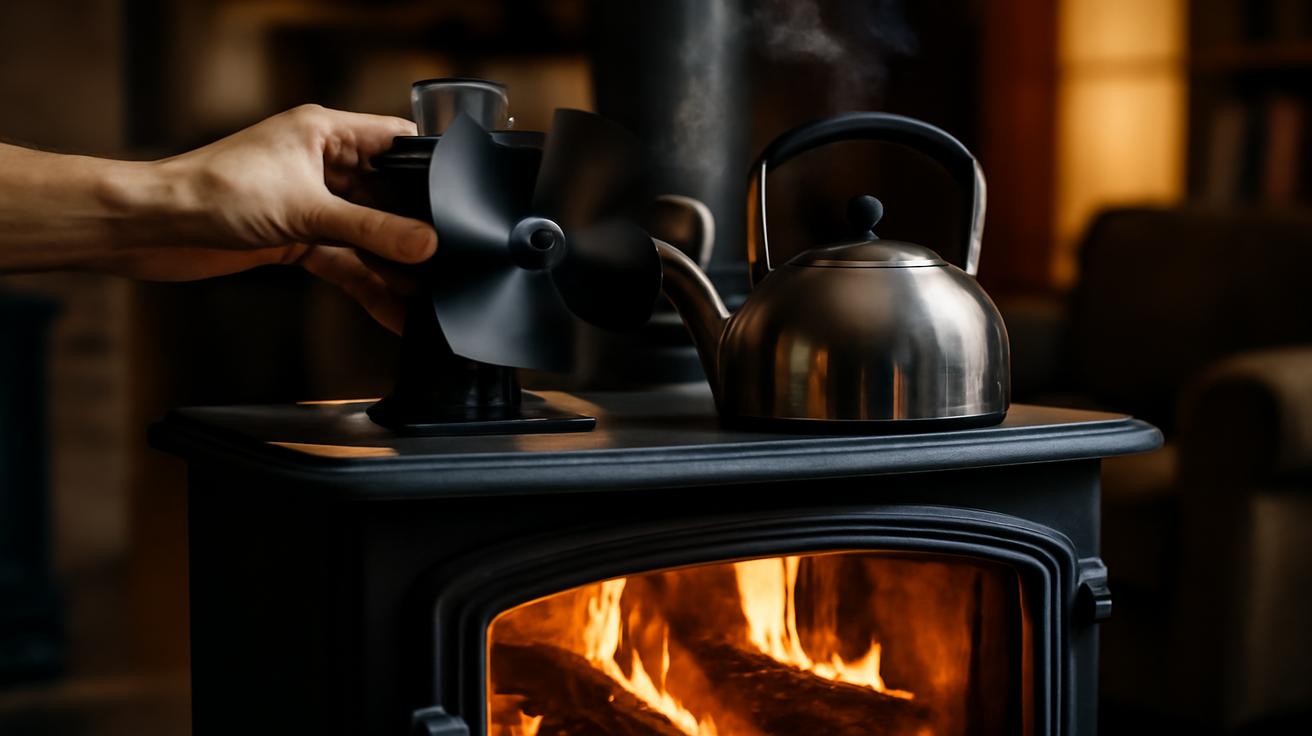
The first snowstorm of the season came in sideways, rattling the old windows and humming in the flue. Inside, the wood stove glowed, a small orange sun in the corner of the room. But if you stepped just a few feet away, the air turned surprisingly cool. Your face might flush from the heat while your back stayed cold, and the far end of the room felt like a different climate altogether. For many wood stove owners, that’s simply “how it is”: blistering hot up close, chilly in the corners, and a constant shuffle of logs to feed an appetite that never seems satisfied.
It doesn’t have to be like that.
There’s a little accessory, usually no bigger than a housecat and often costing less than a night out, that quietly changes everything. No wires. No batteries. No humming motor. It just sits there, spinning its blades on top of your stove like a tiny windmill. Yet it can turn a temperamental hotspot into a steady, whole-room warmth—and even shave money off your heating costs over the season.
The Tiny Companion on the Stove
It’s possible you’ve already seen one in a neighbor’s cabin or at the corner hardware store: a compact, self-powered stove fan perched on the flattest part of the stove, lazily turning as the fire builds. The first time you notice one, it almost feels like a trick. There’s no cord trailing to the wall. No indicator lights. Just heat and motion.
Imagine this: you lay a couple of birch logs onto a bed of coals, close the stove door with that familiar iron thud, and go about your evening. As the iron warms, a subtle shift begins. The little fan, quiet as a cat’s breath, starts to stir. Its blades turn slowly at first, then more steadily, pushing a stream of warm air across the room. The pockets of cold at floor level and in distant corners soften, the temperature gently leveling out. Instead of one roasting chair in front of the fire and everyone else wrapped in blankets, the whole room finds a comfortable middle ground.
That’s the real magic of this low-cost accessory: not just that it “moves heat,” but that it changes the way your home feels. Your firewood suddenly seems to do more work. The hot air doesn’t loiter at ceiling height or cling stubbornly around the stove. It travels—low, wide, and far enough that you can feel it where you live, read, cook, and sleep.
How Does a Stove Fan Work Without Electricity?
Part of the charm is in the science. On the surface, a stove fan looks like a simple propeller on a metal stand. Underneath, though, is a quiet bit of engineering, usually based on a thermoelectric generator or a bimetallic strip. You don’t have to be an engineer to appreciate it, but understanding the basics can make you see the fan in a new light.
Most modern stove fans use a thermoelectric module—often called a TEG. This small square device sits sandwiched between the hot base (touching the stove) and a cooler upper plate (often connected to a heat sink or fins). When there’s a temperature difference between the bottom and top of the module, it generates a small electric current—a phenomenon known as the Seebeck effect. That current powers a tiny motor, and the motor turns the fan blades. No plugs. No batteries. Just heat and physics.
The result is a kind of elegant loop: the hotter the stove surface (within safe limits), the stronger the temperature difference, and the faster the fan spins. As it spins, it pushes warm air away from the stove surface, helping cool the fan’s upper part and maintain that temperature difference. It’s a small, self-balancing system that responds naturally to the intensity of your fire.
The other detail that wood stove owners quietly come to love is the silence. Unlike box fans or ceiling fans that can drown out the crackle of wood, a stove fan operates in near silence. You might hear a faint whir if you stand right next to it, but from across the room it’s simply invisible motion—nothing more than the soft feeling of warmth moving toward you.
The Comfort Shift: From Hot Spots to Even Heat
To really understand what this accessory does, you have to step into the room at different points in a winter evening. Without a fan, the warmth near a wood stove stacks up in layers. The air above the stove is hot enough to bake cookies; somewhere around head height, it’s pleasantly toasty; by the time it reaches the floor or the next room, it’s cool enough that slippers and sweaters are still mandatory.
Turn on a self-powered stove fan—by which we really mean just “start a fire and let the fan wake up”—and those layers begin to stir. The fan doesn’t blow like a gale; instead, it creates a steady, directional flow that carries heat horizontally, out into the room. Think of it as taking the “bubble” of heat around the stove and gently stretching it outward until it fills more of your home.
Over the course of an evening, you might notice changes like these:
- The chair that used to be “too far” from the stove becomes a comfortable reading spot.
- The cold corner by the bookshelf feels more like the rest of the room.
- You don’t need to stand up and rotate every few minutes to keep the back of your neck from freezing.
There’s also an emotional layer to this comfort. A wood stove is already a gathering point—a place where people drift with mugs of tea, conversations, and quiet thoughts. When the warmth is more even, the circle of comfort widens. Kids sprawl on the rug rather than huddle under blankets on the single warm armchair. Guests don’t compete for the “good spot” by the fire. The room itself feels more generous.
In older homes and cabins, where drafts and thin insulation are simply part of the architecture, this can feel nothing short of transformative. The fan can help nudge warm air into stubborn corners, taking the edge off that old-house chill without any renovation work at all.
Where Savings Sneak In
Comfort is the first thing you notice; savings are what you notice later—often when the season is over and you realize you’re not as low on firewood as usual, or your backup heating has run less often.
A stove fan doesn’t increase the heat your stove produces. The fire burns the same. But it does change how efficiently your home uses that heat. By moving warm air more effectively, you’re using more of what you already paid for in wood, time, and effort. That, in turn, can lead to small but meaningful shifts:
- You may run the stove on a slightly lower burn because the room feels warm enough at gentler settings.
- You might get longer intervals between reloads, especially in shoulder seasons.
- Your supplementary heaters—electric baseboards, space heaters, or furnace—may kick on less often.
Even modest improvements in circulation can translate into noticeable comfort at lower stove temperatures. In practical terms, it might mean choosing the “medium” fire you enjoy instead of constantly pushing a roaring blaze just to get warmth out to the edges of your living space.
For those who buy their firewood, that can mean a cord stretching a little further than it used to. For those who cut and split their own, the savings are measured in fewer hours behind the saw and maul, fewer weekends dedicated entirely to filling the woodshed to the brim.
Consider the balance between cost and benefit. Many stove fans are available in a modest price range—less than, or roughly equal to, the cost of a single fill-up of your car or a dinner for two. Against that, you’re trading years of quieter comfort and incremental savings. Over multiple winters, the math starts to lean clearly in your favor.
A Quick Look at Value in Everyday Terms
Here’s a simplified way to picture the value this accessory can bring into a wood-heated home:
| Aspect | Without Stove Fan | With Stove Fan |
|---|---|---|
| Room Comfort | Hot near stove, cool elsewhere | More even, usable warmth |
| Fire Intensity Needed | Often high, frequent reloads | Moderate, more stable burns |
| Wood Usage Over Season | Higher; cords disappear quickly | Lower; woodpile lasts longer |
| Backup Heating | Kicks in more on cold nights | Runs less; more reliance on stove |
| Noise & Power Use | Extra plug-in fans add noise and cost | Silent, self-powered, no running cost |
Choosing and Using the Right Fan for Your Stove
All of this comfort and savings comes down to something small enough to fit in a grocery bag, but it’s worth matching the fan to your stove and space. The good news is that there’s not much complexity involved, only a handful of practical considerations.
First, think about stove temperature. Most stove fans are designed to start turning around a certain surface temperature, then operate well within a typical wood stove range. Some stoves run hotter than others, and if you’re the type to keep a vigorous fire going, you’ll want a fan rated for higher maximum temperatures. Many owners already use a magnetic stove thermometer on the flue or body; that same awareness is enough to keep your fan in a safe operating zone.
Then, consider stove top space and layout. A broad, flat surface gives you more options. The fan generally belongs toward the back or side of the stove top, where it can capture good heat without crowding your cooking pots or kettle. Because the fan relies on airflow, you want it aimed into the room, not at a wall a few inches away.
Finally, think quietly about your room size and shape:
- In a small cabin or single-room space, one medium-sized fan can be more than enough.
- In a long, narrow living room or an open-plan layout, some owners find that adding a second fan—or pairing the stove fan with a ceiling fan set on low—helps carry the warmth even further.
Once you set it up, there’s almost nothing to manage. The fan simply wakes as the stove warms and rests as it cools. Every so often, a gentle dusting of the blades and body keeps it looking presentable. Some designs use replaceable thermoelectric modules that may eventually need changing after years of use, but for many households, the fan quietly does its job season after season without fuss.
When a Little Accessory Becomes Part of the Ritual
There’s a moment, late on a winter evening, when everything falls quiet. The house settles. The last log of the night smolders behind the stove glass, its flame reduced to a lazy flicker. In that hush, the stove fan slows, blade by blade, and finally comes to rest. It’s a small, wordless signal: the day is over; the house is warm enough to sleep in.
That’s how this modest accessory finds its way into the rhythm of a home. It becomes as familiar as the matches on the mantel or the ash bucket by the hearth. Children notice when it starts to spin—“The fire’s going!”—and they notice when it stops. Guests sometimes ask, “How is that thing running?” and you explain, with a quiet trace of pride, that it’s simply the heat doing the work.
In an age of complicated systems and ever-growing energy bills, there’s something refreshing about an accessory that asks for nothing more than warmth and gives back comfort and thrift in return. It doesn’t demand apps, logins, or updates. It doesn’t blink or beep. It belongs completely to the slow, analog world of firewood and iron stoves and nights measured in logs and cups of tea.
For wood stove owners, that’s the real promise. Not just savings on paper, but a deeper, quieter efficiency—where the same fire that once overheated a single chair can now gently fill a room, a hallway, sometimes an entire small home. Where the labor of splitting and stacking feels better rewarded. Where winter becomes not just something to endure, but a season to lean into: snow against the windows, a kettle hissing on the stove, and warm air flowing softly, almost invisibly, from that low-cost little fan doing its steady work by the fire.
Frequently Asked Questions
Do stove fans really make a noticeable difference?
Most wood stove owners report that a fan makes the room feel more evenly heated, especially a few meters away from the stove. You’ll likely notice fewer cold spots and less need to crowd right up against the fire to stay warm.
Will a stove fan reduce how much wood I burn?
Indirectly, yes. The fan doesn’t change the stove’s efficiency, but by circulating heat more effectively, you can often burn at a moderate level instead of pushing very hot fires. Over a full season, that can mean your woodpile lasts longer.
Is a stove fan safe to leave on the stove all the time?
When used as intended and within its rated temperature range, a stove fan is designed to sit on the stove whenever it’s in use. It’s important to follow the manufacturer’s guidance on maximum temperatures and placement.
Does it work on all types of wood stoves?
Most stove fans are intended for freestanding wood stoves with a flat or gently curved top surface that gets hot enough for operation. They’re generally not suitable for gas fireplaces or stoves with decorative, non-heating tops.
How close should I sit the fan to the edge of the stove?
Place the fan on a stable, flat area toward the back or side of the stove top, with the airflow directed into the room. Avoid putting it right at the front edge where it may be bumped, and make sure it has room behind and around it for air to circulate.
Does a stove fan need maintenance?
Maintenance is usually minimal: occasional dusting and keeping it free of soot or debris. Some models may require a thermoelectric module replacement after many years of use, but most operate for long periods with little attention.
How hot does the stove need to be before the fan starts?
Most self-powered stove fans begin turning when the stove surface reaches a moderate temperature—often somewhere around the lower end of normal operating temps. As the stove gets hotter (within safe limits), the fan typically spins faster, then slows as the stove cools down.







Leave a Comment