
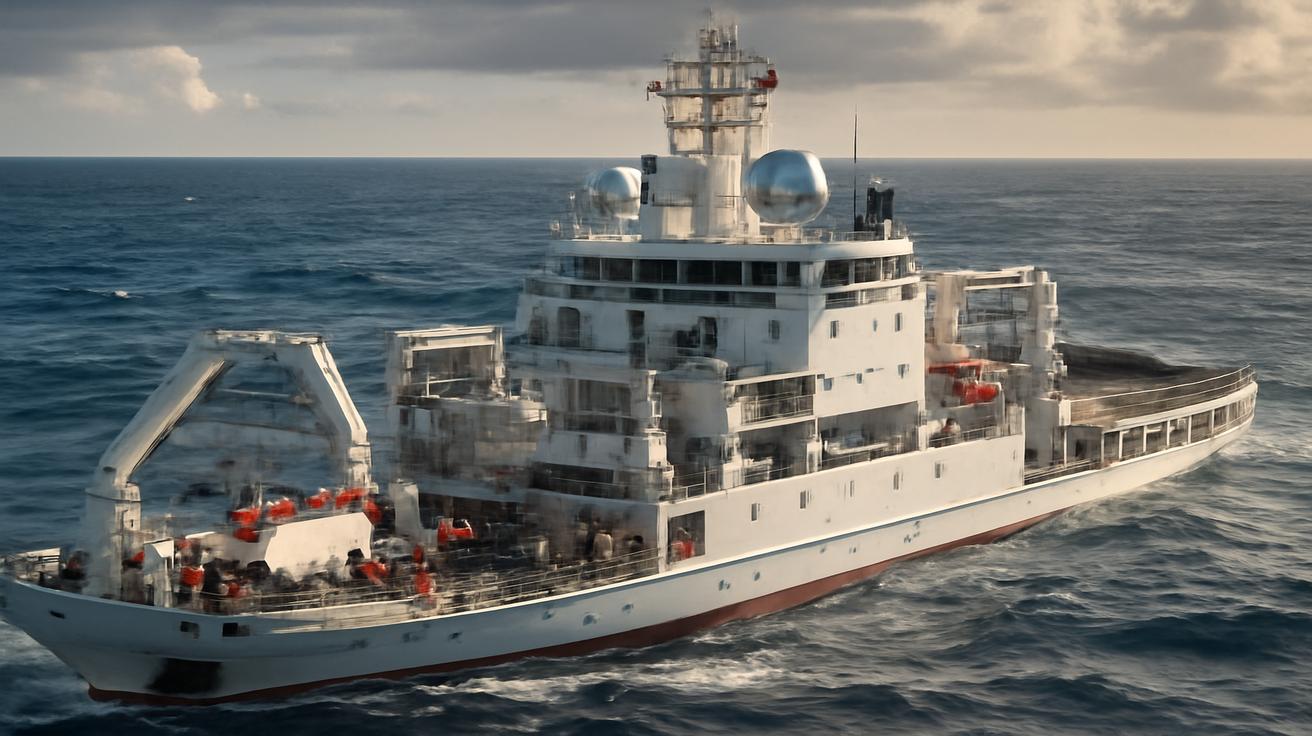
The harbor wakes slowly, like a great animal rolling over in its sleep. Fog drapes itself over cranes and containers, softening the hard edges of industry. And then, easing out of the gray, a hull appears. It is enormous, white and steel-blue, stacked with sensor domes and satellite dishes that glint faintly as the first light lifts over the water. Dockworkers pause mid-step. Phone cameras rise. Even in a port used to big ships, this one feels different—like the future has quietly arrived and tied itself to the pier.
The Ship That Wants to Redraw the Map
In the age of satellites and space telescopes, it’s easy to forget how much of our own planet remains a blank page. More than 80 percent of the ocean floor is still unmapped in high resolution, a vast, dark frontier hiding mountain ranges, deep trenches, and ecosystems we barely have names for. China’s new research vessel—sleek, bristling with instruments, and designed from keel to mast for deep-ocean exploration—has a single, audacious ambition: to start filling in that blank.
Walk along its deck and you hear the language of modern ocean science humming beneath your feet: the steady thrum of power systems feeding multibeam sonar arrays, the soft whir of winches coiled with armored cable for submersibles, the chirp and ping of testing acoustic gear before deployment. This is not just a ship. It’s a floating laboratory, a launchpad for robots and remote vehicles, and a data factory designed to swallow the mysteries of the deep and stream them, almost instantly, to scientists on shore.
The idea behind this vessel is deceptively simple: if you can stay at sea longer, reach rougher waters, dive deeper, and process data faster than anyone else, you don’t just participate in ocean exploration—you begin to set the pace. For China, that means more than scientific prestige. It means getting a head start in understanding, and possibly shaping, the future of the planet’s largest and least understood system.
The Quiet Race Beneath the Waves
There is a race unfolding, largely out of public view, and it doesn’t involve rockets or Mars landers. It is happening on rolling decks and in cramped control rooms lit by blue screens, on stormy midnights in the Southern Ocean and windless afternoons in equatorial heat. Nations are vying to map seabeds, study currents, sample sediments, and decode how the ocean is changing in a warming world.
China’s new ship is tailored for this race. Its hull is engineered for fuel efficiency and stability, capable of stretching missions into months rather than weeks. Dynamic positioning systems hold it steady over a point on the seafloor, even in difficult seas, while robotic arms and heavy A-frames at the stern swing submersibles into the water with the slow grace of a practiced ritual.
Inside, the air smells faintly of metal and coffee. Long corridors lead to labs where seawater is filtered through glinting glassware, where cores of ancient mud are sliced and labeled, where genetic material from invisible plankton is coaxed into revealing its secrets. Technicians gather around real-time mapping displays in a darkened control room, watching as swaths of seafloor appear line by neon line on a glowing grid, canyons and ridges emerging from digital darkness.
Onboard bandwidth—the unseen lifeline—is astonishing. High-capacity satellite systems pump out torrents of data to shore-based centers, allowing oceanographers thousands of kilometers away to join the voyage virtually, steering sensors and helping guide decisions. The old model of “bring samples home and figure it out later” is giving way to something far more nimble: analyze, adapt, and explore in a continuous loop.
More Than a Flag on the Waves
For all the subtle glamour of this high-tech craft, there is a practical undercurrent to its design. Extended range means more time in remote regions: the swirling, storm-lashed Southern Ocean that acts as a planetary heat sink; the fracture zones and seamount chains of the Pacific; the deep trenches that arc like scars along tectonic boundaries. The more ground—or rather, water—it can cover, the more data it can gather; the more data it gathers, the more indispensable it becomes in any global conversation about the sea.
And conversations are coming. As nations negotiate over seabed mining, marine protected areas, and climate action, those who hold the most detailed charts, the richest ecological datasets, and the sharpest models will have a quiet leverage. They’ll have the power to say not just what the ocean is, but what it might become.
The Tech Under the Hull
Standing on the aft deck at dusk, the ship feels almost alive. Cables snake across the painted steel. Yellow and orange vehicles—autonomous underwater vehicles (AUVs) and remotely operated vehicles (ROVs)—sit in cradles, their streamlined bodies gleaming in the fading light. Each one is a small, specialized explorer, able to go where humans cannot.
Some are built for the abyss, descending thousands of meters into crushing blackness where the pressure could flatten a car. They carry high-definition cameras, chemical sensors, samplers, and sonars fine-tuned to pick out details at the scale of individual rocks or corals. Others cruise quietly through midwater, listening to the faint clicks of whales, measuring oxygen and carbon, tracking blooms of microscopic algae that paint vast regions of the ocean green from space.
At the heart of all this hardware lies an orchestra of sensors tied together by software and computation. It’s easy to romanticize ocean exploration as a heroic act—people in bright orange immersion suits braving storms. But in truth, the revolution is mathematical. It’s about machine learning models that can sift through petabytes of noisy, messy data, about predictive tools that can guess where a deep-sea vent field might be hiding or when a current will shift, about turning raw sensor readings into something that looks suspiciously like foresight.
| Feature | Purpose | Why It Matters |
|---|---|---|
| Multibeam Sonar | High-resolution seafloor mapping | Reveals underwater mountains, canyons, resource-rich zones |
| Deep-Diving ROVs & AUVs | Close-up exploration of the deep ocean | Access to extreme ecosystems and potential mining sites |
| Onboard Supercomputing | Real-time data processing and modeling | Faster decisions, more adaptive expeditions |
| Dynamic Positioning Systems | Holding the ship steady over precise locations | Safer operations for deep dives and delicate sampling |
| Global Communication Links | High-bandwidth satellite data transfer | Enables remote collaboration and rapid data sharing |
China’s advantage isn’t just that this ship carries such tools; it’s that they’re integrated, planned from the start as one continuous system. The moment an AUV surfaces, the ship can pull in its data, crunch the numbers, update models, and decide—sometimes automatically—where the next dive should be. That feedback loop is where efficiency turns into acceleration. One discovery seeds the next, and the next, and suddenly the pace of exploration shifts from steady walking to a kind of brisk run.
Exploration as a National Strategy
Every country that builds a research vessel does so with multiple motives. There is the obvious one—science, curiosity, the desire to know. But there are also subtler motivations: training the next generation of marine engineers and scientists, building the industrial base that can produce advanced sensors and navigation systems, signaling capacity to rival nations.
For China, staking a claim as a leader in ocean exploration dovetails with broader goals. The ocean is a climate regulator, a protein pantry, a conveyor belt of trade, and a vault of minerals and energy. A nation that can model, predict, and, to some extent, manage what happens in those waters holds a tangible card in global negotiations, whether the topic is fisheries, shipping routes, or carbon emissions.
Windows Into Earth’s Memory
There’s a quieter story unfolding beneath the geopolitics. It happens when the ship heaves to a stop, engines throttling down, and a cylindrical sampler drops through the water column, unwinding cable as it sinks. When it comes back up, it carries a narrow, surprisingly fragile prize: a core of seafloor mud, stacked with time like a layered cake.
Each layer is a thin memory. Dust from distant continents. The remains of plankton that bloomed in ancient summers. Tiny shards of volcanic glass. Traces of pollution from the rise of industry. Read correctly, these layers tell stories of ice ages and warm periods, of collapsing ecosystems and recoveries, of how the ocean absorbed shocks and redistributed heat and carbon. The same ship that maps the seafloor’s contours is also, in its way, reading Earth’s diary.
Ocean exploration is no longer just about finding what’s out there. Increasingly, it’s about understanding how what’s out there responds to us—and how it might, in turn, shape our future. China’s research vessel can park itself over a coral reef, for example, and monitor how a marine heatwave sweeps across it, bleaching some sections and sparing others. It can visit deep methane seeps, capturing bubbles and water samples to see how much greenhouse gas is leaking out of thawing sediments. It can follow a typhoon’s path, measuring how storms churn nutrients from the depths to the surface, feeding plankton blooms that ripple through food webs.
Every measurement feeds climate models and ecological forecasts, tools that shape everything from coastal planning to insurance markets. The nation that controls a large share of that raw information doesn’t just know more. It can test scenarios more confidently, decide where to build and where to retreat, which routes to favor, which fisheries to protect. Data, in this sense, becomes a kind of soft infrastructure: invisible but profoundly influential.
Discovery and the Deep Unknown
Still, for all the talk of strategy, there is an irreducible wildness to what this ship is doing. Even with the best maps, dropping an AUV into the deep is an act of faith. You watch the signal drift downward on a screen. You wait. You listen to the quiet hiss of air conditioning, the creak of metal, the distant slosh of water on the hull. Hours later, the vehicle returns with a memory full of images from a realm sunlight has never touched.
One dive might reveal a forest of glass sponges, translucent and ghostly, filtering seawater drop by drop. Another might find a hydrothermal vent field: black “smokers” roaring mineral-rich water into the abyss, surrounded by pale crabs and red-plumed tubeworms. Somewhere out there—this ship’s designers are certain of it—lie species no one has ever seen, metabolisms that run on chemistry instead of sunlight, bio-inspired designs waiting to be copied in future materials or medicines.
Frontiers, Stakes, and Shared Seas
It’s tempting to frame this new vessel purely as a competitive advantage, a sleek chess piece in a high-stakes game. And to some extent, that’s true. Whoever catalogues more deep-sea mineral deposits will have more say in if and how they get extracted. Whoever tracks fish migrations most precisely can negotiate quotas with greater confidence. Whoever refines ocean-climate models fastest will be better positioned to adapt infrastructure, agriculture, and industry to a shifting world.
Yet the ocean is stubbornly, beautifully disobedient to borders. Currents ignore lines on maps. Carbon absorbed near one continent can be released centuries later near another. A heatwave in one basin can twist atmospheric patterns somewhere else. In that sense, China’s potential head start in ocean exploration is not only a national asset; it is also a global one—if the knowledge flows outward.
Whether this ship becomes a symbol of shared discovery or a fortress of proprietary information will depend on choices made not in the engine room, but in conference halls and policy documents. Will datasets from its voyages be open to international collaborations? Will its maps support global initiatives to protect biodiversity, or mainly national ambitions for extraction? The vessel itself is neutral: a tool, an instrument. The stories it tells, and who gets to hear them, are still unwritten.
Life Aboard a Floating Laboratory
For the people who live and work aboard, these big questions filter down into smaller, more immediate rhythms. Nights blur into early mornings as watch shifts rotate. The smell of frying garlic from the galley mixes with the salt of wet decks. Engineers descend into hot, noisy spaces to coax stubborn pumps back to life. Graduate students stare bleary-eyed at spreadsheets, marking out anomalies that might be errors—or breakthroughs.
There is camaraderie in shared discomfort: seasickness tablets lined up on the mess table, damp socks hanging over heaters, laughter rising during rare calm evenings on the open deck. In a world increasingly defined by screens and abstractions, life at sea feels insistently physical. The ship rolls, and you sway with it. It rains, and you are wet. The ocean, in all its moods, is not an idea. It’s under your boots, under the thin steel plate between the lab floor and four thousand meters of water.
This visceral intimacy changes people. Many who sign on for a single expedition find themselves returning again and again, pulled back by the paradox of the ocean: its vastness and secrecy, paired with the sense that you are always just one more measurement away from understanding something profoundly important.
What a Head Start Really Means
To say that China could gain a head start in ocean exploration with this ship is not to declare a winner in some zero-sum contest. A head start in mapping uncharted seamounts doesn’t prevent others from visiting them. A faster pace in decoding deep currents doesn’t lock anyone else out of climate knowledge. But it does shape the initial narrative—who names new features, who publishes first on new ecosystems, whose baseline data others must cite and build on.
In science, these first moves matter. They influence where funding flows, which institutions grow in stature, which students and early-career researchers get drawn into which networks. A ship like this doesn’t just explore the ocean; it also explores the future shape of global scientific collaboration, setting patterns that may last for decades.
One can imagine several futures. In one, nations compete fiercely, guarding seafloor surveys like state secrets, racing to lease mining blocks and exploit fisheries. In another, rivalry coexists with a recognition that the ocean’s stability is a collective lifeline, demanding at least some shared data and joint stewardship. The design of this ship—embracing advanced sensors, real-time analysis, and long-range endurance—gives China the option to lead in either scenario: as an assertive competitor, or as a central player in an emerging web of shared ocean intelligence.
At dawn, as the harbor fog lifts and the big ship noses toward the horizon, none of this is visible. From the shore, it’s just another outline against the pale sky, engines thrumming, wake unfurling in a white V behind it. But carried inside that hull is a promise and a question. The promise is simple: we will know the ocean better than we did before. The question is more complicated: what will we do with what we learn?
Somewhere ahead, beyond the shipping lanes and the shelf, the water deepens and darkens. Instruments switch on; teams gather at consoles; a hatch opens to release a yellow robot into the blue. The age of ocean discovery is not ending; it is, quietly, beginning again—this time with more eyes, more data, more urgency. And for now, this ship, sliding into open water, is in front.
Frequently Asked Questions
Why is this new Chinese research ship considered a potential game-changer?
Because it combines long-range endurance, advanced deep-sea robots, real-time data processing, and high-bandwidth communications in a single, integrated platform. That lets China explore more, faster, and in greater detail than many existing vessels.
How does ocean exploration give a country a strategic advantage?
Detailed knowledge of seafloors, currents, ecosystems, and resources supports decisions about shipping, fisheries, seabed mining, climate adaptation, and environmental protection. The nation that holds the data often shapes the discussions and policies that follow.
Will discoveries from this ship be shared internationally?
That depends on political choices and scientific policies. Some data may be openly shared through global initiatives, while other information—especially about resources—may be held more tightly. The vessel’s technology enables sharing, but doesn’t guarantee it.
Is ocean exploration mainly about finding resources like minerals?
Resources are a major driver, but not the only one. Exploration also focuses on climate processes, biodiversity, ecosystem health, and basic scientific curiosity about how Earth works, especially in extreme environments.
How does this ship affect global cooperation on ocean science?
Its capabilities position China as a key player. That can fuel competition, but it can also create opportunities for joint expeditions, data-sharing partnerships, and collaborative projects—if all sides see value in working together.







Leave a Comment