
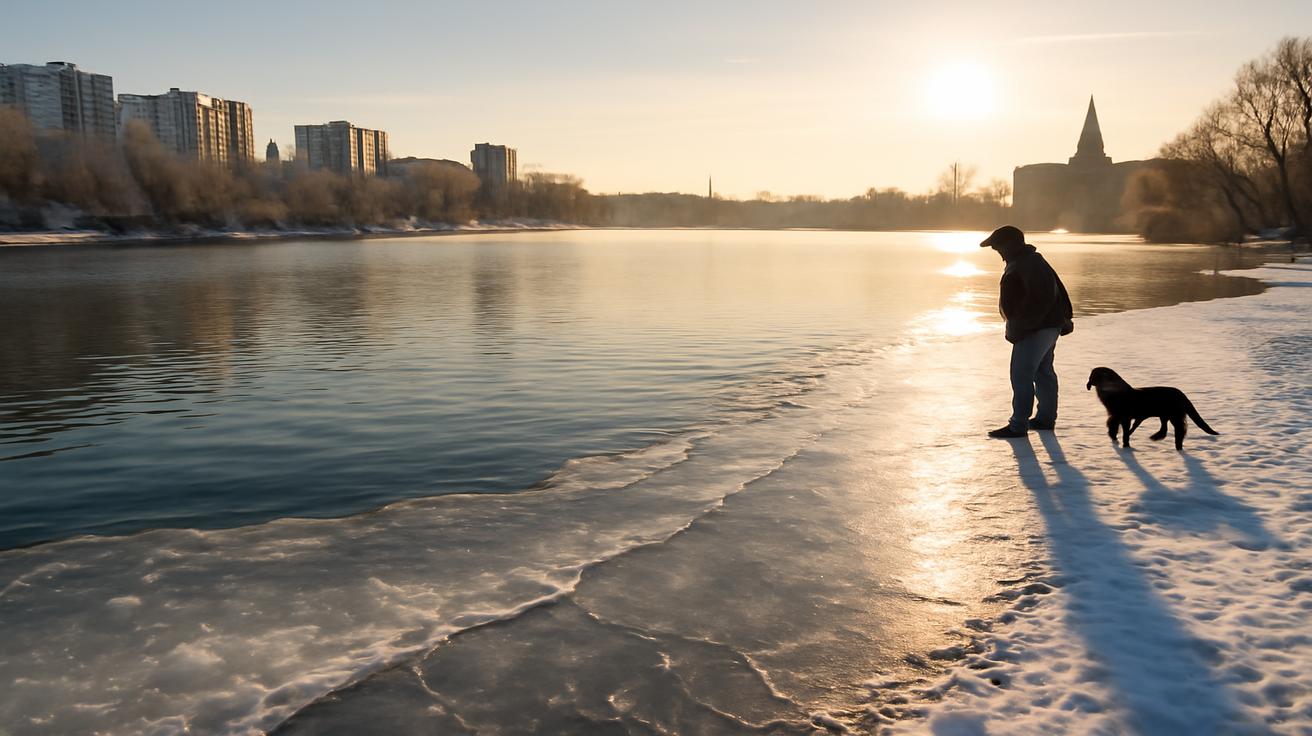
The first thing I noticed was the sound. Not the ducks, not the chattering runners in neon jackets, not even the rasp of a distant stroller wheel on gravel—but the near-silence where I expected water. I had walked down to Lake Créteil on an ordinary winter afternoon, following the usual path through the bare trees, when I realized the shoreline wasn’t lapping or muttering. It was stiff. Still. The kind of stillness that feels like it’s holding its breath.
Along the edges of the lake, a delicate glassy crust held fast to the shore, catching the pale sun and throwing it back in tiny shards of brightness. A child tossed a pebble, and it skittered across the frozen band like a skipping stone on a pond in a fairy tale. Yet just a few meters further out, the lake shifted into a dark, open surface—moving, faintly rippled by the wind. The middle breathed; the edges did not.
Why was Lake Créteil still frozen along the shore this afternoon, but not in the middle? The question hung there, hovering over the cracked ice like mist. It felt like the lake was holding two seasons at once: a thin memory of deep winter hugging the banks, and a more forgiving, early-thaw day rolling silently in the center.
The Lake That Can’t Make Up Its Mind
Walk around Lake Créteil on a winter day, and you notice that it doesn’t behave like a tidy diagram from a science textbook. The cold doesn’t settle evenly; it pools, catches, hides. The path curves in and out of pockets of wind, the towers of nearby buildings briefly block the low sun, and the air temperature wobbles a little from one bench to the next.
This afternoon, the sky over Créteil was that particular winter blue—thin, as if it might crack like old paint. The temperature had crept above freezing, but only barely. You could feel it on your cheeks: not biting cold, but a slow, insistent numbness. In the sheltered spots between the reeds, the ice at the shore was a milky white, dusted with a lace of frost. Stray leaves were trapped just below the surface, their brown shapes blurry and distorted, as though held under glass.
Out in the middle of the lake, though, the water was restless. Wind streaked faint silver lines across it, and a few coots paddled purposefully, sending rings outward that pulsed all the way toward the unyielding rim of ice. It was like watching a city with a frozen belt of suburbs and a bustling, water-rich downtown.
Standing there, you might be tempted to think: shouldn’t the middle of the lake be the coldest? It’s deeper, after all. It seems farther from the sun-warmed land and paved paths. Yet nature loves to work in layers and exceptions, and Lake Créteil, with its reluctant shoreline ice, was quietly demonstrating one of water’s strangest and most beautiful habits.
The Secret Life of Cold Water
To understand why the edges stay frozen longer than the middle, you have to step into the secret life of water—specifically, how it behaves as it cools. Most of the time, we imagine liquids getting steadily denser as they get colder, until eventually they freeze into a solid. Water, however, slips a little surprise into that process.
As water cools from a comfortable temperature down toward 4°C, it does exactly what you expect: it becomes denser and sinks. But once it drops below 4°C, it reverses that pattern. Colder water—close to 0°C, on the verge of freezing—actually becomes lighter again and floats near the surface. And when it finally turns into ice, it becomes lighter still, which is why it floats at all.
On a cold series of winter nights, the water at the surface cools first. This top layer, now lighter, spreads out over the denser, slightly warmer layer below. With enough time below freezing and enough calm, the top film finally locks into ice. The lake doesn’t freeze from the bottom up; it freezes from the surface down. And crucially, not every part of that surface behaves the same.
The shoreline is where the lake pauses to think. Near the banks, the water is shallower. There’s less volume to cool, so it loses heat faster. It’s also more sheltered from wind, which means the water isn’t stirred as vigorously. Quiet, shallow water is the perfect candidate for freezing early—and staying frozen longer.
Wind, Sun, and the Edge of Winter
On this particular afternoon, the wind was doing something subtle but powerful in the middle of Lake Créteil. You could see it in the playful ruffles on the water’s surface, and in the way small waves leaned against the thin band of ice, as if knocking at a locked door.
Wind doesn’t just decorate a lake; it remixes it. When the air stirs the water’s surface, it drives a gentle circulation. Slightly warmer water from lower down rises and mingles with the colder surface layer. That mixing makes it harder for the top to cool all the way to freezing, especially once the deepest cold of winter has passed.
Near the shore, the wind’s fingers don’t reach as easily. Reeds, rocks, low walls, and the simple curve of the land break its force. The shallow water there sits more quietly, less churned, more separate from the heat stored in the deeper parts of the lake. The cold from the previous nights lingers like a memory, sealed into the thin crust you can see from the path.
At the same time, the low winter sun plays favorites. It doesn’t beat straight down from above like in summer; it leans in from the side, sliding light across rooftops, across the tops of bare trees, across the open middle of the lake. Out in that middle, there’s space for the rays to land directly on the water, even in January and February. The dark surface drinks in what warmth it can get, however modest.
Along the shore, shadows complicate everything. Buildings, trees, embankments—each throws a longer shadow in winter, shading the very edges where the water is shallowest. Those shaded edges receive less sun, so the ice there is slower to surrender. If you could watch the lake from above in a time-lapse spanning days, you would likely see the ice first appear in these quiet, shaded coves, then stretch outward—and later, in the thaw, retreat back there last.
Where Physics Meets Footprints: A Closer Look
It’s easy to let your mind drift while circling Lake Créteil: follow the heron with your eyes, read the graffiti on a bench, listen to distant traffic. But if you pay attention to the ice itself, you start noticing delicate boundaries and small, telling signs.
Today, the frozen band along the shore was patchy: solid in some places, fractured in others, with a lacework of thin cracks tracing white lines under the surface. Here and there, someone had tested it with a toe or a thrown stick. A few footprints from a bold dog, stopped abruptly where the ice had clearly groaned a warning.
You could plot a mental map as you walked:
| Zone | Conditions | Why Ice Lingers |
|---|---|---|
| Shallow coves | Opaque, whitish ice, very still water | Less volume, weak wind, often shaded |
| Open shoreline | Thin, glassy ice close to land | Shallow edge cools faster than center |
| Mid-lake surface | Dark water, visible ripples, birds swimming | Wind mixing, more sun exposure, greater depth |
| Near inflows/outflows | Little or no ice, sometimes clearer water | Moving water resists freezing |
Under your feet, the ground itself plays a quiet role. Soil and rock store heat from previous months. Where that stored warmth leaks back into the water along the shore, the ice may be thinner, brittle, or veined with cracks. Just a few meters away, in a shadowed inlet where the ground stays colder and the air rarely stirs, the ice can look almost solid, as if it means to stay.
There is also the matter of what we can’t see: the lake’s internal layering. In deeper parts, the water can remain a degree or two warmer at depth, a liquid archive of slightly milder days. That reservoir of comparative warmth doesn’t vanish overnight, and when the wind mixes the lake’s surface, it lifts and folds those warmer layers upward. The center, therefore, is constantly reminded that not everything is winter yet. The shoreline, sheltered and shallow, doesn’t get the memo quite as quickly.
The Dance Between Ice and Time
Ice is never just an on-or-off switch—it’s a process. The difference between a fully frozen lake and today’s half-hearted shoreline crust is a story written not only in degrees Celsius, but in days and nights, in hours above and below freezing, in whether the wind has been restless or calm.
Imagine the last week at Lake Créteil as a series of frames. At night, temperatures drop. The surface water cools, thin ice spreads from the shore, nudging further out into the dark. In the morning, sunlight returns and the thermometer edges up. If the day is mild enough and the wind persistent, the delicate surface can fracture, slush up, and vanish in the center—while the stubborn, well-established band along the shore clings on, eroded but not erased.
That’s exactly what you were seeing this afternoon: a snapshot in a very slow tug-of-war. The deeper middle has enough heat stored, enough mixing, and enough sun to shrug off the worst of the cold, at least for now. The shallow margin, with its thin veil of ice, is like a fringe of winter fabric that the season has not yet gathered the will to fold away.
Viewed this way, the question—why is the shore still frozen, but not the middle?—becomes less of a mystery and more of an invitation to read time in the landscape. The ice at the edge is yesterday and the day before, still visible. The restless water in the center is an early sign of tomorrow.
More Than a Curiosity: What the Lake Is Telling Us
You could, of course, walk past all this and simply think, “Huh, weird,” and move on. But the frozen rim of Lake Créteil is quietly saying more than, “It’s been cold.” It is a reminder of how carefully balanced the systems around us are, and how a small change in one factor—temperature, wind, sunlight, depth—can redraw the map between liquid and solid.
If you keep returning to the lake through the winter, patterns begin to emerge. After several cloudless, still nights, you might find the ice stretching further toward the center, a tentative bridge almost daring you to imagine walking across. After a blustery storm or a string of milder days, the ring snaps back to the shore again, like a tightening belt.
Some years, the ice will be abundant and long-lasting, the band at the shore thick and opaque for days. In milder winters, you may only ever glimpse it as a fragile morning skin, gone by midday. The lake becomes a kind of living thermometer, a place where your eyes can translate columns of numbers—minimum and maximums, anomalies, averages—into something felt, seen, and heard.
There’s also a quiet lesson in humility here. We like to think of temperature as a single thing: “It’s 2°C today.” But that number is an average at best, a simplification. Along the shore, just above that persistent ice, the air may be a little colder. In the middle of the lake, just below the surface, the water may be a little warmer. Inside a sunny patch on the southern bank, a bench may be holding onto a degree or two of extra warmth. The world, looked at closely, is never as uniform as the weather app suggests.
Watching Winter Loosen Its Grip
By late afternoon, as the light begins to thin, the differences sharpen. The water in the middle of Lake Créteil takes on a heavier, slate-grey tone. The ice at the shore turns from clear glass to something more ghostly and opaque. A jogger’s breath appears in steady white clouds as they loop past, headphones on, oblivious to the tiny drama unfolding between states of matter at their side.
A gull lands briefly on the frozen band, feet splayed awkwardly, then seems to think better of it and lifts off again, banking toward open water. A few kids, sensing the day is almost done, throw a final handful of sticks onto the ice. Some stay on the frozen edge with a clatter; others slide off into the liquid middle, bobbing gently away.
In a few days—or a week, or two—the pattern will change again. Warmer air will arrive in longer stretches. The shallow shoreline water, though it cools quickly, will also warm quickly once the season turns. The ice will retreat in tatters: first turning soft and grainy, then riddled with holes at the edges where it meets the land, then finally collapsing back into the lake with a sound that, if you really listen, is like a field of tiny sighs.
For now, though, the shore holds onto its thin ring of winter, and the center keeps moving. The contrast is not a mistake or an anomaly; it’s exactly what you’d expect when depth, wind, sunlight, and the peculiar physics of water all meet in one place. You just happen to be standing there at the right moment to see it spelled out so clearly.
Frequently Asked Questions
Why doesn’t the middle of the lake freeze first since it’s farther from land?
The middle is usually deeper and more exposed to wind. Deeper water stores more heat, and wind-driven mixing brings slightly warmer water up from below, stopping the surface from staying at freezing temperature long enough to form stable ice. The shallow, sheltered shoreline cools and freezes earlier and keeps its ice longer.
Can the entire surface of Lake Créteil freeze solid?
Under the right conditions—prolonged sub-zero temperatures, light wind, and clear nights—the whole surface can develop ice. However, in many recent winters, conditions haven’t been consistently cold enough. Instead, you tend to see partial freezing, with long-lasting ice near the shore and open water in the middle.
Is the ice along the shore safe to walk on?
Generally, no. Shoreline ice is often thin, uneven, and weakened by contact with rocks, reeds, and varying water levels. Even if it looks solid, its thickness can change dramatically within a few steps. Urban lakes are almost never monitored for ice safety, so it’s best to admire it from the path.
Why does the ice near the shore sometimes look white and the middle ice (when it forms) look clear?
White or cloudy ice usually contains trapped air bubbles or snow that has frozen into the surface, often found in shallow or disturbed areas near shore. Clear ice forms when calm, super-cooled water freezes smoothly without many bubbles. Differences in how the ice formed, how quickly temperatures changed, and whether snow fell on it soon after all affect its appearance.
Does climate change affect how and where the lake freezes?
Yes. Warmer average winter temperatures and more frequent temperature swings reduce the number of days when the lake can freeze. That means thinner, more intermittent ice, often restricted to the shallow shoreline. Over time, regular patterns of full or near-full ice cover can shift toward the patchy, short-lived shoreline freezing you saw this afternoon.







Leave a Comment