
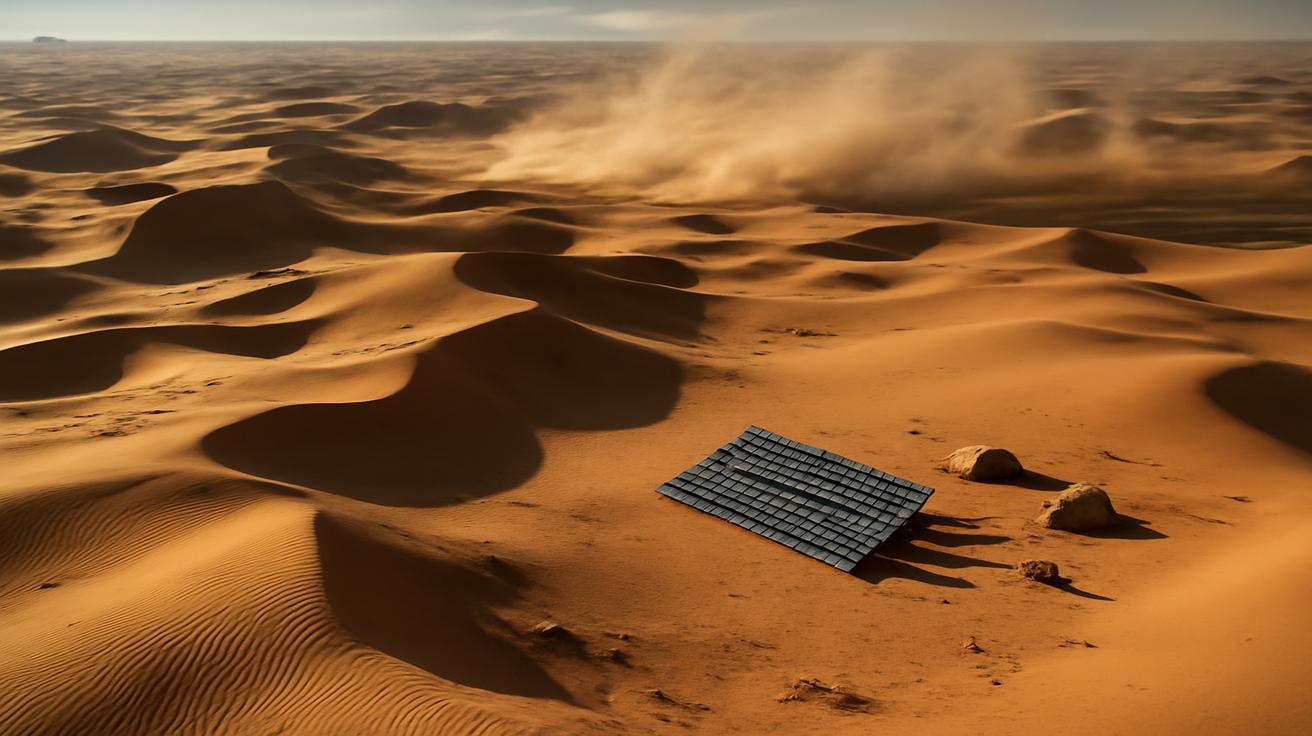
The idea usually arrives on a hot afternoon, when the street shimmers and your phone warns of record-breaking temperatures. You glance at the blazing sun and think: if it’s this fierce here, what must it be like over the Sahara? Then the thought lands, bright and simple as a lightbulb turning on: why don’t we just cover a slice of that giant desert with solar panels and power the whole world? The map in your mind fills with tidy rows of blue rectangles, cables stretching to cities, the climate crisis dissolving like a mirage. It feels obvious. Almost embarrassingly obvious.
The Dream of an Endless, Empty Sunfield
On paper, the Sahara seems almost suspiciously perfect. It’s vast—about the size of the United States. It’s sparsely populated. It’s bathed in sunlight for most of the year, with some of the highest solar irradiance on the planet. From a distance, from the clean altitude of spreadsheets and global energy graphs, it looks like the ultimate blank canvas.
You can even find estimates floating around: cover just 1–2% of the Sahara with solar panels, they say, and you could meet the world’s electricity demand. The math checks out at a basic level—square kilometers multiplied by average solar radiation multiplied by panel efficiency. On a whiteboard, the Sahara becomes an almost utopian symbol: all that “wasted” sunlight, just waiting for us to plug in.
But deserts have a habit of looking simpler from far away than they are up close. The moment you actually step into the Sahara—into its heat, its dust, its remoteness, its politics—the fantasy of a planetary power plant begins to feel less like a straightforward fix and more like a story we tell ourselves about control.
Where the Sand Meets the Solar Panel
The air is not empty in the Sahara. It tastes faintly of grit. Fine dust hangs in it, invisible until the light catches, coating eyelashes, teeth, equipment. Walk through a dune field and you’ll feel it, the sand that gets everywhere, into shoes, bags, cameras.
Now picture a utility-scale solar farm, not a poster-perfect one, but a real one. Vast fields of dark glass tilted toward the sun. Under perfect conditions, these panels can deliver clean, cheap power. But “perfect conditions” rarely involve constant sandstorms.
Dust and sand are the quiet nemeses of solar infrastructure. They scratch the panel surfaces, reduce their efficiency, clog cooling systems, grind into mechanical joints of tracking mounts. Every thin film of dust is a thin film of lost power. To keep such a mega-plant operating near its projected output, you’d need constant cleaning.
In many deserts, water is used to wash panels. In the Sahara, water is not just scarce; it is life-critical for local communities and ecosystems. Diverting large amounts of it to rinse glass would be ethically fraught and logistically painful. Alternatives—like robotic dry cleaning or electrostatic dust removal—are promising but not yet battle-tested at the gargantuan scales we’re talking about.
Temperature’s another quiet enemy. Solar panels lose efficiency as they heat up, and in the Sahara, surfaces bake under fierce sun. Those glimmering rectangles in your mental image? They’d be running hot for most of the day, consistently delivering less than their ideal ratings. The desert’s greatest asset—relentless sun—comes tangled with its liabilities: abrasive dust, brutal heat, and a lack of water to help you cope with either.
The Grid That Doesn’t Exist Yet
Suppose, for a moment, that you solve the dust issues, the heat, the cleaning, the installation. You now have a colossal flow of electricity pouring out of the Sahara. The obvious next question: where does it go?
Electricity is not like data—beaming it around the world is not as easy as shooting it through fiber-optic cables. Long-distance power transmission is possible, and high-voltage direct current (HVDC) lines can carry electricity thousands of kilometers with relatively low losses. But even with advanced tech, distance still matters. You’d need an entirely new super-grid: thick metallic arteries running under the Mediterranean, across borders, through regions that are not known for political serenity.
Every kilometer of line would have to be planned, permitted, financed, and defended. High-voltage substations and converters would rise in coastal towns and inland hubs. International agreements would need to lock in who controls what; who pays; who gets priority when there’s a shortage or an outage.
Seen on a calm diagram, this looks manageable. In the real world, grids are as political as they are technical. Countries worry about dependence. A power line is a lever, and whoever holds it can exert pressure—turn it down, charge more, redirect supply. Europe, for instance, already debates how much energy to import and from whom. Would it willingly center its energy security on mega-plants in the Sahara, crossing multiple national boundaries, some of them fragile?
Even within North Africa, power-sharing is not neutral. Who benefits from these massive exports? Whose land is used? Whose communities live in the shadow of the cables, substations, and dusty panel seas? Building the hardware is one challenge. Building the trust to rely on it may be the greater one.
The Mirage of “Empty” Land
Look at a satellite image of the Sahara and your mind might label it: empty. It’s one of the subtlest mistakes in our thinking about deserts. The population is sparse, yes, but sparse is not the same as void.
Nomadic herders move their animals along routes old enough to predate most nation-states. Oases anchor small communities, complex webs of gardens, wells, and traditions. Archaeological sites lie half-buried in sand. And beyond the visible, there’s the living architecture of the desert itself: plants with roots that probe deep for moisture, insects that emerge in brief windows, reptiles that vanish into crevices as food chains weave through the harsh sunlight.
To treat the Sahara as one giant vacant lot for solar farms is to ignore these quiet forms of occupation and dependence. The desert is an ecosystem, not a backdrop. Large solar installations would need roads, fencing, maintenance bases, security outposts. All of these slice up land that might seem unused from an office in a distant capital but is in fact part of a delicate survival tapestry.
This is where the language of “wasteland” becomes dangerous. Label land as “empty” or “barren,” and it becomes easier to justify appropriating it for noble causes like global clean energy. The risk is a new kind of resource extraction, not for oil or minerals, but for sun and space—yet powered by the same old logic: what’s there is underused and therefore available.
We’ve seen versions of this story before, in hydropower dams that drowned valleys and displaced villages “for the greater good,” in plantations that replaced diverse forests with single cash crops. A desert mega-plant risks adding a modern, solar-powered chapter to that history if local voices aren’t centered from the beginning.
Ecology, Albedo, and a Desert That Fights Back
There’s another layer that rarely makes it into the simplified “just cover the Sahara” fantasies: the climate effects of turning reflective sand into a dark, absorbing surface.
Deserts like the Sahara have high albedo—they bounce a lot of sunlight back into space. Solar panels, being dark, do the opposite. They drink in light. Some of it becomes electricity, but much of it becomes heat. Researchers who modeled what would happen if immense swathes of the Sahara were covered with panels and wind turbines found something surprising: you don’t just harvest energy; you start to alter the climate of the region itself.
The models suggested that large-scale solar and wind deployments could increase local temperatures and change patterns of rainfall. In some scenarios, rainfall actually increased because the warmer land altered atmospheric circulation, potentially greening parts of the desert. That sounds like a bonus until you remember that ecosystems and livelihoods in the region are tuned, however precariously, to existing patterns. Upsetting that balance could ripple in unpredictable ways—affecting agriculture, migration, and biodiversity.
Even at smaller scales, infrastructure leaves marks: the way fences and roads interrupt animal routes; how construction stirs up more dust; how night-time lighting at maintenance sites disorients nocturnal creatures. The Sahara might look tough, almost indestructible. But its resilience is negotiated daily under conditions that leave little room for large human experiments without consequences.
What a Desert Solar Future Might Actually Look Like
None of this means solar in the Sahara is a bad idea outright. It means that the fantasy of “one giant plant to power the world” is the problem, not the idea of harvesting the sun there at all.
A more grounded vision looks less like a single monolithic installation and more like a constellation of projects: smaller, distributed solar farms near existing towns and infrastructure; hybrid setups that combine solar with storage or with other renewables; microgrids that serve communities directly rather than just feeding distant cities. These can be scaled, studied, adapted—with local partners at the decision-making table, not just as an afterthought.
There’s also enormous potential in using desert solar to decarbonize local and regional energy use first: powering water desalination plants, backing up grids in rapidly growing cities, supporting local industries, and reducing reliance on imported fossil fuels. If exports come later, they can do so from a foundation that benefits the people who live closest to the panels, not just those whose lights are powered far away.
Think of it less as “turning the Sahara into the world’s battery” and more as “letting sun-rich regions build their own resilient, clean energy futures”—with possibilities for sharing, rather than obligations to supply.
The Beauty of Not Putting All Our Suns in One Basket
Behind the Sahara mega-plant dream sits another, even more seductive idea: that climate change can be solved by one big clever fix. A silver bullet. A single project or technology that lets us keep the rest of our world roughly as it is. It’s an understandable longing. Transformation is hard; concentrated solutions feel efficient and bold.
But energy systems, like ecosystems, are healthier when they’re diverse. Rooftop solar in cities, wind farms off coasts, geothermal where it’s available, small hydro where rivers can bear it, batteries, smarter grids, better efficiency in the devices we use every day—these add up. A million small suns, scattered and resilient, are harder to break, harder to control, and more democratic than one blazing hub in the desert.
There’s also a quiet justice in spreading solar closer to where people live. Instead of shipping electricity halfway across continents, we can let neighborhoods, towns, and regions become partial producers, not just consumers. That doesn’t mean abandoning large projects; it means refusing to bet our future on monoliths alone.
The Sahara will likely host more solar in the coming decades. It should. The sun there is powerful, and the need for decarbonized energy is urgent. But how we do it—and who it’s really for—matters just as much as the raw terawatt-hours we can squeeze from its horizons.
Imagining a Different Map of Light
So the next time the thought arrives—that gleaming abstraction of blue panels stretching to the curved edge of the Earth—let it stay for a moment. Feel its appeal: the simplicity, the grandness, the sense of control. Then invite in the messier picture.
See the maintenance crews wiping dust from glass under a sky hazed with sand. See the engineers poring over maps, tracing where to lay cables across borders that have seen more tension than cooperation. See the herder watching a new road cut across his grazing path, wondering where his animals will go next year.
And also see something else: a rooftop in a crowded city catching its own sliver of sun; a village in the Sahel running lights and clinics from a microgrid; an offshore wind turbine turning in North Atlantic storms; a desert community council debating how much solar to host and under what terms.
The Sahara isn’t our giant, ready-made power plant partly because the desert resists that kind of simplicity—and partly because the future we need is richer than a single heroic project. It’s knit together from many smaller, humbler acts of generation and care.
In the end, the sun over the Sahara is not wasted. It is doing what it has always done: shaping winds, heating rock, driving the slow physics that make dunes wander across the centuries. Our job is not to conquer that process with the biggest array we can imagine, but to join it carefully, intelligently, and fairly—accepting that sometimes, the most powerful ideas are the ones that learn to live with complexity instead of erasing it.
Key Challenges of Turning the Sahara into a Global Solar Plant
| Challenge | Why It Matters |
|---|---|
| Dust and Sand | Reduces panel efficiency, scratches surfaces, and increases maintenance demands in a region with scarce water. |
| Extreme Heat | High temperatures lower the performance of solar panels and stress electronic components. |
| Lack of Grid Infrastructure | Requires massive new transmission lines, undersea cables, and international coordination to move power to where it’s needed. |
| Political and Security Risks | Cross-border energy dependence raises questions about control, stability, and long-term reliability. |
| Social and Ecological Impacts | Large installations can disrupt local communities, traditional land use, and fragile desert ecosystems. |
Frequently Asked Questions
Could covering just a small part of the Sahara really power the world?
Theoretically, yes—if you only look at sunlight, area, and ideal panel efficiency, a few percent of the Sahara could generate electricity comparable to current global demand. But that simple math ignores transmission losses, maintenance challenges, climate impacts, political risk, and the enormous cost and complexity of building and operating such a system.
Are there already solar plants in or near the Sahara?
Yes. Countries like Morocco, Algeria, Tunisia, and Egypt have built significant solar projects, some in desert regions. Morocco’s Noor complex, for example, uses both photovoltaic and concentrated solar technologies. These projects show the potential of desert solar, but they operate at scales far smaller than a Sahara-wide mega-plant and are mostly aimed at national or regional needs.
What about using robots or new tech to clean panels without water?
Dry-cleaning robots, electrostatic dust repellers, and self-cleaning coatings are all areas of active research and development. They can reduce water use and maintenance, but they add cost, complexity, and failure points. Even with advanced cleaning, extreme dust events and sandstorms would still pose ongoing operational challenges at massive scales.
Would turning the Sahara into a solar hub help fight climate change faster?
Large Sahara projects could contribute significantly to decarbonization, but relying heavily on one region or concept is risky. Diversifying renewable energy across many landscapes and technologies—rooftop solar, onshore and offshore wind, geothermal, storage, efficiency upgrades—is faster to deploy overall, more resilient, and less vulnerable to geopolitical or environmental disruption.
Is it unfair to build big solar farms in the Sahara if most of the power is exported?
It can be, depending on how it’s done. If projects mainly serve distant consumers, while local communities bear the environmental and social costs with limited benefits, it repeats patterns of extractive development seen with oil, minerals, and other resources. Fairness requires local decision-making power, shared benefits, robust environmental safeguards, and using desert solar to support regional development—not just foreign grids.
So what’s the best role for the Sahara in a clean energy future?
The Sahara can be an important contributor, not the single solution. Smaller and mid-scale solar projects, regionally focused grids, and carefully planned export links can all play a part. The priority is to support sustainable development for the people who live in and around the desert, while adding one bright piece to a much larger, more diverse global clean energy mosaic.








Leave a Comment