
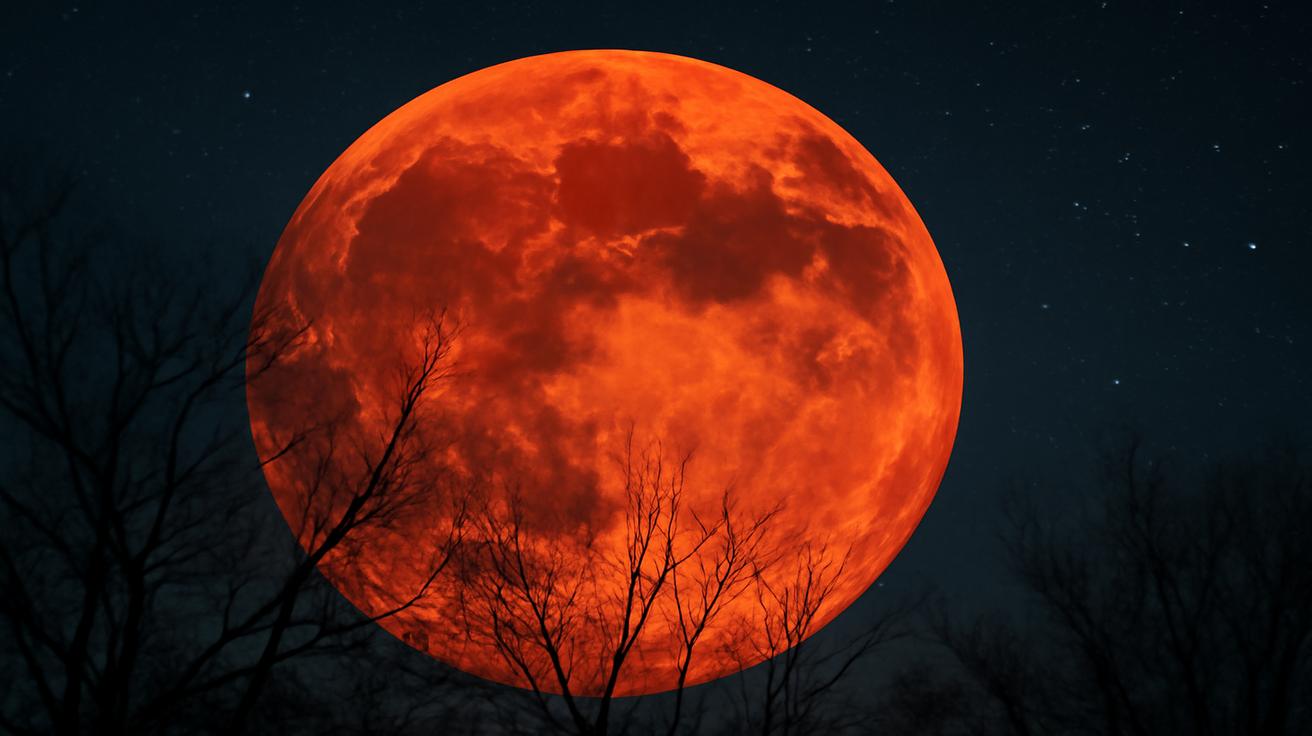
The first time someone tells you the Moon is about to turn red, you might instinctively want to step outside and check that the tides are behaving themselves. A red Moon sounds like an omen, something out of a half-remembered myth whispered around a campfire. But in early March, when the next full Moon eases up over the horizon and slowly blushes into a deep copper color, nothing will be wrong. In fact, something quietly perfect will be happening—a slow, precise dance between the Sun, the Earth, and our closest celestial neighbor.
The Night the Moon Steps into Our Shadow
Picture a cold March evening. The air still tastes faintly of winter—sharp in your lungs—but there’s a hint of thaw in the soil, a hint of mud on the breeze. You step outside, maybe tugging your coat tighter, and there she is: the full Moon, round and bright, hanging low over rooftops or leaning just above the tree line.
At first, nothing seems unusual. The Moon is her usual pale, almost tender shade of light, scattering silver over the backs of parked cars, over old snow piled in shadowed corners, over sleeping fields. But if you keep watching—really watching—you’ll see something change. A tiny dark bite seems to appear on the lunar disk, as if some invisible creature is slowly taking a nibble from the edge of the Moon.
This is the beginning of a total lunar eclipse, the reason the next full Moon in early March will shift from pearl-white to rust-red. The Earth, lit fiercely by the Sun, is about to slip perfectly between the two. Our planet is about to cast its shadow onto the Moon.
What’s beautiful is how gentle this cosmic event really is. There’s no sudden switch, no hard line between normal and strange. The Moon slides into Earth’s shadow like a swimmer drifting into deeper water—first the toes, then the legs, then the torso—until the whole body is submerged in dimness. The bright disc you know so well begins to dim, its surface fading, softening, as if someone is slowly twisting a cosmic dimmer switch.
Why a Shadowed Moon Turns Red Instead of Vanishing
You might reasonably expect the Moon to disappear completely once it’s hidden by Earth’s shadow. After all, when an object moves into the shade, it darkens. A street under a bridge, a room when the light is turned off—that’s what shadows do. But the lunar eclipse in early March will do something far more theatrical. As the Moon moves fully into the deepest part of Earth’s shadow, it will glow in shades of red, copper, or burnt orange.
The reason for this resides in the very air you’re breathing as you look up. When sunlight hits Earth, our atmosphere acts like a filter and a lens at the same time. Shorter wavelengths of light—blue and violet—are scattered in all directions by the molecules in our air. That scattering is what paints our daytime sky blue. Longer wavelengths—red, orange—pass through more easily, bending and slipping around our planet like light through the curved edge of a glass.
During a total lunar eclipse, the Sun, Earth, and Moon line up almost perfectly. The Sun is behind us, the Moon is in front, and we are in the middle, throwing a vast cone of shadow into space. If Earth had no atmosphere at all, the Moon would vanish into pure blackness when it entered this shadow. But our atmosphere bends sunlight around the planet and into that shadow. And by the time this refracted sunlight reaches the Moon, it is mostly in those longer red and orange wavelengths.
From the Moon’s surface, if you could somehow stand there in a bulky suit and look back toward Earth during the eclipse, you’d see our planet as a dark sphere ringed by a band of fiery red—the combined glow of every sunrise and every sunset happening around the world at that moment. That ring of light is what bathes the lunar surface, tinting it red. So when you look up at the moonlit sky in early March and see a coppery orb, you’re actually seeing the echo of every horizon on Earth wrapped into one.
The Subtle Art of Atmospheric Color
The exact shade of red you’ll see depends on what’s happening in that thin, fragile layer of air around our planet. Clean, clear air lets more light through, often giving the Moon a brighter, more vivid copper or orange hue. If there have been large volcanic eruptions or heavy pollution, extra particles in the atmosphere can deepen the color, muting the brightness and pushing it towards a darker, blood-like red or even a smoky brown.
In this way, the red Moon during a lunar eclipse becomes a kind of subtle environmental mirror. Without instruments, without charts, just with your own eyes, you get a hint—only a hint, but a real one—of how clear or hazy our global sky has become.
Why Early March? Timing the Celestial Choreography
You might wonder why this show is scheduled for early March and not, say, next Tuesday or at the end of summer. The answer lives in the geometry and timing of orbits, a puzzle the ancients stared at unblinking for centuries. The Moon circles Earth about every 27.3 days, but our familiar cycle of phases—new, crescent, full—takes roughly 29.5 days. That difference means the apparently simple pattern of full Moons hides a deeper, shifting rhythm.
A lunar eclipse can only happen at full Moon, but not every full Moon becomes an eclipse. For that, the Moon must cross one of the two invisible points where its slightly tilted orbit intersects the plane of Earth’s orbit around the Sun—points astronomers call nodes. Only when that full Moon lines up close to a node do we get that precise alignment needed for an eclipse.
Early March is one of those moments when all the conditions quietly click into place. The Earth, Sun, and Moon glide into a straight line, the Moon passes through our planet’s shadow, and the stage is set for the red transformation. It isn’t random, but it also isn’t frequent. Most full Moons slip by without fanfare, glowing politely and moving along. Every so often, though, like a note in a repeating song that briefly shifts the melody, one of them turns red.
The Seasonal Flavor of a March Eclipse
A lunar eclipse in early March carries a certain seasonal mood with it. In many northern regions, winter is loosening its grip, but nights are still long enough to feel deep and intact. The sky is often crisp and clear on cold March evenings, the kind of clarity that makes stars seem closer and the Moon’s craters more detailed.
The full Moon at this time of year goes by many traditional names—the Worm Moon, the Crow Moon, the Sap Moon—each tied to subtle changes on the ground: thawing earth, calling crows, the first stir of sap in dormant trees. There’s a quiet poetry in the fact that as life begins to seep back into the soil, the Moon above is preparing for its brief passage into shadow, trading its winter-white face for a slow-burning ember.
How to Watch the Red Moon Unfold
You don’t need a telescope to appreciate what’s coming in early March. In fact, watching with the naked eye is often the most intimate way to experience it. You simply need a patch of sky, a reasonably clear horizon, and enough patience to let the night do its slow work.
First, know the timing for your location—when the Moon will rise, when the eclipse begins, when totality (the fully red phase) happens, and when it ends. Then, on that evening, step outside earlier than you think you need to. Part of the joy is watching the Moon as it appears ordinary, then letting the subtle changes catch you by surprise.
As the partial phase begins, you’ll notice a soft shadow growing along one edge of the Moon, like a smudge of gray slowly spreading. That shadow will deepen, darken, and creep across the face. The bright white we’re used to will give way to dulled shades, as though the Moon is being gently erased.
Then, as the Moon moves fully into Earth’s umbra—the deepest part of the shadow—the transformation becomes unmistakable. The bright glow dims dramatically, and the surface shifts into those striking reds and oranges. Stars that were once washed out by the full Moon’s glare begin to appear again, giving the whole sky a new balance. Suddenly, the Moon feels like one object among many, not the dominant lantern it was an hour before.
| Stage | What You’ll See | How It Feels |
|---|---|---|
| Before Eclipse | Bright, familiar full Moon, high contrast craters | Normal, almost too bright to stare at |
| Partial Eclipse | A growing dark “bite” cutting into the Moon’s edge | Subtle tension, like the sky is holding its breath |
| Entering Totality | Moon dimming, colors shifting toward orange-red | A sense of strangeness, familiar object becoming new |
| Total Eclipse | Fully red or coppery Moon, stars much more visible | Quiet awe, the sky feels deeper and more intimate |
| Leaving Shadow | Red fades, bright white returns from one edge | A slow return to normal, like the end of a performance |
Making It a Personal Ritual
There’s something grounding about choosing to stand still while the sky changes. Bring a blanket or a lawn chair. Pour something warm into a cup. Invite a friend who doesn’t usually look up. Watch their face when the Moon first takes on that unfamiliar shade of red.
If you like, keep a small notebook or a note app at hand. Jot down how the Moon looks, how the air feels on your skin, whether a dog is barking somewhere down the street, which constellations you can see when the Moon dims. The eclipse becomes not just an astronomical event, but a memory anchored in texture and detail—the smell of wood smoke, the crunch of frozen ground under your boots, the distant rumble of a passing car.
Science, Stories, and the Old Fear of a Vanishing Moon
Humans have always noticed when the Moon behaves strangely. Long before we understood orbits and light scattering, the sudden darkening or reddening of the Moon hit us in the gut. For a species that navigated by the Moon, planted by the Moon, and told stories by its shifting light, an eclipse was not subtle background information. It was a breaking of pattern.
In many cultures, a red Moon meant danger or change. Some traditions told of dragons or jaguars devouring the Moon, celestial wolves taking a bite, or angry gods sending a warning. People would bang pots, light fires, chant, or pray, hoping to bring the Moon back from whatever had taken it. They didn’t know it, but their fears and their rituals were timed to the same geometry that we now calculate with quiet precision.
Now we stand in a different kind of knowledge. We can predict eclipses centuries in advance. We can map every phase, calculate every shadow, and model every wavelength of light that stains the lunar surface red. Yet the emotional echo of those ancient fears still hums faintly beneath the surface. Even when we know exactly why it’s happening, watching the Moon turn red can feel startling, uncanny. There’s something in us that recognizes the rare, the out-of-pattern event, and leans in.
The Comfort in Knowing What’s Coming
That said, understanding doesn’t kill the magic; it changes its flavor. When you know the red Moon in early March is the result of Earth’s shadow and the bending of sunlight, you’re not just watching a pretty sky trick. You’re watching proof that you live on a real sphere in real space, wrapped in a real atmosphere that changes the color of distant light.
Think of it this way: every time the Moon turns red during a total lunar eclipse, the universe quietly confirms that the story we tell ourselves about the cosmos is working. The math lines up. The shadow falls exactly where we say it will. The color emerges exactly when and where we expect. The show is beautiful because it’s a story we now understand, yet still can’t fully domesticate. No matter how much we know, the sight of that dim, red Moon still stirs something at the edge of rational thought.
Why This Red Moon Matters Right Now
It’s easy to rush through a year watching your life more than your sky. Deadlines pile up. Screens glow long after dark. You might pass a dozen full Moons without doing more than registering a flicker of silver between city buildings as you hurry home.
The full Moon in early March that turns red asks something different of you. It invites you to stop for an hour—or even just a few minutes—and pay real attention. To feel the night as a living thing rather than a dim background. To sense your own smallness and your own belonging at the same time.
Because that’s what happens when you watch a lunar eclipse with your whole attention. You feel the scale of it: the size of Earth’s shadow, the slow pace of orbital motion, the vastness of space. But you also feel your own body in the cool air, your breath turning to steam, your feet planted on soil that’s part of the very planet casting that enormous shadow. You are not separate from the event; you are standing on the object that is causing it.
And for a brief stretch of time in early March, as the Moon turns red and the stars around it sharpen, that truth becomes visible. The everyday illusion that we live on a flat, self-contained world falls away. In its place: a real, spherical Earth drifting through a dark ocean, turning its face toward and away from the Sun, pulling the Moon along for the ride.
FAQ: The Red Full Moon in Early March
Will the Moon really look red to the naked eye?
Yes. During the total phase of a lunar eclipse, most people clearly see the Moon shift into shades of red, orange, or copper. The exact color depends on atmospheric conditions, but the change from bright white to a dim, reddish glow is usually obvious even without binoculars.
Is a red Moon dangerous or a sign of something bad?
No. A red Moon during a total lunar eclipse is completely natural and harmless. It doesn’t affect human health, weather, or events on Earth. It’s the result of Earth’s shadow and the filtering of sunlight through our atmosphere, not an omen.
Do I need special glasses like during a solar eclipse?
No. Lunar eclipses are safe to watch with the naked eye for as long as you like. Unlike solar eclipses, where looking at the Sun can damage your eyes, a lunar eclipse is simply reflected sunlight. You can use binoculars or a telescope to see more detail, but nothing special is required.
Why doesn’t the Moon turn red every full Moon?
Because the Moon’s orbit is slightly tilted compared to Earth’s orbit around the Sun. Most months, the full Moon passes above or below Earth’s shadow. Only when the full Moon lines up very close to one of the points where these orbital planes cross do we get a lunar eclipse and, with it, the possibility of a red Moon.
Will the whole world see the red Moon at the same time?
No. Whether you can see the eclipse depends on which side of Earth is facing the Moon during the event. Regions where it’s daytime or where the Moon is below the horizon won’t see it. People on the night side of Earth with a clear sky will share the view, each under their own stretch of darkness, all watching the same red Moon burn quietly above them.






Leave a Comment