
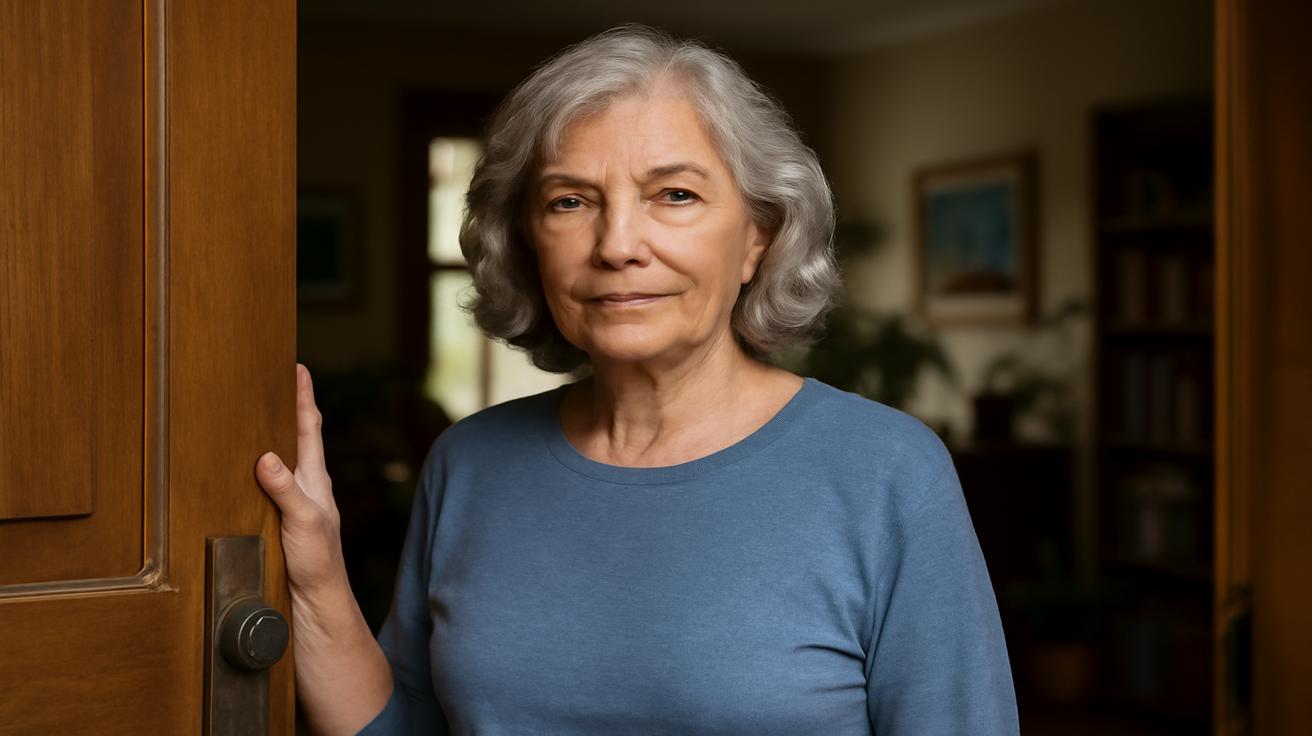
The first time Margaret said “no” out loud, really said it, she was sixty-three and standing in the fluorescent glow of a supermarket aisle. Her phone was pressed between shoulder and ear while she compared labels on cans of tomatoes. On the other end, her cousin was asking—no, expecting—her to host Thanksgiving yet again. It would mean three days of cleaning, two days of cooking, and one long weekend of managing everyone’s moods but her own.
Margaret looked at the tomato can in her hand, the ingredients mercifully simple: tomatoes, salt, basil. No additives. No extra sugar. For a strange moment, she saw her life like that label. She could almost hear herself reading it: “Margaret, age 63. Loves her garden. Needs quiet mornings. Tired of overextending herself.” Then, almost before she knew what she was doing, she said into the phone, “I’m not up for hosting this year.”
There was a silence sharp as broken glass. The old Margaret would have rushed to fill it, offering explanations, apologies, alternatives. But something in her held steady, like a tree that had already survived a few storms and no longer bent at every gust of wind.
“Oh,” her cousin finally replied. “Well. Okay. I guess someone else can do it.” The call ended with awkward politeness. Margaret slid the phone into her bag, set the can of tomatoes in her cart, and felt a surprising lightness in her chest—as if she had just laid down a backpack she didn’t know she’d been carrying for forty years.
Outside, the late-afternoon sky was brushed with clouds the color of ash on cooling coals. The parking lot smelled faintly of rain and gasoline. Margaret stood for a moment beside her car, listening to the far-off rattle of someone’s shopping cart, and realized: she had finally drawn a line around her own life and decided who was allowed to cross it.
The Slow Alchemy of a Lifetime
If you talk to enough people over sixty about boundaries, a pattern emerges. Their stories differ—grandchildren and aging parents, community committees and old friendships—but the undercurrent is the same. Somewhere along the way, they stopped saying yes when they meant no. They stopped trying to be the solution to every problem, the reliable one, the quiet one, the person who went last.
It’s not that people over sixty wake up one day magically enlightened. It’s more like a slow alchemy, the way a forest floor changes over time. Leaves fall, seasons pass, and what was once sharp and scattered becomes rich, dark soil. Experience breaks things down. Old shoulds and expectations decay. What’s left is a simpler, sturdier sense of self.
By the time someone reaches their sixties, they have usually lived through enough to understand what they can survive. Heartbreak, illness, relocations, layoffs, the grief of saying goodbye to parents or partners or friends. After a while, the fear of disappointing someone else can start to seem small compared to the knowledge that time itself is limited—and deeply precious.
There’s a calm that comes with that realization. The horizon line of a life looks different when you know you have already lived more years than you likely have left. Choices sharpen into focus. A cluttered schedule becomes less impressive and more worrisome. The question shifts from “What do they need me to do?” to “What do I genuinely want the rest of my life to feel like?”
This is where boundaries start to grow, almost organically. Not from hard-edged selfishness, but from an understanding of one’s own capacity and the wish to spend the remaining seasons of life in a way that feels honest and humane.
The Body as a Wise, Blunt Teacher
The body often becomes the first enforcer of boundaries. In our twenties and thirties, we bargain with exhaustion. We run on too little sleep and too much obligation, convincing ourselves we’ll rest later. But in one’s sixties, later is now. Knees complain about stairs. Backs argue with heavy suitcases. Mornings announce exactly how much sleep you didn’t get the night before.
This isn’t just inconvenience—it’s information. The ache in the joints after a weekend of traveling to help someone move. The migraine after a week of saying yes to every request. The restless sleep that follows yet another obligation-packed holiday. The body becomes less willing to cooperate with self-abandonment. It begins to speak in the only language it has: fatigue, pain, tension, illness.
Many people over sixty describe a moment when they understood, with quiet certainty, that they could no longer treat their energy as an endless resource. A retired nurse realized that the weekly babysitting schedule she’d set up for her grandchildren left her too drained to enjoy them. A long-time volunteer understood that the committee meetings she once adored now left her resentful. A lifelong caretaker felt the first flutter of fear that if she kept saying yes to everyone else, there might be nothing left of her for herself.
Boundaries, then, are not rules imposed from the outside but agreements made with the body. An internal pact that might sound like, “I will not trade away my health to maintain an image of being endlessly accommodating.” Or, more simply, “I will listen when my body whispers, so it doesn’t have to scream.”
The Subtle Reordering of Priorities
With age, the scale that measures what matters most begins to quietly shift. Things that once felt urgent—impressing others, being liked by everyone, keeping up—lose some of their shine. In their place, subtler priorities rise to the surface: mental peace, meaningful connection, time for reflection, time for joy without an agenda.
The garden starts to win out over yet another meeting. A long, ambling phone call with a close friend feels more worthwhile than an obligation-packed social calendar. Sitting with a book, hearing a clock tick in a quiet house, becomes not a guilty pleasure but a small act of defiance against a culture that worships productivity at all costs.
This reordering of values makes boundaries not just possible, but inevitable. When you know clearly what you prize—your morning walk, your standing coffee with a neighbor, your weekly painting class—it becomes easier to protect it. Every yes is now weighed not only against what it will cost you, but against what it will displace.
| Life Stage | Common Focus | Typical Boundary Challenges |
|---|---|---|
| 20s–30s | Building career, relationships, identity | Saying yes to gain approval or opportunity, fear of missing out |
| 40s–50s | Raising families, peak work responsibilities | Over-caregiving, juggling aging parents and children, chronic overcommitment |
| 60s and beyond | Health, meaning, legacy, joy | Letting go of old roles, learning to say no without guilt |
The table of a life looks different as you move from row to row. What once felt like a reasonable trade—your own needs for others’ approval—starts to look too expensive. So when someone over sixty says, “That doesn’t work for me,” it’s rarely impulsive. It’s the sum of many quiet calculations, many small realizations that time, health, and peace of mind are no longer things to gamble.
The Freedom of Not Needing to Prove Anything
There’s a particular kind of boundary that often blooms in later life: the boundary around identity itself. Many people in their sixties talk about an almost physical relief in no longer needing to prove who they are—to bosses, to neighbors, even to family. The performance of being the “good” one, the “strong” one, the “successful” one can finally soften.
This shift is subtle, but powerful. A man who spent his career in a high-status job might find that in retirement, he no longer feels compelled to attend events he secretly dislikes just to maintain appearances. A woman who spent decades hosting perfect dinners may suddenly discover that she is happier inviting people over for soup and bread, or not inviting them at all.
The less someone feels driven by external validation, the more room there is for honest boundaries. Responses like “I don’t enjoy that,” “That doesn’t feel right to me,” or “I’d rather spend my time differently” become not acts of rebellion but statements of simple truth.
In this way, aging can peel away layers of performance. What’s left is not indifference, but clarity. People over sixty who set firm boundaries are not always harder; often, they’re gentler—with themselves and with the reality that they cannot be everything to everyone. They no longer need every invitation, every opinion, every conflict to pass through them. They can let more things go by without reaching out to catch them.
The Quiet Courage of Disappointing Others
Of course, boundaries would be easy if they didn’t affect anyone else. But saying no at any age means risking disappointment, confusion, sometimes even anger. The difference, for many people over sixty, is not that they enjoy this—they don’t—but that they’ve learned they can live through it.
They have seen relationships survive awkward conversations. They have watched people adapt to new versions of them, or drift away when they couldn’t. They know what it’s like to stand in the aftermath of someone’s displeasure and discover that, actually, the world did not end. The sky still held its color. The coffee still tasted like coffee. Their breath still moved in and out.
This lived evidence makes it easier to choose temporary discomfort over long-term resentment. To say, “I love you, but that doesn’t work for me,” and sit with the silence that follows. To cancel a visit that feels too draining. To step back from being the family problem-solver. To stop explaining themselves to people who are determined not to understand.
There is a quiet kind of courage in this. It’s not the dramatic courage of big, public gestures. It’s the everyday bravery of laying down invisible burdens—unspoken expectations, inherited roles, old stories about always being agreeable. It’s the willingness to be misunderstood in service of being honest, to be temporarily disliked in service of being whole.
Time as a Fierce and Tender Editor
Perhaps the most profound reason people over sixty often become better at setting boundaries is simple: they feel time differently. Not as an infinite stretch ahead, but as a finite, shimmering resource. Every season, every year, becomes something to savor, not just survive.
This perception of time works like an editor with a red pen, crossing out what no longer fits: the social obligations that feel hollow, the relationships that only take, the habits that leave them feeling empty. In their place, other things are underlined, circled, moved to the center of the page: watching the light change across a familiar landscape, laughing with people who truly see them, learning something new just because it sparks curiosity.
When time feels precious, boundaries stop being optional. They become a way of honoring what remains. A woman in her late sixties may choose not to spend every holiday in airport security lines and guest rooms and polite small talk. A man who once said yes to every favor may now weigh each request against his desire to finally write his stories, mend his boat, or simply rest.
These boundaries are not acts of withdrawal from life, but a leaning in—to the parts of life that feel most alive. Those over sixty who embrace this often speak of a deepening sense of gratitude: for the unhurried morning, the familiar mug in their hands, the face across the table that has aged alongside their own.
Boundaries as Bridges, Not Walls
It can be tempting to see boundaries as walls—hard, high, meant to keep people out. But people over sixty who practice them with grace often describe them differently. A clear boundary, they say, allows them to show up more fully, not less.
When they no longer agree to things out of guilt, their yes carries more sincerity. When they stop overriding their own needs, they become far less resentful. Relationships that once felt lopsided begin to rebalance—or, in some cases, fall away, making room for healthier ones. The time they spend with others is more intentional, more present, because it is chosen rather than coerced.
Boundaries, in this way, become bridges between authentic selves, not barriers. “I can’t talk right now, but I care about you and want to call you tomorrow when I have space” is both a boundary and an offering. “I can’t host, but I’d be happy to bring a dish” is both an honest limitation and a gesture of connection. These are the kinds of nuanced, flexible boundaries that many people only learn to craft after years of trial and error.
The truth is, it takes time to discover what you truly need in order to feel steady, kind, and fully awake to your own life. It takes even more time to begin protecting those needs in a world that constantly asks you to overlook them. By sixty, many have done enough bending to know where they break. The boundaries they draw are rarely impulsive lines in the sand; they are gently carved paths back to themselves.
Frequently Asked Questions
Do people over 60 become less caring when they set more boundaries?
No. In many cases, they become more genuinely caring. When people stop saying yes out of guilt or exhaustion, their acts of kindness come from a place of choice rather than obligation. That often makes their presence more authentic and their support more sustainable.
Is it selfish to start saying no more often after 60?
Protecting your health, time, and emotional well-being is not selfish—it’s responsible. Many over sixty discover that by caring for themselves more honestly, they are less resentful and better able to offer real support when it truly matters.
Why do some families struggle when an older person starts setting boundaries?
Families get used to patterns. If someone has always been the peacemaker, the host, or the fixer, shifts in those roles can be unsettling. It may take time—and a few honest conversations—for others to adapt to the new boundaries.
How can someone over 60 begin setting boundaries if they never have before?
Starting small often helps. Choose one area of life—perhaps social events or favors—and practice saying, “That doesn’t work for me,” or “I need to think about it.” Notice how your body feels before and after. With each small step, it becomes easier to extend that same clarity to other parts of your life.
Can better boundaries actually improve relationships in later life?
Yes. Clear boundaries reduce hidden resentment and unspoken expectations. When everyone knows what is and isn’t okay, there is more room for trust, honesty, and mutual respect. Many people over sixty find that some of their richest, most equal relationships begin after they start honoring their own limits.







Leave a Comment