
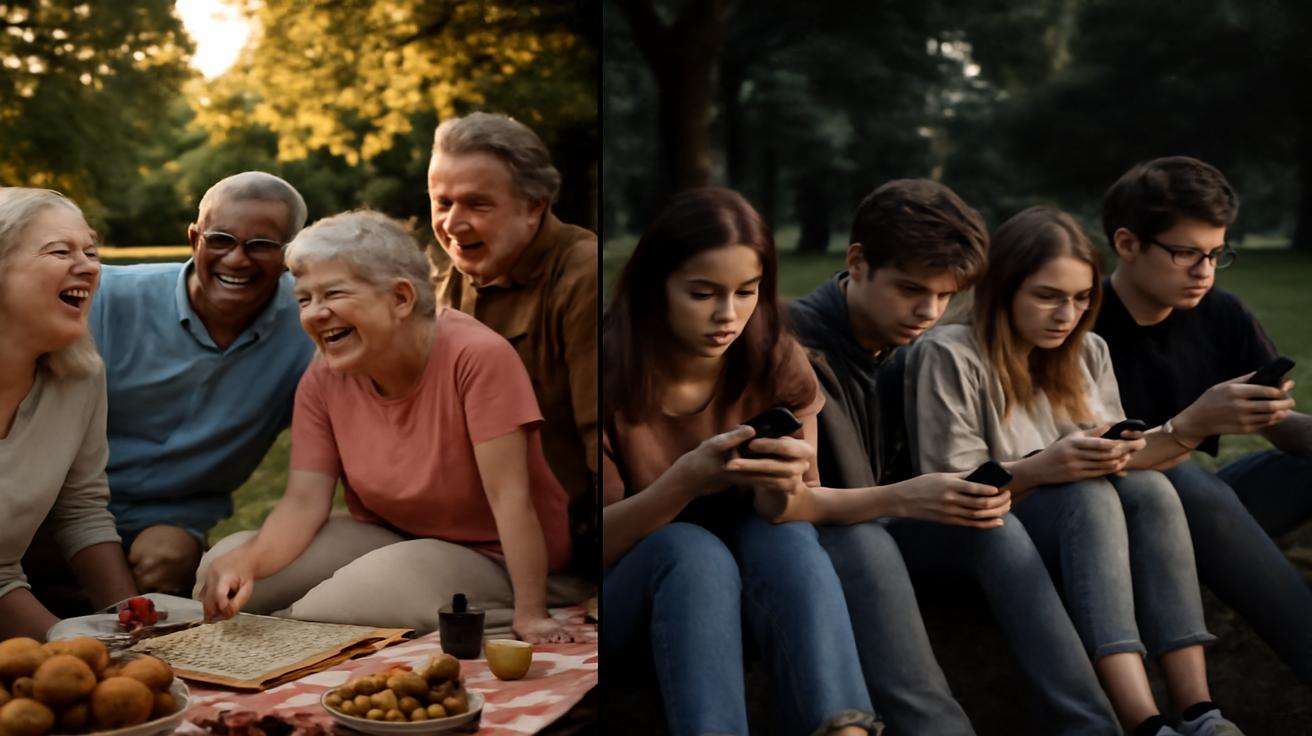
There’s a woman I sometimes see at the park near my apartment. Silver hair pinned up with a pencil, canvas bag looped over one arm, she walks at the same unhurried pace each morning. She stops under the same maple tree, closes her eyes for a moment, tips her face toward the light. No phone in her hand. No earbuds. Just a stillness that seems almost defiant in a world vibrating with notifications. A few feet away, a group of twenty-somethings sit on the grass, shoulders curved, faces lit blue by their screens. The park is blooming: birds skitter in the branches, a breeze combs through the wildflowers, somewhere a dog barks and then howls, delighted with its own voice. But most of the younger faces don’t look up. Watching them side by side—the woman in her seventies breathing in the morning, and the cluster of tech-tethered youth—you can’t help wondering a quiet, slightly uncomfortable thing: who is actually enjoying life more?
Why the Older Generation Isn’t Rushing to Prove Anything
Ask someone in their late sixties what they did last weekend and you’ll often get an answer that sounds… almost scandalously simple. “I gardened.” “We took a drive by the coast.” “I had coffee with an old friend.” They say it without apology, without the urge to make it sound more impressive, more productive, more content-worthy.
Meanwhile, younger people routinely describe their time in a different language: “I was so busy.” “I didn’t get anything done.” “I just scrolled.” There’s a constant undertone of failure, of falling behind on some unseen scoreboard.
The quiet truth: a lot of older people have simply ceased playing that game. Decades of living have taught them a handful of things no app will ever whisper in your ear:
- Most of the things you worry about in your twenties and thirties dissolve or reshape with time.
- Almost nobody is keeping track of your “output” as closely as you think.
- Being present in a moment often feels better than capturing it.
When you’ve watched trends rise and fall like tides—cassette tapes, cable TV, dial‑up, early social networks—you stop betting your self-worth on the next wave. You’ve learned that life is long, but days are surprisingly short. The older woman in the park doesn’t need to document her walk for it to count. She is the primary audience of her own life.
That internal quiet, that loosening of the invisible social rope around the neck, often looks like contentment from the outside. It might not be glamorous, and it doesn’t photograph particularly well, but it is deeply, stubbornly real.
The Subtle Luxury of Being Unreachable
Spend an afternoon with someone in their seventies and you’ll notice something radical: their phone rings, and they do not always answer. A text arrives, and it can wait. They are not being rude. They are simply remembering what it felt like to live in a world where nobody expected you to be available every second.
Younger people, on the other hand, carry a whole universe in their pockets—work emails, group chats, dating apps, news alerts, banking, streaming. There is no “off stage,” only varying levels of performance. Even boredom has been colonized; the moment there is a pause, the thumb flicks up and a new river of content rushes in.
Older adults often straddle both realities. They remember riding buses with nothing but a paperback and their own thoughts, or waiting days for a letter to arrive. They’ve traveled without GPS, met friends at prearranged times without live location sharing, and gone entire evenings without knowing what anyone else was doing. That memory acts like a quiet anchor: they know being unreachable is not the end of the world. It is, in many ways, a form of freedom.
You can feel the difference in the small rituals. The seventy-year-old making tea who actually waits for the kettle to sing, instead of microwaving water in a rush. The sixty‑five‑year‑old who takes an hour in the garden without checking a single notification. These are little rebellions against the tyranny of constant availability. And they add up to something like peace.
It’s not that older people are magically immune to technology’s pull. Many are as active online as anyone else. But they often consume technology more like a tool and less like air. There’s a thin but crucial line between using a device and orbiting around it. The older you are, the more you tend to remember that the device is not actually the center.
The Everyday Trade-Off: Presence vs. Performance
To see the difference more clearly, imagine two dinners at the same small restaurant—a table by the window, the hum of conversation, the clink of cutlery.
| Moment | Typical 20s–30s Reaction | Typical 60s–70s Reaction |
|---|---|---|
| Beautifully plated meal arrives | “Wait, don’t touch it yet, I need a photo.” Several shots, filters considered. | Short pause to appreciate, then knife and fork. Maybe one quick photo, maybe none. |
| Conversation lulls | Phone comes out. Check messages, social feeds, email. | Sip of wine or water. Look around the room. A new question, a story from years ago. |
| Friend is late | Mild anxiety, rapid-fire texts, map check, scrolling to kill time. | A glance at the time, then a relaxed wait. People-watching, small talk with staff. |
| Bill arrives | Split digitally, quick mental tally of budget, maybe a photo of the receipt joke. | Cash or card, tip decided by feel and habit, a final lingering chat before leaving. |
Both tables could be full of good people, good intentions, and laughter. But the texture of the experience is slightly different. One is threaded through with the constant awareness of an invisible audience, an invisible scoreboard of productivity, attractiveness, social status. The other is mostly concerned with the person across the table, with the flavor of the food, with the story being told.
When every moment is potentially content, it stops feeling fully like your own. The older generation is far more likely to keep their memories primarily in their bodies and minds: the warmth of the restaurant, the soft ache in their knees after walking there, the way the sun slanted across their friend’s face. They don’t always need proof that it happened.
Why Nobody Wants to Admit They’re Happier
So why do we resist acknowledging that many people in their sixties and seventies might actually be enjoying their days more than a lot of twenty‑ and thirty‑somethings? Why does that simple observation feel almost like betrayal?
Part of it is cultural mythology. We worship youth as the pinnacle of possibility. Advertisements feed us scenes of bronze twenty‑somethings running along beaches at sunrise, as if life peaks somewhere around age 28 and then gently slides into irrelevance. To admit that older people may be quietly happier is to crack that narrative. It threatens an entire economy built on the fear of aging.
There is also an unspoken cruelty: if older people can be that content with their slower mornings and smaller social circles, what does that say about how we’re using our youth? The thought is uncomfortable. It implies we might be squandering time by being continually half‑present, dispersed across half a dozen apps, chasing a version of “connected” that rarely feels nourishing.
Another layer is guilt. Younger generations know, on some level, that grandparents and elders lived through eras of paper maps, long-distance calls, and limited choices—and yet, they often carry a softer, steadier glow of satisfaction. Admitting that can feel like confessing that all the upgrades didn’t buy what we were promised. Faster is not calmer. Constant access is not the same as true closeness. Having more options doesn’t automatically produce more joy.
So we wrap the observation in jokes: “Boomers don’t know how to use their phones anyway.” “My parents are so out of touch, they go to bed at nine.” It’s easier to make fun of their old-fashioned habits than to admit we might actually envy their ability to sit still and read a book without checking their phones three times a chapter.
The Time Horizon Shift: When You Stop Treating Life as a Race
Ask someone in their twenties where they’ll be in ten years, and you’ll often trigger a flash of panic-wrapped ambition. “I hope I’ll have my own place. Maybe a better job. Maybe I’ll have traveled more, started something meaningful.” The future stretches ahead like an endless to‑do list.
Ask a seventy‑year‑old about the next decade, and you’re more likely to hear something different: “I’d like to stay healthy enough to walk every day.” “I’d love to see my grandkids grow a little more.” “I just want more time with the people I love.” The horizon has shifted from accumulation to savoring.
When you are young, life feels measured by what you can build: career, home, identity, portfolio, reputation. You count in expansions—more, bigger, faster, further. Your calendar is full; your mind is even fuller. It’s thrilling, yes, but also relentlessly stressful. Every choice feels like it might change everything. Every pause feels like falling behind.
By the time you reach your late sixties or seventies, you’ve already built and rebuilt many of those structures. Careers have twisted or settled. Families have blossomed, fractured, or reformed. Identities have been tried on and discarded. You’ve mourned losses you once thought you couldn’t survive—and then you did. The fear of every decision being catastrophic starts to loosen its grip.
Instead of racing toward some shimmering distant version of yourself, you begin walking toward the next morning’s coffee, the next story you want to write down for your grandchildren, the next sunrise you hope to catch if you wake early enough. There is an honesty to it: the recognition that the days ahead are finite makes the day in front of you more luminous.
Younger people, staring at what seems like endless time, often treat attention as a resource that can be scattered without consequence. Older people, with a clock ticking a little louder in the background, tend to spend that attention more carefully. They know a quiet afternoon with a book is not a waste of life. It is life.
Slowness as a Superpower, Not a Flaw
In a culture obsessed with speed, older bodies are often treated as glitches in the system. They move slower, hear softer, take a moment to stand, to balance, to remember. But that slowness, viewed from another angle, is a kind of accidental superpower.
A seventy-year-old walking down a street is forced into a different rhythm than the twenty‑year‑old late for a meeting, weaving through traffic with headphones in. They notice the crack in the sidewalk where a weed has decided to be a tiny forest. They hear the particular way a door creaks open in the corner shop they’ve visited for twenty years. They stop on a bench midway up the hill and, while “catching their breath,” actually watch the clouds.
None of that shows up on a productivity tracker. No app issues a badge for “noticed the shape of that cloud today.” But those are the moments that swell when you look back: the small, ridiculous, tender flashes of being alive.
Anxious, tech-addicted youth are very good at capturing life; older people, almost by necessity, are better at inhabiting it. The difference is not moral. It’s practical. When every step costs a little more effort, you wring more flavor out of the ground you cover. You do not waste a walk by disappearing into a screen. You already paid for it with your knees—why not look around?
The Quiet Rebellion We Could All Learn From
None of this is to romanticize old age. Bodies ache. Friends die. Systems fail. There is grief and loneliness and fear, and those experiences can be as intense as any youthful anxiety. Plenty of older adults are as knotted with worry as anyone else. But there is a pattern worth noticing: when older people are happy, they are often happy in ways that run directly against the grain of our tech-saturated culture.
They do not feel compelled to comment on every piece of news. They are content to let some conversations pass them by. They relish routines that outsiders might call boring: watering plants, folding laundry, chatting with the neighbor about the weather for the thousandth time. Their joy is not spectacle-based. It is texture-based.
If there is a rebellion here, it is almost invisible. It is the seventy‑two‑year‑old man who leaves his phone at home when he goes fishing. It is the sixty‑eight‑year‑old woman who prints photographs and slips them into a physical album, instead of letting them dissolve into the endless scroll. It is the older couple who sit on their porch each evening, not to take sunset selfies, but simply to sit on their porch each evening.
Younger people might roll their eyes and call it old-fashioned. But somewhere, under that eye‑roll, is a flicker of longing. To be unreachable. To have fewer opinions shouted at you per minute. To care deeply about ten things rather than shallowly about a thousand.
The technology is not the villain here. The addiction is. The anxiety that if you look away from the feed, you’ll miss something vital; the sense that your worth is stored in invisible metrics—likes, views, followers, responses. Older people, having spent a good portion of their lives without those metrics, often default to measuring their days differently. Did I laugh today? Did I move my body? Did I connect, really connect, with at least one person? Did something surprise me?
Those are questions a notification center can’t answer for you. They require a kind of self‑listening that many older people have, piece by piece, relearned over decades.
If We’re Honest, We’re a Little Jealous
So we circle back to the park. The older woman with the pencil in her hair. The group of glowing screens on the grass. The birds, the breeze, the dog still delighted with its own bark.
We rarely say it out loud, but for many younger, stressed, tech-soaked adults, there is a quiet, private envy of older people who seem at ease in their own days. They move more slowly, yes. They sometimes struggle to keep up with new gadgets and trends. They might not know the latest slang or how to navigate every menu in every app. But they often know, far more clearly, how they like their coffee, which chair is best for reading by the window, what kind of silence feels comforting rather than lonely.
They know the weight of years, of seasons turning, of people leaving and arriving. They’ve outlived fads and survived heartbreaks that once seemed apocalyptic. They’ve learned that most of the things you frantically check your phone about are not, in the long run, what you remember.
Nobody wants to admit they might be happier, not because it isn’t true, but because it forces an uncomfortable question: if more years and fewer apps bring more peace, what are we doing right now with the time we have? How much of our restless, buzzing, multi‑screen youth will we actually remember when we are the ones walking slowly through the park, face lifted toward the light?
There’s no need to wait decades for the answer. You can borrow a page from their playbook now: leave the phone behind for one walk. Let a message sit, unanswered, for a while. Watch an entire sunset with no urge to photograph it. Call someone instead of texting them. Make a cup of tea and stand by the window doing nothing else while the kettle boils.
It will feel, at first, like you’re breaking a rule. But you’re not. You’re just stepping, for a moment, into an older rhythm—one where life is not a race, not a performance, not a feed to be endlessly refreshed. Just a series of ordinary, irreplaceable moments. The kind a woman in her seventies, standing under a maple tree with her eyes closed, already knows how to enjoy.
Frequently Asked Questions
Are older people really happier, or do they just seem calmer?
Research in many countries suggests a “U‑shaped curve” of life satisfaction: happiness often dips in midlife and rises again in later years. Calmness and reduced anxiety are a big part of that. While not every older person is happier, many do report greater contentment and less day‑to‑day stress than in their younger years.
Is technology the main reason young people are more anxious?
Technology isn’t the only cause, but it amplifies many stressors: constant comparison, information overload, work following you everywhere, and the feeling of always needing to be “on.” Older generations simply spent more of their lives without that constant digital pressure, which often makes it easier for them to disconnect and enjoy simple moments.
Can younger people learn to enjoy life the way many older people do?
Yes. You don’t need to wait until your seventies. You can practice older-style contentment now by building tech-free rituals, slowing down on purpose, investing in in‑person relationships, and allowing yourself to do things that are meaningful but not “shareable.”
Doesn’t aging also bring loneliness and health problems?
It can, and those challenges are real. Aging is not a constant state of bliss. But many older adults adapt by focusing more on emotionally close relationships, meaningful routines, and present-moment awareness. These strategies can offset some of the difficulties and lead to surprisingly high levels of life satisfaction.
How can I start reducing my tech addiction without giving it up completely?
Begin small and specific: set phone-free times (like meals or the first 30 minutes after waking), turn off non‑essential notifications, charge your phone outside the bedroom at night, and schedule regular walks or hobbies where your phone stays in your bag. Think of it not as rejecting technology, but as reclaiming your attention—much like many older people quietly do every day.





Leave a Comment