
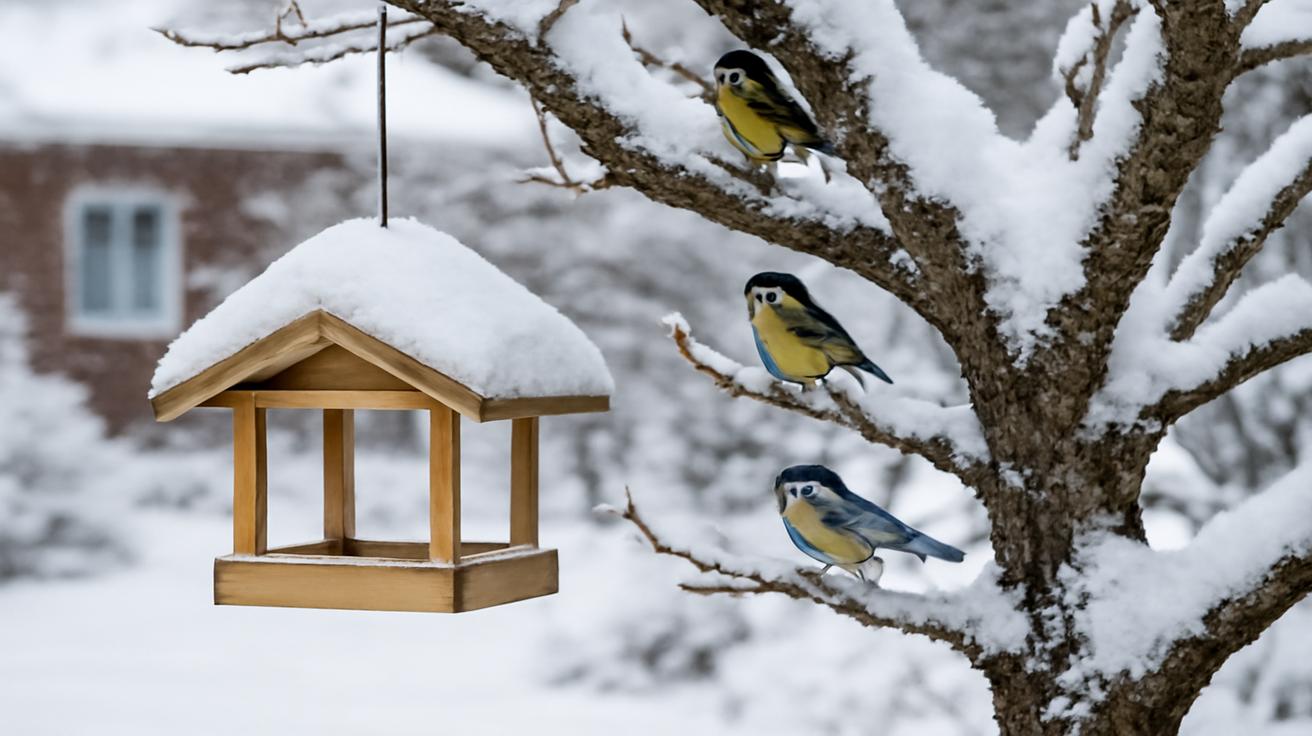
The first time I stood in a Norwegian garden in winter, I thought something was wrong. The air had that crystalline, snow-muffled quiet; birch trunks glowed against a sky the color of iron; the sea, just visible beyond the houses, was a sheet of pewter. There were bird footprints stitched across the snow, delicate and purposeful. But what I didn’t see was almost unsettling.
No feeders. No seed bells. No fat balls. No bustling chaos of garden birds at hanging buffets. Just silence, and the occasional shadow of a crow sliding across the white.
In my own country, winter gardens are like tiny airports of frantic arrivals and departures: tits, finches, robins, sparrows; wings jittering, sunflower seed hulls raining down onto frosted grass. We feel good about this. We feel kind. We are “helping.”
Norwegians, for the most part, are not.
Ask around a typical Norwegian neighborhood and you’ll find some people do feed birds—especially in urban areas or among older generations—but nothing like the near-universal devotion you’ll see in the UK, parts of North America, or Central Europe. Here, feeding birds is closer to a fringe hobby than a seasonal moral obligation.
At first, this can feel almost cold. But stand in that still, snow-packed garden for long enough, listen to how Norwegians talk about nature, and a unsettling suspicion slowly creeps in.
Maybe, just maybe, they’re right.
When “Helping” Birds Became a Hobby
Where I’m from, feeding garden birds is almost a cultural script. Autumn arrives; out come the feeders. Bags of peanuts, sacks of seed mix, expensive fat balls with earnest packaging. We buy special feeders to “keep predators away,” place them where we can see them from the kitchen table, then spend months proudly narrating the comings and goings as though we’ve personally rescued the local ecosystem.
It’s not entirely vanity, of course. There is genuine affection in the way people talk about “their” robins or chickadees. But it’s also pleasure. We do it because watching birds is calming, joyful, and deeply satisfying. In many countries, feeding garden birds has become one of the only daily ways most people interact with wildlife.
But quietly, in the background, scientists have been asking awkward questions.
- Are we actually helping wild birds long-term?
- Or are we simply creating a permanent, artificial food subsidy?
- Who really benefits most from this—birds, or us?
In Norway, these questions land on more fertile ground. That’s partly because the cultural backdrop is different: the relationship between people and wild nature is older, more spacious, and less sentimental. When Norwegians say “we love nature,” they generally mean nature as it is—wild, unscripted, and perfectly capable of surviving without our steady drizzle of sunflower hearts.
Norwegian Nature Isn’t a Pet, It’s a Neighbor
To understand why many Norwegians rarely feed garden birds, you have to walk away from the tidy houses and out into the forest—or at least, to its edge. In a country where more than a third of the land is forest, and enormous strips of coastline are still relatively wild, you don’t have to walk far.
This is a place where outdoor preschool is normal, where schoolchildren go on ski trips that last days, where the word friluftsliv—open-air living—is as familiar as “weekend.” Nature here is not a background decoration; it’s an active, daily participant in life.
And crucially, it is not seen as fragile in quite the same way. Important, yes. Threatened by climate change and development, absolutely. But not delicately dependent on human handouts.
There’s a subtle but powerful difference in mindset:
- In many places, we see wild birds and feel an urge to care for them.
- In Norway, people see wild birds and feel a stronger urge to respect their autonomy.
Ask a Norwegian why they don’t keep a line of feeders in their garden, and you’ll often hear something like, “They find food in the forest,” or, “They manage fine by themselves.” It’s not disinterest; it’s confidence in the birds’ own competence.
Underneath that confidence is another, quieter belief: that drawing wild creatures too tightly into our human orbit—into our windowsills, onto our patios, into our constant gaze—is not always an act of kindness. Sometimes, it’s an act of control dressed up as compassion.
The Invisible Costs of Our Bird Buffets
To be clear, bird feeding isn’t evil. It helps many individuals survive harsh winters. It provides joy and connection for millions of people. But “good for this bird in this moment” is not the same as “good for wild bird populations across decades.”
Across Europe and North America, studies have started to map the complex consequences of long-term, large-scale bird feeding. Some of what they’re finding would not surprise a Norwegian forester.
1. Changing Who Thrives—and Who Doesn’t
Feeders tend to favor certain species over others: the bold, the adaptable, the ones happy to cluster in noisy groups. Think great tits, blue tits, house sparrows, starlings. These species can increase in number around feeding hotspots, while shyer or more specialized birds benefit far less.
Over time, that can tilt the balance of local bird communities. It’s like holding an endless buffet for the same guests: eventually, they start to dominate the room.
2. Disease and Dependency
Any place where animals crowd together around food is a place where disease can spread more easily. Trichomonosis in finches, salmonella outbreaks, respiratory infections—many have been linked to dirty feeders and dense feeding sites.
Then there’s the behavior shift. In heavily fed areas, some birds adjust their movements and timing around human-provided food. If those feeders suddenly stop—because people move, travel, or just forget—birds that leaned heavily on the subsidy can be left in trouble during the leanest months.
3. Shaping Evolution in Real Time
This is where things get uncanny. In some regions, scientists have documented physical and behavioral changes in bird species that are strongly associated with garden feeding. In the UK, for instance, certain migratory habits in blackcaps have shifted in response to the reliable presence of winter food in gardens.
We are, quite literally, editing wild species with our generosity. Not always for the worse—but not necessarily for the better, either. Just different, and increasingly dependent on us continuing to play the role of permanent caterer.
Norway, by contrast, is still a country where the primary forces shaping birds are weather, habitat, and the old, hard rules of winter—not the kindness of people with seed dispensers.
Norwegians Will Help—But on Nature’s Terms
None of this means Norwegians are indifferent to the fate of wild birds. Spend time there in winter, and you’ll notice something interesting: when people do step in to help, they tend to do it in ways that feel more structural, less day-to-day emotional.
They support large protected areas where birds can nest and feed without disturbance. They argue (sometimes fiercely) about forestry practices, hydropower, and offshore wind, weighing energy needs against migratory flyways and coastal bird habitats. They put up nest boxes near cabins in the mountains, where natural cavities may be scarce. Hunters participate in monitoring schemes, reporting what they see with a level of detail that would make some birders blush.
Rather than compensating for a wounded landscape with endless bags of seed, the focus leans more toward making sure the landscape itself is still generous. Instead of asking, “How can I keep these birds alive in my garden?” the question becomes, “Do these birds have what they need out there?”
It might help to compare the two approaches side by side:
| Approach | Common Elsewhere | More Typical in Norway |
|---|---|---|
| Main focus | Feeding individual birds | Protecting habitats and ecosystems |
| Motivation | Closeness, enjoyment, rescue | Respect, long-term resilience |
| Daily action | Fill feeders, watch from window | Limit disturbance, spend time in wild areas |
| View of wildlife | Needing care in human spaces | Capable, mostly self-sufficient |
This doesn’t mean Norwegians never feed birds. They do—especially in harsher inland areas, on remote farms, or simply because they enjoy it. But there is less sense that they ought to. Less belief that the local blue tit population is personally counting on them.
The Hard Lesson of the Scandinavian Winter
Winter in Norway is not gentle. It is long, dark, and often utterly uncompromising. Snow smothers the ground; ice coats branches; daylight shrinks to a brief, bluish window between hours of black. Storms slam into the coast with a force that rattles houses to their bones.
In this world, every wild bird alive by March is a survivor in the truest sense. Many do not make it. For Norwegians raised close to this reality, there is less urge to interfere with that harsh arithmetic.
It’s not that death is welcomed. It’s that death is recognized as part of a larger pattern that has shaped these species for millennia. To keep a few extra individuals alive through constant feeding, every winter, indefinitely, starts to look less like mercy and more like a quiet erosion of natural selection.
A Norwegian biologist once put it this way, standing under a spruce tree thick with crossbill calls: “If you make winter too easy, you change who is left to breed in spring. You decide which genes move forward. Are you sure you want that job?”
Most of us, filling our garden feeders in suburban neighborhoods, are not thinking on that timescale. We’re thinking about the one robin we’ve grown attached to, the pleasure of his visit, the satisfaction of seeing him plump and bright instead of thin and ragged.
Norwegians grew up in a culture where the distance between “this animal I like” and “this population over time” is shorter. People hunt. They gather berries and mushrooms. They see carcasses in the snow. They watch populations of grouse or ptarmigan rise and fall not as personal tragedies, but as signals in a living, shifting system.
That system has its own rules. And those rules, more often than not, do not include us serving lunch.
What We Might Learn from Not Helping (So Much)
None of this demands that you dismantle your bird feeder tomorrow and repent in a snowdrift. But standing in that quiet Norwegian garden, where the only trace of birds was a thin stitch of tracks across untouched snow, it felt important to at least ask: what would change if more of us borrowed a bit of this northern restraint?
Maybe we would start by redefining what “helping” means.
Instead of thinking primarily in terms of direct handouts, we might ask different questions about our gardens and neighborhoods:
- What if we planted more native trees and shrubs that carry real winter food—berries, seeds, shelter from wind—instead of sterile ornamentals?
- What if we left a messy corner of the garden where insects could overwinter, leaves could rot, and natural food chains could quietly operate without our supervision?
- What if we fought, not for more feeders, but for more wild patches: unmowed verges, re-wilded city parks, small wetlands saved from drainage?
Feeding birds can be part of this, especially in extreme weather. But perhaps it shouldn’t be the headline act—the thing we cling to as proof that we care about nature, even as we live in ways that steadily shrink and simplify its real world beyond the patio.
Norwegians, by not making a religion out of bird feeding, accidentally remind us of a harder, cleaner truth: wild birds do not exist in order to make us feel good. They are not garden accessories, nor emotional service animals with wings. They are citizens of a much older order, one in which storms, hunger, and cold have always played starring roles.
Our responsibility, if we claim to love them, may be less about keeping them perpetually comfortable and more about ensuring that there is still space for them to live out their own difficult, magnificent lives.
So… Should You Stop Feeding Birds?
Here is the quietly uncomfortable answer: not necessarily. But you may want to do it more thoughtfully, and with an awareness that what feels like kindness can have hidden edges.
If you choose to keep feeding garden birds, many ecologists would suggest a few principles that line up surprisingly well with Norwegian instincts:
- Cleanliness. Scrub feeders regularly to limit disease.
- Consistency. In the coldest months, don’t start and stop abruptly; birds may come to rely on your offerings.
- Diversity. Offer a range of foods and, more importantly, plant native species so food exists when you’re not around.
- Moderation. Think of your feeding as a supplement, not a replacement for natural foraging.
And then, perhaps, raise your gaze beyond the fence line:
- Support the protection of local wild areas, from wetlands to woodlots.
- Advocate for bird-friendly building design and reduced light pollution.
- Leave dead trees or snags where it’s safe; they’re priceless real estate for cavity-nesters and insects alike.
Norway shows one path: a culture where people feel deeply connected to wild places, but don’t automatically equate love with constant intervention. Where watching a bird struggle and even fail isn’t a moral emergency—it’s a reminder that we’re glimpsing a world that doesn’t revolve around us.
There is something humbling, and strangely freeing, in that. To stand in a winter garden with empty hands, no seed bag in sight, and trust that the birds—those light, fierce, astonishing bundles of muscle and hollow bone—have their own strategies, honed over ages long before we ever hung the first feeder.
It may not be as emotionally satisfying as a flurry of wings outside the kitchen window. But it might, in the long run, be closer to what wildness actually needs from us: less management, more room.
Frequently Asked Questions
Do Norwegians really never feed garden birds?
Not never—but far less than in many other European countries. Bird feeding isn’t as culturally ingrained or widespread, and there’s less social pressure to do it. Where it happens, it’s often more casual and less intense.
Is feeding garden birds bad for them?
Feeding isn’t inherently bad. It can help individual birds survive harsh conditions and offers valuable human–nature connection. But large-scale, continuous feeding can shift bird communities, spread disease, and increase dependence on human-provided food. The impact depends on how, how much, and where you feed.
How does Norwegian culture influence this attitude?
Norwegians grow up with friluftsliv—a strong tradition of outdoor life. Nature is treated as something to be respected and experienced more than “cared for” in a hands-on, daily way. Wildlife is seen as largely self-sufficient, and support often focuses on protecting habitats rather than individuals.
What’s a better alternative to constant bird feeding?
Improving habitat is usually more beneficial long-term. Plant native trees and shrubs, keep parts of the garden wild, avoid pesticides, protect local wetlands and woodlands, and support policies that safeguard natural areas. Feeding can be a supplement, not the main strategy.
Should I stop feeding birds in my own garden?
You don’t have to stop altogether, but it’s worth reassessing. If you feed, do it cleanly, consistently in the harshest months, and in moderation. At the same time, shift more of your effort toward creating and defending rich, natural habitats so birds aren’t relying solely on your generosity.







Leave a Comment