
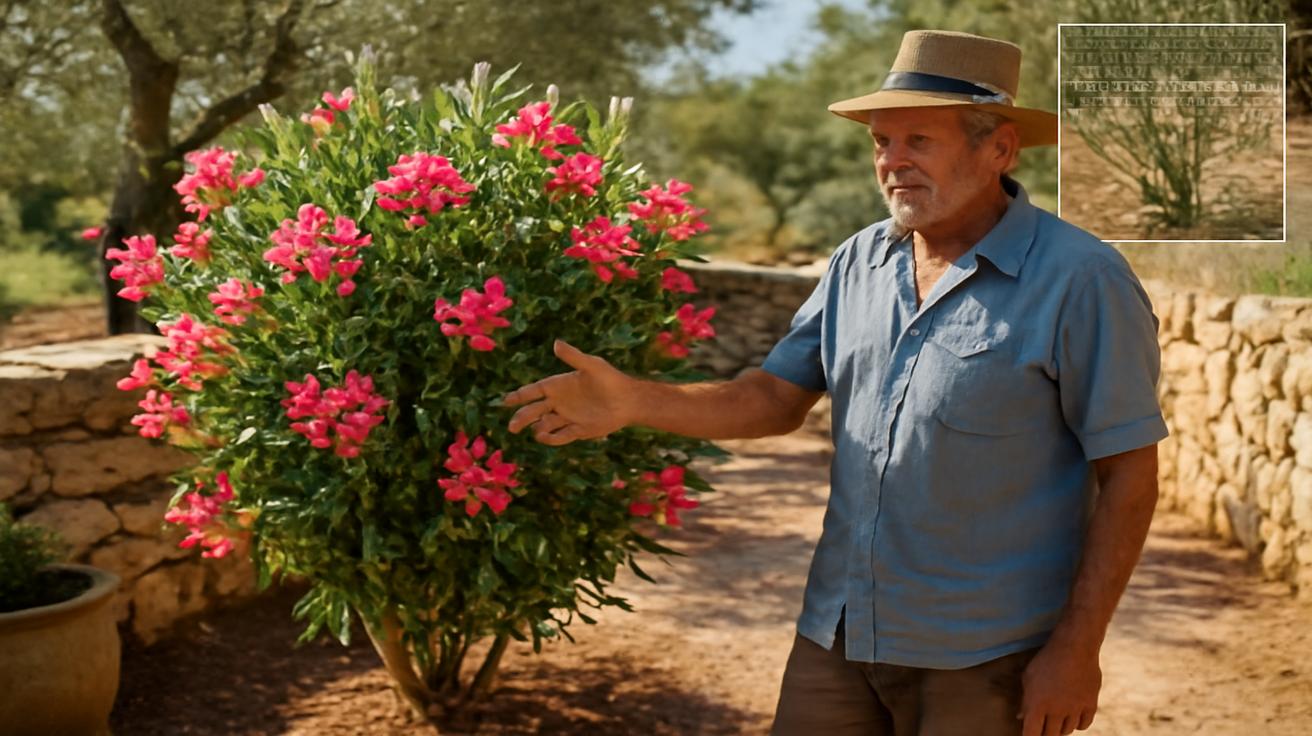
The first time I watched an old man in southern Spain “prune” an oleander, I thought he’d forgotten his glasses. He shuffled over in rope-soled shoes, squinted up into a twelve-foot-tall cloud of pink flowers, and did… almost nothing. One snip here, one snip there. A dead twig. A rubbing branch. Five minutes, maybe. Then he stepped back, admired the plant like a finished painting, and walked away.
I stood there, tourist-sunburned and full of gardening opinions inherited from books and garden-center advice back home, silently horrified. Weren’t we supposed to cut oleanders back? Hard? Shape them into civilized, obedient shrubs? That’s what we did in my temperate-climate neighborhood—turn them into green boxes that cough out a few flowers on good years.
In that Mediterranean garden, though, the oleanders loomed like small trees—arching, layered, alive with insects. They framed paths, shaded walls, and leaned over a dusty lane the way willow branches skim pond water. There was nothing “tidy” about them. There was, however, something undeniably right.
How We Turn Oleanders Into Furniture
Back home, pruning oleanders often looks less like tending a plant and more like assembling flat-pack furniture. You measure, you cut, you force it to fit a mental diagram of what a “proper” shrub should look like. Straight lines. Symmetry. Nothing taller than the windowsill, nothing wider than the path.
We prune to keep things under control: to stop the plant swallowing the driveway, blocking the view, scraping the gutters. What begins as maintenance slides, very quietly, into domination. Every winter or early spring, out come the loppers and saws. Branches are shortened like haircuts gone a bit too far. We strip off the top growth in a single decisive afternoon, all in the name of “rejuvenation” or “keeping it neat.”
The result? Oleanders that never quite look comfortable. You’ve seen them: tight green domes peppered with flowers on the outside but oddly bare inside. Long, fast regrowth that races to replace what was lost, leaving leggy stems tipped with blooms and an empty middle that birds and insects ignore. Sometimes they sulk entirely, responding to the pruning drama with fewer flowers, more disease, and a permanent air of being slightly offended.
We tend to think of pruning as a universal language, a set of rules that apply across climates and cultures. Cut by a third. Never at this time. Always at that time. Mediterranean gardeners, though, are speaking a very different dialect—one learned not from books but from hillside terraces, whitewashed courtyards, and generations of practicing restraint.
The Mediterranean Secret: Pruning As a Whisper, Not a Shout
Walk through an older village anywhere along the Mediterranean—Corsica, Crete, coastal Portugal, southern Italy—and you’ll start to notice something. Oleanders are… tall. They’re rarely “shrubs” in the way we define shrubs. They’re multistemmed, often tree-like, sometimes bordering on small thickets. They lean, arch, and twist. They bloom in a high canopy that seems to float over stone walls and dusty roads.
The people tending them haven’t abandoned pruning. They’ve just scaled it down, way down. Think of it more like editing than rewriting. Mediterranean gardeners tend to:
- Remove dead, diseased, or storm-damaged wood.
- Thin out the oldest, most congested stems at ground level, but only occasionally.
- Snip away branches that rub or cross awkwardly.
- Let the plant decide its overall shape and height, intervening only to solve a problem, not to satisfy a sketch in someone’s design notebook.
This kind of pruning happens in little bursts across the year. A few cuts after a storm. A bit of thinning when walking past with secateurs in the pocket. There is rarely that big, annual, adrenaline-fueled “pruning day” we love so much in cooler climates.
It’s not laziness. It’s skill. A gardener who lives with dry summers and fierce sun knows that every leaf on a plant like oleander is shade, is protection, is an investment. Strip the plant, and it has to pour energy into regrowing foliage before it can think about flowers. Cut too hard, and you shock a shrub that, in that climate, might need every reserve to coast through a summer where it won’t see rain for weeks or even months.
Why Their Oleanders Look Better: Climate, Rhythm, and Respect
The real reason Mediterranean gardeners don’t prune oleanders like we do lies in a quiet conversation between plant and place. Oleander is, at heart, a child of that climate: tough, drought-tolerant, sun-loving. In its element, it doesn’t need the same forceful encouragement we try to give it. It simply needs space and time.
In hot, bright regions, a dense outer layer of foliage protects the inner stems from sun scorch. We look at that as “overgrown.” Mediterranean gardeners see it as armor. When we cut back hard in early spring, we expose previously shaded stems and bark to the rising sun. That sudden light can burn the plant, especially on the south and west sides. Their response is to keep pruning light and mostly structural—removing a little, leaving a lot.
The flowering rhythm also plays a role. Oleanders bloom on new growth, yes—but that new growth comes best from a happy, steadily growing shrub, not one that’s been drastically reduced. In Mediterranean gardens, where heat and light are reliable, a gently thinned plant can produce wave after wave of blossoms. When you stand beneath one that’s been allowed to stretch and arch, you’re wrapped in flower-scented shade instead of peering at a tight, clipped ball.
There’s something else, too: respect for age. An older, lightly pruned oleander develops the kind of branching you can’t buy in a pot. Thick, twisting stems that catch light; a pattern of growth that supports layers of birds, insects, and secret lizards. In many Mediterranean towns, an old oleander is almost a neighbor, not a piece of living decor. Why brutalize it every year when you can negotiate instead?
What Mediterranean Gardeners Know That We Forget
When you watch how oleanders are handled in their home territory, a set of quiet lessons starts to surface. None of them are dramatic. All of them invite you to change the way you look at pruning in general, not just at this one plant.
| Our Usual Approach | Mediterranean Approach |
|---|---|
| Shape-driven: make it fit the space and the design. | Plant-driven: let the natural form lead, edit only when needed. |
| Heavy, scheduled pruning once a year. | Light, opportunistic pruning in small doses. |
| Short-term neatness is the goal. | Long-term health, shade, and structure matter more than tidiness. |
| Treats shrubs like furniture: static objects to be kept in line. | Treats shrubs like companions: living beings that respond and remember. |
From these differences flow a few practical truths that Mediterranean gardeners absorb almost by osmosis:
- More growth equals more resilience. A well-leafed oleander can weather heat, wind, and inconsistent watering far better than one that’s been stripped and forced to regrow quickly.
- Harsh cuts invite problems. Big wounds, especially in hot or humid weather, can open doors to disease and dieback. Small, thoughtful cuts heal faster and disturb less.
- Wildness isn’t the enemy of beauty. An oleander that has been allowed to build height, depth, and character catches the eye in ways a neat green ball never can.
Listening to the plant, in this context, means reading its body language. Is it leaning too far over a walkway? Remove the one or two stems causing the lean, right at the base. Is it too dense in the center? Thin out a few older branches, don’t shear the top. Are flowers only at the tips? Then perhaps last year’s prune was too harsh—and the plant is still recovering.
How to “Prune Like the Mediterranean” in Your Own Garden
You don’t have to live near the Aegean or smell sea salt in the air to borrow from these gentler methods. Whether your garden sits in a rainy maritime climate, a dry inland valley, or somewhere chilly and unpredictable, you can approach your oleanders (and other shrubs) with a more Mediterranean mindset.
Start by stepping back. Literally. Stand far enough from the plant that you can see its entire outline. Instead of asking, “What can I cut?” ask, “What’s actually wrong here?” You may find the answer is not much.
Then:
- Begin with the three Ds: dead, diseased, damaged. Any branch that’s clearly lifeless, broken, or sick goes first. Cut it cleanly, either back to a healthy junction or right at the base.
- Remove at the base, not just the tips. Instead of shortening branches by half, trace a few of the oldest or most awkward stems down to where they rise from the ground or main trunk, and remove them entirely. This opens space without creating tufty regrowth.
- Limit yourself. Decide in advance: three to five significant cuts, and then stop. Come back next year if it still feels crowded. This trains you to prune with intention, not momentum.
- Aim for layers, not balls. Let some stems grow taller. Accept unevenness. You’re sculpting something more like a small tree, less like a hedge.
In cooler or wetter climates, this approach still pays off. Your oleander may never reach the towering heights it would on a Greek island, but it can absolutely grow into a multi-stemmed, flowering presence rather than a clipped ornament. The plant spends less time repairing pruning damage and more time building strong wood and generous flower buds.
Over a few seasons, you’ll notice a change not just in how the plant looks, but in how it behaves. Flowering may come in longer waves instead of a brief show. The shrub might hold its shape better without constant correction. Birds may begin to use it as a lookout or nesting place. And you might—quietly, maybe a little smugly—feel less pressure to march out with loppers every spring.
Letting Go of the Fear of “Untidy”
The biggest barrier to pruning oleanders the way Mediterranean gardeners do isn’t climate. It’s psychology. We’ve been trained to see any plant that spills beyond its allotted rectangle as a problem: messy, neglected, somehow morally suspect. Garden design photos show tight balls, sharp hedges, crisp lines. Real life, especially with vigorous shrubs like oleanders, tends to resist those edges.
Standing in front of an oleander that’s grown taller than you are, it’s easy to feel a flicker of panic. Isn’t it too big? What will the neighbors think? Will it swallow the house? The Mediterranean gardener’s answer would often be: so what if it’s big? Is it healthy? Is it beautiful? Does it do harm?
There’s a deeper invitation here, hidden in the dappled shade of those tall shrubs: to trade control for relationship. To see pruning not as enforcement but as conversation. When you remove only what’s clearly in the way—of people, of light, of the plant itself—you start to notice nuances. How new shoots arc toward the sun. How flowers cluster at branch tips when given enough room. How the shrub leans into wind and recovers after storms.
This doesn’t mean surrendering your garden to chaos. Paths still need to be clear. Windows still deserve their light. Safety and structure matter. But it does mean allowing a bit of looseness, a bit of personality, especially in a plant that evolved to stretch and stride along rocky riverbeds and sunburned slopes.
Perhaps the most radical thing you can do, inspired by those Mediterranean oleanders, is nothing—at least for a season. Skip the big spring makeover. Watch. Walk past with your secateurs, yes, but use them like a pencil, not a chainsaw. One cut at a time. You may find, by autumn, that the only thing you truly missed was the sound of your own pruning lecture in your head.
FAQs About Pruning Oleanders the Mediterranean Way
Do Mediterranean gardeners really never prune oleanders?
They do prune, but usually much less and far more selectively than many gardeners elsewhere. Instead of annual heavy cuts, they make small, thoughtful edits: removing dead or damaged wood, thinning a few older stems, and lightly shaping only where a branch is genuinely in the way.
Is it bad to cut oleanders back hard?
It’s not always fatal, but heavy pruning can stress the plant, reduce flowering for a year or more, and encourage long, weak regrowth. Especially in hot, sunny climates, big cuts can expose inner stems to sun scorch. A gentler, thinning-based approach tends to lead to healthier, more natural-looking plants.
When is the best time to prune oleanders?
In most climates, late winter to early spring—after the risk of hard frost but before vigorous new growth—works well for any significant thinning. Light tidying (removing a dead twig, a crossing branch) can be done almost any time. Mediterranean gardeners often prune in small amounts throughout the year, avoiding very hot, dry periods for major cuts.
Can I still keep my oleander small using Mediterranean-style pruning?
You can limit size, but not with shearing. To keep it smaller, remove a few of the tallest or oldest stems right from the base each year, rather than shortening everything. This slowly refreshes the plant while maintaining a more natural outline, though truly compact size may not be realistic with very vigorous varieties.
What if my oleander is already a tight, clipped ball?
You can transition it. Over a couple of seasons, stop shearing the top. Instead, each year remove several of the oldest, thickest stems at ground level and allow new shoots to grow in their place. Gradually, the plant will open up, gain height and structure, and start to resemble those airy Mediterranean oleanders—without the shock of a single drastic change.







Leave a Comment