
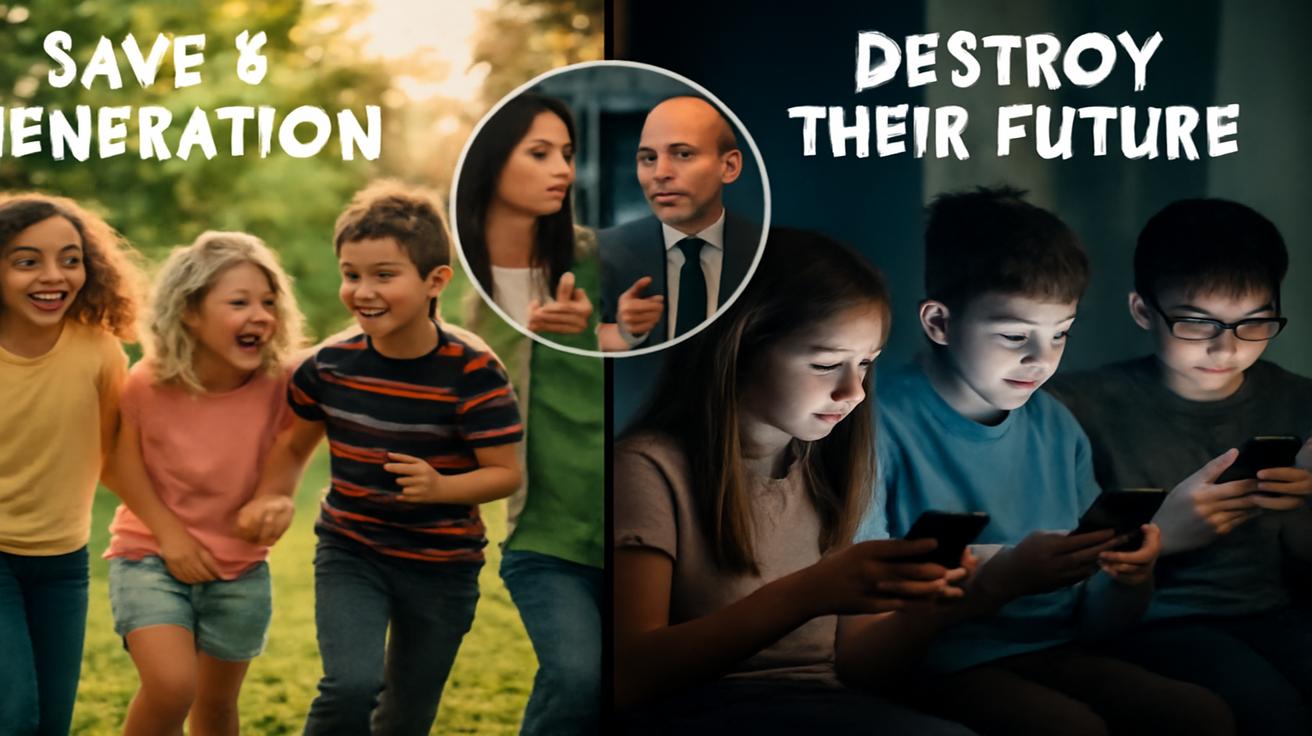
The argument started, as these things now often do, with a notification. A chime, a buzz, a quick flash of blue light on the kitchen counter. Twelve-year-old Ava reached for the phone like it was a reflex more than a choice, her thumb already poised to unlock the screen. Her mother’s hand got there first. What followed was not just a family squabble, but a tiny, kitchen-sized version of a global debate: who owns a child’s attention, and what should a “normal” childhood even look like in a world where almost every moment has a screen waiting in the wings?
The childhood we remember vs. the one they’re living
For many adults, the word “childhood” comes wrapped in the smell of wet grass, the clatter of bike chains, the ritual of ringing a friend’s doorbell to ask, “Can you come out and play?” It’s tactile and uncurated—mud on knees, sunburns, boredom so loud it pushed you outside just to make it stop. That memory has become a quiet measuring stick we hold against the blue-lit faces of children today.
Step into any park and you’ll see the disconnect. A cluster of kids on the swings, yes—but also a boy leaning against a tree, neck bent at a familiar angle, fingers twitching over a screen as a soccer ball rolls past his feet. On the bench nearby, a parent scrolls in a mirror image. Real life, paused. The air holds the rustle of leaves, the distant bark of a dog, and the faint, tinny echo of a mobile game soundtrack.
That scene has transformed into a moral question: if we banned smartphones for children altogether, would we be rescuing them from a digital storm or locking them out of the very language of their own generation?
A generation under glass
Psychologists and pediatricians are sounding alarms. They talk about attention spans shaved down to seconds, about rising rates of anxiety, depression, self-harm, and sleeplessness that track eerily with the rise of smartphones and social media. They describe a generation that lives under glass—always visible, always reachable, always compare-able. Childhood, once private and clumsy and safely forgettable, is now archived in high definition.
Some clinicians paint an almost visceral picture. Imagine being thirteen and walking down the hallway at school knowing that one bad hair day, one awkward stumble, one unflattering angle could be captured, shared, and replayed in group chats for days. Imagine carrying that hallway in your pocket—twenty-four hours a day. The bully never has to go home; the crowd never really disperses.
For these experts, the argument for banning smartphones for children feels less like a philosophical question and more like emergency triage. “We don’t hand ten-year-olds car keys,” one child psychiatrist says, “not because cars are evil, but because their bodies and judgment aren’t ready. Why should a portal to the whole world be any different?”
The case for the ban: “We owe them a protected space”
Advocates of smartphone bans aren’t just hand-wringing nostalgics longing for rotary phones. Many are scientists, doctors, teachers—people who spend their days in the trenches with young minds and notice a pattern they can’t ignore. In their view, banning smartphones for children is an act of protection, not punishment.
They point to brain development. A child’s brain is still wiring its pathways for self-control, attention, and emotional regulation. Drop an endlessly refreshing feed of social metrics—likes, hearts, streaks—into the middle of that fragile system and you get something like neurological whiplash. Every ping is a promise: this next message, this next notification, might be important. Children are, quite literally, not built to walk away easily.
Then there’s sleep. Blue light, late-night scrolling, buzzing phones on bedside tables: a thousand small sabotages to the deep rest that fuels learning, memory, and mood. Teachers report kids arriving at school foggy and emotionally volatile, their nights colonized by screens and social drama.
For ban advocates, the fix seems simple—even elegant. Just remove the device. Give children back a world they can touch and climb and fall out of, one where their worth isn’t measured in followers. The smartphone ban becomes a time machine of sorts, an attempt to restore something that feels lost: long afternoons of unstructured play, face-to-face conflict, physical risk instead of emotional exposure.
The freedom side of the argument: “Don’t build them a bubble they can’t live in”
But as the push to restrict phones gains traction, another camp of experts pushes back hard. Banning smartphones for children, they argue, may solve one set of problems while quietly creating another—less visible but just as dangerous.
They start with a fundamental fact: the digital world is not going away. Today’s children will come of age in a world where navigating online systems, social networks, and digital tools is as necessary as reading and writing. Pulling the plug entirely, they argue, doesn’t prepare kids for this reality; it shields them from it. “You don’t learn to swim,” one education researcher says, “by never touching the water. You learn by entering the pool with someone who can show you how not to drown.”
There’s also the question of autonomy. Adolescence is, at its core, a practice round for adulthood. It’s when kids test boundaries, make mistakes, learn cause and effect. If adults seize total control over their access to technology, some experts warn, we rob them of the chance to build internal judgment. When those young people finally get unrestricted access—at sixteen, eighteen, or later—they may binge in ways that are more reckless, not less.
And then there are the children for whom smartphones are not toys but lifelines. Kids in unsafe homes may use them to reach helplines or trusted adults. Neurodivergent teens may find their first true feeling of belonging in online communities. Queer youth in non-accepting environments often describe the internet as the first place they could say, out loud and without flinching, “This is who I am.” A blunt ban, these experts argue, risks cutting the tightest ropes for the kids who cling to them most.
The messy middle: not a switch, but a dimmer
Between these two camps—ban the phones, or keep them fully in kids’ hands—lies a wide, messy middle where many parents and educators are quietly trying to live. In this middle ground, smartphones are neither demonized nor glorified; they’re treated as tools that must be taught, modeled, and gradually entrusted, like matches or kitchen knives.
Some schools experiment with “phone-free zones” instead of blanket bans, inviting students to experience lessons, playgrounds, and cafeterias without the constant tug of screens. The phones go into lockable pouches during school hours, then come back to life when class ends. Many students describe the initial separation as a low-grade panic that, over time, softens into relief.
At home, some families gather around the kitchen table and draft what looks something like a treaty. The phone can live in the living room at night. No social media until a certain age. Parents can spot-check messages, but not as spies—more as climbing partners on a new, steep wall. The idea isn’t to create perfect safety, but to create a framework in which kids can practice digital responsibility while the stakes are still relatively small.
To understand how these approaches differ, consider this simplified comparison:
| Approach | Potential Benefits | Potential Risks |
|---|---|---|
| Full smartphone ban for children | Less exposure to social media harm, better sleep, more offline play, fewer distractions at school. | Limited digital literacy, possible social exclusion, loss of helpful online communities and safety tools. |
| Unrestricted access from a young age | High digital fluency, easy communication with peers and family, access to information and creativity tools. | Higher risk of addiction, cyberbullying, exposure to harmful content, disrupted sleep and focus. |
| Guided, gradual access with clear rules | Builds digital skills and judgment, encourages balance, allows tailored support and monitoring. | Requires time, consistency, and tech-savvy adults; rules can spark conflict; no guarantee of perfect protection. |
In this middle path, the question shifts. It’s no longer “Should kids have smartphones at all?” but “When, how, and with whom at their side?”
What does a “normal” childhood even mean now?
Running beneath the debate is a stubborn, slippery phrase: “a normal childhood.” Ban supporters argue that smartphones have stolen it—replacing backyards with feeds, in-person games with digital ones, deep friendships with shallow networks. Restore that lost normality, they say, and you restore resilience.
But whose normal are we reaching for? The childhoods adults remember were shaped by different dangers: unsupervised streets, fewer seatbelts, limited access to mental health care, scarce information about bullying or abuse. The absence of smartphones didn’t guarantee innocence or safety; it simply meant that the risks lived closer to home and further from screens.
Today’s kids grow up in a thicket of new and old hazards. They inherit both climate anxiety and instant weather alerts, both cyberbullying and online crisis lines, both misinformation and free educational videos that can explain algebra in ways their parents never learned. A “normal” childhood for them will inevitably include negotiation with technology. The real question might be: can we help them weave digital life into the fabric of their days without letting it smother everything else?
Some child-development experts suggest we stop chasing a return to the past and start asking what a healthy, present-day childhood looks and feels like. Maybe it smells like rain on hot pavement after a sudden storm, while a kid stands outside filming slow-motion drops for a science project on their phone. Maybe it sounds like laughter over a group video call with cousins on the other side of the world, followed by the soft thud of a basketball on the driveway as the screen clicks off. Both real, both valid. Both part of the story.
The hidden players: design, profit, and power
There’s one more layer that rarely makes it into dinner-table arguments but weighs heavily in expert circles: smartphones are not neutral objects. They’re delivery devices for apps and platforms built to compete for human attention—and they’re very good at it.
Adults sometimes talk about kids and phones as if the problem is weak willpower or bad choices. But beneath the thumb swipes and scrolling is an entire industry of behavioral design: infinite feeds, autoplay, variable rewards, social pressure loops. These were not accidents; they were business decisions. And children, with their still-forming brains and intense hunger for peer approval, are the most outmatched users in the system.
So when we ask whether banning smartphones for children will save them or harm them, we’re also sidestepping a deeper question: why are children the ones being asked to self-regulate in an environment engineered to overwhelm them? Some experts argue that focusing solely on bans and family rules is like handing kids helmets and telling them to cross a highway whose speed limit we refuse to lower.
Prize-winning pediatricians and ethicists increasingly call for broader changes: age-appropriate design rules, limits on addictive features for young users, stricter data protections, more honest transparency from tech companies. In their eyes, the burden shouldn’t rest exclusively on the smallest shoulders.
A future built together, not for them
In living rooms, classrooms, and therapist offices, the conversation keeps circling back to one central tension: control versus collaboration. Do adults seize the reins hard, or do they place the reins in small hands and walk alongside, holding the bridle together?
Maybe the future won’t be defined by a global yes-or-no ruling on smartphone bans, but by a thousand small, context-specific decisions. In some families, a child who struggles profoundly with anxiety might genuinely need a phone-free childhood to heal. In another, a teenager dealing with social isolation or identity questions might need that same device as a bridge toward survival and self-understanding.
What experts increasingly agree on, across their disagreements, is that the conversation can’t just be about devices—it has to be about relationships. A smartphone in the hands of a child surrounded by attuned, present adults who talk openly about what they’re seeing and feeling online is a different object than the same phone in the hands of a child moving through their days largely unseen.
Some evenings, in that kitchen where the first argument started, Ava and her mother now sit side by side, screens in front of them—not as strangers on separate islands, but as co-pilots. They scroll through the settings together, talk about why one app stays and another goes, laugh at a ridiculous meme, pause at a painful comment a classmate posted. The phone isn’t gone. The childhood isn’t, either. They’re both being negotiated in real time.
We may never reach a universal answer about whether banning smartphones for children will save or endanger a generation. But we can keep asking better questions: not just “Will they have phones?” but “Will they have us, really have us, while they learn what those phones can do to them and for them?”
Frequently Asked Questions
At what age should a child get a smartphone?
There’s no single “correct” age. Many experts suggest waiting until at least early adolescence and then starting with limited functions (calls, messages, GPS) before adding internet and apps. The child’s maturity, impulse control, and family situation matter more than a specific birthday.
Is a basic phone safer than a smartphone?
In many cases, yes. A basic or “dumb” phone can provide contact and safety without the full range of social media, games, and constant notifications. It’s often a good first step before moving toward a full smartphone, if needed.
Do smartphone bans at school actually help?
Early research and school reports suggest that phone-free classrooms often improve focus, reduce disruptions, and can ease some social pressures. However, long-term impacts on mental health and learning are still being studied, and results can vary by school culture.
How can parents reduce smartphone harm without a full ban?
Set device-free times and spaces (like bedrooms at night and family meals), use parental controls thoughtfully, delay social media, and keep ongoing conversations about what children see and feel online. Modeling balanced tech use as an adult is one of the most powerful tools.
What are signs that a child’s phone use is becoming unhealthy?
Warning signs include secretive behavior around the device, declining grades, chronic sleep loss, withdrawal from offline friends and activities, dramatic mood swings tied to online events, and an inability to tolerate even short breaks from the phone. These changes may warrant a deeper look and possibly professional support.








Leave a Comment