
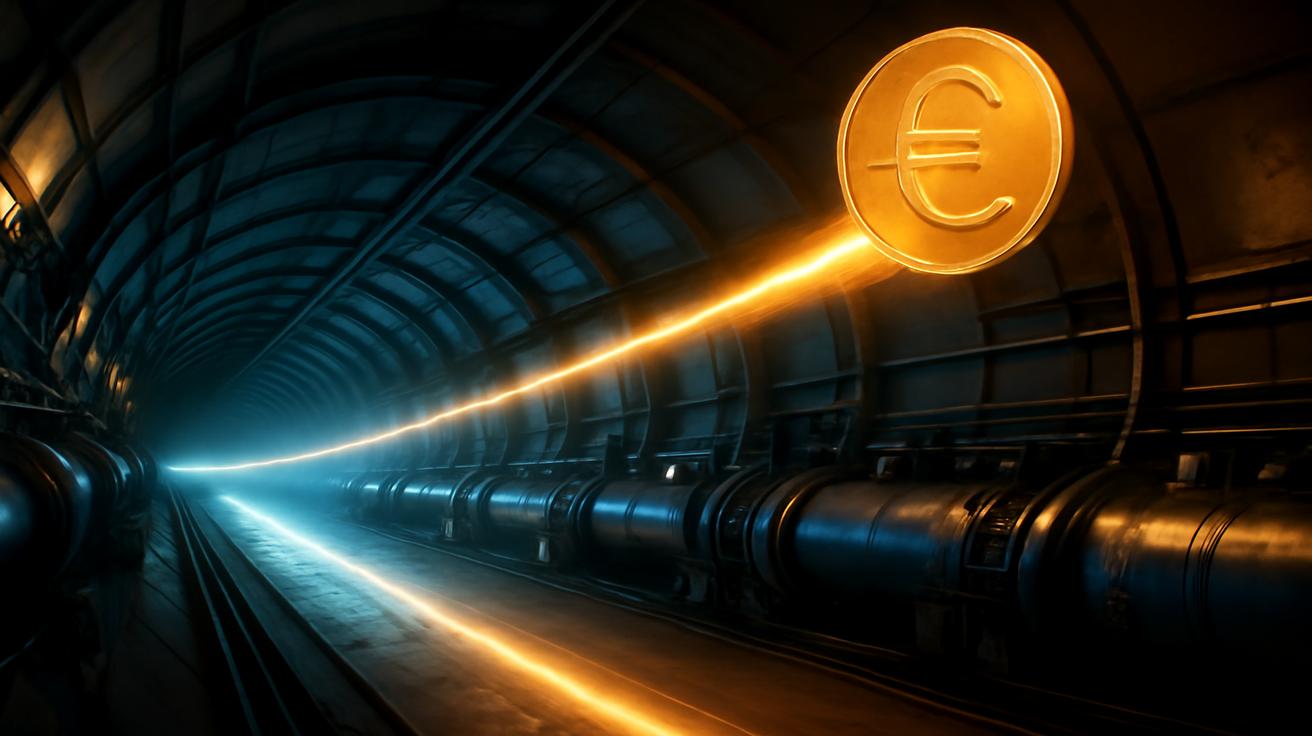
The news dropped like a stone into a perfectly still lake: Europe’s billionaires, long caricatured as art‑collecting, yacht‑buying, tax‑optimizing misers, had just helped funnel an astonishing €850 million toward something you can’t hang on a wall or sail to Capri—the next giant step in humanity’s quest to understand the universe. No, not another app, not another satellite constellation, but a machine so vast it will literally redraw the maps placed beneath our feet: the Future Circular Collider, the FCC. Somewhere between Geneva’s quiet lakeside streets and the snow‑etched Alps, people who could buy anything have signed up to build a ring of magnets big enough to encircle an entire city and fast enough to chase particles to the edge of existence.
When Wealth Meets Wonder
Picture this: early morning at CERN. The air is damp; the mountains are still banded with the last stubborn snow of spring. In the control room, screens glow pale blue and green, fractured with numbers and trace lines. Coffee cups are everywhere, like sacrificial offerings to the gods of uptime. A sleepy engineer scrolls through the night’s data when a notification flashes: funding confirmation. The Future Circular Collider—long a shimmering, far‑off dream sketched in technical reports and budget wars—has just secured a massive new lifeline.
In a world wired for instant outrage and bite‑size cynicism, the idea that billionaires would throw nearly a billion euros behind a machine that smashes subatomic particles together for a living sounds like the setup to a joke. But this isn’t the apocryphal billionaire building a rocket just to feel tall. It’s a coalition of public agencies, research councils, and yes, ultra‑rich individuals and foundations who have decided that their legacy should be written not only in stadium names and museum wings, but in quarks, leptons, and the fabric of spacetime itself.
The FCC is not a quiet project. It’s an audacious, almost impolite idea: dig a tunnel up to 91 kilometers around—more than triple the size of the Large Hadron Collider—thread it with superconducting magnets colder than deep space, and then spend decades hurling particles around it at energies we’ve never reached before. All to ask mostly philosophical questions: What is mass, really? Why is there something rather than nothing? Are we seeing only the surface of a deeper, hidden reality?
As the news circulates, somebody in the cafeteria jokes, “Who said billionaires were stingy?” The line sticks. Because beneath the humor is something more unsettling and more hopeful: some of the world’s deepest pockets have just voted, with astounding sums of money, that fundamental knowledge—invisible, intangible, and impossible to monetize directly—is worth it.
What Exactly Is The FCC, And Why Should Anyone Care?
Walk with your imagination down a quiet forest road outside Geneva. Beneath your feet, deeper than the roots of the tallest spruce, runs a vast circular tunnel. Right now, it’s the domain of the LHC, the machine that gave the world the Higgs boson in 2012 and cemented CERN in the public imagination as the place where we build “Big Science” as casually as others build office parks. The FCC is the proposed successor, designed to go further, see deeper, and run longer.
To understand why it matters, it helps to peel back the clichés. No, it’s not “just” a bigger atom smasher. The FCC is essentially a time machine and a cosmic mirror rolled into one enormous underground ring. By slamming particles together at previously unreachable energies, it recreates, for an instant and in miniature, the temperatures and conditions that reigned just after the Big Bang. In those tiny fireballs of collision, nature reveals its rulebook.
We like to pretend we’ve almost figured things out. We mapped the human genome; we send rovers to Mars; we hold computers thinner than books that can stream movies from satellites. But at the most fundamental level, our “Standard Model” of particle physics—beautiful, precise, and extensively tested—is also incomplete. It doesn’t include gravity. It can’t explain dark matter, that invisible scaffolding holding galaxies together. It shrugs when we ask why the universe prefers matter over antimatter, a bias that allows us to exist at all.
The FCC is designed to poke holes in that model. Maybe it will find new particles that can be candidates for dark matter. Maybe it will reveal hidden symmetries, new forces, or something we lack words for today. Or maybe, in the most tantalizingly frustrating scenario, it will find nothing where we expected something, forcing us to rewrite theories from the ground up.
The Price Tag Of Curiosity
All of this curiosity comes with a very terrestrial cost. Digging the tunnel. Cooling the magnets. Powering the beams. Building the detectors—these cathedral‑sized instruments whose innards look like the set of a science fiction film and whose construction rivals any world‑class concert hall in complexity. The FCC’s total projected cost runs into tens of billions of euros over several decades.
That’s why €850 million landing in one go feels like a thunderclap. This isn’t the entire budget, of course, but it’s a seismic statement: we are serious enough to commit real money, right now, to a project that will still be collecting data when many of today’s donors are long gone and much of today’s tech looks quaint as dial‑up modems.
| Collider | Approx. Circumference | Max Energy (planned) | Era |
|---|---|---|---|
| LEP (Large Electron–Positron Collider) | 27 km | ~209 GeV | 1989–2000 |
| LHC (Large Hadron Collider) | 27 km | 13–14 TeV | 2009–present |
| FCC (Future Circular Collider) | Up to ~91 km | Up to ~100 TeV (hadron stage) | Planned mid‑21st century |
Look at that last line: “planned mid‑21st century.” This is the temporal scale of cathedrals and climate strategies, not quarterly earnings. The people signing the checks know that. They won’t be here to cut the final ribbon. Yet they’re choosing to begin anyway.
Who Said Billionaires Were Stingy?
The stereotype of the billionaire is almost a stock character now: a sunglasses‑wearing avatar of excess, measuring life in private islands and Gulfstreams, with philanthropy as a thin glaze of respectability on top. And yes, the skepticism is earned. For every donor funding malaria vaccines or scholarships, we’ve seen others steer money into vanity projects or lobbying that protects the very inequalities that made them rich.
So when a story like the €850 million toward the FCC surfaces, it feels countercultural. Here is money aimed at something that offers no obvious brand leverage, no product launch, no box to put under a tree. You cannot own a proton. You cannot corner the market on the Higgs field.
What you can do, if you are extraordinarily wealthy and even a little bit visionary, is help tilt the arc of human curiosity. You can choose to accept that the returns on your investment may come not as profit, but as a sentence in a physics textbook, or as a technology born by accident from the struggle to build the collider: new medical imaging methods, more efficient power systems, AI techniques honed to sift the data torrent from the detectors.
There’s a delicious irony here. For years, critics of big science have claimed that giant physics projects are little more than ego monuments. But the philanthropists stepping into the FCC story are, in a sense, de‑centering themselves. They are writing checks that will enable thousands of people they will never meet, in countries they may never visit, to ask questions on their behalf.
Is it enough to redeem the billionaire class? Of course not. Wealth inequality remains brutal, often obscene. But to dismiss these kinds of contributions as mere PR would be to ignore something important: even in a flawed system, human beings with disproportionate power sometimes aim that power at problems whose answers belong to everyone.
Legacy In The Language Of Particles
Imagine, decades from now, a young physicist scrolling through a paper on a train ride. Somewhere in the footnotes, beneath arcane equations and detector jargon, there’s a sentence: “This work was made possible in part by early‑stage funding committed in the 2020s.” That is what legacy looks like here—not a foundation logo, but a footnote in the story of the universe.
Billionaires are often obsessed with immortality, whether through biotech or buildings named after them. The FCC offers a different kind of immortality: the chance that your resources will help uncover something genuinely new about reality, something that will outlive not just your name, but your civilization, encoded in the laws of physics themselves.
The Underground Cathedral
Stand, if you can, in your mind’s eye inside one of the planned FCC caverns. The space is gigantic, an underground nave of poured concrete and steel. Cables coil along the walls like vines; the air smells faintly of dust and coolant. Technicians in hard hats look small against the curving bulk of a detector, its layers nested like a mechanical onion. This is the architecture of curiosity.
Detectors at colliders are not simple cameras; they are time‑framing devices, peeling apart the debris of a collision microsecond by microsecond, tracing the faint tracks left by particles that live shorter than any flicker you’ve ever seen. Some are built to weigh how the Higgs boson interacts; others to tease out whispers of rare processes that might point to new physics. Each is a monument to precision, designed by consortia that stretch across continents.
The FCC will not simply be one machine, but a program—a sequence of collider stages and detector configurations unfolding over decades. An initial electron‑positron collider could act as a “Higgs factory,” measuring that shy particle with exquisite accuracy. Later, a hadron collider in the same tunnel could ramp up the energy into the tens of TeV, hunting for heavier, stranger quarry.
To make all that work, engineers redesign the future: superconducting magnets that push the limits of material science, cryogenic systems that maintain temperatures colder than the cosmic microwave background, data acquisition architectures that can sort through billions of collisions per second without missing the rare gem where new physics hides.
Side Effects: The Unplanned Gifts Of Big Science
When people ask, “What’s the point? How does this help my life?” it’s tempting to reach for the greatest hits: GPS, invented because we cared about relativity; the World Wide Web, born at CERN to share data between scientists; medical accelerators used for cancer therapy adapted from particle physics research. Big machines shake loose big innovations.
The FCC will likely continue this tradition. Handling the mind‑boggling data volumes will sharpen AI and machine learning tools. Building more efficient cryogenics and power systems may feed directly into energy and climate technologies. Even the civil engineering lessons—how to dig massive tunnels with minimal environmental impact—could ripple outward into rail systems and urban infrastructure.
But there’s a deeper answer that doesn’t fit easily into a cost‑benefit spreadsheet: meaning. We are the only known species that not only survives, but also insists on asking, “What is all this, really?” The FCC is, at its core, a coordinated act of defiance against ignorance, an assertion that understanding the universe is part of what it means to be human.
Democratizing The Universe
Of course, giant physics projects live and die by more than donors’ whims. Governments, international organizations, and taxpayers are the backbone of CERN’s funding. Without them, €850 million would be a spectacular but insufficient gesture. The real engine is the long, sometimes painful process of political negotiation, budget justification, public communication.
Here’s where the story twists again: a billionaire’s donation can actually help democratize the universe. Large upfront contributions can de‑risk early stages of a project, making it easier for public institutions to commit. They can fund prototypes, feasibility studies, outreach, and training programs that broaden who gets to participate.
Walk into a typical collider control room, and you’ll hear accents from all over the world. Young researchers from countries that could never independently afford such infrastructure are there on equal footing, writing code, analyzing data, giving talks that shape how we interpret the results. The FCC, if realized, will be one of the most diverse scientific ecosystems on Earth, not because billionaires chose diversity as a brand strategy, but because physics doesn’t care where you were born—only whether your equations hold up.
There is tension, of course. Some critics argue that no amount of scientific ROI can justify big philanthropy as long as the underlying economic structures remain so skewed. Others push back, pointing out that refusing donations doesn’t fix inequality; it just starves public goods. The FCC doesn’t answer that debate. It just sits there, in the plans and the soil, as an uncomfortable, shimmering fact: this is what we can do when we pool power, however unevenly distributed, toward a common question.
The Long View
To love a project like the FCC is to think in longer sentences than a news cycle. The engineers planning its tunnels right now will retire before its last experiments run. The politicians signing off on early budgets will be historical footnotes by the time future grad students are debugging code at 3 a.m. in its control rooms.
And the billionaires whose funds just landed? Many of them will not live to see the final discoveries. Their names will recede into the background hum of acknowledgments and plaques. What will remain are the particles themselves, their behavior etched into equations and lecture notes, and into the minds of people who were not yet born when the first checks were written.
That kind of humility—conscious or not—cuts against the popular image of wealth as a way to bend time to your will. Here, money is being used to construct a stage on which it will quickly become irrelevant. Once the beams are on, protons do not care who paid the power bill.
So, Who Said Billionaires Were Stingy?
Sometime in the near future, you might stand on a hillside above Geneva. The wind will carry the smell of pine and damp earth; cowbells may clink hollowly in the distance. Beneath you, invisible, a river of particles will be circling at nearly the speed of light, curated by magnets and guided by equations that took generations to refine.
You could look out at the lake, at the cranes dotting the skyline, at the endless choreography of human striving, and remember that once, in the early 21st century, a group of people who could have bought anything decided, instead, to buy us a question. Not an answer—those we still have to earn—but the possibility of asking better, deeper ones.
We can and should argue about how wealth is created, taxed, and shared. We can push for systems where the burden of funding big science falls more fairly on all of us, not just on the whims of the ultra‑rich. But when €850 million lands on one of the world’s boldest physics projects, it’s worth pausing to feel the strangeness and the hope of that moment.
For all the valid critiques of plutocracy, there’s something undeniably moving about the idea that some fraction of extreme private wealth is being sublimated into collective knowledge—into a machine that lets us watch reality crack open, frame by frame. Stingy? Maybe in some arenas. But down in the tunnels, in the cold glow of the control rooms, in the long shadows of late‑night theory discussions, you can almost hear a different story being written: about what we choose to do when we have more than we need, and about how, now and then, even the richest among us decide that the most valuable thing in the universe is understanding the universe itself.
FAQ
What is the Future Circular Collider (FCC)?
The FCC is a proposed next‑generation particle collider to be built near CERN, designed as a circular tunnel up to about 91 km in circumference. It would host multiple collider stages over several decades, aiming to reach much higher energies and precision than the current Large Hadron Collider.
Why is the FCC so much larger than the LHC?
Higher particle energies require stronger magnets or a larger ring—or both. By increasing the size of the tunnel, the FCC can bend higher‑energy particle beams without losing control of them, allowing scientists to explore new physics beyond the reach of the LHC.
What could the FCC discover?
The FCC could precisely study the Higgs boson, search for new particles that might explain dark matter, test theories involving new forces or symmetries, and probe the fundamental structure of spacetime at unprecedented energy scales.
Why does building the FCC cost so much?
The cost reflects the massive civil engineering work, the development and production of advanced superconducting magnets and cryogenic systems, the construction of enormous detectors, and the long‑term operation and data analysis needed to run such a facility safely and effectively.
How are billionaires involved in funding the FCC?
Alongside public funding from governments and research organizations, some philanthropists and foundations have committed significant sums—part of the recently highlighted €850 million—to support early development stages, R&D, and related scientific and educational activities.
Will the FCC have direct benefits for ordinary people?
Direct benefits include technological advances in computing, materials, cryogenics, and medical applications. Indirectly, the FCC contributes to education, international collaboration, and our broader understanding of the universe, enriching culture and scientific literacy.
When will the FCC be built and start operating?
The FCC is a long‑term project. Detailed design, approvals, and early construction would span many years, with first operations planned for the mid‑21st century if funding, political agreements, and technical milestones align as expected.





Leave a Comment