
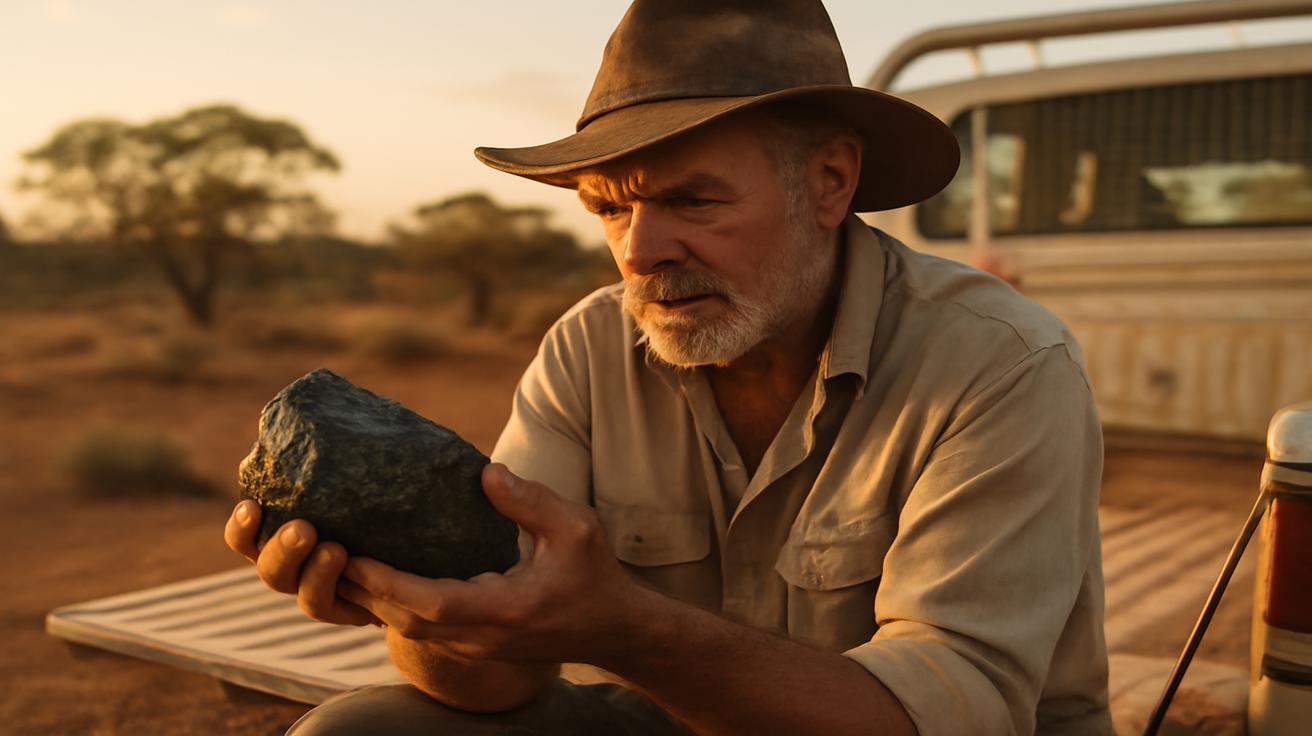
The sound came first—a hard metallic clink against the shovel that didn’t belong in the language of river stones and rust-red dirt. The man straightened, breath shallow in the sharp Australian heat, and scraped back the soil with his boot. Something glinted dully in the afternoon light. It was small, dark, heavy in a way that felt promising. Out here, in the ochre heart of Victoria’s gold country, that kind of glint has rewritten lives before. He rolled it in his palm and smiled, convinced he’d joined that long, lucky lineage. He had no idea that what he was holding wasn’t just a rock, or even a fortune. It was a piece of time itself—a fragment of the solar system that had fallen silently into his hands.
The Day the Sky Hid in the Soil
On the maps, the place barely registered—a ribbon of scrubland cut by a shallow creek, the kind of spot weekend prospectors circle with red pen and hopeful hearts. The man, whose name would eventually be buried in the avalanche of headlines, had come armed with a secondhand metal detector, a borrowed pan, and that familiar Australian blend of optimism and resignation.
The sun leaned hard on his shoulders; the air shimmered in waves above the muted greens of saltbush and stringybark. Cicadas shrieked like hot wires in the trees. He moved the detector back and forth in patient arcs, listening for that telling whine that means you’ve found something denser than dust and dreams.
When the detector finally squealed—sharp, bright, insistent—he almost didn’t believe it. Plenty of false alarms out here: old nails, rusted tins, forgotten relics of people chasing the same glittering idea. But this signal was different. It was strong, concentrated, humming at a pitch that tightened his chest with possibility.
The soil where he dug was caked and sunburnt, the color of dried blood. He chipped away until the shovel struck something that answered back with a metallic note, deep and satisfying. He knelt, fingers suddenly clumsy, and pried it loose.
In his hand sat a stone the size of a small mango: lumpy, oddly smooth in patches, the color of burnt charcoal with hints of red-brown. It was heavier than it looked, like a secret it wasn’t ready to share. Most people, seeing it for the first time, would have thought “rock.” Out here, he thought “gold.” Or at least gold-bearing quartz, the kind that could pay off debts and buy new beginnings.
He turned it over and over, searching for those telltale yellow veins. Nothing. Just a strange, dark shell, with tiny pits and ripples, like it had been shaped by fire and frozen wind. It didn’t quite fit the picture of gold—but it didn’t fit any normal rock either. And that, more than anything, is what made him clutch it tighter. Maybe, he thought, this is what gold really looks like before it’s cleaned, before it’s polished and weighed and locked away. Maybe this ugly, heavy thing is the start of a miracle.
The Rock That Refused to Be Ordinary
Back home, he did what hopeful people do: he tested it. He tried scratching it. It barely marked. He held a magnet to it. It twitched, almost imperceptibly, as if trying to remember another life. He even tried to chip a corner with a hammer but stopped when the sound it made—dense and bell-like—didn’t match any rock he knew.
Finally, curiosity trumped secrecy. He took it to a local museum, the sort of place that smells a little like dust and old paper, where cabinets of minerals sit quietly under fluorescent lights. The geologists behind the counter had seen a lifetime’s worth of “strange rocks” that turned out to be nothing more than hopeful gravel. But when he unwrapped his find, the room changed.
One geologist leaned in, eyes narrowing. Another fetched a loupe. The rock’s surface, up close, was a maze of tiny fusion crusts—glassy, melted patches that looked like dried tar. There was a thin dark rind around it, the kind that forms when something punches through the atmosphere at terrifying speed and survives the fall.
They weighed it. Heavier than it looked. They measured it. Too dense, too magnetic, too peculiar to be from here. Then came the quiet statement that pulled the floor from under his assumptions:
“This might not be gold,” one of them said softly, “but it could be much, much rarer. You may have found a meteorite.”
The word hung there, reshaping the room. Meteorite. Not a glimmer from beneath the Australian soil, but a messenger from somewhere impossibly far away. Gold had seduced humans for millennia; meteorites had seduced something deeper: our hunger to understand where we came from.
From Gold Fever to Cosmic Origins
The rock’s journey changed then, from the world of prospectors and pans to the cool, humming corridors of laboratories. Under microscopes and in scanners, slices of its dark interior were studied like ancient script. What they found was older than any story written on Earth.
Its minerals were arranged in patterns that didn’t match common terrestrial rocks. Tiny metal grains gleamed within, rich in nickel and iron—an unmistakable signature of something forged in the vacuum between worlds. Locked inside were isotopes and elements that formed before Earth had even finished pulling itself together from dust and gas.
This wasn’t just a meteorite. It was a time capsule.
Scientists determined it was likely a stony meteorite that had once been part of a larger body—maybe an asteroid that circled the young Sun when the solar system was still more chaos than order. Over billions of years, collisions shattered that ancestor into fragments. One of those fragments, after an eternity drifting in cold darkness, crossed paths with Earth. It hurtled through the atmosphere in a streak of incandescent fire, slowed, cooled, and fell unnoticed onto a lonely patch of Australian ground.
By the time the prospector’s metal detector beeped over it, that rock had existed for over four and a half billion years. Before there were forests, before there were oceans as we know them, before any living thing had drawn a breath, it was already old.
The Unexpected Value of a Dark, Heavy Stone
Had it been the gold he’d hoped for, its value would have been immediately clear—neatly weighed, assigned a price per ounce, and converted into all the human things we trade life for: homes, cars, wiped-out debts. But its real worth wasn’t something you could pin down in a currency column.
To planetary scientists, a meteorite like this is a priceless clue. While Earth has churned and melted and recycled its own rocks through volcanic fire and tectonic grind, meteorites have remained largely unchanged. They preserve the conditions of the early solar system in a way our own planet’s surface no longer can.
Within its matrix, they can read hints about how dust first began to clump together around the newborn Sun. They can tease out the temperature, chemistry, and violent events that sculpted the planets. Trapped gases, if present, may whisper about atmospheres that never formed, or worlds that never were.
For the man who first lifted it from the dirt, that transformation in meaning was dizzying. The object in his hands had stepped outside the scale of personal fortune and landed squarely in the realm of collective human curiosity. He hadn’t found a shortcut to wealth. He’d found a story. A huge one. One that began before Earth, before continents, before language itself.
The Meteorite, the Miners, and the Long Memory of Land
There was something almost poetic about where it landed. The region he’d searched was drenched in gold rush history—a patch of Earth where men once tore up the ground on a feverish promise that the next shovelful might be the one. Towns had risen overnight, saloons and tent cities mushrooming along creek beds. Fortunes were made and lost so quickly that the land barely had time to memorize their names.
Now, more than a century on, the ghosts of that rush linger: old diggings softened by grass, broken bottles buried under fallen leaves, rusted relics flaking away quietly in gullies. People still come with detectors and dreams, hoping that the ground hasn’t entirely given up its last secrets.
But the land, it turns out, holds more than gold. It also holds memories from far beyond its own history.
Imagine the timeline: The gold that lured prospectors formed deep underground as ancient hot fluids threaded through cracks in rock, cooling slowly over millions of years. Much later, humans arrived with picks and pans and relentless hunger. The meteorite, by contrast, began its journey long before Earth’s crust settled, long before gold veins stitched through it. It slipped silently through space for billions of years, then fell to a patch of ground that, by sheer accident, would one day be sifted and prodded by people chasing a different kind of treasure.
Two eras of human longing intersected in that quiet moment when a metal detector squealed and a man bent down to see what lay beneath. He was reaching backward, in a sense—digging into Earth’s geological past for gold—when something older still pushed its way into his story.
How We Tell the Story of a Fallen Star
Once the meteorite’s nature was confirmed, the narrative unspooled quickly. Local news picked it up first: “Prospector Mistakes Space Rock for Gold Nugget.” The angle was irresistible. There is humor in misidentification, in the way human expectations collide with the universe’s indifference.
But beneath the catchy headlines ran a deeper thread. Scientists shared images of the rock’s interior, those fine cross-hatched metal patterns and minuscule, glassy inclusions that looked like frozen lightning. They spoke of chondrules—tiny, round grains formed as droplets of molten rock in the early solar nebula. They explained that by studying the ratio of certain isotopes, they could estimate its age with remarkable precision, anchoring it to the earliest days of our planetary neighborhood.
The public, for a moment, looked up from their screens and daily noise and contemplated what it means to hold something that predates Earth’s oceans, mountains, and species. Children in classrooms imagined rocks falling from the sky. Adults looked at the night in a slightly different way, sensing the invisible rain of cosmic dust that is always, always drifting down.
The prospector himself slipped into the background as the object outgrew the story of a single human find and settled into a broader narrative about where we come from. If he felt a pang about the lost fantasy of sudden riches, he didn’t say much. There was something larger at work: a recognition that he’d stumbled, quite literally, onto a relic so rare and meaningful that money seemed a clumsy way to talk about it.
Why Meteorites Matter More Than Gold
Gold is, in a sense, easy. We know what to do with it. We turn it into coins, circuits, rings, and reserves. It’s woven into our economies and ceremonies, a metal that has become almost a character in human history—tempting, corrupting, dazzling.
Meteorites are harder to categorize. They don’t fit neatly into shelves of value. They sit at an intersection: science, wonder, and something that almost feels like philosophy.
In laboratories, scientists grind, polish, and examine them, pulling data from the smallest flecks. They learn how water might have arrived on Earth, hitchhiking on ancient rocks. They test ideas about how planets differentiate into cores and mantles. Some meteorites, especially carbonaceous chondrites, even contain complex organic molecules—building blocks that may have contributed to life’s eventual emergence.
But stand in front of a meteorite in a museum, and the experience isn’t just intellectual. There’s an emotional weight as well.
It’s right there, within arm’s reach—a long-distance traveler that has known the cold silence between stars, then the violence of entry through our atmosphere. It has literally been somewhere else. People gaze at it and feel that old, familiar pull: the sense that we are part of something much larger, much older, than any plotline we write for ourselves.
Gold tells us stories about human ambition. Meteorites tell us stories about time.
A Tiny Piece of a Vast Neighborhood
We live in a solar system that is, despite its familiarity in posters and diagrams, still wild with debris. Asteroids, comets, dust and stone—remnants of the great construction project that built the planets—continue to loop around the Sun in elongated, tilted paths.
From time to time, gravity nudges one of these fragments onto a collision course with Earth. Most of them flame out harmlessly as meteors, painting quick strokes of light across the night. A few are large enough to punch through and land as meteorites. Rarer still is the person in the right place, at the right time, with the right kind of curiosity to dig one out and ask: “What are you?”
The man in Victoria might have thought he was just looking for gold, but what he was truly doing was listening—for anomalies, for signals that hinted at something denser, stranger, than the background noise of ordinary soil. The universe answered with a small, heavy visitor.
In the end, that meteorite became part of a growing collection of space rocks found across Australia—an important region for meteorite recovery thanks to its open landscapes and relatively stable surfaces. Each one adds another brushstroke to the portrait scientists are painting of our solar system’s past.
| Feature | Gold Nugget | Meteorite |
|---|---|---|
| Origin | Formed in Earth’s crust | Formed in space, often from asteroids |
| Age | Up to billions of years, but altered by Earth processes | Often ~4.5 billion years, largely unchanged since formation |
| Main Value | Monetary; used for jewelry, finance, electronics | Scientific and cultural; reveals solar system history |
| Common Traits | Bright yellow, malleable, non-magnetic | Often dark, dense, may be magnetic, fusion crust |
| Where It’s Found | Goldfields, quartz veins, riverbeds | Anywhere on Earth where a meteor survives the fall |
Holding a Fragment of the Solar System
There’s a small, almost cinematic detail people tend to imagine: that moment in the Australian heat when he first weighed the stone in his palm, sweat beading along his brow, flies orbiting lazily in the air. He believed he was holding a possibility—a break, a stroke of luck. He was right, just not in the way he thought.
Because in that instant, without knowing it, he was closing a gap of billions of years and unfathomable distances. His fingers curled around matter that had once been closer to the young Sun than Earth itself, then cast adrift. He felt its weight. It left a faint dust on his skin, an ancient powder made from minerals older than any mountain he’d ever seen.
He’d gone out searching for wealth, and instead, he picked up context.
That’s what these stories do, in the end. They remind us that the ground beneath our boots and the sky above our heads are not separate worlds but facets of a single, ongoing experiment. Fragments fall. People look. Sometimes they mistake them for gold. Sometimes they send them to a lab. Either way, a thread is tugged that leads us back through fire and ice and darkness to the beginning.
Somewhere in a display case or climate-controlled drawer now, that Australian meteorite rests—labeled, cataloged, sampled. Visitors might press close to the glass and read that it is 4.5 billion years old, that it formed from the same cloud of gas and dust that birthed Earth, that it carries within it the memory of a time when our planet was still an idea.
And maybe, if they step back for a moment, they’ll feel what the prospector felt in a different way: the sudden, vertigo-like awareness that we live not just on Earth, but in a solar system. That the sky is not only something to look at, but something that, sometimes, quite literally, lands in our hands.
Frequently Asked Questions
How can you tell if a rock might be a meteorite?
Potential meteorites are usually heavier than typical rocks for their size, may attract a magnet due to iron content, and often have a thin, dark “fusion crust” from burning through the atmosphere. They rarely have bubbles (unlike slag or man-made metal waste). Laboratory analysis is required for confirmation.
Are meteorites worth more than gold?
Some rare meteorites can be extremely valuable to collectors and institutions, sometimes rivaling or exceeding gold by weight. However, most of their true value is scientific rather than monetary, because they help researchers understand the early solar system and planetary formation.
What should I do if I think I’ve found a meteorite?
Keep the rock as clean as possible, avoid cutting or polishing it, and document where you found it. You can contact a local university geology department or museum with photographs and details. They may offer to examine it or direct you to a specialist.
Why are meteorites so important to science?
Meteorites are relatively unchanged remnants of the early solar system. While Earth’s rocks are constantly recycled by tectonics and erosion, many meteorites preserve original materials and structures from over 4.5 billion years ago, providing a window into conditions when planets were forming.
Do meteorites fall often, and is Australia a good place to find them?
Meteorites fall to Earth regularly, but most are small and many land in oceans or remote regions. Australia, with its wide open landscapes and stable, dry surfaces, is an excellent place to find them. Dark meteorites often stand out against pale soils and desert pavements, increasing the chances of discovery.




Leave a Comment