
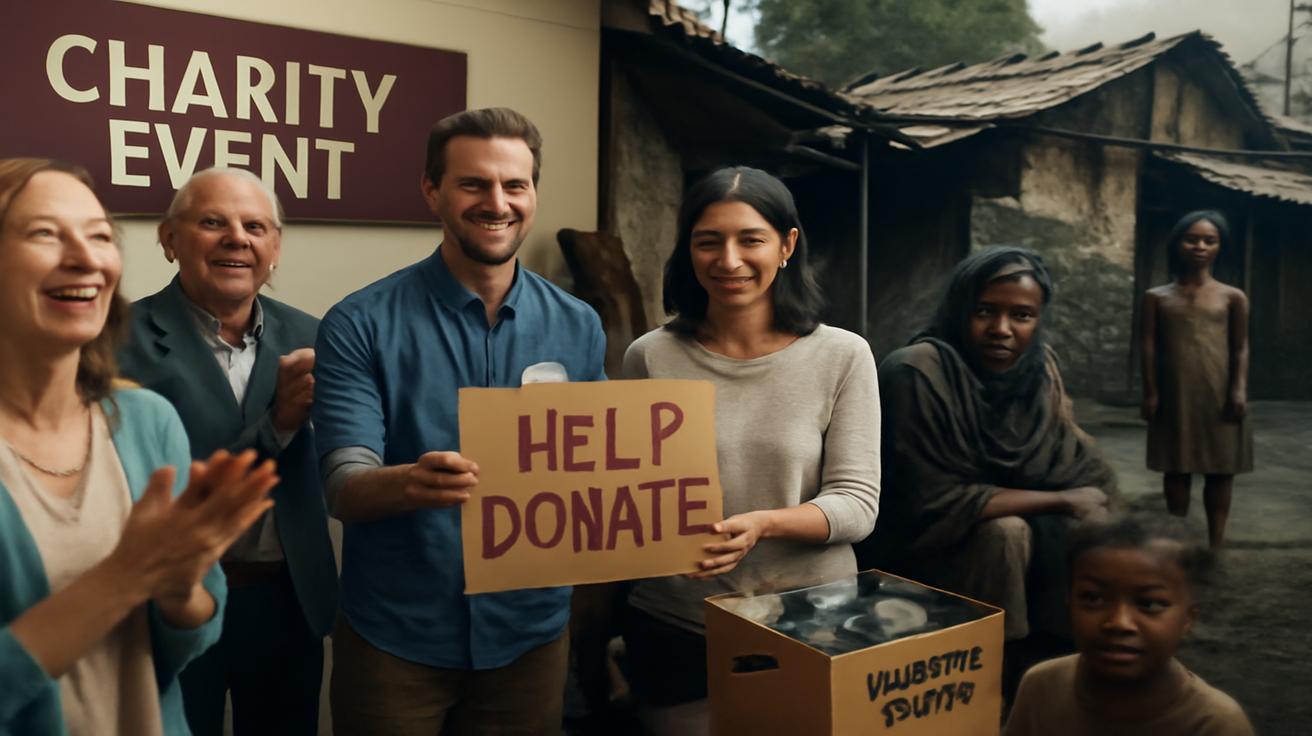
The bus doors wheezed open to a cloud of red dust and heat. You stepped down with a bottle of hand sanitizer clipped to your backpack, a string of carefully rehearsed local phrases in your head, and a phone full of photos waiting to be taken. Ahead, a handmade banner—WELCOME, FRIENDS!—fluttered above a painted concrete school where your volunteer group would spend the week. You were ready to help. Ready to make a difference. Ready, if you’re honest, to feel something.
By the time you left, you had dozens of selfies with smiling children, a few mosquito bites, and a story that would play well on social media and at dinner parties. “It was so humbling,” you said. “They have so little, but they’re so happy.”
What you didn’t know—what no one really talked about—is that the school you “built” was mostly rebuilt each year to give each batch of volunteers a sense of accomplishment. Or that the local builders, who could have used the paid work, were passed over because volunteer labor was “part of the experience.” Or that the teacher whose classroom you painted would quietly repaint it after you left, because the colors were wrong for children with visual sensitivities. You left feeling changed. The community felt… tired.
That is the uncomfortable truth at the heart of many “feel-good” charities: sometimes, the biggest transformation happens not in the places we claim to help, but inside the people who come to help—and that glow can hide a shadow.
The Seductive High of Doing Good (For Ourselves)
There’s a particular kind of buzz that comes from altruism. Behavioral scientists sometimes call it the “warm glow” effect—our brains literally light up with reward when we give. We are wired to feel good when we help. Charities, understandably, build on that. They show us emotional stories, simple solutions, big smiles, and urgent countdown timers. They offer us a bargain: a small donation in exchange for a sense of being a decent human in a complicated world.
But it’s a bargain that comes with fine print.
To work as advertised, this kind of charity needs three things more than anything else: vivid stories, visible results, and emotional satisfaction for donors. Impact, in the deeper sense—whether communities actually thrive in the long term—often sits quietly in the back row. It’s hard to photograph “structural change.” It’s messy to explain why sustainable solutions can take years. It’s uncomfortable to admit that the right answer might be, “We don’t know yet.”
So we get short-term projects, photogenic interventions, and simple narratives. Dig a well. Drop in some shoes. Build a classroom in a week. Fly in a volunteer team. Put your name on a plaque. Post the smiling kids. Sleep well.
Meanwhile, the harder questions stay unasked. Who wanted this project? What local skills and businesses did it displace? Who will repair the well when it breaks? What laws or power dynamics keep this community from meeting its own needs? And perhaps the sharpest one of all: whose comfort are we really protecting?
When Help Lands Like a Hammer Instead of a Hand
Walk through many communities that have hosted wave after wave of well-meaning projects, and you start to notice a strange kind of archaeological layer cake: abandoned schools, unused water tanks, broken solar panels with no one around who knows how to fix them. Projects that looked wonderfully hopeful on a donor brochure slowly decaying into monuments of disconnection.
Ask around, and the pattern repeats: things came from the outside—money, people, ideas—and then… left.
Consider a pattern that has played out countless times in rural villages. An international charity arrives with a truck, cement, and proud declarations about “bringing clean water.” A well is dug. Photos are taken. A ribbon is cut. Donors receive a glossy report: “You provided clean water to 500 people!”
Two years later, the pump breaks. The parts are expensive and can only be ordered through a foreign supplier. No one in the village was trained to repair or manage the system. The local mechanic, who once fixed handpumps, lost business when everyone switched to the “new” technology. The charity has moved on to the next project.
So people walk to the river again.
From the donors’ perspective, nothing is wrong. The well existed, photos were taken, impact was “delivered.” The emotional contract is complete. But for the community, the story is one of disruption and dependence—a way of helping that arrives like a hammer, not a hand.
Now zoom out from wells to orphanages that are full of children who still have families, because funding flows more readily to institutions than to family support. To clothing drives that flood local markets with free clothes, destroying local tailors’ livelihoods. To food aid that undercuts farmers trying to make a living. To volunteer trips that spend more on flights than on the communities they visit.
The intentions are kind. The outcomes can be quietly brutal.
How “Feel-Good” Becomes “Net Harm”
When you strip away the glossy surface, harmful help often carries the same fingerprints:
- It centers the giver’s experience more than the receiver’s reality. The project is designed around what will feel meaningful for the donor or volunteer, not what will be most useful, respectful, or sustainable for the community.
- It loves quick wins—things that can be built, photographed, and reported within a grant cycle or a vacation week, even if they don’t fit into a long-term plan.
- It assumes outsiders know best, treating local knowledge as background color rather than the foundation of any real solution.
- It rarely asks “What happens when we leave?” Maintenance, training, local governance, and financing all take a back seat to the thrill of the initial launch.
Most dangerously, it offers donors a form of moral comfort that is cheap—emotionally and financially. Small monthly payments, round-up-at-checkout options, shareable posts: tiny costs that buy us a story about ourselves as caring people, without requiring us to confront the systems that actually produce inequality and suffering.
We buy a bandage. We look away from the wound.
The Quiet Distance Between Stories and Reality
Imagine two possible charity campaigns you might scroll past on your phone.
The first shows a barefoot child cradling a tin cup, framed by cracked earth. “For just $2 a day, you can save her life,” the caption says. You tap to donate. You picture your money traveling like a beam of light, landing neatly in her hands. Relief mingles with tenderness. You did something.
The second shows no children, no tears—just a group of community leaders in a fluorescent-lit hall, arguing over a whiteboard. The caption reads: “Your donation helps local advocates fight for fair land rights, so families can grow food and access water without fear of displacement. This work is slow, political, and sometimes fails.”
Which campaign do you instinctively feel drawn to?
The first is emotionally immediate. It offers a simple arc: problem, hero (you), solution. The second is messy, abstract, and lacks a central character—least of all, you. Yet the second one may be the kind of work that actually prevents famine, water shortages, and broken communities in the long run.
Feel-good charities often lean heavily on that first kind of story. They have to: competition for attention and funding is fierce. Emotion sells. But when charities treat the people they serve as props in someone else’s redemption arc, they flatten complex lives into consumable images. Suffering becomes a backdrop for the donor’s heroism.
And here’s the twist: narratives designed to comfort us can actually prevent us from seeing what would help most. If every issue is framed as “a sad child who needs your $20,” we’re trained to think in terms of rescue, not justice; of individual acts, not collective responsibility.
Red Flags: When Your Alarm Bells Should Start Ringing
Not all charities fall into these traps. Many do careful, evidence-based, community-led work with deep humility. But it helps to notice when something feels off. If a charity or project checks several of these boxes, pause and look closer:
| Red Flag | Why It Matters |
|---|---|
| Only emotional stories, almost no data | They may be optimizing for feelings over measurable, lasting impact. |
| Promises of “saving” people easily | Real change is rarely simple, fast, or driven by outsiders alone. |
| Lots of focus on volunteers’ experiences | If the main product is your transformation, the community may be an afterthought. |
| No mention of working with local groups | Lack of partnership often leads to projects that don’t fit real needs. |
| Vague about what happens after the project | Sustainability, maintenance, and community ownership may be missing. |
These signs don’t automatically mean a charity is harmful, but they do suggest your dollar may be buying you more story than substance.
Voluntourism: When the Trip Is the Product
Few phenomena capture the clash between moral comfort and meaningful help as sharply as voluntourism: short-term “service trips” abroad, often by students or church groups, that promise both adventure and impact.
On paper, it sounds ideal. You travel. You learn. You help. You come home with new perspective and a sunburn. But look at it from the other side of the check-in counter.
Every new group of volunteers must be greeted, oriented, translated for, supervised, and emotionally managed. Children are asked again and again to bond with strangers who will soon disappear. Local professionals are sometimes pushed aside so visitors can “teach” or “build,” even when the visitors lack training. Projects must be broken down into tasks that can be done quickly by amateurs: painting, mixing cement, playing with kids.
The trip, not the transformation, becomes the real product.
Many communities learn to smile and accept; there is real money in hosting these trips. But quiet resentment grows too. “They come for a week,” one community organizer in Latin America once said, “and for that week, we perform our poverty. After they leave, we keep living it.”
That doesn’t mean all travel-based programs are bad. When structured around listening, skill-sharing, long-term partnership, and local leadership, they can foster solidarity and understanding. But if the experience is advertised mostly in terms of what it will do for you—how it will change your heart, your college application, your Instagram feed—then the real client, the one being served, isn’t the community at all.
Buying Moral Comfort on the Cheap
Underneath all of this lies a quieter story about ourselves. Modern life comes with a constant, low-level hum of awareness: climate breakdown, inequality, displacement, injustice. We know, even if we don’t always say it aloud, that our comfort is tangled up with other people’s hardship—through supply chains, emissions, politics, history.
That awareness is heavy. It sits in the chest like a stone. Charities step into that space with an offer: for the price of a coffee each day, you can feel lighter.
There’s nothing inherently wrong with wanting that relief. A healthy response to suffering includes action. But when our primary goal becomes soothing our discomfort rather than confronting its sources, we drift into a strange emotional economy. We treat donations like indulgences: small payments that let us continue our habits largely unchanged, with less guilt.
We recycle, we donate, we share a powerful video, and then we shield ourselves from the harder work of asking: what would it mean to live so that fewer bandages were needed in the first place? What systems around me could be changed? What privileges of mine rest on other people’s precarity?
The most transformative forms of solidarity don’t always feel good. They can stir shame, anger, grief, and confusion. They may demand more from us than money: listening, unlearning, political engagement, giving up convenience or status. They move us beyond being rescuers into being co-laborers in a world that is, frankly, unfair by design.
How to Help Without Hurting (At Least, Not as Much)
So what do we do with all this? It’s tempting, when you first see the shadow side of feel-good charity, to swing in the opposite direction: to mistrust all organizations, to stop giving, to protect yourself from disappointment by withdrawing. That response is understandable—and, ironically, unhelpful too.
The reality is that money and effort can do profound good when channeled thoughtfully. The challenge is not to give less, but to give with more curiosity and courage.
Here are some ways to start.
1. Ask annoying questions. Before donating or signing up for a project, ask:
- How do you know this program works, beyond stories?
- Who designed it? Were local people involved from the start?
- What happens in five or ten years if your organization leaves?
- How do you handle it when projects fail or cause problems?
Notice not just the answers but the attitude. Are they defensive, or grateful you care about impact?
2. Look for humility in the story. Good organizations talk about partnership, not rescue. They highlight the agency and leadership of the people they serve. They’re honest about complexity. They sometimes say, “We don’t know yet.” They don’t put donors, volunteers, or foreign staff at the center of the narrative.
3. Prioritize boring, unsexy work. Preventing disease, changing laws, training local health workers, supporting community organizers, funding advocacy—these don’t always come with heartwarming before-and-after photos. They are, however, the kinds of things that shift conditions instead of just treating symptoms.
4. Check where the money goes—but not only that. Administrative percentages matter less than most of us think. A well-run organization needs staff, training, monitoring, and evaluation. A charity that spends very little on “overhead” may be underinvesting in quality. Look instead for clarity, transparency, and learning: do they share both successes and failures?
5. Be willing to be changed by what you learn. If you visit a community or read about an issue, don’t stop at feeling moved. Ask: what does this reveal about the systems I’m part of? Are there policies I can support, businesses I can challenge, habits I can alter? Let the discomfort turn into something sturdier than guilt: responsibility.
Becoming the Kind of Giver the Future Deserves
Imagine, for a moment, that you’re back stepping off that bus into the heat and dust. But this time, the banner doesn’t say WELCOME, FRIENDS. It says something else: WELCOME, LISTENERS.
Instead of grabbing a paintbrush, you grab a notebook. Instead of teaching English to people who already speak three languages and need, say, legal protection or land rights, you ask community members what they’re already doing and what’s in their way. Instead of leading the project, you follow the people who will still be there when your plane takes off again.
Maybe, by the end of the week, you haven’t built anything you can photograph. Maybe you’ve spent most of your time in unglamorous meetings with local organizers, or sitting under a tree listening to farmers describe how weather patterns have changed. You fly home without a heroic story. You come back with questions, some of them uncomfortable, rattling in your head.
That, too, is a kind of help. Maybe a deeper one.
We live in a time when the distance between our choices and their consequences is often very long: miles of supply chains, layers of policy, invisible networks of cause and effect. It’s understandable that we reach for something we can see and touch. But justice in the 21st century will likely be built less on moments of emotional rescue, and more on sustained, sometimes tedious, efforts to move the ground under people’s feet.
In that work, donors are not saviors buying moral comfort. We’re participants investing in shared futures. The measure of our generosity is not how good we feel when we click “confirm donation,” but how much more possible we’ve made someone else’s own plans, someone else’s own power.
Helping will always carry risks. We will misstep. We will support organizations that disappoint us. We will look back on some choices and wince. But if we’re willing to trade a little of our warm glow for clearer sight—if we can bear to stay in the discomfort long enough to ask better questions—then our giving can start to resemble less a mirror, and more a window.
Through that window, the people we aim to help are not distant figures waiting to be saved. They are neighbors, teachers, organizers, farmers, nurses, children, elders—experts in their own lives. Not the supporting cast in our story, but authors of their own.
And the role we get to play isn’t the hero. It’s something quieter, less cinematic, and far more necessary: the ally who shows up, listens hard, shares resources, sticks around, and understands that sometimes the most loving thing you can do with your comfort is to stop buying it cheaply—and start investing it wisely.
FAQ
Are all “feel-good” charities harmful?
No. Many organizations that make you feel good also do excellent, community-led, evidence-based work. The problem isn’t feeling good; it’s when emotional satisfaction replaces serious attention to impact, accountability, and local leadership.
How can I quickly assess if a charity is likely to be effective?
Look for clear explanations of their programs, independent evaluations or data, long-term partnerships with local groups, and honest discussion of challenges and failures. Vague language and purely emotional appeals are reasons to dig deeper.
Is it always bad to volunteer abroad?
Not always. Programs that prioritize learning over “saving,” work through long-term local partnerships, match tasks to actual skills, and avoid displacing local workers can be valuable. Be wary of trips marketed mainly as personal transformation experiences.
Do small donations even matter if real change is systemic?
Yes. Small donations, pooled together, fund advocacy, frontline services, and organizing. The key is to pair giving with larger engagement—supporting policy changes, voting, organizing, and adjusting personal choices where possible.
What if I’ve supported charities that turned out to be ineffective or harmful?
Most people have, often with the best intentions. The important step isn’t guilt; it’s learning. Let that realization refine how you give and speak about these issues going forward. Ethical giving is a skill we grow, not a test we either pass or fail once.






Leave a Comment