
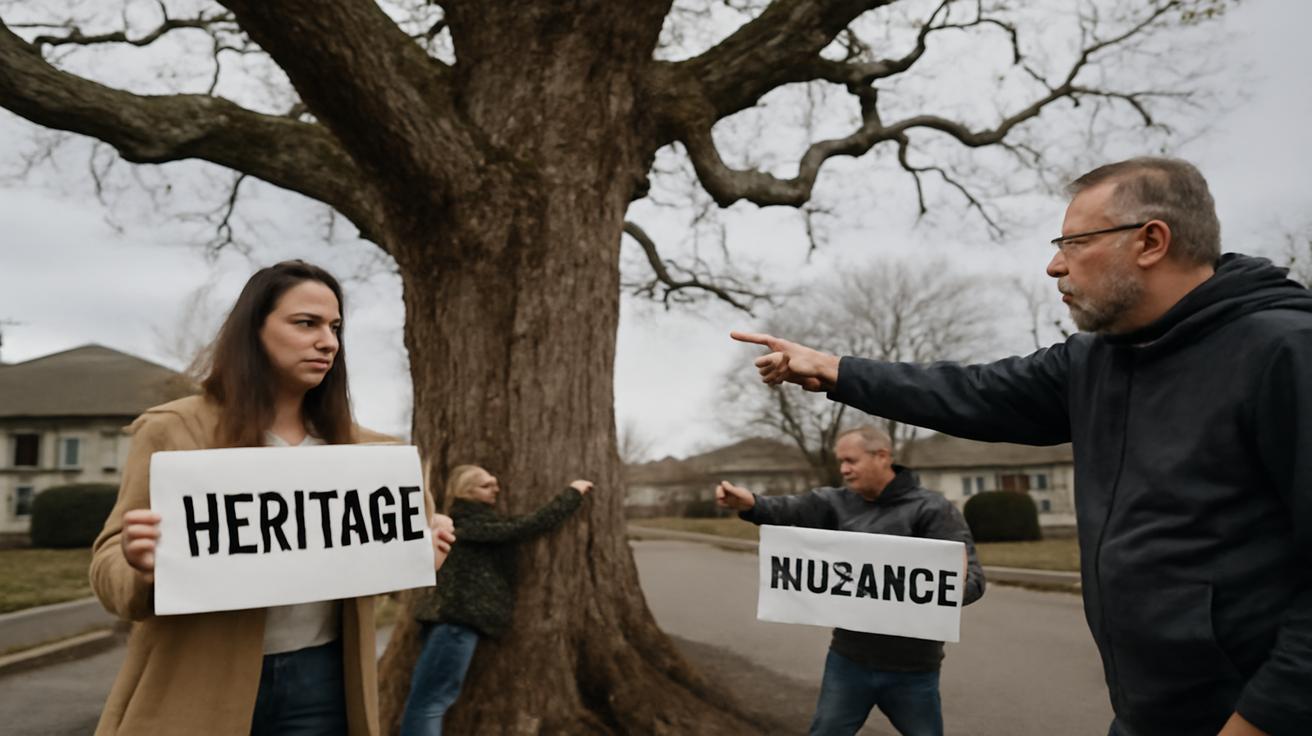
The first time I saw the oak up close, a squirrel shot down its trunk like a dislodged knot, skidding to a halt near my shoes as if I’d stepped into its living room uninvited. The tree rose above us in a rough, twisting column, the bark split and furrowed like the palm of someone who’d worked with their hands for a very long time. The crown, though, told a different story—whole sections naked and gray, branches like exposed ribs against the sky. From the sidewalk, you could see where storms had snapped off limbs, jagged stumps jutting out like broken bones. It was late September in a neighborhood where everything else still seemed stubbornly green, but the old oak looked tired. Not peacefully old. Tired in the way of something that had been asked to hold on too long.
The Tree at the Center of Everything
By the time I moved onto Sycamore Lane, the oak was already famous. It had a nickname—“The Sentinel”—and, depending on who you asked, it was either the soul of the street or a lawsuit waiting to happen. People pointed it out the way they pointed out their favorite café or the best shortcut to the park.
“That thing’s been here longer than any of us,” Mrs. Greene told me the day I moved in, her arm heavy with grocery bags and history. “You could build a museum around it, if the city had any sense.”
Two hours later, when the moving truck was blocking half the road, a man in a high-visibility vest rapped on the driver’s window and jabbed a finger toward the oak. “You can’t park under that,” he said. “You want a branch through your roof?” His name was Dan, I’d learn later. He and Mrs. Greene had not been on speaking terms for at least three years, and the tree was the reason.
It didn’t take long to figure out that everyone in the neighborhood had a stance about the dying oak, and those stances were stubbornly carved into the social landscape. You could almost chart invisible borders by who watered their front yard with a smile and who trimmed their hedges with the vigilance of a besieged castle. The oak was the unofficial dividing line, both literally and emotionally.
The tree itself stood on the thin stripe of city-owned land between sidewalk and street, its roots heaving up the concrete in slow-motion waves. A rusty sign nearby read NO PARKING—TREE ROOTS, as if the roots were sentient and might object personally if you tried to leave your Honda there.
Some afternoons, I’d watch leaves drift down like exhausted confetti as cars crawled past to inspect the warning tape still fluttering in the higher branches. Neighbors lingered, too—some with phones out, documenting every crack, every fungus bloom, every hollow. Others came with folded arms and practiced sighs. The oak, like a celebrity past its prime, couldn’t leave its house without causing conversation.
The Day the Clipboard People Arrived
The first real battle began on a bright Tuesday morning when two white city trucks pulled up, followed by a car with a logo that said URBAN FORESTRY in tasteful green letters. Three people stepped out: two in vests, one with a clipboard and a posture that said she’d been yelled at by residents before and was fully prepared to be yelled at again.
Word travels faster than Wi-Fi in a neighborhood that needs something to talk about. Within minutes, people materialized out of houses and driveways—a small crowd forming under the dappled shadow of the oak. I’d been sitting on my porch with a mug of coffee, and now I wandered down, drawn by that particular electricity that says, “Something is happening, and you might regret not witnessing it.”
The woman with the clipboard introduced herself as Marta, a city arborist. She walked slow circles around the trunk, tapping with a mallet, peering up into the canopy, brushing lichen with gloved fingers. Every time she pressed her ear to the bark or took a photo, the group behind her leaned forward, reading her silence like a verdict.
“You can see the dieback in the crown,” she finally said, looking up, hand on her hip. “Loss of fine twigs, major limbs already gone. There’s fungal conk at the base here—see that?” She pointed to a shelf of brown, spongey growth. “Heart rot. The interior is compromised.”
It was technical, measured, and might have sounded neutral if it weren’t for the sharp intake of breath from Mrs. Greene.
“Compromised isn’t dead,” she shot back. “You people cut things down the second they get inconvenient.”
Marta nodded, like she’d been expecting that sentence. “I’m not here to cut it down. I’m here to evaluate risk.” She pointed upward. “From the lean and the decay, if we get a major windstorm, we’re looking at possible failure toward the street. Possibly the house.”
Everyone turned instinctively toward the small white bungalow just beyond the oak’s girth. The house belonged to the Nguyens—quiet, gentle people who somehow managed to be on every volunteer list in the neighborhood. Their youngest kid, Lily, liked to sit on the curb in front of the tree and chalk tiny constellations on the split sidewalk.
“We love the tree,” Mr. Nguyen said softly, coming down his steps with a dish towel still over his shoulder, like he’d left a pan on the stove to join the gathering. “But if it falls on the house…” He trailed off, glancing up with a look that was part apology and part fear.
A murmur rose. This wasn’t just about bark and fungus anymore; it was about insurance premiums and bedtime stories and the place you’re supposed to feel safest.
The Petitions and the Lines in the Sand
Within a week, there were two petitions on Sycamore Lane—one to save the oak, one to cut it down. They lived in dueling clipboards by the neighborhood bulletin board, each with its own handmade sign.
On the left: SAVE OUR OAK! HERITAGE CAN’T BE REPLACED.
On the right: SAFETY FIRST. WE CAN PLANT NEW TREES—WE CAN’T REPLACE LIVES.
Where you signed—or if you signed at all—became a kind of declaration, like putting a campaign sign in your yard. Your signature aligned you with a story about what mattered more: the past or the future, beauty or safety, roots or roofs.
The “Save” faction was led, unofficially, by Mrs. Greene, who claimed her father had planted the acorn the year the subdivision was built. Whether or not this was historically accurate, no one could entirely disprove it, and in neighborhood arguments, a good story is almost as strong as a deed.
“That tree saw us grow up,” she told anyone who’d listen. “We played under it, we threw our graduation caps under it, we took wedding pictures with it in the background. You think you can just erase that because someone’s afraid of a branch?”
Dan—the man in the high-visibility vest who’d warned me about parking under the oak—became the face of the “Cut It Down” group. A contractor by trade, he’d spent his adult life calculating weight loads and failure points. He started texting out photos every time a new crack appeared in the lifted sidewalk, every time a storm tore off another branch and left it sprawled across the road like a warning.
“You want heritage?” he’d say. “I’ll make you a beautiful table out of the wood. We’ll put it in the cul-de-sac, call it a memorial, and nobody has to die for it.”
At one hastily organized backyard meeting, both sides showed up armed with folders and feelings. A plastic folding table sagged under the weight of printed articles: case studies of hazardous trees, essays about urban canopies, research on how old trees lower neighborhood temperatures and increase biodiversity. Someone even brought a laptop with a slideshow of historic photos—the oak in sepia tones, standing beside fresh pavement and boxy new houses, its canopy still small, its future still unargued.
| Perspective | Main Concern | What the Oak Represents |
|---|---|---|
| “Save the Oak” Neighbors | Loss of history, character, and community identity | Memory, continuity, and a living witness to shared stories |
| “Cut It Down” Neighbors | Falling branches, property damage, safety and liability | Risk, neglect, and the cost of clinging to the past |
| Undecided / Quiet Neighbors | Social tension, conflict, being forced to take a side | A symbol of how small things turn into big neighborhood rifts |
From the back of the yard, someone muttered, “It’s just a tree.” But that wasn’t true anymore. It had become a mirror.
When Roots and Nerves Get Tangled
As the debate deepened, it stopped being strictly about the oak’s health. The conversations grew rootlets of their own, drilling into older grievances and unspoken resentments.
“Funny how you care so much about safety now,” Mrs. Greene said one evening, voice sharp as she watered her petunias. “You’ve had that broken railing on your porch for months.”
“My railing won’t crush a minivan,” Dan shot back from his driveway. “And at least I fix things before they rot completely.”
At the mailboxes, I overheard one neighbor whisper to another: “They just want the tree gone so their solar panels get more sun.” The reply came quick: “Please, they only care about it because it makes their house look ‘charming’ for resale.” Every observation about rot and windload carried a quiet subtext: You’re selfish. You don’t understand. You don’t belong.
The oak became the safe surface people could scrape their frustrations against without ever admitting the deeper sting. It was easier to argue about a trunk than about the slow drift of the neighborhood—from modest, working-class roots toward something more curated, more expensive, more exposed. New families brought compost bins and electric cars and earnest ideas about pollinator gardens. Long-timers brought stories about when the street was still gravel and nobody called the city for anything, because you just handled it yourself.
One Saturday I watched a kid—maybe ten, in basketball shorts and bedhead—stand at the base of the oak, palms pressed to the cracked bark. It was early, the road still quiet, mist hanging low. He looked up for a long time, the way people look at old churches, or mountains they haven’t decided whether to climb.
“You okay, buddy?” I asked.
He shrugged. “My mom says they’re gonna cut it down. My dad says it’s dangerous and it should’ve been gone years ago. I don’t know.” He kicked at a root bulging through the dirt. “I like it here. It’s like… it watches us.”
There was something achingly honest in that. The tree as witness, as keeper of secrets and scraped knees, as the one unchanging vertical line in a neighborhood whose story was otherwise trending up, up, up.
Heritage vs. Hazard: What the Experts Actually Say
In the heart of the debate, facts tried to elbow their way in. Marta, the city arborist, came back with more detailed assessments. She explained how decay in a tree doesn’t always mean it will collapse tomorrow, how trees can compartmentalize damage, how risk isn’t a binary of “safe” or “unsafe” but a gradient of probabilities tangled with weather patterns, soil conditions, and maintenance.
She suggested an option no one had truly considered: aggressive pruning and cabling. Remove the heaviest, most compromised limbs. Install support in the main trunk. Accept a changed silhouette in exchange for buying time.
To Dan, this sounded like denial—cosmetic surgery on a failing system. “So we pay thousands to keep a hazard we know is compromised?” he asked. “Who’s responsible when something still falls?”
To Mrs. Greene, it sounded like hope. “Trees aren’t perfect. People aren’t perfect. We don’t give up on them because they’re old and need help.”
The science of risk assessment clashed with the art of how people emotionally calculate danger. For some, the small daily risk of a falling limb paled beside the looming, abstract fear of losing a landmark that anchored their sense of place. For others, the statistical odds of disaster were overshadowed by the terrifying image of worst-case scenarios: a siren, a crushed car seat, a roof caved in at 2 a.m.
And somewhere in all this, another question lurked, one few said out loud: Are we arguing about a tree, or about who gets to decide what our street looks like, feels like, becomes?
Just Another Excuse to Meddle?
As fall deepened, tempers and temperatures both cooled a little, but the oak still stood like an unanswered question in the middle of Sycamore Lane. People adjusted their routines around it in small, telling ways. Some stopped parking anywhere near its reach. Others staged tiny acts of devotion: fresh mulch laid at its base, a small circle of stones, a mason jar of wildflowers tucked into the roots like an offering.
I started to notice another layer beneath the conflict: an almost irresistible urge people had to manage one another’s choices. The tree was public enough that everyone felt entitled to a say, yet close enough to individual homes that the consequences felt private. That combination drew out the neighborhood’s inner meddlers like moths to a porch light.
“You should really sign the petition,” one neighbor told me, unprompted, as I pulled my trash bin to the curb. “We’re trying to reach a majority so the city understands what we want. It affects all of us, you know.”
“Have you called the city about the liability?” another asked, later that week. “We can’t just sit back while people cling to nostalgia. That’s how disasters happen.”
Everyone was sure they knew what was best—not just for the tree, but for one another. There’s a strange intimacy in that kind of certainty, an assumption that your neighbors are an extension of your own judgment and must therefore be corrected when they stray.
But watching kids weave their bikes around the oak’s roots, listening to the buzz of conversation at dusk as people walked dogs under its thinning canopy, I started to wonder if the meddling wasn’t entirely a bad thing. In an era when we can live next door for years and never really know each other’s stories, it was the tree that forced people into each other’s orbit. The oak made them talk, argue, organize, show up to meetings in church basements and city council chambers. It made them say, out loud, what they valued and why.
Maybe we meddle, at least in part, because we still care what happens just beyond our own property line. Because we still believe, even if it annoys us, that we share more than just adjacent driveways—we share a fate.
The Ending That Wasn’t Quite an Ending
The city’s final decision didn’t arrive with trumpets, just a bland PDF emailed out and fixed to the bulletin board with a crooked pushpin. It recommended a compromise: substantial pruning, installation of support cables, yearly inspections, and a timeline—a plain, bureaucratic sentence that said, in effect, “We anticipate removal may be necessary within the next five to ten years.”
Both sides claimed partial victory. The “Save” group celebrated the reprieve, talking about fundraising for maintenance and maybe a little plaque at the base explaining the tree’s history. The “Cut It Down” group pointed to the admission of future removal as proof that they’d never been overreacting.
In the months that followed, the tree changed shape. Crews came with bucket trucks and ropes, the buzz of chainsaws and the smell of fresh-cut wood filling the street. Great limbs descended slowly, cradled by pulleys, as careful as lowering chandeliers. When they thudded to the ground, a few people flinched as though something important had been severed inside them too.
Afterward, the oak stood slimmer, asymmetrical, a little awkward in its new proportions, like someone who’d lost a lot of weight too quickly. Sunlight slipped through gaps that had been dense shade before. The sidewalk beneath looked briefly exposed, vulnerable without its leafy ceiling.
But spring still came. Tiny buds pushed out along the surviving branches, stubborn as always. Birds returned, testing perches along the remaining limbs. Kids played on, now with parents occasionally glancing up, calculating in quiet, personal ways whether they still trusted this towering neighbor.
Over time, the argument softened at the edges. People found new things to disagree about: parking, noise, someone’s experimental front-yard prairie that looked suspiciously like weeds. Yet the oak remained, not quite a triumph, not quite a failure—just a complicated, living fact the neighborhood had to keep accommodating, year after year.
When I walk past now, I run my hand along its battered bark. I think about how something can be a priceless heritage, a dangerous nuisance, and an excuse for meddling—all at once. I think about how rare it is, in a world of rapid, invisible change, to have an argument that you can stand under, measure with your arms, watch cast a shadow.
Some evenings, when the light angles just right, the pruned branches scribble long, spare lines across the pavement. Kids hop over those shadows as if they’re lava. Neighbors pause mid-dog-walk to see how many leaves it managed to keep this year. Someone always stops to tell a new version of the story: about the time a limb almost hit the mail truck, or the time a thunderstorm splintered the top, or the time people packed into a too-small living room to yell about whether a tree could be worth more than the chance, however small, of a bad night.
The oak is still there. So are they. And so, for better or worse, is the messy, human tangle of caring enough to fight about what survives in the places we call home.
Frequently Asked Questions
Why do old neighborhood trees cause so much conflict?
Large, aging trees touch many parts of daily life at once: safety, property values, history, and even personal identity. People project different values onto the same tree—one person sees shade and memories, another sees risk and maintenance costs. Because the tree is shared rather than privately owned, everyone feels they have a stake, and that shared ownership often leads to friction.
How do arborists decide if a tree is too dangerous to keep?
Arborists look at several factors: the tree’s overall health, structural defects, presence of decay or fungi, root stability, past limb failures, and the targets below—houses, sidewalks, cars, or people. They combine visual inspections with tools like mallets, probes, and sometimes advanced instruments to estimate internal decay. The decision is usually about managing risk, not eliminating it completely.
Is it always possible to “save” a dying tree with pruning and cables?
Not always. Pruning, cabling, and bracing can reduce the chance of failure and extend a tree’s life, but they can’t reverse extensive decay or guarantee safety. In some cases, these measures buy time for the community to prepare for eventual removal and replanting; in others, the risk is already too high to justify keeping the tree.
Why do people get so emotional about trees in their neighborhood?
Trees quietly mark time for us. They are backdrops for childhood games, family photos, walks, and conversations. When a tree predates most of the residents, it can feel like a living elder, a witness to a shared past. Losing it can feel like losing part of that story, especially in places where everything else changes quickly—neighbors move, houses remodel, traffic patterns shift. The tree stays, and that constancy becomes meaningful.
How can neighborhoods handle these disputes more constructively?
Transparent communication and early involvement help. Bringing in certified arborists, sharing clear reports, and discussing options openly—pruning, cabling, staged replanting—can move the conversation from emotional stand-off to practical problem-solving. It also helps to acknowledge that people’s fears and attachments are real on both sides. When neighbors recognize that they’re not just fighting over wood and leaves, but over identity, safety, and belonging, the conversation often becomes more thoughtful, even if agreement is still hard to reach.







Leave a Comment