
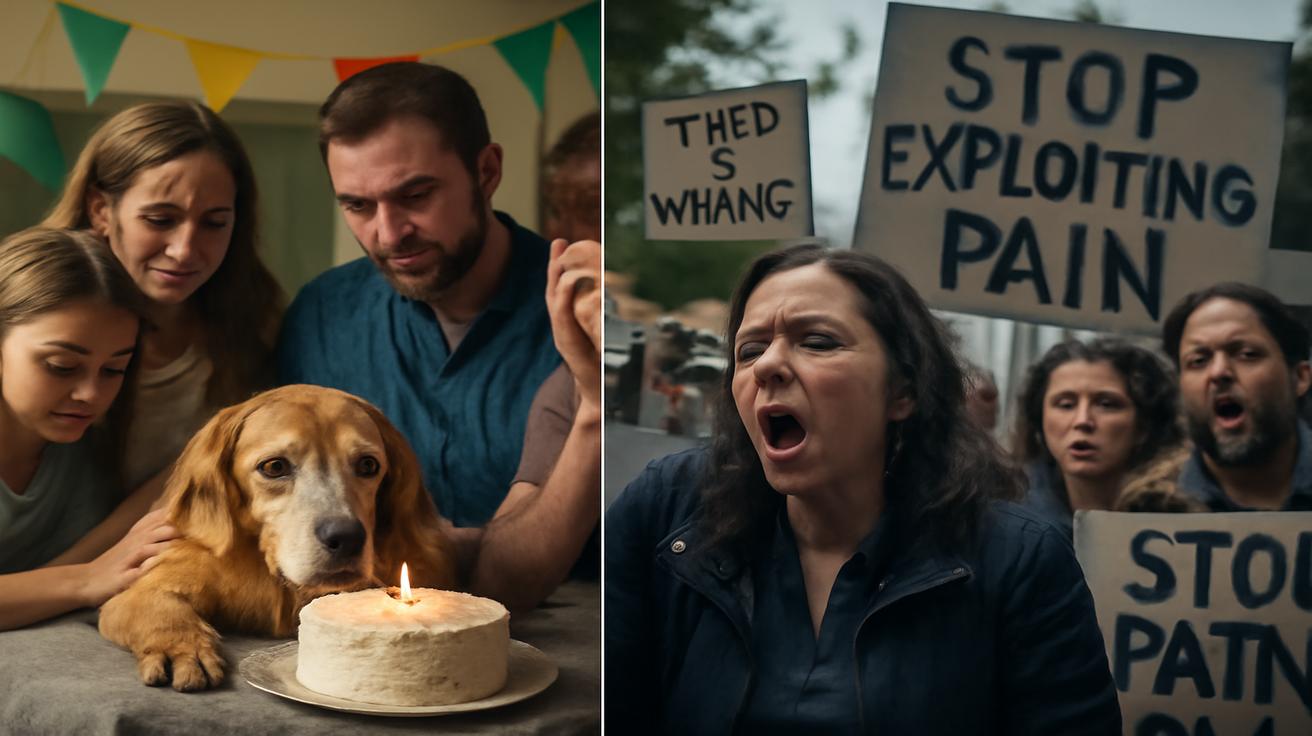
The dog wore a glittery paper crown, the kind you’d find in a children’s party pack, slightly askew between his ears. Around his neck, a bandana read “Best Boy Forever” in looping blue letters. Balloons bobbed against the ceiling; a banner stretched across the living room: “We Love You, Max.” Someone hit play, and a soft, nostalgic playlist trickled through the speakers—songs that had accidentally soundtracked years of ordinary days. Friends passed around cupcakes, taking turns crouching beside the old golden retriever, stroking the white fur on his muzzle, whispering thank-yous and goodbyes.
On social media, the photos looked like something out of a children’s birthday spread: pastel plates, party hats, smiling faces. But the caption beneath the post told a different story.
“Max’s farewell party. He’s going to sleep tomorrow. Thank you for loving us for 14 years.”
By morning, the video of Max’s party had gone viral. Thousands of comments poured in. Some were tender and grateful: “This is beautiful. What a lucky dog.” Others were furious: “How dare you turn his last day into content?” “He looks scared.” “This is cruel.” “Let him go with dignity, not balloons.”
Somewhere between the strings of fairy lights and the raw edge of impending loss, the world had found a new fault line. What one group saw as an act of love, another saw as exploitation. And in that crowded living room, where a family was simply trying to say goodbye, the question spilled out into something much larger: when we share an animal’s last moments, are we honoring love—or profiting, emotionally or virtually, from their pain?
The Party Before the Silence
Max’s story is fictional, but it could belong to dozens of real dogs whose last days have been documented, celebrated, and criticized online. If you’ve spent any time scrolling lately, you’ve probably stumbled across similar scenes: a dying dog eating a “forbidden” mountain of cheeseburgers, a bucket-list day at the beach, a park picnic with all their favorite humans, video montages stitched with sad piano music.
We watch a senior husky receive a steak dinner, the camera trembling as the owner sniffles out, “He’s been my best friend since college.” We see a pit bull splashing in a lake for the last time, slow-motion droplets glowing in the sunset, the caption reading, “One last swim before he crosses the rainbow bridge.”
There is something disarming about these videos. They bypass the usual emotional filters and sink straight into the chest. We know, instinctively, that we are witnessing the hinge between life and death, the precise moment when “someday” becomes “now.” And in that rawness, something else bubbles up: discomfort.
You might feel it as an ache behind the ribs, or a tightening in your throat that has very little to do with the dog at all—and everything to do with the losses you’ve known or are afraid to face. But for others, discomfort morphs into judgment: Why are you filming this? Why is there cake? Why is the dog wearing a costume when he’s clearly sick? Is this really about the animal—or about the humans needing proof they loved him enough?
The farewell party, in all its pastel and tears, becomes a Rorschach test. What you see in it reveals more about your beliefs than about the event itself.
Where Compassion Ends and Spectacle Begins
Turning Grief into a Performance
We live in a world where almost everything can be shared, from the innocuous (your lunch) to the excruciating (your breakup, your miscarriage, your parent’s final days, your dog’s last breath). Platforms reward what makes us feel intensely: awe, rage, tenderness, outrage. It’s not surprising that videos of animal goodbyes gain traction. They are engineered, intentionally or not, for maximum emotional impact.
To some, this is precisely the problem. When a dying dog’s farewell becomes content, it can feel like grief is being packaged for public consumption—narrated, edited, and curated with the same tools we use to sell products or promote a vacation. A terminal diagnosis turns into a storyline. The dog becomes, even gently, a character whose suffering drives engagement.
Critics argue that this crosses an ethical line. The animal, who cannot consent to being filmed or shared with millions, is placed at the center of a spectacle. Even if the owner’s intentions are pure, the eventual effect is the same: clicks, shares, comments, metrics. Pain becomes currency.
Yet, even here, nothing is simple. Because grief, especially animal grief, can be profoundly isolating. Many people find themselves surrounded by a culture that still sees pets as “just animals,” rolling its eyes at someone taking time off to mourn a dog. For these people, posting about their dying pet is not performance—it’s an attempt to locate a village. To say, “This matters. He mattered. Please, someone, understand.”
And often, strangers do. They flood the comments with stories of their own lost companions, with photos, with shared weeping. A digital wake ignites. That outpouring can soften the jagged edge of goodbye in a way that silence cannot.
The Quiet Language of Animals
What Does the Dog Actually Experience?
Behind the screen, behind the comments, lies the one participant whose voice we can’t ever fully hear: the dog. As we argue about ethics, he is simply living in his body, moment by moment. A different kind of question surfaces: what does he feel in that party-lit room?
Dogs inhabit the world through smell, touch, tone, and routine far more than through the symbolic spectacle we call “events.” Max does not know it is a farewell party. He knows his favorite people are in the house. He knows the air smells like roast chicken and frosting. He knows someone is crying and their hands are a little shaky when they scratch his ear. He knows that his hips ache, that his breathing is heavier, that he is tired in a way that sleep doesn’t fix.
If the party is gentle—no blaring music, no roughhousing, no forced tricks—he may experience it simply as an unusually rich, slightly confusing, but comforting day. More laps to rest on. More bites of sausage than usual. More “good boy”s whispered into his fur.
The line between compassion and cruelty, here, is not drawn by balloons or streamers. It’s drawn by stress. Is the dog being pushed beyond his comfort for the sake of a good photo? Is he being woken, posed, manipulated, hugged tightly when he’s in pain? Is his anxiety being ignored because the humans are too tangled in their own sorrow?
Veterinarians who do in-home euthanasia often report that the best “farewell parties” are quiet, sensory-rich, and simple. A favorite blanket. A final walk if the body allows. A plate of once-forbidden foods. The couch where years of Netflix and thunderstorms were weathered together. It’s less a party than a meditation on familiarity.
In other words: the dog’s welfare is not automatically compromised by a structured “last day.” It is compromised when the ritual centers human needs at the expense of the dog’s physical or emotional comfort.
Love, Guilt, and the Need to Prove “Enough”
Who Is the Party Really For?
When we look closely, many farewell celebrations are scaffolded not just by love, but by guilt. Guilt for the times we came home late. For the vet appointments we postponed. For the irritation when they chewed the shoe, had the accident, barked too long. Guilt, more than anything, that someone who gave us unconditional affection is now dying and we cannot fix it.
A party, a bucket-list day, an over-the-top photo montage can feel like a way to balance the scales. To prove—to ourselves most of all—that we did right by them in the end. That we showed up. That we didn’t look away when things got ugly.
This is not inherently wrong. Rituals are how humans metabolize grief, how we turn the chaos of loss into something we can hold. We send flowers. We cook for the family. We stand in lines at funerals to say the same three sentences. We write eulogies trying to pin a whole life down in four minutes.
Saying goodbye to a dog is no different. The farewell party becomes a kind of living eulogy—one the dog is still there to attend. But when social media enters the room, so does a new layer of complication. The ritual may quietly slide from “for us and our dog” to “for us, our dog, and everyone watching.”
That’s where the outrage often lives: in the suspicion that the public eye has transformed tender private grief into performance. People sense when something feels choreographed, angles carefully chosen, captions tuned just so. The line between remembrance and branding gets smudged.
Yet it’s also true that not every shared goodbye is calculated. Some are impulsive, raw, uploaded through tears. The same person posting might later regret the exposure—or treasure the comments that arrived from unexpected corners of the world, saying, “He was beautiful. I’m crying with you.”
How Culture, Class, and History Shape Our Reactions
Not Everyone Mourns the Same Way
Reactions to farewell parties don’t arise in a vacuum. They’re shaped by culture, class, personal history, and even urban versus rural life. In some places, animals are still broadly regarded as tools or property; in others, they’re full-family members with health insurance, strollers, and birthday cakes.
For someone who grew up on a farm where working dogs were buried quietly behind the barn after a long, unsentimental life, a glitter-filled goodbye may feel outrageous, even obscene. For someone whose dog helped them survive trauma, depression, or isolation, any less than a deeply ceremonial departure would feel like a betrayal.
We also bring our human funeral customs to the table. Some cultures wail, dance, and feast around the dead. Others keep grief buttoned up and private. To the former, a party—human or animal—at the edge of death is perfectly natural. To the latter, it can read as voyeuristic.
Layered on top of all this is the question of access. Not everyone can afford multiple vet visits, palliative care, or elaborate bucket-list adventures. Watching glossy videos of a dog “going out in style” can sting, especially for those who had to say goodbye in a fluorescent clinic room, on a lunch break, after scraping together what they could for the final injection.
So when we see anger online, sometimes it isn’t only about the dog. It’s about class, grief, envy, and a sense of unfairness in who gets to wrap their losses in beauty and who doesn’t.
Drawing Kind Lines in a Blurry World
Questions That Matter More Than Outrage
Maybe the better question isn’t “Are farewell parties right or wrong?” but “How can we move through an animal’s final days in a way that is honest, gentle, and rooted in their well-being?” Instead of policing each other with sweeping judgments, we could start by asking a different set of questions.
When planning any kind of “last day” or shared goodbye, consider:
| Reflection | Gentle Guiding Question |
|---|---|
| Comfort | Will this plan make my dog’s body feel better, safer, or more relaxed—or might it exhaust or overwhelm them? |
| Consent-in-Spirit | If my dog could speak, would they choose more visitors and activity today, or more quiet and closeness? |
| Motivation | Am I doing this primarily for my dog’s joy—or to soothe my guilt, gather attention, or avoid sitting with my own grief? |
| Sharing | Would this still feel meaningful and kind if no one outside my immediate circle ever saw it? |
| Aftermath | A year from now, will I feel at peace with how visible I made my dog’s last moments—or might I wish I had kept more of them private? |
There is no universal answer to these questions, but sitting with them may soften the edges of both our choices and our judgments of others.
We might also remember that compassion doesn’t need a camera. You can pour love into a dog’s final days without a single post, just as you can flood the internet with teary videos while quietly neglecting what your animal actually needs. The ethical core isn’t whether there’s a hashtag—it’s whether their suffering is minimized, their fear soothed, and their preferences honored as best we can read them.
Living With the Mess, Not Against It
In that living room where Max lies, crown slipping, we imagine a universe without the internet for a moment. No followers. No likes. Just the smell of roasted meat and melting wax from the candles. Just quiet conversation and someone absentmindedly rubbing the soft spot behind his ear, where the fur still feels like puppyhood.
Would the party feel different? Probably. It might be smaller, or louder, or more awkward. It might feel less like something that needs to be “done right.” It would still, inevitably, be messy—because death is messy, and love is messy, and trying to stitch meaning into the space between them is one of the most human things we do.
When we argue online about farewell parties, we’re often trying to clean that mess up. To declare a neat moral verdict: that this is either an act of pure devotion or a grotesque staging. But most of the time, it’s neither. Most of the time, it’s a desperate, fumbling attempt to say a goodbye that feels big enough for the love that came before.
Maybe the real cruelty is not in the balloons or the bathtub steak dinners, but in how quickly we condemn each other for grieving incorrectly. Maybe compassion, in this gray and conflicted territory, begins with a quieter stance: to ask, before we type, “What might this person be holding that I can’t see?”
Some goodbyes will always make us wince. Some will move us so deeply we’ll save them, revisit them, cry again. Some, no doubt, will be exploitative, turning a dying body into a prop. We are right to name that when we see it. But we’re also called to tolerate a certain amount of discomfort in watching others mourn in ways that don’t match our scripts, especially when the animal’s immediate welfare appears gently tended.
In the end, the question—“Are we honoring love or exploiting pain?”—might never have a clean answer. The truth often lives in the uneasy place where both possibilities flicker at once. We honor love by trying, imperfectly, to say goodbye. We risk exploitation any time we invite an audience into our most vulnerable moments.
Perhaps what matters most is what happens in the quiet seconds when the camera is off: the hand resting on fur, the soft murmur of a familiar name, the stillness that spreads after the last breath, and the knowledge, sharp and clear and unbearable, that this small, ordinary life changed yours.
And perhaps compassion, in a world that can’t agree where it ends or begins, is simply this: to care fiercely about that bond, and to tread as gently as possible around the ways others choose to honor it.
FAQ
Is it wrong to throw a farewell party for a dying dog?
Not inherently. A farewell gathering can be a loving way to celebrate your dog’s life and give friends a chance to say goodbye. What matters most is that your dog is comfortable, not overwhelmed, and that the event is planned around their needs rather than for photos or social media.
How can I tell if my dog is too stressed or tired for a last-day celebration?
Watch for signs like panting at rest, pacing, hiding, trembling, refusing food, turning away from touch, or trying to leave the area. If you see these, scale back. Fewer people, softer voices, shorter visits, or even canceling the event entirely may be kinder.
Should I share my dog’s final days or euthanasia online?
This is a personal decision. Sharing can bring support and help others feel less alone, but it also exposes a very intimate moment to public scrutiny. Before posting, consider how you might feel months or years later and whether your motivation is connection rather than validation or attention.
What are some gentle ways to honor my dog before euthanasia?
Offer favorite foods, a quiet walk or car ride if they’re able, extra time cuddling in their preferred spot, playing soft music, or inviting a few beloved people to visit. Many find in-home euthanasia comforting, allowing the dog to pass in a familiar environment.
How do I respond when I see a farewell party online that upsets me?
You can choose to scroll past, mute or block accounts, or, if you comment, do so with care. Instead of attacking, you might gently voice concern for the animal’s comfort or simply offer condolences. Remember you’re seeing a curated moment, not the whole story of that family’s love or grief.





Leave a Comment