
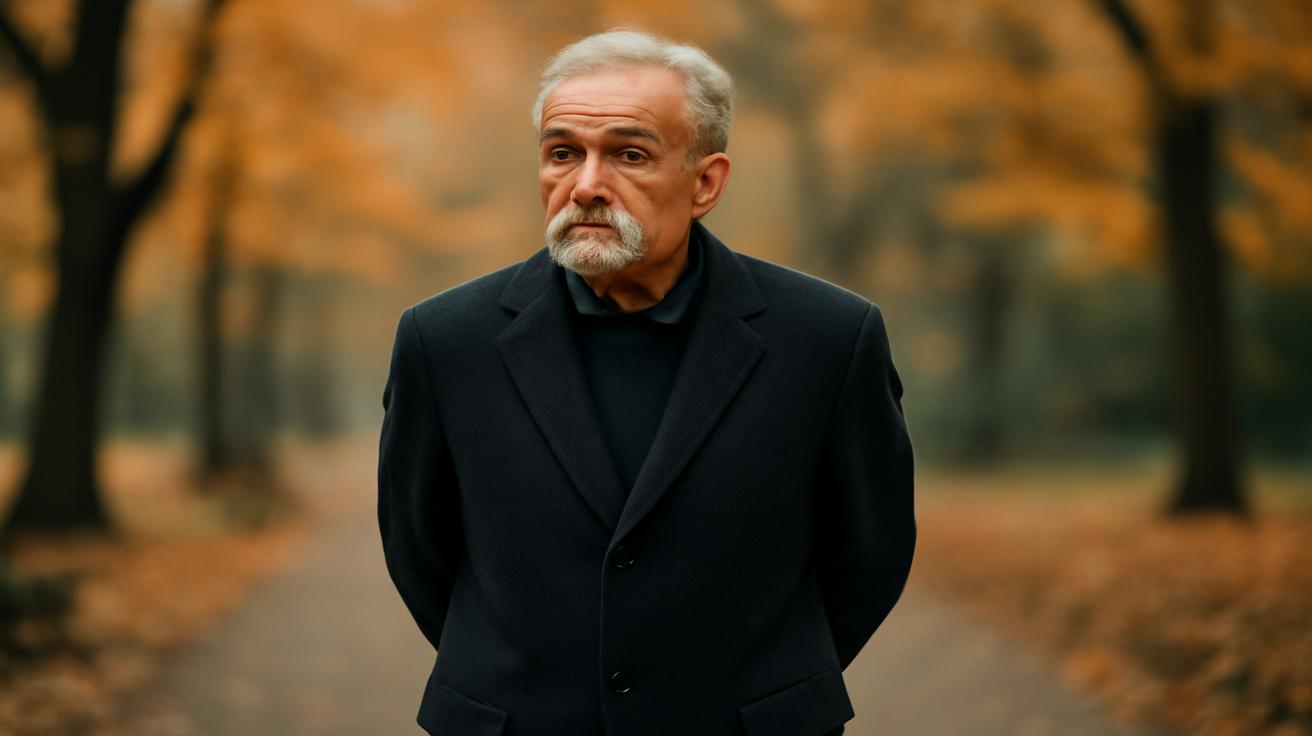
On a cool evening in early autumn, you notice a man on the river path moving against the wind. His pace is unhurried. He doesn’t swing his arms the way runners and power walkers do. Instead, his hands are folded neatly behind his back, fingers laced, elbows angled out like a quiet set of wings. He looks almost like he’s carrying something delicate there—though, of course, there’s nothing in his hands at all.
You’ve seen this posture before: in old professors wandering across campus lawns, in grandparents meandering around parks, in museum guards making their slow circuits around silent rooms. But out here, on a path meant for motion and speed, that backward fold of the hands stands out. It feels old-fashioned, almost ceremonial. Part of you wonders: Why do some people walk like that, and what does it say about them?
Psychologists have been asking similar questions for a long time. Walking with your hands behind your back seems like such a small, ordinary thing—a quirk of posture, a habit inherited from somewhere you can’t quite remember. Yet this simple gesture can be an open window into personality, mood, upbringing, culture, and even the way someone solves problems. It is body language in motion, a kind of moving punctuation mark at the end of each step.
To understand it, you have to begin where all walking begins: in the body’s constant, quiet negotiation between balance, comfort, and meaning.
The Posture of Quiet Calculation
Imagine yourself trying it right now. You slip your hands behind your back, maybe interlacing your fingers or cupping one hand in the other. Your chest opens slightly. Your shoulders roll back. Your strides become smaller, more deliberate. There’s a faint sense that you’ve stepped out of ordinary time, into a slower, more interior rhythm. You’re not rushing through space anymore—you’re moving with it.
Psychologists often read this posture as a sign of inward focus. When your hands are free and swinging, your body is primed for action: to grab, to gesture, to reach toward something. But when your hands are gently locked away behind you, that reaching impulse is on pause. You’re not trying to shape the outside world so much as you’re letting your thoughts roam on the inside.
In observational studies of everyday body language, walking with hands behind the back tends to show up in people engaged in what researchers call cognitive processing—problem-solving, reflecting, puzzling something out. It’s common in teachers pacing at the front of a classroom, doctors making their hospital rounds, or people in leadership roles listening more than they’re speaking. There’s a reason this posture appears so often in portrayals of detectives and philosophers: it has become a visual shorthand for contemplation.
Some psychologists suggest an even deeper layer: when you place your hands behind your back, you’re literally moving your tools—your manipulators—out of view. It’s a nonverbal way of saying, “I’m not here to interfere. I’m here to observe, to think.” The body becomes less about doing, more about knowing. And other people, watching you from a distance, can often feel that difference without quite being able to explain it.
A Subtle Signal of Confidence and Control
There is something paradoxical about exposing your chest and belly—two of the most vulnerable parts of the body—while tucking your hands away where they can’t react quickly. In the animal world, most creatures protect their softest areas in moments of uncertainty. Humans do this too, crossing arms over the torso, slouching forward, or folding into themselves in crowded or uncomfortable spaces.
Walking with hands behind the back does the opposite. It opens you up. It claims space without aggression. In psychology, this is often associated with a form of quiet confidence. Not the puffed-up swagger of someone trying to appear bigger, but the settled stance of someone who feels safe enough to relax their natural defenses.
Think of how often you see authority figures adopt this posture: headmasters crossing the school quad, senior officers inspecting a row of soldiers, curators strolling through an exhibit, seasoned managers walking the factory floor. This is no coincidence. The stance communicates that the person feels in control of their environment. Their hands don’t need to be ready for sudden action. The world, at least for the moment, is predictable enough that they can afford to walk unguarded.
Yet it’s not just about power or status. You might see the same posture in a child wandering through a garden, reading the shapes of leaves and petals, or in an elderly person taking in the slow theater of a city street. In each case, there’s a similar undercurrent: “I’m okay here. I can take my time.”
The Ritual of Restraint
There’s another, more complex psychological thread running through this posture—the idea of self-restraint. When you walk with your hands behind your back, you create a tiny barrier between yourself and the impulse to touch, grab, or gesture. It’s like putting a soft brake on your own reactivity.
This becomes especially clear in environments where people are expected not to touch: galleries, historic houses, high-end shops, laboratories. Many museum guards and docents walk with clasped hands behind their backs, partly for practicality, partly as a signal to visitors. Their posture echoes the signs on the walls: Look, but don’t touch. Yet it does so without a single word.
In social situations, the posture can play a similar role. People who know themselves to be fidgety or animated with their hands sometimes adopt it as a way of keeping their gestures in check. Someone who doesn’t want to appear confrontational might tuck their hands away to avoid pointing, poking, or waving. In this context, the posture becomes a quiet agreement with oneself: “I’ll stay calm. I’ll listen more than I speak.”
The feeling of restraint can also be soothing. Repetitive behavior research shows that small, self-imposed limits—like clasping the hands—can help some people feel more grounded in overstimulating situations. Instead of flailing into every sensation, the body creates a compact center, a personal anchor. When you see someone walking slowly with their hands behind their back at a party, a conference, or even a family gathering, they may be gently regulating their own energy, containing the urge to spread themselves too thin in the room.
Culture, Class, and the Posture We Inherit
Like many forms of body language, walking with your hands behind your back doesn’t exist in a vacuum. It carries cultural and historical echoes. In some European traditions, this walk is deeply associated with formal education. Think of professors in long coats crossing stone courtyards, or headmasters passing under arches, hands tucked away as if cradling invisible books. Over time, the posture became linked with thoughtfulness, bookishness, even mild eccentricity.
In certain parts of Asia and Europe, walking this way can signal respect and attentiveness. Children might be taught to listen to elders with their hands neatly folded behind the back or at their sides, as a way to show they are giving full attention rather than fidgeting. That physical habit can linger into adulthood, surfacing whenever a person wants to show politeness or deference.
Class also plays an interesting role. Historically, people whose work required the use of their hands—laborers, artisans, farmers—walked with them free, ready, practical. Those whose work was supervisory, scholarly, or administrative had more reason to adopt the behind-the-back stance. Their primary tool was thought, not touch. Though the lines between these social roles have blurred over the years, the symbols remain.
This doesn’t mean that walking with your hands behind your back makes you “upper-class” or “intellectual.” Instead, it means the posture carries certain associations that others might read into, often unconsciously. Someone seeing you stroll this way through a park might assume you are lost in thought, even if you’re only deciding what to have for dinner.
Comfort, Habit, and the Body’s Secret Preferences
Of course, not every psychological meaning is dramatic. Sometimes, the explanation is as simple as this: it feels good. The backward-folded hands adjust your posture. Your shoulders tilt back. Your chest opens. For people who spend long hours at desks or screens, hunched over, this position can feel like an unspoken stretch. A reset.
People who regularly walk with their hands behind their backs often describe it in very plain terms: “My shoulders hurt less,” “It makes my back feel straighter,” “I can breathe better this way.” Over time, that feeling of ease becomes habit. The body remembers what gives relief and quietly chooses it again and again, especially in slower, more reflective moments.
Habits of posture also tend to be inherited—not in the genetic sense, but socially. You might have grown up watching a parent or grandparent walk this way on quiet evenings. You might have copied a favorite teacher without meaning to. The body acts as a kind of mirror, learning postures the same way it learns accents: subtly, cumulatively, over years.
Psychologically, those learned postures can also become small identity markers. You don’t just walk with your hands behind your back because it’s comfortable; you walk that way because it feels like you. When you catch yourself in a window reflection, that familiar silhouette can be oddly reassuring—a reminder that no matter what else is changing, certain mannerisms remain.
Mood, Meaning, and Misinterpretation
If you ask around, you’ll find wildly different emotional interpretations of this same walk. One person might say it looks peaceful, another that it looks arrogant, another that it looks melancholy. This is where things get tricky. Psychology can map tendencies, but it can’t turn body language into a clean, universal dictionary. Context is everything.
Picture two scenes. In the first, someone wanders through a botanical garden, hands folded behind, pausing every few steps to study a bloom or a bee. Their gaze is soft, their face neutral or gently curious. In that setting, the posture likely reads as calm reflection.
In the second, someone paces in a confined office, hands pinned stiffly behind their back, body tense, jaw clenched. Same posture. Very different mood. Here, it might signal agitation, worry, or suppressed frustration. The hands are locked away not for comfort, but because the person is trying not to slam them on the desk.
Research on nonverbal communication repeatedly warns against assuming too much from a single gesture. A posture can be a clue, not a verdict. To understand what walking with hands behind your back might mean in any given moment, you need to read the whole scene: facial expression, pace, setting, relationship dynamics, and the person’s own baseline behavior.
Yet even with all that nuance, the posture keeps inviting interpretation. That’s part of its power. Because it looks a little old-world, a little cinematic, it almost begs to be read as meaningful—even when, in someone’s inner world, it’s just what their shoulders happen to choose that day.
What This Posture Might Be Saying About You
If you’re someone who often walks with your hands behind your back, you might be curious what psychology would tentatively suggest about you. While no gesture can define a person, patterns can hint at common themes. Here is a simplified overview of some tendencies researchers and observers often connect to this way of walking.
| Possible Psychological Signal | What It May Suggest |
|---|---|
| Inward focus | You tend to think while you move, using walking time for reflection or problem‑solving. |
| Quiet confidence | You generally feel safe in your surroundings and don’t feel the need to appear defensive. |
| Self‑restraint | You may prefer to listen and observe, keeping impulses and gestures gently in check. |
| Cultural learning | You might be echoing how elders, teachers, or authority figures around you used to walk. |
| Comfort and habit | It simply feels good for your back, shoulders, or breathing—and has become your default stride. |
None of these explanations are mutually exclusive. You might walk with your hands behind your back because it’s comfortable and because you like the thoughtful feeling it creates. Or you might notice you adopt it only in certain spaces—an art museum, a library, a familiar neighborhood—as if flipping a silent mental switch: Now I’m in my observing mode.
If you rarely walk this way but sometimes find yourself doing it during particularly deep or emotional thinking, that’s worth noticing too. Body language often surfaces a feeling before words do. The moment your hands drift back behind you, you may already be entering a slower, more reflective inner space, even before you consciously recognize it.
Listening to the Walk
Next time you’re out on a trail, in a park, or just walking a long hallway between meetings, you might experiment. Let your arms swing freely and notice how action-oriented you feel—ready to reach, to gesture, to speed up. Then fold your hands behind your back and slow your steps by just a fraction. Does your mind change gears? Do your thoughts turn inward, or do your eyes roam more carefully over your surroundings?
Body language isn’t just something others display for you to decode. It’s also a quiet feedback loop between your muscles and your mind. When you alter your posture, you alter the conversation between the two. Walking with your hands behind your back is one subtle way to invite patience into that conversation. You might find that problems feel less jagged, decisions less urgent, when your strides are contained and your hands are resting out of sight.
At the same time, watching others can be its own gentle education. The old woman tracing the same route around the pond each morning, hands clasped loosely behind her, might not be merely “killing time.” She might be revisiting memories, balancing anxieties, or savoring the daily ritual of being unhurried in a hurried world. The teacher pacing the classroom like that might be ordering their thoughts before answering a difficult question. The friend who shifts into that posture at a party might be grounding themselves, quietly pulling their energy back from the room for a moment.
In a culture obsessed with speed and productivity, walking with your hands behind your back can look almost rebellious—a deliberate refusal to pump your arms and power ahead. But on another level, it is simply adaptable human psychology, expressed through tendons and bone. It says: I’m here, but I’m not rushing. I’m moving, but I’m also thinking.
So the next time you notice that familiar shape—a figure on a path, a silhouette against evening light, hands folded in the small of their back—see if you can let go of quick judgments. Instead, imagine the many possible stories being carried there: confidence, restraint, habit, culture, comfort, curiosity. Our hands say a lot, even when they’re tucked quietly out of sight.
FAQ: Walking With Your Hands Behind Your Back
Does walking with your hands behind your back always mean someone is confident?
No. While the posture is often associated with quiet confidence, it can also show up in people who are anxious, deep in thought, or simply comfortable in that position. To understand the emotion behind it, you need to consider facial expression, pace, environment, and the person’s usual behavior.
Is this posture considered rude in any cultures?
In many cultures, it’s neutral or even respectful, especially in formal or contemplative settings. However, in some contexts, it might be read as aloof or overly formal. Its meaning depends heavily on local norms and on the relationship between the people present.
Can walking like this affect my mood?
Yes, posture and mood influence each other. Walking with your hands behind your back can encourage a slower pace and a more reflective state of mind. Some people find it calming or grounding, while others feel constrained. The effect is personal—notice how you feel while trying it.
Why do older people seem to walk like this more often?
Several factors may play a role: it can relieve shoulder or back tension, it may be a habit from earlier cultural norms, and it often fits with a slower, more contemplative pace of life. With age, people also tend to favor postures that feel physically supportive and familiar.
Is there anything unhealthy about walking with my hands behind my back?
For most people, it’s harmless, especially at a relaxed pace. If you have shoulder, back, or balance issues, you might want to notice whether this posture causes strain or instability. As always, if you experience pain or discomfort, it’s worth consulting a medical or physical therapy professional.
Can I use this posture deliberately to seem more thoughtful or calm?
You can, and many people do in subtle ways. Just remember that authenticity matters: forcing a posture that doesn’t fit your natural way of moving can feel awkward and may be noticed. It’s usually better to let your body language grow out of genuine attention, patience, and calm breathing.
Why do I start walking like this only when I’m thinking hard?
Your body may have learned to pair that posture with focused thinking, almost like a physical “thinking cap.” By lightly restraining your hands and slowing your stride, you free up more mental bandwidth for internal processing. Over time, this can become an automatic habit your body returns to whenever your mind dives deeper.








Leave a Comment