
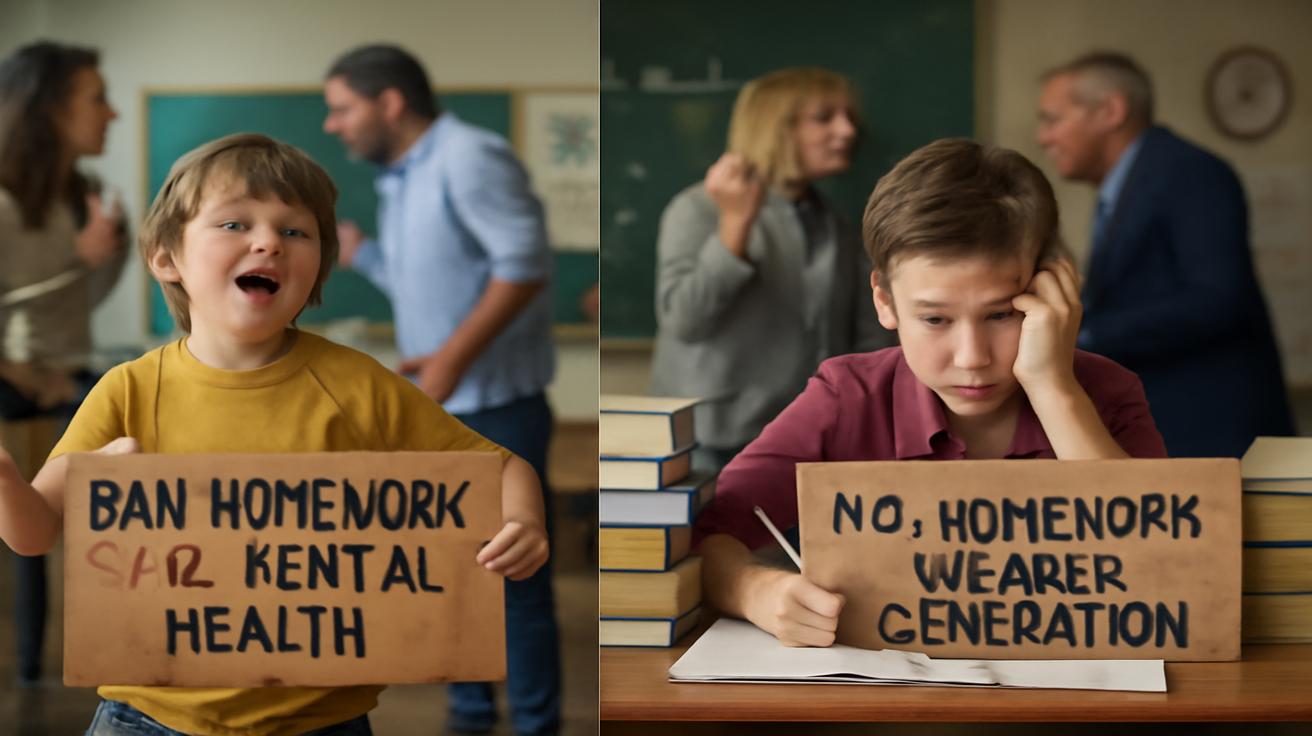
The boy in the red sweatshirt sits at the kitchen table, a pencil hovering over the blank worksheet like a wary bird skimming a frozen lake. Outside, the late afternoon light spills gold across the street, where other kids are pedaling bikes and chasing a half-deflated soccer ball. Inside, the clock hums. His mother watches from the sink, hands buried in suds, feeling the tug-of-war in her chest. The math problems are simple enough, but the boy’s shoulders are already high and hard with tension, eyes shiny with that now-familiar glaze of exhaustion. One more page, she thinks. One more page and he’ll sleep badly again.
Across town, another kitchen, another child. This one has no homework tonight. The school banned it, citing “student well-being” and “reduced cognitive overload.” His backpack hangs light on the chair. He wolfs down dinner, then disappears into his room. The door clicks shut. A blue glow seeps under the frame. Hours pass. His fingers flicker over a controller; the world outside the screen grows softer at the edges. No battles with algebra. No forced reading. No looming essay. No particular reason to push against anything at all.
Between those two kitchens, a quiet war is building—the war over kindness. Are we protecting our children from a crushing system, or cushioning them so thoroughly that their muscles for effort, discipline, and resilience quietly atrophy? And if a generation grows up weaker, less able to tolerate discomfort, less practiced at sustained focus—who carries that cost?
The seductive kindness of “no homework”
The movement is easy to like at first glance. “No homework” slips off the tongue like a vacation plan, like a deep breath. In staff rooms and parent forums, in school board meetings and on social media, the rhetoric gathers speed. Homework is outdated. Homework is oppressive. Homework steals childhood. Homework harms mental health.
And the research, at least the pieces that go viral, can seem to agree. Studies show that beyond a certain threshold, additional homework brings diminishing academic returns while anxiety and sleep deprivation rise. Parents describe children sobbing over kitchen tables, their evenings shrinking to a narrow corridor of tasks and tantrums. Teachers confess that they assign work they don’t have time to review thoroughly. It’s not hard to feel that something has gone badly wrong.
So the kindness solution arrives: strip it away. Let the kids breathe. Let them play. Let home be home again, not an extension of the classroom. It feels humane, progressive, enlightened.
But beneath that soft promise, a harder set of questions waits. When we remove homework in the name of mental health, what exactly are we removing? The busywork—and there is plenty of that—or the daily, unglamorous practice of stretching one’s mind beyond comfort? Are we eliminating a source of toxic stress, or quietly erasing a training ground for grit?
The problem with kindness that stops at “easy”
Modern childhood is already quieter than we remember. Fewer scraped knees from climbing too high, fewer unguided adventures in creeks and alleys, fewer unsupervised conflicts on playgrounds that used to sting, then strengthen. We’ve padded the world for our children—their schedules, their playgrounds, their online spaces—out of genuine love and genuine fear.
Removing homework can feel like the next logical cushion. But kindness that only protects from difficulty can become a strange kind of cruelty in slow motion. Growth, in nature and in people, usually happens at the edge of discomfort. Trees bend under wind and grow denser wood. Muscles tear and repair themselves stronger. Brains wire and rewire in response to challenge.
Homework, when it’s well designed and carefully dosed, sits exactly at that edge. It is the moment a child encounters something they almost understand but not quite—the extra problem, the unfamiliar word, the paragraph that doesn’t come together on the first try. It’s the small, daily rehearsal of a lifelong skill: “I don’t get this… yet.”
Ban it entirely, and you don’t simply remove stress; you may also remove an important chance to practice tolerating frustration, to wrestle with boredom, to build the muscles of self-directed work. You are left with school as the only training ground for effort, packed into hours already heavy with stimulus, distraction, and social noise. Once the bell rings, there is no structured moment in the day when a child must choose, on their own turf, to keep going when the work feels dull, irrelevant, or hard.
When protection becomes permission
There is another layer to the war over kindness: the invisible permission it grants. Tell a child “no more homework, for your mental health,” and the message can bend, subtly, into something else: anything that feels stressful is unsafe and should be removed. Discomfort becomes not a signal to listen to, but a red flag to flee.
At first, that sounds like self-care. But stretch it into adulthood and you can see the outline of a cultural shift already underway—toward lives curated to avoid friction. The job that’s challenging? Toxic. The relationship that demands growth? Harmful. The task that requires sustained focus without immediate reward? Pointless.
It’s not that children should endure misery to learn perseverance. Chronic overload, especially in young brains, is genuinely damaging. But a world where every hard thing is automatically labeled harmful is just as dangerous, because it trains children to assume that inner strain always signals an enemy, never an invitation to grow.
In that light, homework bans marketed as mental health interventions risk blurring the most crucial distinction children need to learn: the difference between harmful pressure and healthy challenge.
Who pays when kids never practice pushing through?
Imagine a generation that has rarely had to push itself when nobody is watching. No persistent practice after school music lessons fade. No nightly reading that creeps slowly toward fluency. No math problems that don’t yield in the first few minutes. No friction beyond what happens in the classroom, where the teacher is always the conductor, where peers are both audience and distraction.
Who will pay for that?
First, the children themselves. Today’s easy evenings become tomorrow’s fragile confidence. The first demanding college course, the first job with deadlines, the first long project without immediate applause—they crash harder against people whose past is filled with early exits whenever something felt “too much.” Without proof from their own history that they can stay with discomfort and come out the other side, anxiety swells to fill the unknown.
Then, the parents. A generation of young adults who struggle to self-motivate without external scaffolding is a generation more likely to boomerang back home, to stall between aspirations and action, to need financial and emotional backup far longer than their parents planned.
Eventually, the cost spills outward—to employers who must design work environments around shrinking attention spans, to health systems absorbing the impact of chronic underachievement and its emotional toll, to communities grappling with a quieter form of inequality: the gap between those who were gently protected from effort and those who were trained to coexist with it.
The quiet inequity of homework bans
The irony is sharp. Homework bans are often framed as equity measures, intended to level the playing field for children who lack quiet, safe, or well-resourced homes in which to work. In reality, they may widen the very divides they aim to close.
When schools remove homework, they remove it for everyone. But what replaces that time is wildly different from household to household. One child spends the evening in a rich landscape of conversation, books, nature walks, community activities, and hobbies that require focus and persistence. Another spends it in cramped rooms filled with stress and screens, where the easiest path is also the one that demands the least mental effort.
Homework, even imperfectly, once served as a partial counterweight—a structured obligation that at least nudged every child, regardless of background, toward some practice of reading, writing, or problem-solving outside of school hours. Take it away with no meaningful substitute, and you hand the advantage to families who can and will fill the void with other forms of cognitive and emotional training.
There is a subtler inequity too: the inequality of expectations. Children are exquisitely sensitive to what adults believe they are capable of. When we say, “We don’t assign homework because it’s too stressful for kids,” some hear, “You are too fragile for this.” Others hear, “We don’t expect you to handle ongoing responsibilities without an adult hovering nearby.” Expectations, repeated over years, can harden into self-image.
Making homework kinder without making kids softer
The choice is not cruelty or cushion. It’s possible—essential—to thread a third path: homework that nurtures mental health because it strengthens capacity, not because it disappears.
That means reimagining homework, not simply counting minutes. Short, focused tasks that reinforce key skills rather than sprawling projects that spill into family life. Reading that invites curiosity instead of rote page counts. Occasional, open-ended assignments that connect learning to the real world: measure the height of a tree using its shadow; interview a grandparent about their childhood; map the insects in your backyard.
It also means acknowledging that the problem is rarely homework alone. Childhood mental health is strained by a whole ecosystem: overscheduled activities, family stress, economic insecurity, social media pressures, sleep deprivation. Homework becomes the visible villain because it is tangible and school-controlled. But remove it without tending to the rest, and you’ve only pulled one stone from a much larger wall.
Done well, homework can be a small, daily chance to practice time management, to negotiate priorities with parents, to experience the satisfaction of completing a task that no one can do in their place. This is not about maximizing test scores; it is about flexing the muscle of “I can do hard things—even when I’d rather not.”
What the numbers can’t fully tell us
Educators, policymakers, and parents often lean heavily on data in this debate, hoping for a clean answer. Does homework improve grades? Test scores? Graduation rates? Does it correlate with anxiety levels, sleep hours, or reported well-being?
The findings are mixed, nuanced, and fiercely contested. That’s partly because “homework” is not a single, standardized intervention; it’s a wild variety of tasks, contexts, and expectations that defy easy measurement. Ten minutes of joyful reading and two hours of punitive busywork both count as homework in studies, yet they imprint on children’s minds in radically different ways.
Still, we keep trying to quantify what is partly qualitative: the formation of character over time. The numbers can say, “Beyond this many minutes, benefits decline.” They can hint that certain kinds of tasks support learning better than others. But they struggle to capture the long, quiet apprenticeship that happens when a child sits alone with a problem they cannot yet solve, chooses not to give up, and succeeds on the second, or fifth, or tenth try.
| Approach | Short-Term Effect on Stress | Long-Term Effect on Resilience |
|---|---|---|
| Heavy, daily homework load | High stress, fatigue, potential burnout | Can build grit for some; can erode well-being for many |
| Complete homework ban | Lower immediate stress after school | Fewer chances to practice sustained effort and self-discipline |
| Light, purposeful homework | Moderate, manageable challenge | Steady training in focus, problem-solving, and follow-through |
Numbers also don’t answer the question that hovers behind this entire debate: what kind of adults do we want to raise? Not simply how high they score, but how they move through the friction of real life—late buses, difficult colleagues, complex projects, heartbreak, uncertainty.
The nature lesson we keep ignoring
Step outside the classroom for a moment and into a forest after a storm. Branches lie cracked and scattered. Some trees snapped clean through; others only lost leaves. Look closely and you’ll see a pattern. The trees that grew shielded from wind, tucked behind buildings or other trees, often suffer the worst damage when a real storm finally comes. Their trunks are tall but brittle, their roots shallow in soft soil. The ones that have swayed and creaked through many gusts bear scars—but they stand.
We like to imagine we can raise children like greenhouse plants: controlled temperature, filtered light, the right nutrients, and no rough weather. Homework, in that metaphor, looks like hail. Why let it pelt them, we ask, when we could protect them?
But children are not houseplants. They are more like those trees. They need wind—not hurricanes, but steady, varied gusts that teach their fibers to flex and hold. Properly designed homework is one of those winds: a manageable stressor, a small storm in a safe environment. Remove all such winds, and you don’t get a calmer forest. You get taller, weaker trunks waiting for the first real storm to break them.
Redrawing the line between harm and hardship
So where is the line? How do we distinguish between homework that harms and homework that simply hurts a little in the way growth often does?
Children’s mental health must matter first. No assignment is worth panic attacks, chronic sleep deprivation, or the slow erosion of joy in learning. If homework regularly ends in meltdowns and midnight tears, the system—not the child—is failing.
But children’s future strength must matter too. If we reflexively label every complaint as a crisis and every sigh as a sign of damage, we risk raising kids who are exquisitely attuned to their own discomfort and poorly equipped to move through it.
The line, then, is not drawn in minutes but in meaning and design. Homework should be:
- Reasonable in length and difficulty, with clear purpose.
- Flexible enough to honor different home realities.
- Predictable, so families can plan evenings without constant chaos.
- Supported by teachers who listen when the load is too heavy.
- Seen as practice, not punishment.
We can protect children’s mental health not by banning all homework, but by refusing bad homework—mindless repetition, last-minute projects, assignments that assume every home is quiet and well-supplied. We can also teach children the language to describe their experience: this is stressful in a way that helps me grow; this is stressful in a way that is crushing me.
The real question: what do we believe kids are capable of?
In the end, the war over kindness is a war over belief. Do we believe children are fundamentally fragile, likely to crack under even modest pressure? Or do we believe they are fundamentally capable, needing guidance and guardrails—but also chances to discover their own strength?
It is possible to look at a tired, overworked child and think, “You need less.” It is also possible to look at a drifting, unchallenged child and think, “You need more.” Both can be acts of love, depending on the child and the context. The danger is in letting one story—overload—drown out the other—under-challenge.
Perhaps the better kindness is not to strip away every burden, but to walk alongside children as they carry age-appropriate ones. To say: yes, this is hard; yes, you are capable; yes, you can rest; and yes, you will try again tomorrow. To replace the blunt instrument of “ban it all” with the careful craft of “shape it better.”
The boy in the red sweatshirt at the kitchen table doesn’t need another hour of worksheets. He might, though, need fifteen focused minutes of work that matters, followed by a parent who notices when his shoulders soften, who names the effort, not the grade. The boy in the other kitchen, behind the blue glow of his closed door, doesn’t need a flood of assignments overnight. He might, though, need a gentle but firm expectation that some part of his evening will ask more of him than his thumbs.
If we choose the easy kindness of banning homework entirely, we will feel the relief quickly—lighter backpacks, calmer evenings, fewer tears. The bill will come later, in subtler currency: a generation less practiced at facing hard things that don’t come with instant rewards. When it does, it will be paid not only by the children we tried to protect, but by everyone who counts on them.
The storm is coming either way. The question is not whether we shelter our children from every gust, but whether we help them grow roots deep and strong enough to sway, break a little, mend, and stand taller the next time the wind rises.
Frequently Asked Questions
Does homework actually improve academic performance?
Homework can improve academic performance when it is purposeful, limited in scope, and aligned with what is taught in class. Excessive or poorly designed homework, however, often adds stress without meaningful learning gains.
Is banning homework a good way to protect children’s mental health?
Banning homework may reduce short-term stress for some students, but it can also remove important opportunities to practice focus, responsibility, and resilience. A more balanced approach is to redesign homework, not eliminate it.
How much homework is reasonable for children?
Research often supports a “10-minute rule” per grade level (about 10 minutes per day in first grade, 20 in second, and so on), with adjustments based on individual needs. Quality is more important than quantity.
What should parents do if homework is clearly overwhelming their child?
Parents should communicate with teachers, share specific examples of struggle, and collaborate on adjustments. It’s helpful to differentiate between normal frustration that comes with learning and ongoing distress that signals overload.
Can life experiences outside school replace homework?
Rich home experiences—reading, creative projects, outdoor exploration, meaningful conversations—can complement or even outperform traditional homework in some ways. However, without any structured academic practice, some children may miss chances to strengthen key skills and habits needed for future learning.







Leave a Comment