
The first thing you notice is the silence. Not the pastoral silence of a forest clearing or a snowy field, but a strange urban hush—like a movie where someone’s turned the volume down on traffic. An electric car glides through a downtown intersection, its tires whispering over rain-dark asphalt. On one side of the street, a cyclist nods approvingly. On the other, a man in a diesel pickup mutters something under his breath as the EV slips past. Same road, same destination, same shared planet—two entirely different stories about what that silent car means.
When a Car Stopped Being Just a Car
Once upon a time, a vehicle was a pretty simple thing to explain. It was what got you from your driveway to your job, from the grocery store to your kids’ soccer field, from first dates to final goodbyes. Maybe it was a status symbol. Maybe it was a trusty workhorse. But it was, fundamentally, a tool.
Then came the electric revolution—or what was supposed to be one.
Politicians stood at podiums beside shiny prototypes, promising cleaner air and “green jobs.” Tech CEOs described a future where your car would be smarter than your first laptop. Environmental groups warned that every gasoline trip was a small cut against the climate. And across the country, in suburbs and rural towns and sunburned highway stops, a new suspicion took root: Was this really about saving the planet, or about telling people how they’re allowed to live?
This is how the EV—electric vehicle—slipped out of the dealership lot and rolled right into the center of the culture wars. No longer just transport, it became a litmus test. Are you an eco-savior or a freedom fighter? Enlightened or stubborn? Responsible citizen or “real American”? The answers depend less on miles per kilowatt and more on the stories we’ve been told—and chosen to believe—about ourselves.
The Eco-Saviors: Salvation at 60 Miles an Hour
To stand at a public charging station in a coastal city is to step into a kind of secular chapel. There’s the soft electronic chime as the cable locks in place, the muted hum as electrons start rushing from grid to battery. The owners mill around with reusable coffee cups and phone apps glowing with kilowatt metrics. For many of them, the EV isn’t just a sensible purchase; it’s a moral upgrade.
Ask an electric-car enthusiast why they made the switch, and you’ll hear a familiar litany: climate change, air quality, oil dependence, technological progress. They talk about wildfires that turned the sky orange, heat waves that buckled roads, asthma rates near highways, and the unsettling knowledge that the fuel in your tank has probably seen more of the world than you have—pumped from desert sands, shipped across oceans, refined in guarded complexes.
There’s also, undeniably, some joy. The instant torque that snaps you back into your seat. The futuristic dashboards. The quiet. For many drivers, their EV feels like the first car that truly belongs to this century rather than the last one.
In this story, the electric car is a hero machine. Every commute is a tiny act of resistance against a warming world. Every home charger is a vote of confidence in a cleaner future. Maybe it cost a bit more up front, maybe they had to learn a new vocabulary of range and kilowatts and Level 3 charging, but it feels like the right side of history—and who doesn’t want to be there?
The Shadow in the Battery
But even among believers, the halo flickers when you talk about what’s inside the battery—the cobalt and lithium and nickel scraped from the earth, often under brutal conditions and heavy environmental toll. The eco-savior narrative runs into uncomfortable questions: Can you save the planet with machines that require intensive mining, long supply chains, fossil-fueled electricity grids?
Many EV advocates answer with a pragmatic shrug: nothing is pure, but this is better than the alternative. And they have data to back them up. Over the lifetime of a typical electric car, even factoring in manufacturing and grid emissions, most studies show lower overall climate impact than a gasoline equivalent. The numbers matter. But the feelings do, too.
The EV, once marketed as a clean break from the old world, turns out to be more like a messy compromise. It is cleaner, but not clean. It is progress, but not utopia. Still, for those who see the climate clock ticking loudly in the background, a compromise that cuts emissions is vastly better than standing still.
The Freedom Fighters: Don’t Tread on My Tailpipe
Drive a few hundred miles inland, away from the coastal tech hubs and dense urban corridors, and the mood around EVs changes. On a gravel driveway outside a small town, a pickup’s exhaust roars to life. The owner hooks a trailer to the hitch, muscles a load of equipment into place, and laughs at the idea that a battery-powered “computer on wheels” could do this work through a blizzard, a blackout, and a week without reliable cell service.
For this world, the car—or more often, the truck—is more than transport. It’s independence, capacity, and identity. The noise is part of the pleasure. The smell of fuel on cold air, the rumble that echoes off the barn walls, the sense that if the power lines go down, your engine will still turn over as long as there’s gas in the can.
In that worldview, EVs don’t look like salvation. They look like a leash.
Range anxiety isn’t a theoretical spreadsheet problem when the nearest charger is one broken machine at a rest stop eighty miles away. Dependence on the power grid doesn’t feel futuristic when the grid fails after every ice storm. And when politicians start talking not just about encouraging EVs but phasing out gas cars altogether, the conversation shifts from technology to control.
This is how electric cars became, for many, a symbol of something unwelcome: urban values imposed on rural realities, tech elites dictating lifestyles to people whose daily lives involve towing, hauling, long distances, and dirt roads. The EV becomes a proxy for a broader resentment: They don’t understand us, but they still want to tell us what to drive.
More Than Metal and Wires
In this telling, a loud engine is not wasteful; it’s honest. It wears its power out in the open instead of hiding it behind silent motors and invisible currents. The gasoline station isn’t a relic; it’s a trusted ritual. And the fear isn’t just that EVs won’t work—it’s that owning one will feel like surrendering to a culture that looks down on trucks, rural life, and anyone who doesn’t live within walking distance of a high-end coffee shop.
So the EV becomes, unfairly but powerfully, a stand-in for “them.” For “the coast.” For “the government.” And if they love these cars, some people feel, then maybe rejecting them is how you hold the line.
The Middle Class in the Tug-of-War
Somewhere between these two camps lives a quieter majority: the families doing math at the kitchen table. They hear the climate warnings. They also hear the rumble of layoffs, the spike of rent, the constant drip of “service engine soon” lights and repair bills.
They walk through a dealership, fingers trailing over the smooth curve of an EV fender, eyes catching on the price tag. Incentives help, but batteries are still expensive, and interest rates don’t care how green your intentions are. Maybe they can afford it; maybe they can’t. Maybe the charging station near the grocery store is enough; maybe it’s not. They’re not trying to make a statement. They’re trying not to go broke.
For this middle class, the “war on wheels” feels less like a noble cause and more like another stressor. They’ve watched gasoline prices spike with geopolitical tremors. They’ve listened to ads promise that their next car will save them money on fuel, then seen electricity rates rise. They’ve heard politicians argue heatedly about mandates and subsidies while their old sedan coughs its way toward another inspection.
In the crossfire of rhetoric, the actual question they’re asking is simple: What can we realistically drive in the next ten years that won’t wreck the climate, our budget, or our daily routine?
When Politics Gets in the Driver’s Seat
Turn on a news channel, scroll through social media, and you’ll see a familiar pattern: electric cars as heroes on one network, villains on another. One side frames them as essential tools of planetary rescue; the other as tools of government overreach. Somewhere beneath those talking points lies reality: complicated, boring, stubbornly resistant to slogans.
In practice, many middle-class drivers are making mixed choices. A plug-in hybrid here. A used electric hatchback there. A family that keeps one gasoline car for road trips and buys an EV for city commutes. They’re not joining a side; they’re hedging their bets.
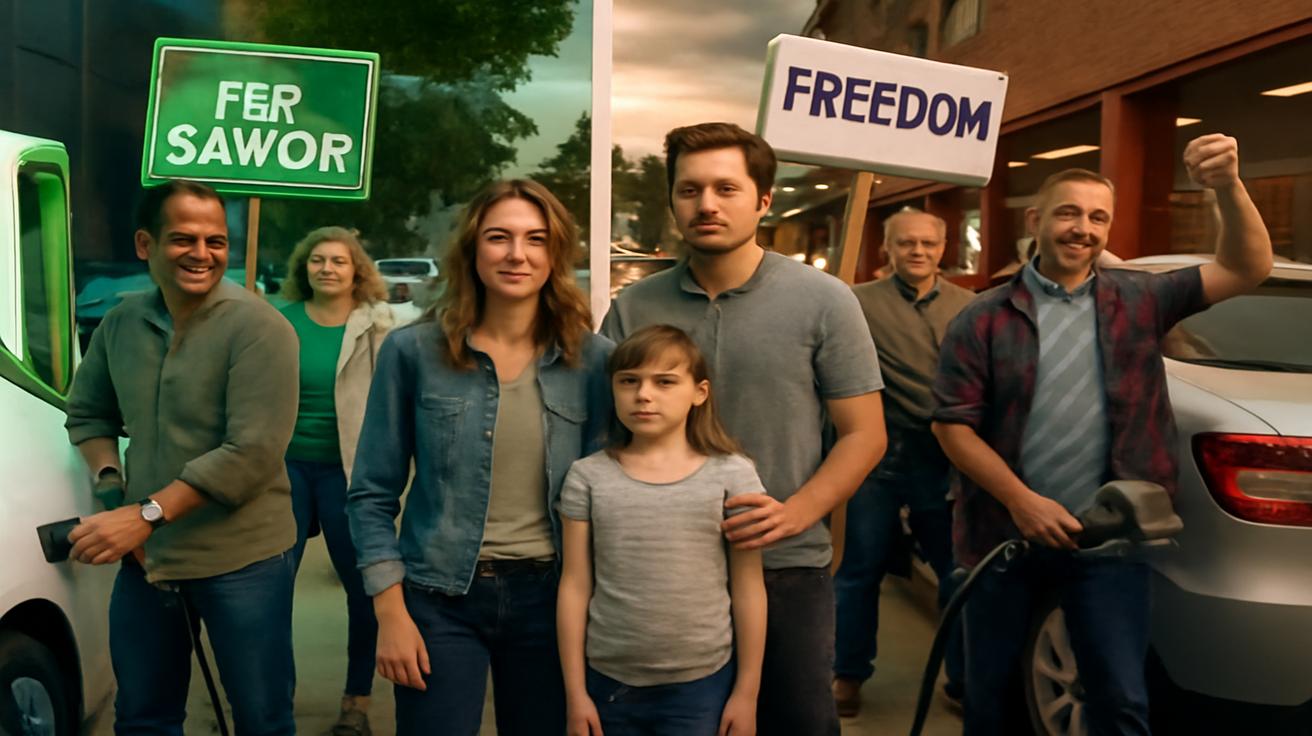
But politics has a way of turning everyday decisions into tribal markers. Yard signs and bumper stickers start doing the talking. “I support the environment” and “I support freedom” get coded, implicitly, as opposite things—as if breathing clean air and choosing your own lifestyle were mutually exclusive goals. The person just trying to figure out how to afford a reliable car gets pushed to the edges of someone else’s ideological fight.
The Planet, Watching From the Back Seat
Hover high above the highways and cul-de-sacs, and the arguments look absurdly small compared to the scale of the problem. From that vantage point, you can see the brown haze over cities, the shrinking snowpacks, the burning forests. You can also see the parking lots packed with vehicles, millions upon millions of them, each designed to burn something or pull something from a power plant every time a human needs groceries.
The planet doesn’t care whether you are driving an EV because you love the climate or because you love the tax credit. It doesn’t care if you resent being told what to buy or if you proudly Instagram your carbon footprint reductions. It responds only to physics: greenhouse gases in, heat trapped, weather changed.
Electric cars are not a silver bullet. Even a world where every car is battery-powered would still be grappling with sprawl, resource extraction, and an aging grid. But EVs are one of the few climate solutions that ordinary citizens physically touch, every day. That tangibility makes them powerful—and politically explosive.
| Aspect | Typical Gas Car | Typical Electric Car |
|---|---|---|
| Upfront Cost | Lower purchase price, fewer incentives | Higher purchase price, potential incentives |
| Fuel/Energy Cost | Variable, tied to oil prices | Generally lower per mile, tied to electricity rates |
| Maintenance | More moving parts, more routine service | Fewer moving parts, less routine service |
| Refueling/Charging | Fast, widely available stations | Slower, infrastructure still growing |
| Climate Impact (Lifetime) | Higher emissions overall | Lower emissions in most regions |
Numbers like these can clarify trade-offs, but they don’t erase the politics swirling around them. The same data set can be wielded as proof that EVs are the only rational choice or that they’re still too flawed to be forced on anyone. Meanwhile, the atmosphere quietly totals the sum of all exhaust pipes and smokestacks, unmoved by talking points.
Gridlock on the Road to Solutions
The cruel irony is that the louder the culture war gets, the harder it becomes to solve actual, practical problems. Rural charging deserts don’t shrink because of a viral tweet. Battery recycling programs don’t blossom because a politician scored a point on television. Grid upgrades, new transit options, better urban planning—these are unglamorous, slow, and require the kind of long-term cooperation that culture wars are designed to destroy.
So we stay stuck. EV fans insist that resistance is just ignorance or bad faith. EV skeptics insist that support is just virtue signaling or elitism. And in that stalemate, the planet keeps warming, the middle class keeps juggling costs, and the automotive companies keep trying to guess which way the wind—political and literal—is going to blow.
Vehicles or Values? Maybe Both
If you stand at a busy intersection and watch the traffic roll by, you will see the future and the past sharing the same lane. A battered sedan with a cracked bumper idles behind a gleaming electric crossover. A delivery truck exhales diesel fumes next to a city bus that hums quietly on a battery pack. A lifted pickup with a flag in its bed pulls up alongside a compact EV with a climate sticker on its rear window.
Each of those vehicles carries more than passengers; it carries assumptions about what matters. Reliability. Status. Cost. Ecology. Freedom. Belonging. And underneath all of that is a more fundamental question: Who gets to define progress?
Is progress the elimination of tailpipes, no matter the growing pains? Or is it the protection of personal choice, no matter the emissions? Can it be both?
When you talk to people outside the heat of the comment sections, the answers start to sound less like war cries and more like negotiation. A rancher who says he’d happily buy an electric truck if it could truly work his land and charge reliably. A city dweller who loves her EV but still worries about where its battery materials came from. A suburban dad who can’t afford anything new but would love better transit so his kids don’t have to drive at all.
Telling a New Story About the Road Ahead
The culture war over EVs is, in many ways, a story war. It pits one narrative—“good, modern, responsible people drive electric”—against another—“proud, independent, practical people stick with gas.” Neither story is complete. Both contain slivers of truth and big blind spots.
Maybe the way out is to tell a different kind of story—one that admits that a car can be both a climate tool and a personal lifeline, that acknowledges legitimate worries about cost and infrastructure without dismissing the urgency of the warming world, that refuses to turn engines and batteries into moral litmus tests.
In that story, we don’t measure virtue by vehicle type. We measure success by how quickly we reduce emissions while protecting people’s dignity and options. We talk honestly about the limitations of EVs in certain places and for certain jobs—and then invest in fixing those limitations rather than pretending they don’t exist or using them as an excuse to do nothing.
We might still argue, of course. Humans do. But the argument could shift from “Are EVs good or evil?” to “How do we make cleaner transport work for as many people as possible, as fast as possible?” That’s a fight worth having. It’s also a fight that leaves room for nuance, adaptation, and the kind of messy, practical compromise that real progress usually requires.
FAQs
Are electric cars actually better for the environment than gas cars?
Over their full lifetime, most electric cars produce fewer greenhouse gas emissions than comparable gasoline vehicles, even when electricity comes partly from fossil fuels. Manufacturing an EV, especially the battery, is more carbon-intensive upfront, but lower emissions during driving usually outweigh that within a few years of typical use.
Why do some people see EVs as a threat to personal freedom?
Many people associate their vehicle with independence and self-reliance. When governments talk about banning new gasoline cars or setting strict mandates, it can feel like a top-down attempt to control personal choices, especially in areas where EVs are still impractical due to cost, range, or lack of charging infrastructure.
Are electric cars only for wealthy people?
Early EVs were mostly premium products, and many models are still expensive. However, prices are gradually coming down, used EV markets are growing, and some governments offer incentives. Even so, for many middle-class and working-class households, cost and access to home charging remain real barriers.
What about the environmental impact of mining for EV batteries?
Battery materials such as lithium, cobalt, and nickel are often mined in ways that can harm local ecosystems and communities. This is a serious issue. At the same time, research into alternative chemistries, better mining standards, and recycling can reduce these impacts over time. The challenge is to improve supply chains while still moving away from fossil fuels.
Will everyone be forced to drive an electric car?
Some regions have proposed or passed laws phasing out sales of new gasoline cars on specific timelines, but that doesn’t mean existing gas cars will suddenly be banned. The reality will likely be a long transition with a mix of EVs, hybrids, and traditional vehicles, shaped by technology, policy, and consumer demand.
What’s the biggest barrier to wider EV adoption right now?
It depends on where you live. For many, the main hurdles are upfront cost and access to convenient charging, especially for people without garages or driveways. In rural areas, concerns about range, towing capacity, and grid reliability are also significant. Addressing these issues requires investments in infrastructure and technology, not just better marketing.
Can we solve climate change with EVs alone?
No. Electric cars are one important piece of the puzzle, but not the whole picture. Reducing emissions also means cleaner electricity, better public transit, walkable communities, more efficient freight systems, and changes in how we build and heat our homes. Focusing only on what’s in our driveways won’t be enough—but ignoring it won’t work either.








Leave a Comment