
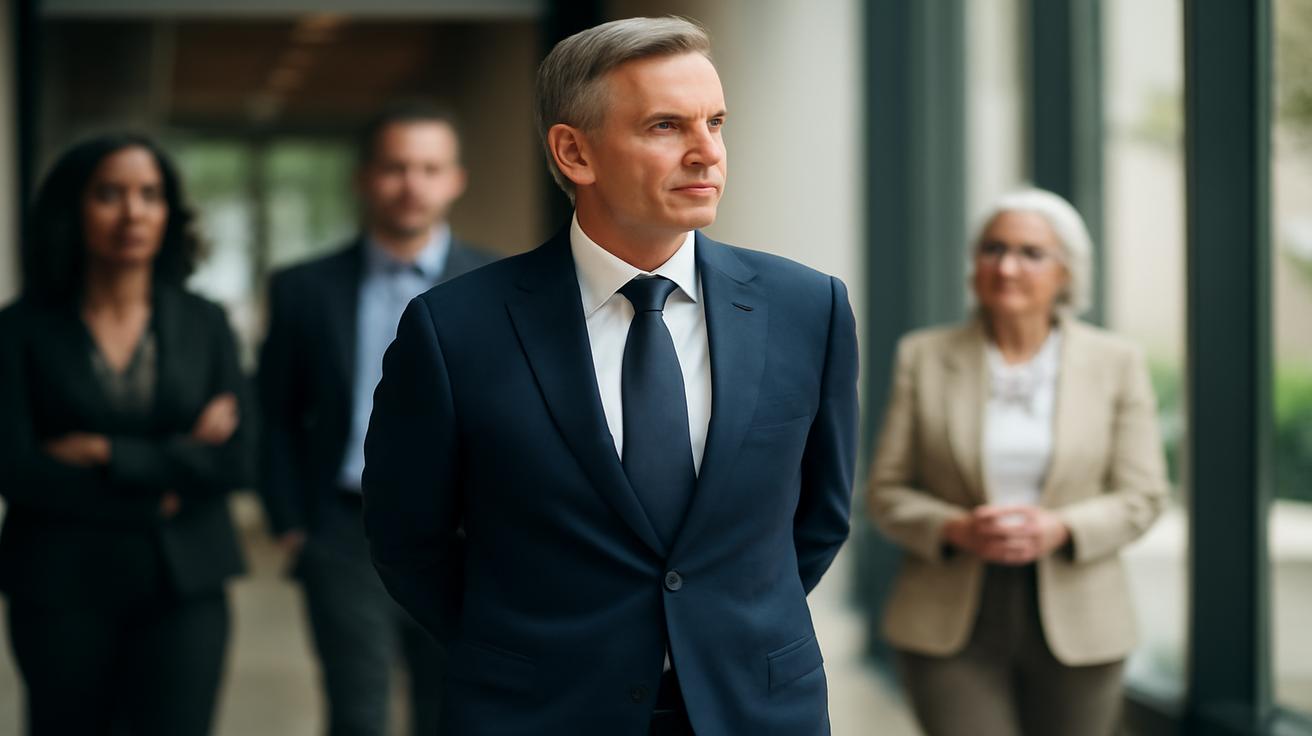
The first time you notice it, you don’t think much of it. An old man shuffling along a riverside path, hands clasped loosely behind his back. A school principal making their slow rounds through a quiet hallway. A company founder pacing before a big presentation, shoulders relaxed, fingers interlaced out of sight. You may have caught yourself doing it too—perhaps while wandering through a museum or waiting for a train—hands gently tucked behind you, gaze drifting, thoughts roaming wider than your steps. It feels natural, almost automatic. But for something that looks so small and ordinary, this simple gesture is hiding a surprising amount of meaning.
The Quiet Posture of People Who Don’t Need to Prove Themselves
Walk outside and watch people for a while—not in a creepy way, just in that curious, human way. You’ll probably notice that most people walk the same: arms swinging at their sides, shoulders slightly tense, eyes front. But every now and then you’ll catch someone who looks like they’ve stepped out of a slower world. Their pace is calm. Their shoulders are loose. Their hands rest behind their back like they’ve put away their defenses for a moment.
This, psychologists say, is one of the body’s most understated signals of quiet confidence.
When we feel under threat, exposed, or uncertain, our bodies instinctively protect our front—the vulnerable center where the heart, lungs, and vital organs live. Crossed arms, clenched fists, hunched shoulders, phone clutched in front like a shield: these are all micro-shields we throw up without thinking. But when someone willingly exposes the front of their body, hands tucked politely out of the way, it sends a different message: I am not preparing for impact. I do not feel under attack.
This isn’t always conscious. Leaders, mentors, and people who are used to being observed often end up walking with their hands behind their back without even noticing. Their nervous systems have slowly learned that they don’t need to broadcast aggression or defense in every moment. They’ve been in the room, they’ve been in the spotlight, and nothing terrible happened. Their bodies remember that.
In fact, some leadership coaches note that one of the subtle differences between posturing and presence lies in what you do with your hands. A leader trying too hard to impress often gestures big and fast, fingers slicing the air. A leader who is deeply comfortable in their role sometimes does the opposite: they minimize motion, slow down, and choose a posture that suggests, I’m here, I’m grounded, and I don’t have to win you over with theatrics.
The Hidden Language of Safety and Control
In psychology and body language research, the front of the body is sometimes called the “exposure zone.” We expose it when we feel safe; we protect it when we don’t. Walking with your hands behind your back opens that zone, offering the world an unshielded version of yourself.
Here’s the paradox: it’s both vulnerable and powerful.
On one level, this posture says: I trust my surroundings enough not to guard myself. On another, it communicates: I’m so comfortable with my own authority that I don’t need to look like I’m ready to swing or defend.
Think of a head teacher moving slowly through a classroom, a conductor strolling onto a stage before a performance, or a park ranger giving a tour through an old forest. Their hands often drift behind them as if they’re pushing their body slightly forward into the world, not bracing backward. They aren’t making themselves smaller; they’re making themselves more available.
That availability is a type of presence that others pick up on, often unconsciously. You may not be able to articulate why, but a person who walks that way can come across as composed, trustworthy, and oddly calming—someone who doesn’t need to dominate space, just inhabit it fully.
Why Leaders Drift into This Posture Without Realizing
Here’s where it gets especially interesting: many leaders don’t learn this from a book, a public-speaking course, or an executive coach. They discover it the way you discover a comfortable sleeping position—you just wake up one day and realize, oh, this is how my body likes to exist when it’s not bracing for impact.
Over time, people in leadership or guiding roles get used to three things: being watched, being asked, and being waited on. Their body responds by spending more time in a “survey” state rather than a “struggle” state. Instead of charging through space, they move with it—observing, scanning, reflecting. Hands behind the back is a natural anchor for that state of mind.
It frees the hands from the responsibility of talking for you. It slows down the steps. It keeps your center open, which not only looks calmer but feels calmer from the inside. The spine stacks differently. The breath deepens. The gaze lifts.
Leadership researchers and social psychologists often describe leadership presence as the balance of warmth and authority. This one posture quietly holds both: warmth in the openness of the chest, authority in the unhurried, grounded stride. No clenched fists, no wagging fingers, no frantic pointing. Just a walk that says, I’m listening more than I’m performing.
Many leaders adopt it unconsciously for another reason too: it lets their attention move outward. With their hands “parked,” they’re not fussing with pockets, pens, or phones. They are, in a very literal way, less self-oriented and more world-oriented—scanning the environment, reading the room, noticing where they’re needed.
Comparison of Common Walking Postures
To see how distinct this gesture is, it helps to compare it with other everyday walking styles we slip into without thinking.
| Walking Style | Common Meaning | Emotional Tone |
|---|---|---|
| Hands in pockets | Reserved, self-contained, sometimes insecure | Guarded, thoughtful, shy, or cold |
| Arms crossed while standing still | Defensive, skeptical, or just comfortable | Closed-off or evaluating |
| Arms swinging freely | Neutral, energetic, everyday movement | Engaged, normal, sometimes hurried |
| Phone held in front | Shielding, distraction, escape | Anxious, overstimulated, withdrawn |
| Hands behind back | Openness, quiet authority, contemplation | Calm, confident, reflective |
Of course, context matters. A teenager with hands in pockets isn’t always insecure; they might just be cold. But over thousands of small observations, patterns emerge. And hands behind the back remain one of the clearest physical hints of calm, curiosity, and soft power.
A Gesture Borrowed from Monks, Generals, and Grandparents
If this posture feels strangely familiar, it’s because we’ve seen it framed in so many different worlds. In monasteries, monks pace cloisters with hands clasped behind their robes, heads bowed, attention turned inward. In military settings, high-ranking officers stroll through ranks with the same posture—chin up, hands parked, assessing, listening, rarely rushing. In parks and quiet neighborhoods, elderly people drift along paths like this, breathing in the afternoon, letting their minds wander across decades.
There’s a uniting thread: contemplation.
Walking with your hands behind your back does something interesting to your attention. It slows your physical tempo just enough that your thoughts can catch up. Your arms are no longer swinging you forward; they’re gently tethering you to each step. You’re not marching. You’re meandering with purpose.
Many people report that this is the posture they fall into while thinking through a knotty problem, replaying a conversation, or absorbing something complex—like a piece of art, a new idea, or a difficult choice. In these moments, the body makes a quiet negotiation with the world: Let me move, but don’t demand too much expressiveness from me right now. I’m working on something inside.
Leaders often live in that dual space, where they’re present in an outer scene while processing an inner one. They are listening to what someone is saying in front of them while simultaneously asking themselves: What does this mean for the whole team? How will this ripple outward? What do I need to say—and not say—right now?
Hands behind the back makes room for that kind of multilayered thinking. It conserves emotional energy, reduces visible fuss, and creates a small island of stillness around a moving body.
The Cultural Echo of “I’m In Charge, But I’m Not Chasing You”
There’s another, slightly more primal layer here. When you watch an authority figure walk slowly with their hands behind them, they rarely look like they’re chasing anything. They’re not pursuing; they’re surveying. There’s a sense that things and people will eventually come to them.
This is one of the human nervous system’s oldest readings of power: the one who doesn’t need to hurry has control. Predators don’t rush unless they’re mid-hunt. Wise elders don’t sprint; they wait. Leaders who are secure in their role can afford to move at a human speed instead of constantly proving how busy and in-demand they are.
So the gait becomes a story: you can approach me; I’m not running away, but I’m also not chasing you down. This balance—available but not needy—is one of the subtlest signals of healthy leadership. It says, my value doesn’t depend on how frantically I move or how loud I am.
Is It Always Confidence? When the Same Gesture Means Something Else
This posture isn’t a magic decoder ring. Context is everything. The same gesture can mean different things on different days, in different bodies.
An anxious person might walk with their hands behind their back as a self-soothing habit, subconsciously gripping their own fingers to release nervous energy. Someone raised in a strict environment might have been taught to stand this way as a sign of respect or discipline. In some cultures, it’s the default “proper” way to walk in uniform or in formal spaces, no matter what you feel inside.
So it’s helpful to watch for other cues:
- Shoulders: Are they loose and open, or tight and hunched?
- Face: Calm, curious, or clenched jaw and furrowed brow?
- Speed: Unhurried and steady, or stiff and fast, as if they’re trying to get away from something?
When you combine hands-behind-the-back with relaxed shoulders, soft gaze, and a steady pace, the signal leans toward calm confidence and thoughtfulness. Add tension, rushing, and a frozen face, and the same posture can read as forced or anxious.
This matters because body language is less about single gestures and more about clusters. A leader who occasionally clasps their hands behind their back while also listening intently, making eye contact, and inviting questions is likely radiating genuine openness. Someone who stalks around with that same posture, jaw sharp, voice cutting, and eyes scanning for faults is broadcasting something very different.
Trying It On: How It Feels from the Inside
There’s an easy experiment you can run the next time you’re on a walk, alone on a hallway, or wandering through a quiet place.
- Walk as you normally do, arms swinging freely. Notice how fast your thoughts move, how your eyes scan, how your breathing feels.
- Now gently clasp your hands behind your back. Don’t force your shoulders; let them fall naturally. Slow your pace by just a fraction.
- Notice what changes—not in how you look, but in how you feel.
Many people report small but distinct shifts: a longer exhale, a slightly more lifted gaze, a softening of the face, a sense that internal dialogue becomes a bit clearer. You might find your attention drifting to details you normally pass by. A tree’s texture. The sound of your own footsteps. The way light moves over a window.
Even if you don’t feel suddenly powerful or wise (and you won’t; this isn’t a magic trick), you may feel a little less like you’re chasing your own life and a little more like you’re walking through it with awareness.
What This Gesture Teaches Us About Everyday Leadership
Leadership isn’t reserved for CEOs, generals, or public figures. You practice it whenever someone looks to you for steadiness—a child, a colleague, a friend in crisis, or even your own future self. In those moments, the signals your body sends can either amplify your inner calm or sabotage it.
Walking with your hands behind your back suggests three quiet commitments that matter in everyday leadership:
- I’m not here to dominate the room. I don’t need to wave my arms or inflate my gestures to be heard.
- I’m willing to see the whole picture. My hands are out of the way so my attention can move outward.
- I trust myself enough to stay open. I’m not hiding my core, even when others are watching.
When you start paying attention, you may see this posture appear in moments of subtle influence rather than loud authority: a nurse walking quietly into a patient’s room. A teacher pacing slowly during a discussion, allowing silence to stretch so students can think. A parent in a park, giving a child space to climb and fall while staying close, observant, unhurried.
These are tiny scenes of leadership that rarely make headlines but shape the emotional weather of homes, classrooms, and workplaces. They’re built not just on what people say, but on what they nonverbally communicate: I’m here. I’m steady. You don’t have to brace yourself around me.
Reclaiming a Slower Way of Moving Through the World
We live in an age where urgency is performed as status. We rush, gesture, scroll, and signal importance by how overwhelmed we appear. Against that backdrop, the person who moves slowly, walks with hands gently folded behind the back, and looks unbothered can feel almost subversive.
They aren’t shrinking or checking out. They are choosing not to flail.
There’s a quiet kind of rebellion in that choice. It suggests that groundedness is more valuable than frenzy, that observation matters as much as performance, and that you don’t have to be visibly striving every second to be deeply engaged with your life.
So the next time you find yourself naturally slipping into that posture—hands resting behind your back, chin tilted slightly up, steps unhurried—pay attention. Your body might be telling you that, in this moment at least, you feel safe enough to expose your front to the world. Curious enough to look around without having your hands ready to shield or explain. Steady enough to lead, even if only by the way you take your next few steps.
It’s not random at all. It’s a wordless sentence your body has been practicing for years, one that often says more than your mouth ever could:
I am walking through this world with awareness—not racing, not hiding, just fully here.
FAQ
Is walking with your hands behind your back always a sign of confidence?
Not always. While it often signals calm, security, and thoughtfulness, it can also be a learned habit, a cultural norm, or even a way of self-soothing. To understand it, you need to look at other cues—facial expression, pace, and overall posture.
Why do older people often walk with their hands behind their back?
For many older adults, this posture feels physically comfortable and stabilizing. It can also reflect a lifetime of shifting from “doing” to “observing” mode—a natural move toward reflection and slower, more deliberate movement.
Do all leaders naturally adopt this posture?
No. Some leaders are more animated, others more reserved. But many people in positions of responsibility eventually discover calmer, more contained body language that supports thoughtful presence—and hands behind the back is one of those natural defaults.
Can I use this posture to appear more confident?
You can experiment with it, but the goal shouldn’t be to fake confidence. Instead, use it as a tool to slow down, breathe, observe, and ground yourself. When you genuinely feel more centered, others tend to sense it, no matter what your hands are doing.
Is there any downside to walking like this?
In some fast-paced environments, it might be misread as too relaxed or detached. It’s helpful to match your body language to context—using this posture in moments of reflection, conversation, or observation rather than in situations that clearly call for urgency or hands-on action.





Leave a Comment