
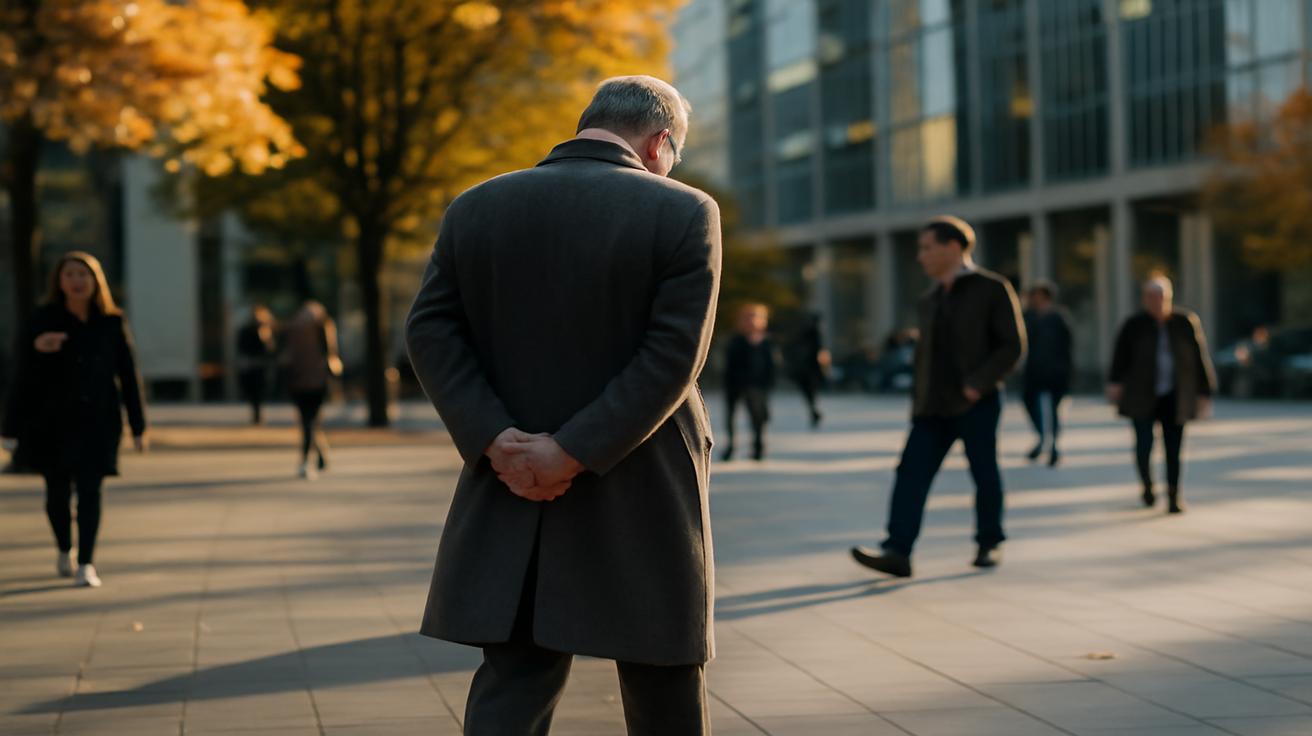
The first time I noticed it, I was standing in line at a tiny train station café, somewhere between cities and deadlines. The man in front of me—grey hair, beige coat—wasn’t scrolling his phone or jiggling coins in his pocket. He was simply standing with his hands folded neatly behind his back, eyes wandering over the battered timetable on the wall. There was something almost disarming about it. Calm. Exposed. Old-fashioned. And then I realized: I’d seen that posture all my life—on teachers pacing the classroom, on grandfathers strolling through parks, on museum-goers drifting from painting to painting. It felt familiar and yet strangely loaded, like a sentence we’ve all heard but never fully translated.
The Secret Conversation Your Posture Has Without You
We like to believe that our words carry the main story of who we are. But long before you open your mouth, your body has already introduced you to the room, made a few impressions, maybe even taken a few social risks on your behalf. Walking with your hands behind your back is one of those small, quiet habits that seems harmless, almost unconscious. You might do it while thinking, while wandering, while waiting for something—or someone.
Psychologists would tell you it isn’t random at all. It’s a kind of posture with a built-in message, a subtle declaration: I am not preparing to use my hands. I am revealing that I am unarmed. I am at ease in this space. But that message doesn’t land the same way with everyone. To some, it reads as confidence. To others, entitlement. To a few, maybe even arrogance. Your spine, your shoulders, your tucked-away hands—they all whisper an opinion about you before you get to say who you actually are.
Imagine you’re walking through a city square on a cool evening. Your jacket is unbuttoned, the air smells like rain on pavement, and your hands drift behind your back as you stroll. You’re not consciously “doing” anything; you’re just letting your attention float. To a stranger watching from a café window, though, you might look like a professor mid-lecture, a detective solving a case in his head, or someone who knows exactly where he belongs in the world. And that is the mysterious, sometimes unfair, power of this simple posture.
The Body Language Behind the Back
When your hands slip behind your back, your body is actually performing a tiny psychological trick: it’s trading control for openness. Our hands are our tools, our weapons, our shields. We use them to gesture, to grasp, to defend, to point. When we hide them, especially behind us, we do something counterintuitive—we disarm ourselves in public.
Psychologists and body language researchers often interpret this as a sign of one of three states: comfort, contemplation, or control. It’s a posture many people adopt when they feel safe enough not to guard themselves, but confident enough not to fidget. It’s also the posture of people whose minds are intensely busy while their bodies are not—think of judges pacing chambers, captains inspecting decks, park rangers walking silent paths through the forest.
There is an evolutionary thread in this too. In social mammals, exposing vulnerable areas—like the chest or stomach—can be a sign of trust or dominance, depending on context. By freeing your chest and opening your posture, you’re either signaling, “I trust that nothing here will hurt me,” or “I am in charge enough that I don’t need to look prepared.” Hands behind the back tend to amplify whatever is already there in the social script.
And then there’s the sensory experience. If you try it now, slowly, you may notice how your breathing subtly changes. Your shoulders roll back. Your chin lifts a few millimeters. The world seems to widen at the edges of your vision. You’re less likely to stare downward and more likely to scan the horizon. You might breathe a little deeper. That’s not just posture; that’s nervous system language. Your body, in that stance, is telling your brain, We’re okay. We can observe instead of react.
Confidence, Curiosity, or Concealment?
The tricky part is that the same posture can come from different emotional roots. Some people walk with their hands behind their back because they’re genuinely relaxed, curious observers. Others may do it as a small act of self-control: to stop themselves from gesturing wildly, from fidgeting, from picking at their nails. A few might even use it to create psychological distance—like putting their thoughts in a quiet corridor behind them where no one else can quite reach.
This is where psychology leans in and says: context is everything. Are you strolling a garden? Wandering a museum? Waiting outside a meeting room you’re about to lead? The meaning shifts. The body may be saying one thing while your history and the environment color it with another layer. But the posture itself remains consistent: hands tucked away, front of the body open, gaze often lifted, steps unhurried.
Why People Judge You for It
Walk like this through a park, and people might barely notice. Walk like this into a tense meeting, and someone will. Our judgments are fast, automatic, and not always fair. When people see you with your hands behind your back, they pull from their own catalogue of associations: teachers, soldiers, aristocrats, tourists, elders, bosses, security guards. Their brains look for the nearest familiar pattern and label you accordingly—often in less than a second.
That’s how stereotypes hitch a ride on something as ordinary as a stroll. In some cultures, hands behind your back signal respect and attention—children might stand this way in front of elders, officers might inspect a lineup like this, visitors might wander shrines or monuments in that posture. In other spaces, though, it can be read as aloofness: the person who doesn’t feel the need to reach out, who’s not here to help or to join, but to observe and perhaps judge.
A manager standing with hands behind the back in front of a team can easily be read as distant or authoritarian, even if they feel calm and reflective inside. A teenager doing the same in a strict household might be labeled “defiant” or “cold,” when in reality they’re trying not to betray their anxiety with restless fingers. We don’t just see a body; we project a story onto it.
How does this play out in everyday life? It helps to see the contrast. Imagine three people entering the same small room:
| Person | Posture on Entry | Common First Impression |
|---|---|---|
| A | Hands in pockets, shoulders slightly hunched | Shy, unsure, casual, maybe disinterested |
| B | Hands behind back, chest open, slow steps | Confident, observant, possibly superior or detached |
| C | Hands visible in front, light gestures while greeting | Approachable, engaged, friendly, present |
None of these impressions are guaranteed to be accurate, but they’re how we sort people in the quick, invisible triage of social life. Walking with your hands behind your back slides you, fairly or not, closer to category B in many minds. That can work in your favor—or against it.
Authority vs. Attunement
The main judgment that trails this posture is about power. The stance looks like someone on inspection, not on invitation. Think of the way security staff in airports sometimes walk, or how headteachers used to patrol school corridors, or how a senior doctor might move through a hospital ward. Hands behind the back can say, “I am looking at everything, and I’m in a position to evaluate it.”
On the other hand, when an elderly person shuffles slowly along a path with their hands tucked behind, we often read it as fragility, contemplation, or habit rather than authority. The posture is the same, but our story about it shifts with age, setting, and clothing. So, what people think of you when you walk this way is less about your intention and more about their own catalog of memories and social expectations.
The risk is that you might be judged as unapproachable in moments when you actually want connection. You may be perceived as detached when you are deeply engaged internally, just not externally. And because judgment happens before conversation, you may never get the chance to explain.
The Quiet Compass of Culture
Culture fine-tunes all of this. In some regions and traditions, walking with your hands behind your back is almost a default setting for respect. It’s how students stand when listening, how visitors move through sacred sites, how juniors follow seniors. There is comfort in that coded gesture: a shared understanding that no one is threatening, everyone is simply present.
Elsewhere, especially in fast-paced urban environments where hands are often busy with phones, bags, or transit cards, that same posture can stand out like an antique in a glass-and-chrome lobby. It may feel “old world,” formal, even anachronistic. People may project assumptions about your background, job, or personality: traditional, disciplined, rigid, or simply out of step with the casual norm.
In nature-centric cultures or communities that value slow observation—birdwatchers, botanists, park guides—the posture of hands behind the back is almost a uniform. It frees the gaze. It slows the body. It gives an air of paying attention not to people, but to the world itself. There, your hidden hands mark you as a listener, a noticer, someone who holds space instead of trying to fill it.
Gender and Generations
There are quieter currents at play too. Depending on where you live, men may be more likely to walk with hands behind their back than women, simply due to long-standing norms about how each “ought” to inhabit space. Older generations may see it as natural; younger ones might see it as stiff or performative. These tiny differences shape the judgments that follow.
When a teenager walks this way, adults may think they’re mimicking authority, trying on a role. When a retired person does it, we might feel nostalgia or tenderness. Your posture becomes a little thread that ties you to other people in your demographic—or pulls you away from them.
What It Reveals About You (That You Might Not Realize)
So what is your body saying when you unconsciously swing your arms back and let your hands rest there? It may be revealing more about your inner landscape than you suspect.
You might be the kind of person who likes to watch before acting, to walk the perimeter before entering the center. Your hands behind your back are your way of telling yourself: Don’t rush. Look first. You might also be someone who has learned, over time, that your gestures can overwhelm or that your fidgeting betrays your nerves. In that case, this posture is a self-edit, a quiet regulation mechanism that helps you feel composed.
In some moments, though, it can signal something else: a reluctance to reach out. When the world has felt unpredictable or demanding, tucking your hands behind you can be a shield made of habit—no one can ask you to do, to hold, to fix, if your hands are already politely out of service. It’s a subtle declaration of distance: I am here, observing, but not necessarily participating.
When Calm Becomes a Wall
The line between serenity and separation is thin. Someone who often walks with hands behind the back might be praised for being unflappable, poised, steady. But the same person may struggle to show warmth in situations that call for visible engagement: interviews, first dates, sensitive conversations. Their posture tells a story of control when vulnerability might be what’s needed.
If this is you, it doesn’t mean you must abandon the habit. It means you might want to notice when it shows up. Do your hands drift back when you’re bored, when you’re anxious, when you’re curious—or when you’d prefer not to be drawn in? Are you using the posture as a lens, or as a barrier?
How to Use (or Soften) This Posture Intentionally
Once you realize your walk carries all this unspoken meaning, you gain a subtle kind of power: you can choose when to lean into it and when to let it go. Like any body language, it becomes more ethical, more human, when you use it with awareness instead of autopilot.
If you want to embody calm authority—say you’re giving a tour, leading a nature walk, or moving through a space where people look to you for assurance—walking with your hands behind your back can work in your favor. Pair it with a soft gaze, slight nods, and an easy half-smile and you shift the impression from intimidating to reassuring. You become the person who sees everything but doesn’t need to dominate.
On the other hand, in situations that demand approachability, you might experiment with bringing your hands forward. Let them be visible. Rest one lightly on the back of a chair, hold a notebook loosely, or gesture gently as you talk. Your body then says, I am part of this, not above it.
A simple practice: the next time you catch yourself walking with your hands behind your back, ask, “What am I feeling right now?” Not what you’re thinking, not what you’re doing—what you’re feeling. Curiosity? Tension? Comfort? Boredom? Over time, you’ll start to map your own private code for this posture. It may tell you when you’re retreating into your head instead of showing up with your whole self.
Turning Judgment into Curiosity
And what about the judgments other people make when they see you? You can’t entirely control them, but you can soften their edges. Make eye contact. Offer a genuine greeting. Let your face do what your hidden hands cannot: reach out. When your expression and your posture tell the same story—calm but kind, observant but open—people tend to relax.
You can also reverse the lens. Next time you spot someone walking the old, thoughtful way—hands clasped behind, gaze drifting across rooftops or tree lines—pause the reflex to categorize them. Instead, wonder: Are they soothing their nerves? Turning a problem over in their mind? Relishing a moment of unhurried solitude? That flicker of curiosity is a small act of resistance against the quick, flattening judgments our brains like to make.
Walking Through the World, Fully Seen
There is a quiet beauty in this posture, once you stop to feel it from the inside out. Hands tucked away, world in front of you, spine aligned with sky, you become a kind of human question mark moving through streets and fields. Not threatening, not grasping, not broadcasting—just observing. The air brushes your fingertips where they touch each other behind your back. Your feet find their rhythm. Your mind drifts into longer sentences than usual.
Psychology tells us that nothing in our behavior is truly random. Every tilt of the head, every fold of the arms, every hidden hand is part of a constant conversation between your inner life and your outer world. Walking with your hands behind your back is one of those phrases in the language of the body that many people speak but few translate.
It can make you look wise or arrogant, contemplative or cold, relaxed or removed. It can invite people to trust your calm or keep their distance from what they read as hauteur. It may reveal your comfort in your own skin—or your desire to keep that skin safely unbothered. All the while, you are just walking, feeling the ground meet your heels, letting your thoughts loop and wander like birds above the rooftops.
Maybe that’s the most human part of it: your body quietly sends out signals you never meant to broadcast, and the world replies with judgments you never meant to invite. Somewhere in the middle of that exchange lies a chance—for both sides—to slow down, to ask better questions, and to remember that every posture is a story mid-sentence, not an ending.
So the next time you find yourself slipping your hands behind your back as you walk—through a city, a forest, a hallway at work—notice the tiny shift in your breathing, the way the world seems to open just a little wider. You’re not just moving through space. You’re speaking without words. And someone, somewhere, is listening.
Frequently Asked Questions
Is walking with your hands behind your back a sign of confidence?
Often, yes. This posture opens your chest and removes your hands from “ready” position, which can signal that you feel secure and unthreatened. However, it can also be a way of self-soothing or controlling nervous movements. Confidence is part of the story, but not the whole thing.
Why do older people often walk with their hands behind their back?
For many older adults, it’s partly habit and partly comfort. Over time, this posture can feel natural for balancing, reducing arm swing, and slowing the pace. It’s also tied to past cultural norms where this stance was associated with respect, contemplation, and attentiveness.
Does this posture make me seem unapproachable?
It can, especially in formal or tense settings. People may read it as distant, superior, or overly formal. You can soften this impression with warm facial expressions, brief smiles, and occasional visible hand gestures when you speak.
Is walking with my hands behind my back bad for my posture?
In moderation, it’s not usually harmful. It can even encourage an open chest and upright spine. However, if you overarch your lower back or tense your shoulders, it may create strain. Varying your posture and staying aware of tension is generally healthier.
Can changing this habit really affect how people see me?
Yes. Small shifts in body language can noticeably change first impressions. Showing your hands more often, especially in social or professional contexts, tends to make you look more open and engaged. You don’t have to give up the posture entirely—just use it intentionally instead of automatically.





Leave a Comment