
The first posters went up in the half‑light, when the mist still clung to the hedges and the village street smelled of damp stone and woodsmoke. By the time the shop opened, they were everywhere: on the noticeboard outside the hall, taped to the bus stop, pinned into the soft cork above the “Lost Cat” flyers. White paper, black letters: “OUR HOMES, OUR FUTURE. VOTE NO.”
The village that was slowly disappearing
For most of the year, the village sounded hollow. One in every three cottages on the main street was dark behind lace curtains, its chimneys cold even in January. On winter evenings, you could stand by the war memorial and hear the river much louder than the people: a distant rush under the old stone bridge, the soft slap of water on the mossy banks. If a car came through, its headlights swept past rows of empty windows and for a moment the whole street looked like a stage set nobody had bothered to strike.
The locals had names for the houses, old ones – The Firs, Rosebank, Miller’s Yard – but the new names sat heavier on their tongues: “the Airbnb one,” “that London couple’s place,” “the holiday let with the hot tub.” In the pub, where the fire burned mostly for show these days, people leaned in over their pints to swap small weather reports on the village itself.
“Another ‘Sold’ board up by Lowfield,” said Irene, who’d been teaching in the primary school since before the mine closed. “No lights there since Christmas. That’ll be another weekend place.”
“Course it will,” muttered Tom, whose family had farmed the same fields since anyone could remember. “Why would anyone live here? No work, no buses, and the internet’s held together with string.”
Yet under the complaints, there was a quieter grief. Once, the spring fair had filled the green with stalls; now you could count the kids who still lived in the village on your fingers. The football team had folded five years back. The shop survived partly on nostalgia and partly on the passing hikers who bought postcards of dry stone walls and misty hills, carrying a version of the village home that barely existed anymore.
The mayor – though here everyone still called him simply “Paul” – watched this slow vanishing not from a distance, but from a house just off the square, where his front garden backed directly onto the village’s small absences. His own kids had left for the city and not come back. On his walks to the council office, he passed shuttered cottages with “FOR SALE” boards that seemed as permanent as the walls themselves.
It was in these absences that his idea took root.
The plan nobody saw coming
The first time Paul said the word “refugees” in a council meeting, the room went very still. The radiator clicked and hummed, the fluorescent light flickered, and someone’s pen rolled off a folder and onto the floor with a tiny clatter. Outside, a tractor grumbled past, indifferent.
“We’ve got forty‑seven empty properties inside the village boundary,” he said, tapping the spreadsheet with the edge of his glasses. “Most of them structurally sound. The government is begging for rural placements. They’re offering grants to councils that can provide housing. We keep saying we want the village to live. Well, here’s a way.”
The clerk cleared his throat. “You’re suggesting we house… how many?”
“Depends on the families,” said Paul. “Maybe twenty, thirty people to start. Young families, they’ve said. They’d need schools, shops, buses. Services we’re already losing. This could be leverage. We could argue for funding, for infrastructure. We don’t have to choose between saving the past and building a future.”
In the silence that followed, the rain intensified, drumming on the windows. It was early spring; daffodils were making bright promises along the verges, but frost still clung to the shadows until noon. Change felt possible, but still brittle.
Someone finally said what others were thinking. “Refugees here? In this village? They don’t even speak the language.”
“Some will,” said Paul. “Some won’t. But their kids will learn faster than ours ever did their French verbs. We keep saying the place is dying. I’m handing you a way to breathe life back into it.”
He didn’t say out loud what he’d seen on his own screen late at night: the footage of families in rubber boats, the faces drawn tight with wind and fear. The way the camera lingered on children in soaked pyjamas, their toy cars or dolls half‑clutched even as coastguards hauled them into safety. He didn’t say that he thought of the empty cribs in village cottages, of the shuttered schoolroom where the paint was beginning to blister.
By the time the council voted – narrowly, reluctantly – to explore the scheme, the idea had already begun leaking out into the village, not as policy but as story. Stories travel faster than minutes from a meeting. By the weekend, people weren’t talking about “up to thirty new residents” but about “busloads” and “hordes” and “they’ll be everywhere.”
Posters, whispers, and old friendships fraying
The first conversations were tentative, half‑whispered over garden walls and at the till in the shop.
“Did you hear what Paul’s planning?” asked Irene, sliding a loaf of sliced white into her basket.
Behind the counter, Rita shrugged, her bracelets clinking. “I heard he wants to fill the old council houses. Better than seeing them rot, isn’t it?”
“With refugees,” said the man behind Irene, placing a crate of eggs on the counter a little too firmly. “From goodness knows where. No say in it. Just dumped here.”
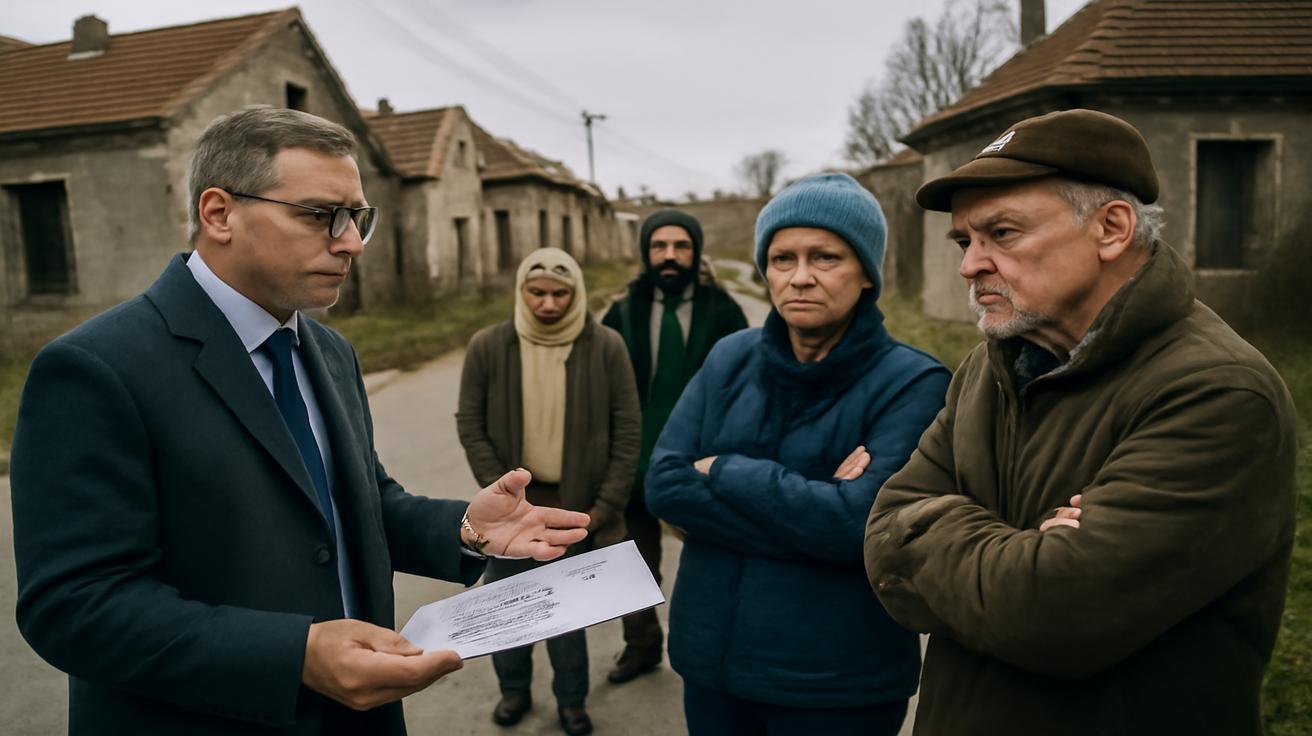
It didn’t take long for someone to turn that unease into action. The posters appeared after the mayor announced an official consultation. THE VILLAGE DECIDES, the council leaflet said. But the posters spoke a different language: OUR HOMES, OUR FUTURE. VOTE NO. Nobody signed them, but everyone guessed.
One afternoon, as low cloud pressed the hills into the horizon, two men stood on the green watching a new poster flutter on the noticeboard. Tom, the farmer, arms folded; and Mark, who’d grown up here but left for fifteen years before returning with a laptop and a head full of freelance contracts.
“This isn’t us,” said Mark quietly. “We’re not that kind of place.”
Tom scuffed his boot on the damp grass. “What kind of place is that?”
“Scared,” said Mark. “Suspicious. Mean.”
“Mean?” Tom’s voice sharpened. “I’ve watched this village bleed out since the pits closed. People leaving, shops shutting, fields going to seed because nobody can afford to work them. And now you want to tell me I’m mean for wondering why we should be the ones to carry the burden, when nobody lifted a finger while we were being left to die?”
The words hung there, heavier than the grey sky. Behind them, the playground swings creaked idly in the wind, their chains bright where rust hadn’t yet reached. The village, always quiet in the middle of the day, felt suddenly too quiet, as if listening.
It wasn’t just politics at stake. At the edge of the village, in the row of old council houses, neighbors who had shared sugar and childcare for decades now found themselves on opposite sides. In one kitchen, the radio announced national headlines about “rural unrest over migrant housing” while a pan of soup bubbled gently, filling the room with the smell of leeks and potato.
“You’re going to vote for it, aren’t you?” asked Joan, not looking up from the bread she was slicing.
Her husband, Alan, hesitated. “It’s not that simple.”
“Isn’t it?” The bread knife hit the board with a soft thud. “Either you think bringing strangers here will fix everything, or you remember this place as it was and you want to protect it.”
He wanted to say he remembered it so well that sometimes it hurt: the packed harvest dances, the sound of kids on bikes rattling down the lane. He wanted to say that maybe you protect a place not by freezing it like an insect in amber, but by letting it change shape enough to stay alive. Instead he said nothing, and the silence between them was thicker than the soup.
The numbers behind the emotions
Underneath the emotion, there were hard, unromantic facts. The mayor had them in spreadsheets; the villagers had them in their bones.
| Issue | Twenty Years Ago | Today |
|---|---|---|
| Year‑round occupied homes | 9 out of 10 | About 6 out of 10 |
| Primary school pupils | 65 | 19 |
| Local shops & services | Butcher, post office, 2 shops, pub | One shop, pub (limited hours) |
| Average house price vs local wage | 4× annual income | 9–10× annual income |
The village’s young people had not been pushed out by refugees. They had been priced out by second‑home owners and city salaries. Holiday lets glowed warmly on booking sites while the houses themselves stood dark most of the year. But injustice is rarely tidy enough to put on a banner, and anger doesn’t always land where it should.
When the national press finally noticed, they framed it as a simple culture war: “Quiet village rebels against migrant influx.” The reality, as always, was messier. People weren’t just fighting over who should live in the empty houses. They were arguing over what those houses meant, and who, if anyone, still had the right to dream a future for the countryside.
Faces behind the word “refugee”
On the day the delegation came – a small team from the resettlement charity, a translator, and two families – the village seemed to hold its breath. It was early summer now, the hedgerows frothy with cow parsley, swallows stitching the sky with their quick, dark wings. The bus arrived late, of course; the countryside might be picturesque, but the timetable was theoretical at best.
They were just people, in the end. A boy in a Spider‑Man T‑shirt clutching a worn‑out football. A woman whose scarf couldn’t quite hide how tired she was. A man who kept looking around as if measuring how far this green, damp place was from everything he’d left behind.
They were shown the houses, the school, the surgery that opened only three mornings a week. They were served tea in mismatched mugs in the village hall, where faded posters for jumble sales and harvest suppers still clung to the walls.
The translator – a young woman who had grown up in a not‑so‑distant town – explained in gentle phrases how quiet it would be, how different from the cities where many had first been placed. “There are less buses,” she said carefully, “but also less people shouting at you in the street.”
Later, as the visitors waited for their bus back, the boy in the Spider‑Man shirt wandered over to the playground. The swings were empty, the roundabout still. He set his football down, gave it a tentative kick. It skidded slightly on the damp grass and rolled towards the bench where Tom sat, arms folded, watching.
For a moment, everything hung in that narrow space between the ball stopping and someone deciding what to do next.
Tom bent, picked it up, and held it out. “You any good, then?” he asked, voice gruff.
The boy turned to the translator, who smiled and translated. He grinned, nodded vigorously.
“Right,” said Tom. “Next time you’re here, bring a few mates. The pitch is going to waste.”
The boy didn’t understand every word, but he caught enough. His smile widened, full and sudden as sun through cloud. On the edge of the green, a curtain twitched, then settled.
Who owns a place that’s always changing?
In the weeks before the vote, conversations like that multiplied quietly, even as the loudest arguments got louder. It felt as if the village had been forced to look in a mirror it had been avoiding for years.
Who owned the countryside now? The families whose grandparents’ names were carved into the war memorial? The pensioners from the city who had bought their dream of peace and pasture? The hikers whose boots scuffed the paths every weekend? The children who might never be able to afford a house here but still knew every bend of the river by heart?
And what about those who had never even heard of the village until war or disaster pushed them across continents, onto boats, and then into allocation spreadsheets in government offices? Did they have the right to call these empty houses home, to anchor new memories in old stone?
The truth, as the land itself kept quietly insisting, was that the countryside had never been as fixed as the postcards suggested. Slip your hand into the soil and you’d find layers of arrivals and departures: Roman coins, Viking place‑names, wave after wave of people pushed and pulled by forces far beyond their own choosing. The fields had been enclosed once, the commons divided. Farms had swallowed smallholdings; big machines had replaced hands. Each change had triggered its own panic, its own sense that something essential was being lost.
Standing by the river one evening, watching the water catch the last of the light, the mayor thought of all this. He thought of the last public meeting, where an elderly woman in a floral dress had stood up and said, “What if they don’t like it here? What if they’re miserable? We can’t even keep our own young people, and you want to bring in more?”
He had no easy answer. Sometimes, he admitted to himself, his plan felt less like vision and more like desperation. A way to grab at any lever that might slow the village’s slide into irrelevance. But when he looked at the empty houses, at the weed‑choked front paths and the peeling paint, he felt the same word pushing back at him every time: waste.
The day the village chose
On the morning of the vote, the village hall smelled of polish and paper, just as it always had. The polling station sign flapped in the breeze. Swallows looped above the roof. Dogs waited patiently outside as people went in, one by one, to put a cross in a box that would not only decide whether a few dozen families might one day live here, but also signal what kind of place this was willing to become.
Old resentments and private hopes all condensed into the small, secret moment in the voting booth. Some people thought of house prices. Some thought of the boy with the football. Some thought of their own children, sending messages from city flats where the nearest tree was a carefully managed ornamental on a roundabout.
That evening, when the counting was done and the hall chairs stacked away again, the result went up on the same noticeboard that had held the anonymous posters.
The village had voted to go ahead. Not by a landslide; this wasn’t a story of overwhelming enlightenment. It was a story of a place split almost in two, with the narrowest of majorities tipping the balance. Enough people, just enough, had decided that the risk of remaining exactly as they were felt greater than the risk of change.
Some residents walked home angry, already composing letters to the local paper in their heads. Others walked home hopeful, imagining children’s voices in the street again. Most walked home carrying a muddle of both, because real life is rarely as tidy as the ballot result.
Outside his house, the mayor paused. The evening air smelled of cut grass and the faint, clean tang of rain on its way. Above the dark line of the hills, a strip of sky was still holding onto pale blue. He thought of the work ahead: negotiations, renovations, welcome packs, the slow stitching together of new lives and old routines.
The empty houses wait. Inside, their rooms hold the ghosts of past families: faded wallpaper where height marks once climbed the doorframe; a disused fireplace blackened from winters long gone. Soon, perhaps, there will be different ghosts beginning to form: the trace of unfamiliar recipes in the kitchen air, lullabies in another language soft at bedtime, someone swearing in frustration at the unreliable boiler.
The countryside will not look different from the postcard at first glance. There will still be cows in the fields and mist in the valley and tourists taking photos of the church. But if you listen more closely, there might be another language joining the birdsong at the bus stop. The future of the village will not belong entirely to those who grew up here, nor entirely to those who arrive with suitcases and trauma. It will belong, uneasily and imperfectly, to all of them, trying together to make something that lives.
And perhaps that is the quiet truth nestled beneath the banners and the arguments: no one truly owns the future of the countryside. We only ever borrow it, for a while, from the people who will come after us – whoever they turn out to be.
Frequently Asked Questions
Why are rural villages being asked to house refugees?
Many governments and charities are looking beyond cities for long‑term refugee housing. Rural areas often have empty properties, falling school rolls, and struggling local services that could benefit from new residents. At the same time, placing people in small communities can offer a safer, quieter environment for recovery after conflict or displacement.
Do refugees really help revive declining villages?
Evidence from various rural projects suggests they can. New families mean more pupils in local schools, more customers for shops and pubs, and a stronger case for maintaining bus routes and health services. Success depends on good support, language classes, employment opportunities, and genuine engagement with existing residents.
What are the main concerns local residents usually have?
Common worries include pressure on housing, cultural differences, language barriers, and fears about crime or safety. In many places these concerns are intensified by existing frustration about second homes, lack of local jobs, and years of feeling ignored by national decision‑makers.
How can villages prepare for welcoming refugees?
Practical steps include setting up volunteer groups, organizing language support, coordinating with schools and health services, and creating clear channels for dialogue – both with new arrivals and between neighbors who disagree. Visible planning and honest communication help reduce rumor and mistrust.
Who should decide the future of the countryside?
There is no simple answer. Long‑term residents, newcomers, local authorities, landowners, and national governments all play a role. The most sustainable futures tend to come from inclusive decision‑making, where those who live with the consequences – present and future – have a genuine voice in shaping how their communities change.






Leave a Comment