
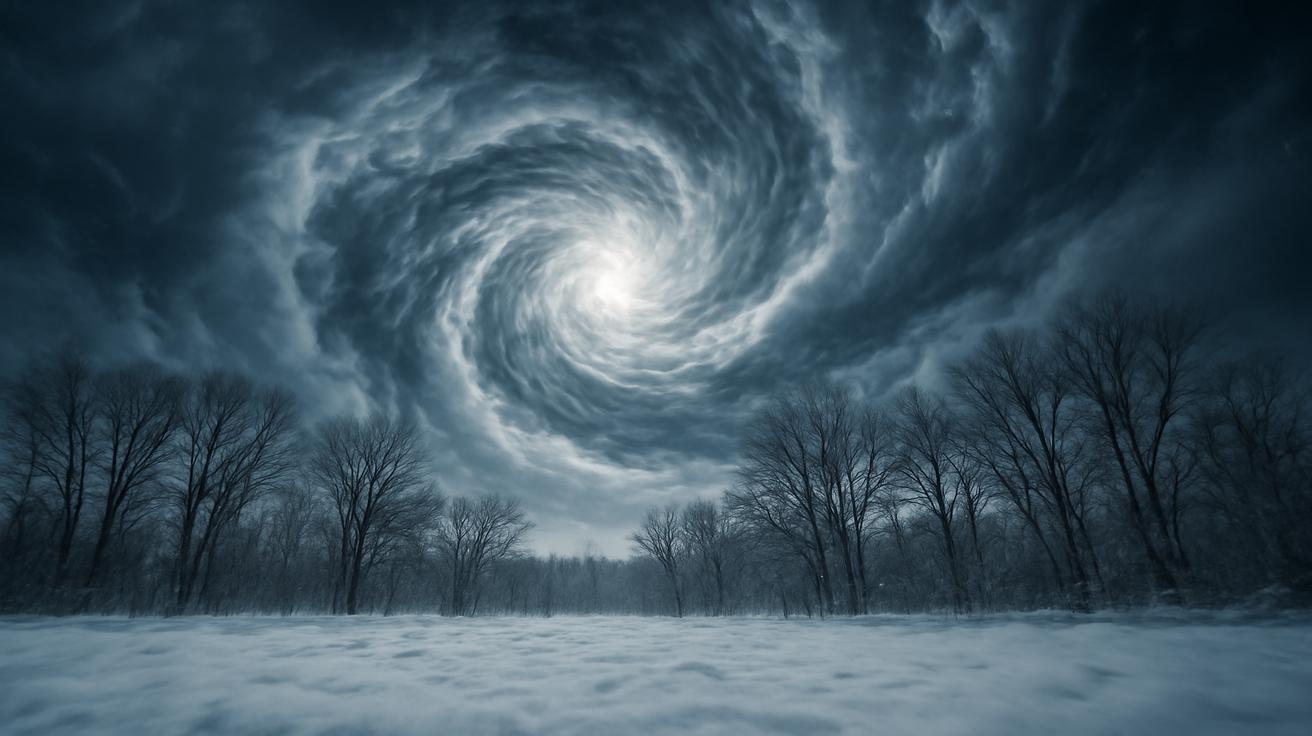
The wind changed before the news did. High above the clouds, in a layer of air most of us never think about, something began to tilt, buckle, and slide. Pilots flying red-eye routes across the North Atlantic reported unexpected turbulence. Weather balloons rose into the winter dusk and came back whispering of a sky under stress. In January, when the atmosphere is usually locked into its most stable, predictable pattern, the planet’s great winter engine—the polar vortex—was quietly rewriting its own rules.
A Winter That Didn’t Feel Quite Right
Maybe you felt it before you heard about it. The strange, almost guilty warmth on a mid-January afternoon. The rain that should have been snow. The way the long-range forecasts seemed unsure, their confidence bars wobbling. In a small town in the American Midwest, a school custodian complained that the snowblower hadn’t left the shed all season. In central Europe, ski slopes looked like the aftermath of a party—patches of exhausted snow slumped between brown, exposed grasses.
Farther north, in communities that define themselves by winter, elders shook their heads. The ice arrived late, they said. The rivers stayed open too long. Migratory birds lingered, confused by the lingering softness of the cold. On social media, people joked about “fake winter,” posting pictures of green lawns where there should have been drifts piled high.
But dozens of miles above all that, where the air grows thin and the blue of the sky deepens toward black, a different story was unfolding—one of violent winds, surging temperature contrasts, and a spinning ring of air that scientists have watched more closely each passing year. The polar vortex, normally a frigid crown of westerly winds that sits atop the Arctic, was beginning to shift early…and hard.
An Unseen Giant Over Our Heads
To understand why this matters, you have to imagine something we almost never see. The polar vortex is not a storm in the usual sense. You can’t track it on your weather app as a swirling icon. It’s a vast, cold, high-altitude circulation, tens of kilometers above the surface in the stratosphere, wrapped around the Arctic like a loose, spinning halo.
In a “normal” winter, this halo tightens and speeds up through December and January, containing the cold like a lid on a freezer. Arctic air stays more or less bottled up near the pole. The rest of us get the usual rhythm of fronts and storms, but the basic structure of the jet stream—those high-altitude rivers of air that steer weather systems—remains relatively stable.
When that halo weakens, warps, or splits—especially earlier than expected—the consequences can cascade downward. The jet stream twists and buckles. Storm tracks change course. Warm and cold air masses swap places like actors missing their cues. Instead of winter proceeding with a familiar, measured pace, it arrives in lurches, feints, and sudden lunges.
This year, the shift began in January with an intensity that had veteran atmospheric scientists trading late-night messages and re-checking data. The signal wasn’t just “unusual.” In several metrics, it was brushing up against the edge of what they’ve seen in the modern record.
The Rare Shift Taking Shape
In early-season events, the vortex more often strengthens than stumbles. This time, high-altitude observations showed sudden warming in parts of the stratosphere and a rapid slowing and displacement of the vortex away from its usual perch over the pole. One researcher likened it to seeing a heavy flywheel, spinning smoothly for months, suddenly tilt on its axis and wobble.
It wasn’t just the timing—it was the speed. Within days, wind speeds near the top of the stratosphere dropped sharply. The once nearly circular vortex became lopsided, stretching like taffy toward lower latitudes. Numerical models, those sprawling mathematical machines we use to peer into the future of the atmosphere, began to agree: this was not a passing blip.
For scientists who track long-term climate patterns, the phrase that began appearing in their internal notes and briefings was cautious, but clear: “nearly unprecedented for January.” The kind of language they reserve for events that don’t fit neatly into existing categories, that suggest something deeper is stirring in the climate system’s foundations.
What Makes This Event So Unusual?
Scientists quantify the polar vortex using several indicators—wind speeds at certain heights, pressure patterns, temperature anomalies, and the shape and position of the vortex itself. When enough of those dials swing wildly at once, they know they’re dealing with something exceptional.
In this early-season case, several factors combined:
- Timing: Major disruptions typically peak later in winter, toward February. Seeing such an intense shift in January is rare.
- Strength of the anomaly: Winds in the stratosphere weakened and shifted more abruptly than usual.
- Geographic displacement: The vortex moved markedly off the pole, changing how cold air could spill southward.
- Background conditions: The event is unfolding over a climate system already warmed and altered by decades of greenhouse gas emissions.
When you add those pieces together, it’s like watching a seasoned orchestra suddenly slip into an unfamiliar key. The music still plays, but the mood changes, and you start to wonder what prompted the shift in the first place.
| Feature | Typical Mid-Winter Polar Vortex | Current Early-Season Event |
|---|---|---|
| Timing | Peak disruptions usually appear in February | Strong shift emerging already in January |
| Vortex Strength | Stable, fast westerly winds around the pole | Significant weakening and wobbling of winds |
| Shape & Position | Mostly circular and centered over the Arctic | Elongated and displaced toward mid-latitudes |
| Surface Impact Risk | Gradual cold outbreaks, more predictable | Higher risk of erratic extremes in coming weeks |
| Climate Context | Aligned with 20th-century norms | Superimposed on a rapidly warming Arctic |
The Arctic, Unmoored
At the heart of the story is the Arctic itself—a region that has been warming at roughly four times the global average. Sea ice that once formed early and thick now freezes later, thinner, and breaks up sooner. Open water absorbs more sunlight than ice, adding heat to a system that evolved to be cold and reflective.
This background warming changes how heat and waves propagate through the atmosphere. Think of it as altering the tension on a drumhead. When storms and mountains send ripples upward from the troposphere (where our weather happens) into the stratosphere (where the vortex lives), those ripples now meet a different, less familiar surface.
Scientists are still investigating exactly how Arctic amplification interacts with the polar vortex. But the pattern is hard to ignore: as the north warms, the vortex seems more prone to dramatic mood swings—sudden warmings, displacements, and splits that tug winter weather into strange shapes.
What This Means for Weather on the Ground
The atmosphere is a patient storyteller. What begins as a high-altitude drama often takes days or weeks to fully reveal itself at ground level. Still, a strong early-season vortex shift loads the dice for certain kinds of weather in the weeks that follow.
One outcome is the classic “warm Arctic, cold continents” pattern. With the vortex weakened and displaced, lobes of frigid air can spill southward, even as the far north remains relatively mild. The result is a weather map that looks almost inverted: above-freezing temperatures in parts of the Arctic, while cities much farther south shiver under intense cold.
In North America, this can mean sharp swings: a week of strangely mild temperatures, followed by a sudden, brutal cold snap as the jet stream buckles and channels polar air southward. In Europe and Asia, similar displacements can send fierce winter storms into regions unprepared for them, or rob traditional snow countries of the sustained cold they rely on.
Crucially, not everyone experiences the same thing. While one region is locked in ice, another may stew under rain and mud. The shared thread is volatility—winter behaving less like a steady season and more like a nervous pulse.
Living With Anxious Seasons
For people who depend closely on seasonal cues, this volatility is more than an inconvenience. A maple syrup producer in Quebec watches as freeze-thaw cycles come out of sequence, affecting sap flows. A farmer in eastern Europe debates whether to risk planting a winter-hardy crop if deep frost might arrive late and sudden. A city planner in the U.S. Midwest wonders if snow-removal budgets should now be paired with emergency heat-relief plans for midwinter warm spells.
In many places, people have built their lives around sturdy assumptions: when winter begins and ends, how hard it hits, what kind of storms it brings. Those assumptions are now under negotiation. Each “nearly unprecedented” event is a nudge, a reminder that the past is no longer a reliable script.
Standing outside on a milder-than-expected January night, it can be hard to connect that gentle air touching your face to a screaming jet of wind fifty kilometers above your head. But it’s all the same story—heat moving, boundaries shifting, a planet recalibrating under the pressure of human-made change.
Signals in the Noise
Weather is famously noisy. One cold winter doesn’t disprove global warming; one warm winter doesn’t prove it. Scientists are careful not to pin every wobble and storm directly on climate change. But they also look for emerging patterns—the ways the dice are being loaded over time.
In the last few decades, the data on the polar vortex has begun to look less like a smooth, predictable heartbeat and more like something with extra spikes and swings. There are more frequent and sometimes stronger disruptions. They don’t line up cleanly year to year, but the envelope of behavior has widened.
Pair that with the dramatic loss of Arctic sea ice and the steady climb of global temperatures, and the picture sharpens. We’re not just living through weather; we’re living inside an experiment, one where we’ve altered the energy balance of the entire Earth and are now watching how the atmosphere responds.
How Scientists Read This Moment
For experts, this early-season polar vortex shift is both a challenge and an opportunity. They feed new observations into their models, testing how well those models capture the unfolding reality. They compare this event with previous ones—like the notable disruptions of 2009, 2013, and 2018—tracing similarities and departures.
Behind the technical work is a very human mix of emotions. There’s scientific curiosity, of course, but also unease. Many of the people studying these patterns have children, favorite hiking trails, hometowns that used to have a dependable winter. They’re not just plotting contours on a map; they’re watching the seasons they know reshape themselves in real time.
When they use phrases like “nearly unprecedented,” they are, in a way, being conservative. They’re leaving room for new data, new understanding. But inside that careful language is a quiet alarm: the systems that once anchored our climate in recognizable cycles are being nudged into more experimental territory.
Learning to Read an Unprecedented Climate Signal
For the rest of us, the question becomes: what do we do with a story like this? A polar vortex shift in January can seem abstract, far away, one more complicated term in a world already crowded with things to worry about. Yet paying attention to these signals can ground us, not just in fear, but in understanding.
Knowing that the atmosphere is capable of such sudden reorganizations reminds us that climate is not a distant backdrop—it’s the living context of every day. The heat in summer, the pattern of rains, the depth and timing of snow: all of these are threads in the same larger fabric that’s being tugged and stretched.
As individuals, we may not feel we can do much about the high-altitude winds roaring over our heads. But we can recognize that these “weird weather” moments are not random quirks; they’re part of a trend line that points directly at our collective choices—energy, land use, consumption.
When experts warn that an event is nearly unprecedented for January, they’re not just marveling at the atmosphere’s theatrics. They’re telling us the baseline is shifting, and that the climate our infrastructure, our economies, and our expectations were built for is slowly receding into the past.
Holding on to Wonder, Not Just Worry
It’s easy, in the face of such news, to slide into numbness or dread. But there’s another response available: paying closer attention, and refusing to let the familiar beauty of the world slip by unnoticed even as it changes.
On a clear winter night, if you step outside and look up, you might see the stars as they’ve always been—cold, sharp, indifferent. Somewhere far above, the polar vortex is twisting into a new configuration. You can’t see it, but you are inside it. The air you taste, the breeze that stirs the trees, the path of clouds across the moon—each is a hint, a small local expression of a planetary dance.
To live awake in this era is to hold two truths at once: that we are in deep, unprecedented territory, and that the world remains heartbreakingly worth protecting. The unusual warmth in January, the strange timing of snows, the expert language about records and anomalies—these are not just warnings. They are invitations to care more fiercely, to act more boldly, and to remember that the atmosphere is not a distant abstraction. It is the breath between us and every living thing.
Frequently Asked Questions
What exactly is the polar vortex?
The polar vortex is a large-scale circulation of cold, fast-moving air high in the stratosphere, typically centered over the Arctic in winter. It acts like a spinning barrier that helps keep frigid air near the pole. When it’s strong and stable, cold air tends to stay locked up north; when it weakens or shifts, that cold can spill southward.
Why is this early-season shift considered nearly unprecedented?
Because of its combination of timing and intensity. Major disruptions to the polar vortex are more common later in winter, especially in February. Seeing such a strong displacement and weakening already in January, on top of a rapidly warming Arctic, puts this event near the edge of what has been observed in the modern record.
Does a disrupted polar vortex always mean extreme cold where I live?
No. A disrupted vortex increases the chance of unusual patterns, but how that plays out locally depends on where the jet stream bends and how air masses move. Some regions may experience severe cold snaps, others may see mild, wet conditions. The main signal is greater volatility, not a guarantee of specific weather.
Is climate change causing these polar vortex events?
Climate change is altering the background conditions in which the polar vortex operates, especially by rapidly warming the Arctic and reducing sea ice. Evidence suggests this may make large disruptions more likely or more intense, but the relationship is complex and still actively studied. Climate change doesn’t create the vortex—it changes how often and how dramatically it misbehaves.
What can we do in response to events like this?
On a personal level, staying informed and prepared for more erratic weather is important. On a collective level, the underlying driver—rising greenhouse gases—points toward the same actions scientists have urged for years: reducing fossil fuel use, protecting and restoring ecosystems, and designing cities and infrastructure that can cope with a more variable climate. Each unusual event is another reminder that the cost of inaction is already arriving, season by season.





Leave a Comment