
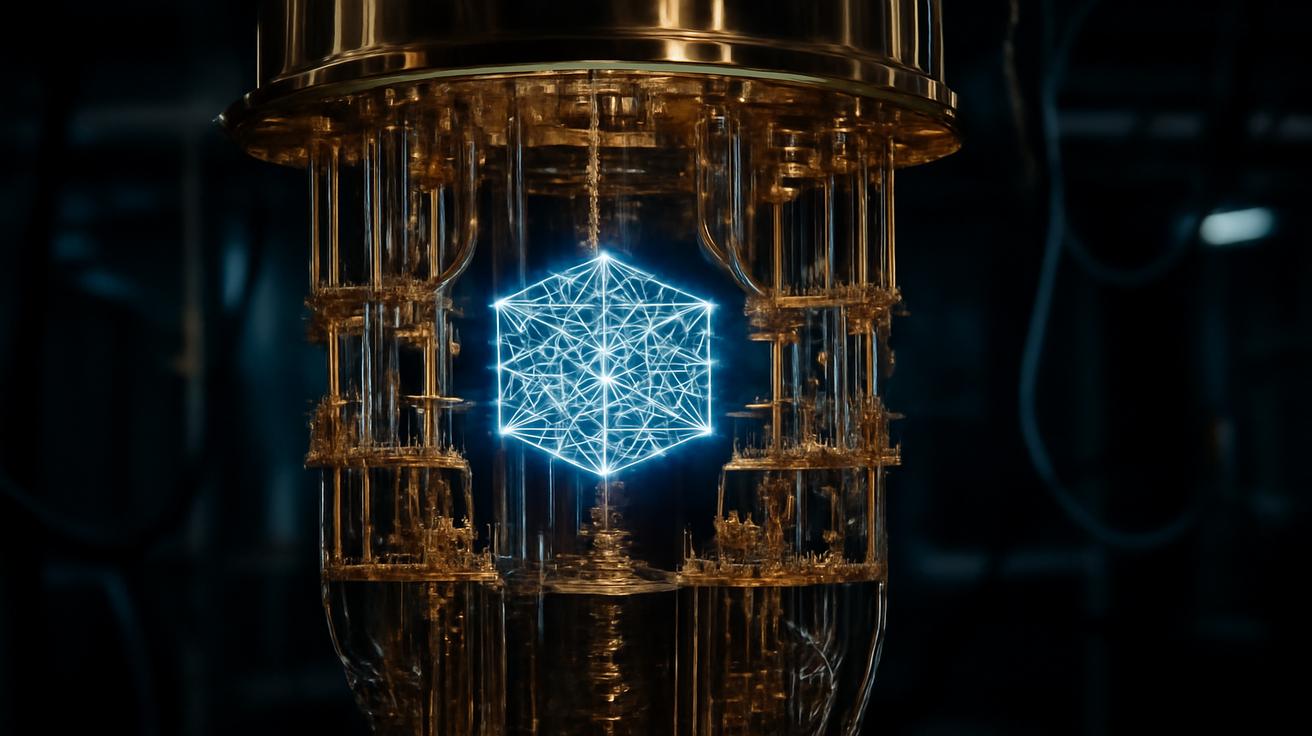
The room is colder than winter in Wyoming, yet the air hums with an almost electric anticipation. Inside a gleaming cylinder the size of a wardrobe, strands of gold-plated wiring descend like the roots of some otherworldly tree, vanishing into a wafer no bigger than a fingernail. On that fragile island of metal and silicon, for just a heartbeat longer than anyone thought possible, a tiny quantum bit—a qubit—holds itself together in a universe that is always trying to tear it apart. One millisecond. A thousandth of a second. It passes in the blink of an eye, and yet for physicists in the United States, it feels like they have opened a small window into forever.
Listening to the Whisper of a Single Qubit
To understand why this one millisecond matters, you have to imagine a world made of whispers. At the quantum scale, particles don’t sit still and behave like well-trained marbles on a pool table. They smear into probabilities, exist in many possible states at once, and shift under the slightest nudge of light, heat, or magnetic fields. A qubit is the attempt to harness that whisper—to capture it, coax it, and convince it to perform calculations that would take a classical computer centuries or longer.
But qubits are shy creatures. They decohere, which is the physicist’s way of saying they forget what state they are in. The environment bumps into them, like a crowd jostling a person trying to balance a coin on its edge. Any tiny disturbance—vibration, cosmic ray, stray microwave photon—pushes the coin to fall, the qubit to lose its quantum “both-at-once” magic and slip back into the familiar binary of 0 or 1.
In many quantum systems, that fragile balancing act lasts mere microseconds—millionths of a second. Long enough to glimpse, but not long enough to do anything deeply complex. So when a team in the United States coaxed a qubit into maintaining coherence for a full millisecond, it was as if someone had silenced the room around that spinning coin, just long enough to hear it sing.
A Record Measured in Heartbeats and Honey
One millisecond seems absurdly short when you look at a clock. But imagine you’re trying to spoon honey into a bottle while riding in the back of a truck careening down a rocky mountain road. Now imagine the driver suddenly finds a stretch of road so impossibly smooth that, for a brief time, your hand stops shaking. In that short distance, you can pour far more honey cleanly into the jar than you could over the previous bumpy miles combined.
That’s what this new record coherence time feels like to quantum researchers. In the calm of that millisecond, more operations can be stacked one after another without the system forgetting what it’s doing. Gates can be applied, states entangled, algorithms progressed, and error-correcting codes tested with more breathing room.
Of course, “record” in science is a slippery word. It slices differently depending on what, exactly, you are measuring: what type of qubit, what kind of environment, what metric of coherence. But within the realm that matters for scalable, practical quantum computers—systems where qubits can interact, be addressed, and eventually woven into useful architectures—this U.S. milestone sits on a new peak.
| System Type | Typical Qubit Coherence | Main Strength | Main Challenge |
|---|---|---|---|
| Superconducting circuits | Microseconds to hundreds of microseconds | Fast operations, strong industry support | Environmental noise, scaling hardware |
| Trapped ions | Milliseconds to seconds | High-fidelity gates, long coherence | Slow gate speeds, complex lasers |
| Spin qubits in semiconductors | Microseconds to milliseconds (with control) | Potential for dense integration | Fabrication precision, noise control |
| New U.S. record system | About 1 millisecond coherent operation | Unprecedented balance of stability and control | Engineering at scale, reproducibility |
On paper, that “about 1 millisecond” looks like just another number to slot into a table. In the lab, it represents years of trial and error, experimental dead-ends, and those rare, bright days when the data on the screen bends upward just enough to suggest that, yes, the impossible might be only extremely difficult.
The Chill at the Center of the Experiment
The heart of this record-setting experiment doesn’t look like a heart at all. It looks like a chrome-plated chandelier in a science-fiction film, nested layers of shielding and wiring descending into a cavern of cold so deep that the usual metaphors—Antarctica, liquid nitrogen, a winter night on the plains—feel clumsy and warm by comparison. We’re talking temperatures just a fraction of a degree above absolute zero, where atoms barely move and heat itself becomes a rare and dangerous intruder.
That cold is not a flourish. It is the price of admission for superconductivity and for fragile quantum states that would otherwise be obliterated by thermal noise. Around the dilution refrigerator, the lab is a careful choreography of silence: vibration-damping platforms, shielded cables, filtered power supplies, radiation-hardened enclosures. The physics may be exotic, but the enemy list is mundane—buzzing electronics, trucks on nearby roads, a summer thunderstorm rolling through the city.
Inside this engineered stillness, the qubit is formed in a device whose design has been tuned and retuned in countless simulations. The researchers have learned to read the murmur of materials—the impurities in a layer of metal, the microscopic roughness of a surface, the random flips of little defects hiding in the substrate. Every improvement in coherence time is less an act of genius and more an act of stubborn listening. The materials speak the language of noise, and the team has spent years becoming fluent enough to answer: “Be quiet. Just for a moment.”
So when that moment stretches into a millisecond, it feels like a reward not just for clever physics, but for discipline. For staying in the lab on Friday evening to rerun a calibration. For questioning a result that seemed too good to be true. For trusting that beneath every unexplained blip in the data there is a story that, once understood, will point the way to a calmer, quieter quantum world.
Why Coherence Is the Currency of Quantum Power
In this landscape, coherence time is the currency that buys you computation. Each quantum gate you apply—each delicate rotation of the qubit state, each entangling operation between neighbors—costs a little of that coherence. You can think of it as a budget of trust: How long can you trust that your qubits are still holding the information you carefully encoded?
With microsecond coherence, you can run only a handful of operations before the fog rolls in and your quantum state is lost. With a millisecond, your options expand dramatically. More operations, deeper circuits, more meaningful algorithms. Crucially, you also gain the breathing room to perform error correction: the art of using multiple physical qubits to protect a single logical qubit from the ever-present whisper of noise.
Quantum error correction is less like fixing typos in a document and more like trying to maintain the position of a perfectly balanced broom on your fingertip while the room around you keeps shifting. You sense the motion, correct it, sense again, correct again. To do that fast enough and often enough, your broom—your qubit—needs to remain upright long enough for you to catch and respond to its wobbles. That is precisely what longer coherence offers: more opportunities to catch the errors before they cascade.
A New Kind of American Road Trip
There is an unmistakable American flavor to this pursuit of longer coherence. It carries the same restless energy that once sent surveyors across the Great Plains with chains and compasses, or propelled the Apollo program toward the Moon. Except this time, the frontier is not across an ocean or up in the sky. It is inward, into the grain of reality itself.
Federal agencies, national laboratories, university groups, and private companies form a loose caravan across this ridge of discovery. Some specialize in exotic materials. Others focus on control electronics whispering microwave tones with exquisite precision. Still others work on the mathematical scaffolding of error-correcting codes and algorithms that can exploit whatever hardware emerges.
Milestones like the one-millisecond coherence achievement serve as waypoints along this journey. They are the road signs that say, “Yes, this valley is passable,” or “Yes, there is indeed a path through these mountains.” The record does not mean the destination is close, but it does mean that the direction is sound.
In conversations over coffee at conferences and in late-night video calls between labs, you can hear a quiet shift in tone. A decade ago, long-term quantum coherence felt almost mythical, the stuff of idealized theory. Today, it feels like a problem of engineering scale: brutally hard, but not beyond the reach of careful work and sustained investment. That’s a subtle but profound transformation, and the United States’ new record is both a symptom and a driver of that shift.
What This Means for Everyday Life—Eventually
From the outside, it’s natural to ask: what does a millisecond of qubit coherence actually do for me? After all, no one logs into their email and thinks, “If only my qubits were slightly more stable.” The answer is that, alone, it does nothing. But as a signpost, it matters enormously for the future shape of technology and the environment around us.
Longer-lived qubits inch us toward quantum machines that can tackle intractable problems: designing new materials for batteries that charge in minutes instead of hours, simulating catalysts that make fertilizers with a fraction of today’s energy cost, optimizing logistics networks the size of continents, or modeling climate systems at resolutions that let us see not just the storm, but the subtle dance of molecules within it.
To be clear, we are not there yet. Even with one-millisecond coherence, the full edifice of a fault-tolerant, general-purpose quantum computer remains under construction. There are still hundreds of engineering and scientific puzzles between today’s demonstration and tomorrow’s tools. But every time a team pushes coherence a little further, they widen the window in which all those other ingredients—gates, connections, codes—can operate together meaningfully.
The Quiet Drama of Competing Visions
In the broader quantum race, the United States is not running alone. Laboratories in Europe, Asia, and beyond are chasing similar goals, betting on different qubit species and architectures. Some systems already boast longer intrinsic coherence times—like certain trapped ion platforms that can cradle quantum information for seconds. Others excel at speed, packing many quick gates into shorter coherence windows.
What makes this U.S. record compelling is its balance: a combination of coherence, controllability, and a path toward integration with existing microfabrication techniques. It doesn’t simply stretch the lifetime of a qubit; it does so in a context that can be manufactured, scaled, and woven into the larger fabric of an emerging quantum ecosystem. That is where records start turning into roadmaps.
The drama here is not a flashy showdown, but a quiet, cumulative comparison of trade-offs. One team may extend coherence by simplifying a device at the cost of scalability. Another may sacrifice a little stability to gain faster gates or more flexible connectivity. Over time, these experiments trace a landscape of possibilities, like explorers sketching coastlines and mountain ranges on the first maps of a new world.
When the history of this era is written, it will not be remembered as “the time we built one clever qubit in one lab.” It will be the time when the world collectively learned what kinds of qubits can be made to behave in the presence of reality’s relentless noise, and which designs can grow from fragile prototypes into resilient engines of computation.
Holding on to the Magic Without the Myth
It is tempting, when talking about quantum breakthroughs, to wrap them in mythic language: to describe the one-millisecond feat as a giant leap or a revolution. The reality is both more modest and more impressive. This is not a light switch flipping from “no quantum computer” to “quantum computer for everyone.” It is one careful stone laid in a road that is still being built, often in the rain, sometimes in the dark.
Yet there is genuine magic in the details. Consider the sheer improbability: across billions of jostling atoms, random fields, and lurking defects, a quantum state survives in a chosen configuration not for a few microseconds, but for a thousand microseconds. Consider the algorithms that now have a little more space to stretch their legs, the error-correcting codes that can catch one more misstep before the whole dance falls apart.
The trick, as always, is to hold both truths at once. To respect the scale of the challenge ahead while also allowing yourself to be astonished by what has already been pulled off—a feat involving temperatures near absolute zero, materials tuned to atomic precision, and control systems that can manipulate the invisible with the accuracy of a poet choosing words.
Frequently Asked Questions
What exactly is qubit coherence?
Qubit coherence is the length of time a qubit can maintain its quantum state—its delicate “both 0 and 1 at once” nature—before interactions with its environment cause it to lose that special property. Longer coherence means the qubit can participate in more operations and more complex algorithms without its information being scrambled by noise.
Why is one millisecond such a big deal?
In many practical quantum systems, coherence times are only a few microseconds. Pushing that up to a millisecond represents a jump of roughly two orders of magnitude in how long information can stay reliable. That extra time dramatically increases the number of operations you can perform and makes techniques like quantum error correction far more feasible.
Does this mean we now have a fully functional quantum computer?
No. A single qubit with record coherence is a critical milestone, but a full quantum computer requires many qubits working together, high-fidelity gates between them, robust error correction, and scalable hardware and software. The one-millisecond achievement is a foundational advance, not the final product.
How does this U.S. achievement compare to other quantum systems?
Some systems, like trapped ions, can already maintain coherence for longer than a millisecond, but often at the cost of slower operations or more complex setups. The significance of the U.S. result lies in combining long coherence with an architecture that is more easily integrated, scalable, and compatible with existing microfabrication and control technologies.
When will this kind of breakthrough affect everyday technology?
It is difficult to give a precise timeline. Moving from laboratory records to commercial, general-purpose quantum machines will likely take years to a couple of decades, depending on progress across many fronts. However, each advance, such as this coherence record, accelerates that journey and expands the range of problems that early quantum devices might tackle in specialized domains like chemistry, optimization, and materials science.







Leave a Comment