
The ship eased through a patchwork of sea ice, the metal hull sighing softly with each slow push. Above, Antarctica stretched out like a blank page—white, wind-scrubbed, almost empty. At least that’s how it looked from the deck. No birds circled. No seals lounged. Just cold air, the grumble of engines, and the muted crush of ice on steel. It felt, one researcher would later say, “like driving across the surface of the moon.” No one on board suspected that, a few hundred meters below, they were gliding over the most unexpected and crowded nursery ever seen in the polar deep: a sprawling city of fish nests, tens of thousands of them, each one guarded by a single, determined parent.
An Ordinary Survey in an Extraordinary Place
The discovery began the way many transformative field stories begin—quietly, almost boringly. A German research vessel, the RV Polarstern, was out in the Weddell Sea, that great, often ice-choked bay tucked into the eastern side of the Antarctic Peninsula. The crew was mapping the seafloor, towing a camera system behind the ship to take long, slow, continuous images of the bottom, like a photocopier sliding under the ocean.
For hours, the camera feed showed what everyone expected: featureless mud, scattered stones, the occasional ghostly sea star drifting across frame. The team monitored the live video in a small, darkened control room, blue light from screens painting their faces. It was work that demanded patience—watching, waiting, logging depths and coordinates. Outside, the air hovered far below freezing. Inside, coffee cooled beside notebooks.
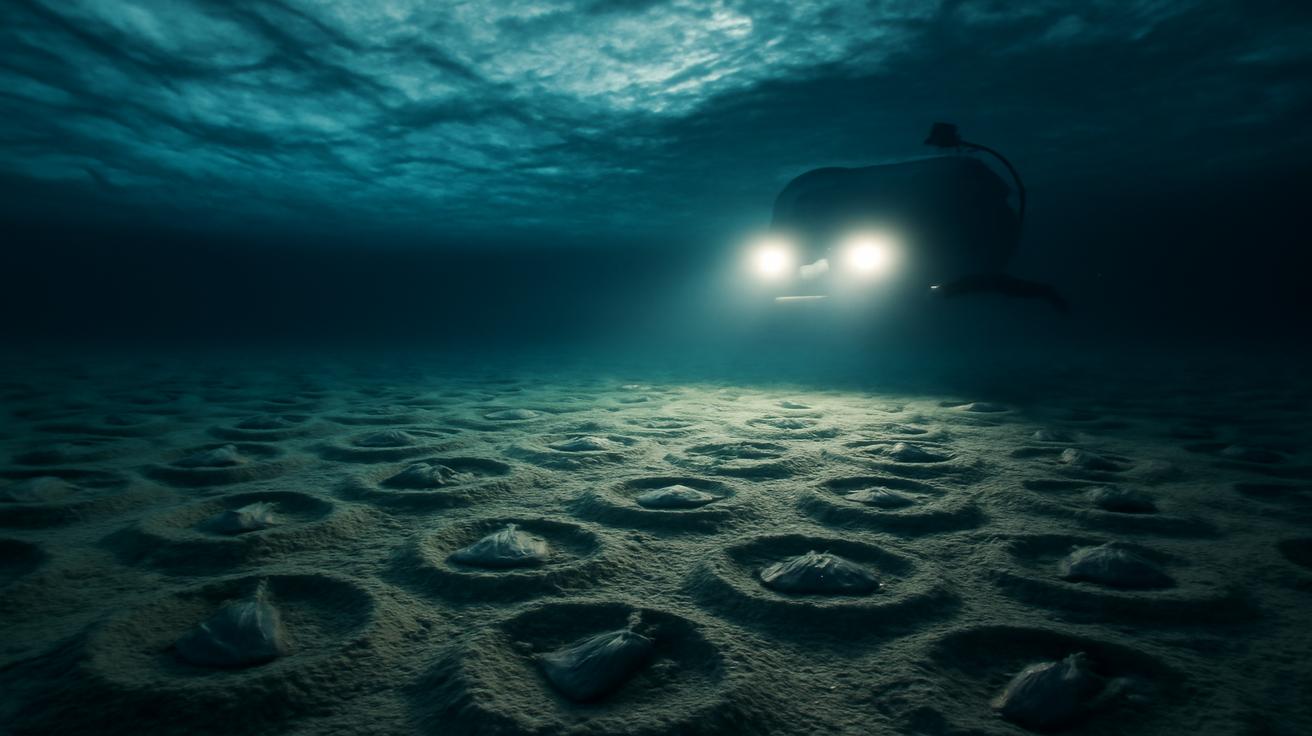
Then, without warning, something changed. The seafloor on the screen developed a pattern, like someone had walked across fresh snow leaving careful, circular footprints. Depressions appeared—perfectly shaped, rimmed with pebbles. In the center of each was a scatter of pale, spherical objects.
The scientists leaned in.
“Are those… eggs?” someone asked.
The circles kept coming. One. Five. Twenty. They appeared in neat, repeating clusters, all about the same size, all with a single fish hovering close by, tail moving just enough to hold position in the frigid current. The control room, usually softly murmuring with routine chatter, went quiet except for the hum of electronics and the gentle creak of the ship.
This was no random curiosity. This was a colony.
A Hidden City of Nests
The video seemed almost unreal. Each depression in the seafloor was roughly the width of a car tire, scooped out of the mud, ringed with small stones like someone had carefully landscaped each little circle. In the middle: clumps of eggs, glowing faintly in the artificial light of the camera, each egg barely larger than a pea yet bright with possibility.
Over nearly four hours of towing the camera, the team realized they weren’t looking at a few nests—they were crossing a landscape built by fish. The circles extended into the darkness, row after row like an underwater orchard. The more they measured, the more impossible it seemed.
When they finally did the math, the estimate landed like a small explosion: around 60 million active nests spread over hundreds of square kilometers beneath the ice. The researchers were stunned. In a part of the world thought to be sparsely populated and difficult to access, life had built something massive, organized, and utterly unexpected.
All the while, above this underwater city, the Antarctic surface held its careful disguise: flat ice, numbing cold, and the illusion of emptiness.
The Architects: A Little-Known Antarctic Fish
The nest builders belong to a group of fish called icefish, specifically a species known as Jonah’s icefish. They are not flashy. They do not race like tuna or leap like salmon. If you saw one floating in the camera beam, you might not look twice: pale, almost translucent, a body shaped like a typical bottom-dwelling fish, eyes dark and glassy, fins tucked, hovering just above its nest.
But icefish carry a secret more astonishing than any bright color: their blood is clear. Unlike most vertebrates, they lack hemoglobin, the red pigment that binds oxygen. In the gloom of cold, highly oxygenated Antarctic waters, they’ve evolved an extraordinary way of moving oxygen through their bodies without the usual iron-rich coloration. It’s as if their bodies have been tuned to the extreme environment so precisely that they can afford to let go of the molecule nearly every other vertebrate relies on.
To see one guarding a nest is to witness a quiet, stubborn devotion. The fish hovers over its circular patch of seafloor like a sentinel, sometimes resting right on the eggs, sometimes nudging a stone back into place along the rim. In many nests, only a single adult is visible, thought to be the male, fanning the eggs with gentle fin movements to keep water flowing and oxygen levels high.
In this cold, that care is not optional. The Weddell Sea’s bottom temperatures hover near freezing, and development is slow. The eggs may take many months to hatch, and predator pressure, though often out of sight, is constant. Every little movement by the guarding parent—each fin flick, each repositioning of a pebble—can mean the difference between survival and decay.
Why Here, and Why So Many?
To understand the magnitude of this nursery, imagine a vast, wide valley under the sea, gently sloping and bathed in water only a few degrees above the freezing point of saltwater. The nests are concentrated along this underwater terrain, especially around spots where slightly warmer, nutrient-rich deep water wells up from further below.
This upwelling seems to be key. Warmer is relative here—it might be a degree or two above the surrounding bottom water—but in the Antarctic, a single degree can redraw the map of where life can flourish. The slight warmth may speed up egg development just enough to matter, while the nutrients carried upward can feed plankton, which in turn support other creatures in the food web.
It’s as if the icefish have learned, over millennia, to read the invisible currents of the Weddell Sea and settle exactly where conditions narrowly favor their offspring. One nest, built by one fish, is a small act of life. Sixty million nests, each with a guardian and a mound of eggs, is an entire strategy written across the seafloor.
Scientists suspect that this nursery is not just important for the icefish themselves; it may feed the entire Antarctic ecosystem. When the eggs hatch, an enormous wave of juvenile fish likely floods the water column. These young icefish become food for seals, penguins, and other predators. Indeed, nearby observations of Weddell seals suggest they may spend a lot of time foraging over the nest fields, drawn to the predictable concentration of prey.
In that way, what happens in these quiet, unseen circles of mud and stone shapes the food chain all the way up to the charismatic animals that capture our imagination—the seals basking on ice floes, the penguins torpedoing through water, the whales cruising under the pack.
Seeing the Invisible: How We Found the Nursery
Finding such a vast breeding colony in one of the least accessible seas on Earth was no accident, but it also wasn’t guaranteed. It depended on technology, persistence, and a willingness to look carefully at what many might have dismissed as monotonous seafloor.
The key instrument was a towed camera system, slowly hauled behind the ship just above the bottom. It collected high-resolution images and video while sensors recorded depth, temperature, and salinity. The process is slow, like mowing a lawn with a flashlight—back and forth, meticulous, patient.
As the team reviewed the footage, each nest was logged, each fish counted, the density mapped. In some areas, the seafloor hosted over one nest per three or four square meters, a density that would be remarkable in any ecosystem, let alone under Antarctic ice. Acoustic mapping of the area added another layer, providing a broader view of the valley and allowing extrapolation of how far the nest fields extended beyond the camera’s narrow trail.
Below is a simple overview of how the discovery came together, and what makes the site so unusual:
| Aspect | Details |
|---|---|
| Location | Eastern Weddell Sea, Antarctica, beneath seasonal and permanent sea ice |
| Depth of nests | Roughly 400–500 meters below the surface |
| Estimated number of nests | Around 60 million active nests across several hundred km² |
| Nest characteristics | Circular depressions (~75 cm diameter), ringed with small stones, filled with thousands of eggs |
| Key species | Jonah’s icefish (a hemoglobin-free Antarctic icefish species) |
| Environmental feature | Influenced by slightly warmer deep-water upwelling that may aid egg development |
Even with such careful work, the discovery carried an element of luck. If the camera had been towed just a little higher, the nests might have appeared only as faint dimples, easy to overlook. If the survey lines had fallen in a slightly different place, the team might have crossed just the edge of the colony and dismissed the nests as a local oddity.
Instead, the camera happened to trace a route directly across the heart of the nursery. It was as though a spotlight had suddenly been aimed at a city that had been living in total darkness for millennia.
Antarctica’s Quiet Complexity
For many people, Antarctica exists in imagination as a white emptiness: a place of blizzards and creaking glaciers, of penguins huddled against the wind, of heroic explorers pushing sledges into oblivion. But the icefish nests tell a more nuanced story, one of hidden structure and slow, patient evolution.
Beneath the ice, life arranges itself according to rules that are only now coming into view. Microbes flourish in brine channels. Soft corals cling to rocky outcrops. Sponges, centuries old, filter water that has circled the globe. And in this particular valley of the Weddell Sea, millions of fish have transformed bare mud into a network of nurseries that shape who lives, who eats, and who survives.
There’s also a profound humility in realizing how recently we learned of their existence. For all our satellites and models and maps, vast corners of the ocean remain essentially blank to science. Entire ecosystems, like this nesting ground, can operate out of sight for as long as humans have been walking the Earth.
Standing on the deck of a ship in the polar twilight, it’s almost impossible to hold the image of that underwater city in your head. The ice floes slide past, indifferent. The wind gnaws at your cheeks. Somewhere beneath your boots, in the black water you cannot see, millions of fish hover over their nests, guarding the next generation against the cold.
From Surprise to Responsibility
Discoveries like this don’t stay just stories. They quickly become questions: How vulnerable is this nursery? What happens if the region warms? Could fishing fleets eventually target these icefish or disturb the seafloor? Should we act now to protect an ecosystem we’ve only just met?
At the moment, this part of the Weddell Sea is relatively untouched by commercial fishing. The logistics alone—thick ice, distance from ports, brutal weather—offer a kind of accidental protection. Yet history has taught us that remoteness is rarely a lasting shield. As technology improves and demand grows, once-inaccessible places become reachable, then exploitable.
Marine scientists and conservationists are increasingly arguing that areas like the Weddell Sea nursery deserve proactive protection. The logic is simple: when you stumble upon one of the largest known fish breeding colonies on Earth, you don’t wait to see what might damage it; you think about safeguarding it before the threats arrive.
This perspective fits into a broader shift in how we view Antarctica itself. No longer just a frozen backdrop for human ambition, it is recognized as a complex, living system with global impact. The water that forms around its ice shelves helps drive ocean circulation worldwide. The carbon stored in its waters and sediments influences climate. The creatures that inhabit its extremes represent evolutionary experiments that may inform everything from medicine to our understanding of life’s boundaries.
What These Nests Tell Us About the Future
Peering into the future of this vast nursery means considering forces that stretch far beyond the Weddell Sea. As the planet warms, even one or two degrees of temperature change could reshape Antarctic ecosystems. Sea ice extent, water circulation patterns, and the timing of plankton blooms—all critical ingredients for species like icefish—may shift.
Some changes might initially seem beneficial. Slightly warmer water could accelerate egg development, shortening the vulnerable phase when they sit as still, pale orbs on the seafloor. But warming can also bring mismatches. If the pulses of food that young fish depend on no longer align with their hatching, or if predators expand their range into formerly colder refuges, the carefully balanced success of the nursery could falter.
There’s also the question of cascading effects. If a crucial link like the icefish is disrupted, what happens to the seals that feed on them, or the larger predators that depend on those seals? What happens to the communities that share the same currents, the same subtle upwellings of warmth and nutrients?
In that sense, the discovery of the nests is more than a revelation about a single species. It’s a reminder that the Antarctic, so often painted in simple blacks and whites, is a web of relationships. Tug on one thread, and vibrations run outward into the blue distance.
Listening to the Ocean’s Quiet Stories
On that ship in the Weddell Sea, long after the first nests flickered onto the screen, the researchers kept watching. They watched until the shapes blurred and the camera feed felt like a dream of circles and fin flicks, of pebbles and eggs. Outside, night brushed against the ice, though in Antarctic summer, darkness is a relative thing.
In the following months and years, their footage would ripple outward—first through scientific papers, then through news stories, then into the minds of people who might never see Antarctica but would now carry a new image of it: not just a white desert, but a place where millions of fish settle in, season after season, in a deep, unseen valley to raise their young.
We often talk about the ocean as if it is silent, empty, or unknowable. Yet it is busy with stories like this, unfolding in the slow language of currents and migration, of nest-building and egg-guarding, of survival in places we once believed too harsh for such intricate life.
Next time you see a photograph of the Antarctic ice, that endless blue-white plane under a low sun, try flipping it in your mind. Turn the picture upside down. Imagine the ice as a ceiling, not a floor, and beneath it an entire world: cold, yes, but also crowded and purposeful. Somewhere down there, in the dim light of a camera you cannot see, a single pale fish drifts back to its nest, adjusts a stone with the soft brush of its tail, and resumes its long, patient watch over the future.
FAQ
How were the Antarctic fish nests discovered?
They were found during a routine seafloor survey using a towed camera system behind a research vessel in the Weddell Sea. Scientists reviewing the live video feed noticed repeating circular depressions filled with eggs and guarded by fish, revealing an enormous nesting ground.
What species of fish built these nests?
The nests belong to Jonah’s icefish, a type of Antarctic icefish known for its clear blood and extreme cold adaptations. These fish construct and guard circular nests on the seafloor, each holding thousands of eggs.
Why is this discovery important?
The colony is one of the largest fish breeding areas ever recorded, with an estimated 60 million active nests. It likely plays a crucial role in the Antarctic food web, supporting predators such as seals and influencing ecosystem dynamics in the region.
Are these nesting areas protected?
Currently, the area is relatively undisturbed due to its remoteness and harsh conditions, but it does not enjoy comprehensive, permanent protection everywhere. Scientists and conservation groups are advocating for stronger safeguards to protect the nesting grounds before industrial activities expand into the region.
Could climate change affect these fish nests?
Yes. Changes in sea temperature, sea ice cover, and ocean circulation could alter the conditions that make this nursery viable, such as slight deep-water warmth and food availability. Even small shifts may impact egg development, survival of young fish, and the predators that depend on them.







Leave a Comment