
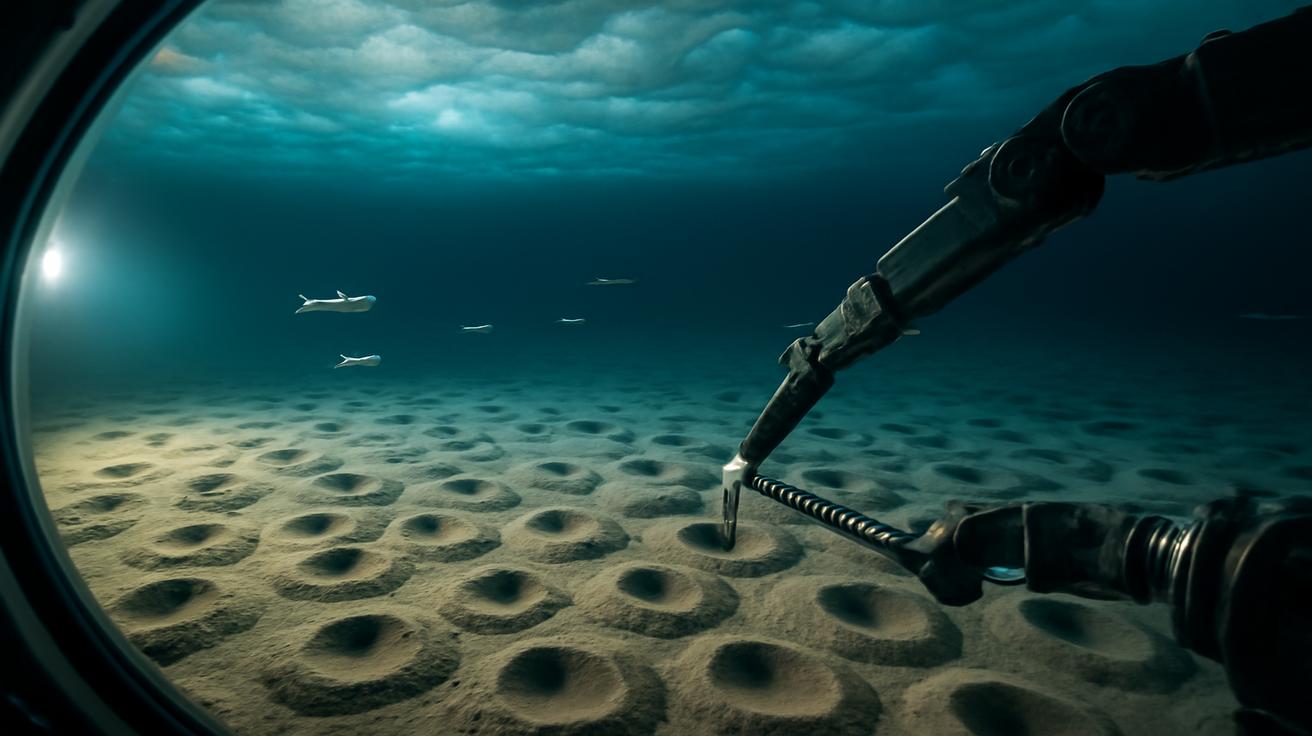
The sonar screen bloomed with strange circles—knots of brightness clustering on the seafloor like constellations. The research team on the German icebreaker Polarstern leaned in, squinting at the monitor, their coffee growing cold as their curiosity warmed. This was supposed to be a routine survey beneath the Antarctic ice, a quiet patch of the Weddell Sea that, on paper, promised very little excitement. Instead, something uncanny was staring back at them from the deep: neat, repeated shapes, over and over and over again. Not random, not geological. Intentional. Alive.
A Secret City Beneath the Ice
Imagine standing on a frozen plain of sea ice, wind scouring your face, horizon blurred by white and sky blending into snow. It is a place that, to the human eye, appears nearly empty—just ice and silence and the distant moan of the ship’s hull shifting against pressure ridges. Yet directly below your boots, 400 to 500 meters down, an immense city is pulsing with life.
The team from the Alfred Wegener Institute had threaded a fiber-optic cable through a narrow borehole in the ice, lowering a camera and sensors into waters that hover just below the freezing point of seawater. They anticipated a landscape of mud, scattered rocks, maybe the occasional sea star or sponge. Instead, the camera passed over a circular depression in the seafloor. Then another. And another. Each basin was ringed with stones, its center cleared of sediment, and in that cleared space lay a cluster of translucent eggs.
Nest. The word slipped into their thoughts almost shyly at first, like an absurd guess. Then the camera kept drifting, and hundreds more appeared in the cone of light. The absurd became undeniable. They weren’t staring at a few nests. They were staring at a sprawling colony of them—thousands, as far as the camera could see.
The Icefish Architects
The architects of this underwater city are not flamboyant coral-builders or towering kelp. They are icefish—more specifically, Jonah’s icefish (Neopagetopsis ionah), pale and ghostlike, creatures adapted to the brutal cold of Antarctic waters. Some adults hovered protectively above their nests, waving translucent fins to fan oxygen-rich water over the eggs. Others lay flush against the seafloor, their long, white bodies forming a living roof above their brood.
Icefish are strange even by polar standards. Their blood is nearly transparent, lacking the red hemoglobin that carries oxygen in most vertebrates. Instead, in the frigid, oxygen-rich waters of the Southern Ocean, they survive with a minimalist biology: large hearts, slow metabolisms, and antifreeze proteins circulating through their veins. If penguins are the cartoon mascots of Antarctica, icefish are the quiet oddities—overlooked, under-studied, and, until recently, assumed to lead solitary, unremarkable lives.
But the nests told a different story: this species is not just surviving beneath the ice; it is engineering one of the largest known fish breeding colonies on Earth.
The Moment the Numbers Hit
Back on the ship, once the initial shock settled, the scientists did what scientists do: they measured. Using high-resolution sonar and methodical transects, they mapped the nesting area. Each bright dot on the screen was one nest. The tally climbed.
Ten thousand. Fifty thousand. One hundred thousand.
The area kept expanding. By the time they had finished their calculations, the numbers felt unreal: roughly 60 million individual nests spread across a seafloor area of about 240 square kilometers—a space larger than many major cities. Each nest was about 75 centimeters in diameter, spaced only a few fin-lengths apart, an endless neighborhood of stone-ringed cradles.
It is hard to visualize sixty million of anything. Picture a crowded stadium: 50,000 people packed shoulder to shoulder. Multiply that by 1,200. Or imagine every seat in every large sports stadium on Earth filled, and you’re still nowhere near the number of icefish nests resting on the Antarctic seafloor, quietly incubating the next generation.
Life in a Place That Shouldn’t Have Much
The Weddell Sea, especially near the Filchner Ice Shelf where this discovery was made, isn’t the sort of environment we typically associate with abundance. Sunlight barely penetrates the thick sea ice. The water temperature hovers around -1.8°C, as cold as seawater can be without freezing. For much of human history, this region lay beyond our reach, avoided by ships wary of crushing pack ice and invisible hazards.
Yet even in this harsh place, nature has been quietly staging a spectacle. The icefish nests are not scattered at random. They cluster in warmer patches of water, where a subtle upwelling of slightly higher-temperature, nutrient-rich deep water rises along the continental shelf break. These micro-gradients—just a fraction of a degree warmer, a bit more oxygen, a touch more plankton—seem to matter tremendously to these fish. They have chosen, over evolutionary time, the best possible real estate in an extreme neighborhood.
To stand on the ice above this colony is to misread the world. The monotone surface suggests emptiness. The reality below is dense, vulnerable, and vibrantly alive.
The Architecture of a Nest
Each nest tells a story of effort. These are not passive hollows carved by currents. They are deliberate constructions. The adults shovel away the loose sediment, exposing cleaner substrate. Then they gather pebbles and small stones, moving them one by one with their mouths, forming a ringed boundary. The center is meticulously cleaned to hold thousands of eggs.
Some nests are brimming with bright eggs and guarded by a vigilant adult. Others stand empty, ring intact but no fish in sight—perhaps newly built, awaiting eggs, or abandoned after a failed breeding attempt. The scientists noted that roughly three-quarters of the nests held eggs, an astonishing rate of occupancy. It’s as if you flew over a human city at night and found lights on in nearly every apartment.
To give a sense of the scale and density, imagine scrolling through the following simple snapshot of the colony’s structure and significance:
| Feature | Approximate Value | Why It Matters |
|---|---|---|
| Total area of colony | ~240 km² | Comparable to a large metropolitan footprint beneath the sea ice. |
| Number of nests | ~60 million | One of the largest known fish breeding aggregations on Earth. |
| Nest diameter | ~75 cm | Each nest is a carefully engineered micro-habitat. |
| Eggs per nest | Up to several thousand | Billions of eggs overall, a vast engine of biomass. |
| Water depth | ~420–535 m | Demonstrates thriving life in deep, ice-covered environments. |
Every one of these nests is a gamble. In the months it takes for the eggs to develop, the guarding adult will barely feed, if at all. The fish hovers and fans, maintaining a delicate flow of oxygen, warding off scavengers. It is a vigil measured not in hours but in seasons.
Predators, Plankton, and a Hidden Food Web
From above, through the camera’s eye, the nests create a polka-dotted pattern of life. But in the water column, something else is happening: movement. Seals—especially Weddell seals, sleek and silver—dive repeatedly into this region, drawn by an invisible scent trail of food. The seals know about the fish colonies, of course. They have probably known for far longer than any human. To them, this is a buffet, a rich patch on their mental map of the sea.
It’s not just seals. The icefish colony is a living engine, pumping energy through the ecosystem. Icefish feed on small crustaceans and other invertebrates, converting the tiny, drifting life of the Southern Ocean into larger bodies that predators can hunt. Their eggs and larvae, in turn, become food for other organisms. The colony’s sheer size suggests that it may be a critical node in the food web, a place where matter and energy are concentrated in a way we never suspected.
For decades, satellites have watched the Southern Ocean from space, tracking swirls of phytoplankton blooms, shifting sea ice, and currents curling like brush strokes across the globe. Yet no satellite saw this. No fishing vessel stumbled into it. The colony waited, invisible, until the right cable, camera, and curiosity aligned.
How Do You Miss 60 Million Nests?
It feels almost comical to ask: how do you overlook something this enormous? The answer folds in on the limitations of our tools and imagination. Antarctic waters under stable sea ice are among the least explored environments on Earth. Ice is both a shield and a barrier; it locks out storms, but it also locks out most ships and their instruments. The seafloor beneath is dark, cold, and logistically expensive to reach. For many years, scientific attention has focused on more accessible edges—open water, continental shelves without heavy ice, places where gear and people can operate more freely.
The discovery of the nesting colony came only because the Polarstern was equipped with a towed camera system and advanced sonar, and because the team was willing to methodically map what many would have written off as “just another blank stretch” of seafloor. Serendipity helped: a slight change in route, a willingness to explore a plateau that looked unremarkable on older maps.
But beneath that serendipity lies a deeper truth: the planet still holds vast, uncharted realms, not on distant exoplanets but right here, under our own ice. What else is hiding in those blank blue patches on our maps?
The Emotional Weight of Discovery
For the scientists on board, the realization came not in a single cinematic gasp, but in a dawning, repeated shock. Hours into the survey, as the nests kept sliding beneath the camera, someone muttered that this had to end soon. It didn’t. The sonar track stretched on, and the dots—each representing a nest—maintained their stubborn density.
There is a particular kind of awe that arises when nature exceeds your mental capacity to tally it. It is the awe of standing beneath a forest of ancient trees or on the lip of a great canyon. On the Polarstern, the forest was digital—a glowing cloud of points on a screen—but the feeling was the same. You realize that your previous image of the world was too small, too incomplete, and it is being forcibly expanded.
Later, reviewing the footage on shore, the researchers watched icefish fanning their eggs in the deep cold, guardians in a place of permanent night. It is hard, looking at these ghostly parents, not to feel a sliver of kinship. The devotion to offspring, the investment of time and energy in the next generation—these are themes that cross the taxonomic divide.
A Nursery in a Changing Ocean
If this story ended at wonder, it would be simple. But the Southern Ocean is not static. The water around Antarctica is warming, subtly but steadily. Ice shelves are thinning. Currents are shifting. The very conditions that make this massive nursery possible—specific temperature ranges, oxygen levels, and current patterns—are under pressure from planetary change.
In that light, the discovery becomes urgent. It is one thing to protect a few isolated nests; it is another to consider the fate of millions clustered in one region. If ocean conditions shift beyond what icefish can tolerate, will this vast colony contract, fragment, or disappear? We do not know. We have found this place late in the story, with no long-term record of how it has changed over decades or centuries.
This uncertainty has quickly fed into discussions of conservation. The Weddell Sea has been proposed as a marine protected area, but political negotiations, as with many things in Antarctica, move slowly. Now there is a massive, visible reason to accelerate that process. This is not a theoretical biodiversity hotspot. It is a literal, sprawling nursery that we can see and map, right now, before industrial fishing or climate shifts have a chance to reshape it.
The Thin Line Between Curiosity and Impact
Exploration always carries a shadow: the risk that simply by discovering a place, we mark it for exploitation. Vast aggregations of fish inevitably attract commercial interest, even in remote Antarctic waters. Trawling fleets are increasingly capable, and the idea of tens of millions of breeding fish could be tempting to industries hungry for new frontiers.
Here, scientific humility becomes as important as scientific bravery. Knowing when to share, when to advocate, and when to push for strict protections is now part of the researcher’s job description. The team that documented the colony did not merely publish their findings; they framed them as a strong argument for urgent, precautionary conservation.
There is a quiet irony in this: a breeding colony that remained unknown for likely centuries is discovered just as human influence reaches even the planet’s coldest edges. The timing feels tight. The question is whether knowledge will arrive in time to safeguard, rather than simply record, what is there.
Redrawing Our Mental Map of the Poles
Stories like this one force us to redraw our mental maps. Antarctica is no longer just a white emptiness in the southern latitudes—a place of penguins, seals, icebergs, and heroic expeditions. It is also a place of invisible architecture: ringed nests, elaborate behaviors, ecosystems that flourish in what appears, from above, to be desolation.
Think of all the under-ice shelves not yet explored with modern instruments, all the glacial fjords where cold currents slip silently along the seabed. If an icefish mega-colony can exist unnoticed for so long, what about sponges the size of cars, coral gardens adapted to darkness, or other aggregations of life we haven’t yet named? Polar regions, long treated as static backdrops to climate narratives, are revealing themselves as dynamic, intricate biological theaters.
The unexpected discovery of thousands—then tens of millions—of fish nests is more than a headline. It is a reminder that our understanding of Earth’s most remote places is still in its infancy. The planet is not a solved puzzle. There are still pieces turned face-down on the table, waiting for someone to flip them over.
On a calm day in the Weddell Sea, the surface might seem unmoved by all this. The ice still creaks. The wind still prowls. But somewhere below, millions of translucent eggs are slowly changing, cell by cell, into the next generation of icefish. Parents hover, patient, under ancient ice. Seals dive and weave above them. Currents braid past stones arranged into careful rings.
We are, belatedly, learning to listen.
FAQ: Antarctic Icefish Nests and the Weddell Sea Discovery
What exactly did scientists discover beneath the Antarctic ice?
Scientists discovered an enormous breeding colony of Jonah’s icefish in the Weddell Sea. They found around 60 million individual nests spread across roughly 240 square kilometers of seafloor, each nest holding thousands of eggs and often guarded by an adult fish.
Why is this discovery considered so important?
The colony is one of the largest known fish breeding aggregations on Earth. Its size suggests a major hotspot of biomass and energy in the Southern Ocean, making it likely crucial for the broader Antarctic food web, including predators like seals. It also highlights how little we know about life beneath permanent sea ice.
How did scientists find the nests if they’re under thick sea ice?
Researchers aboard the icebreaker Polarstern used a combination of towed camera systems and high-resolution sonar. They lowered instruments through holes in the sea ice and systematically mapped the seafloor, revealing the circular structures and the fish guarding them.
Who are the icefish, and what makes them unique?
Jonah’s icefish are Antarctic fish adapted to extreme cold. They have nearly transparent blood with little or no hemoglobin, relying on cold, oxygen-rich water and specialized physiology to survive. They construct stone-ringed nests on the seafloor and invest heavily in guarding their eggs.
Are these nests or the fish currently protected?
Parts of the Weddell Sea are under discussion for designation as a marine protected area, but comprehensive, enforceable protection is still being negotiated internationally. The discovery has strengthened calls from scientists and conservationists to protect this region before fishing or climate impacts intensify.
Could climate change threaten this massive nesting colony?
Yes. The icefish colony depends on specific temperature ranges, oxygen levels, and current patterns. As the Southern Ocean warms and ice shelves thin, these conditions could shift, potentially affecting breeding success, food availability, and the long-term stability of the colony.
What does this tell us about unexplored parts of the planet?
The discovery demonstrates that even in the 21st century, vast and ecologically vital habitats remain unknown, especially under sea ice and in deep, remote waters. It’s a powerful reminder that our understanding of Earth’s oceans is far from complete, and that major discoveries may still lie in the least accessible places.








Leave a Comment