
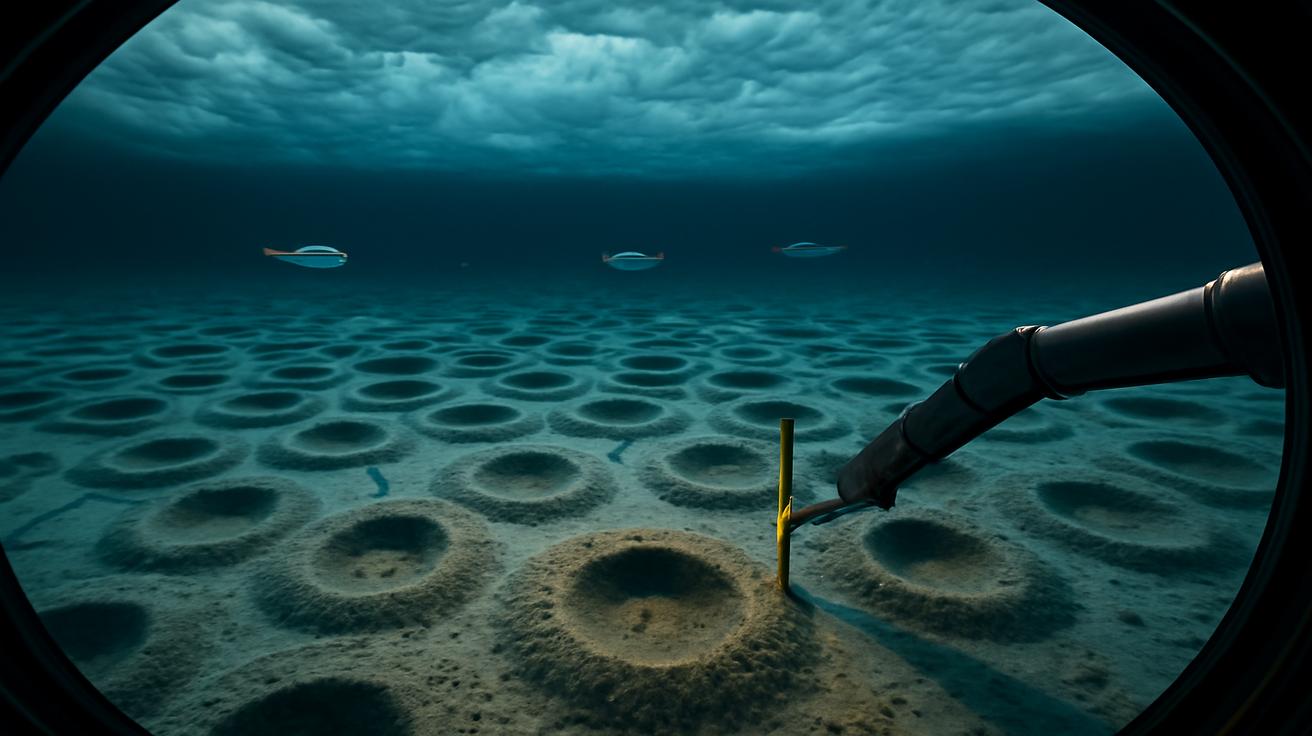
The first thing they saw was movement—tiny flickers of silver on the seafloor, where there should have been nothing but darkness and ice. The cameras, drifting slowly beneath the frozen ceiling of the Weddell Sea, caught the shimmer as if the ocean itself had exhaled a secret. Then the outlines emerged: circles, hundreds of them, then thousands, pressed into the sediment like ancient symbols. It took a few stunned minutes for the researchers to understand what they were looking at. Not random marks. Nests. Fish nests. A sprawling, living city hidden beneath Antarctic ice.
A Desert of Ice That Wasn’t Empty After All
For decades, Antarctic waters were treated scientifically like a kind of biological desert—a place so cold, so remote, that life was assumed to be sparse and slow-moving. Of course, there were penguins, seals, krill, and whales. But the deep seafloor beneath thick, permanent ice? That was expected to be mostly empty. A bit of mud. Some scattered invertebrates. The occasional ghostly fish drifting through the black.
So when a team of scientists, riding aboard a research vessel in the Weddell Sea, lowered a camera system through a hole in the ice, they were ready for long stretches of monotony. Just cables humming, monitors glowing, and images of endless gray sediment slipping by.
Instead, as the cameras glided a few meters above the seafloor, the screens burst into pattern and structure. Perfect circles dotted the bottom, each about the size of a kitchen table. At the center of each ring, a single icefish, pale and still, hovered like a guardian over a cluster of translucent eggs. It was as if someone had lifted the lid on an entire hidden neighborhood that had been there, quietly thriving, all along.
The scale of it didn’t sink in right away. The ship moved forward, and the camera kept sending back the same view—circle after circle, nest after nest. The scientists watched as minutes turned into hours and the screen never changed. The seafloor was absolutely crowded with life, extending beyond the edge of every frame.
The Hidden City of Icefish
The fish responsible for this astonishing sight are called Antarctic icefish—ghostly, almost translucent creatures, uniquely adapted to the extreme cold. Their blood is nearly clear, lacking red blood cells and hemoglobin. That might sound like a disadvantage, but in frigid, oxygen-rich water, it works. Their bodies have dialed in to the physics of cold, moving oxygen without the iron-rich pigment that makes most blood red.
For years, scientists knew icefish lived in these remote waters, but not like this. Not in a vast, concentrated colony spanning hundreds of square kilometers. What the cameras captured was one of the largest known fish breeding colonies on the planet—an estimated tens of millions of nests. Not a few dozen. Not a few thousand. Millions.
In each nest, a single, dedicated parent—usually the male—is on guard, fanning the eggs with gentle movements of its fins, keeping them oxygenated and clear of sediment. The circles in the mud are not random at all. They are carefully tended cradles, sculpted into existence by restless fins and instinct.
In the dim light of the cameras, the nests looked almost eerie. Pale fish hovering over shimmering clusters of eggs, their eyes reflecting the artificial glow. But there was also something deeply familiar about the scene. This was parenting, caretaking, the same ancient story unfolding at the bottom of the world in freezing blackness: the fierce, quiet labor of bringing new life into a harsh place.
How Do You Count a Million Nests?
At first, the discovery felt like a glitch. Could the cameras be circling back on the same area, replaying the same stretch of seafloor? The researchers checked their instruments, double-checked the coordinates, recalibrated the system. Everything was working perfectly. The ship kept moving in a straight line, and still, the nests never stopped.
To make sense of what they were seeing, the team mapped the area as precisely as they could. For hours, then days, the camera system trailed behind the vessel, collecting video and high-resolution images. The patch of seafloor they covered was enormous—hundreds of square kilometers—and yet almost every frame showed the same thing: nest after nest after nest.
By carefully stitching the data together, they realized they weren’t just looking at a dense cluster. They were seeing the edge of a supercolony, a vast breeding ground where the seafloor had effectively been transformed into a nursery. It was like flying over a city built not of buildings and roads, but of circular nests and hovering fish, extending in all directions.
To help visualize this incredible scale, here’s a simplified snapshot of what the researchers observed:
| Observation | Approximate Value |
|---|---|
| Estimated number of nests | In the millions |
| Area covered by colony | Hundreds of km² |
| Depth of seafloor | Around 400–500 m |
| Average nest diameter | Roughly 50–75 cm |
| Eggs per nest (typical) | Often thousands |
Even with conservative estimates, the number of potential offspring sheltered in this nursery is staggering. You’re not just looking at a community of fish; you’re looking at a major engine driving the food web of this region, maybe even the wider Southern Ocean.
Why Here? The Subtle Clues Beneath the Ice
The obvious next question is: why this place, of all places?
From above, the Weddell Sea looks uniform—an unbroken plain of white ice and blue shadows. But beneath that frozen lid, the ocean is anything but uniform. There are subtle gradients in temperature, currents that snake along the seafloor, and patches of water that carry more heat or oxygen than their neighbors. These tiny, almost invisible differences may be exactly what the icefish are tuned into.
When researchers overlaid their nest maps with physical ocean data, patterns began to emerge. The supercolony sits in an area where slightly warmer, nutrient-rich water rises close to the seafloor, enough to create a microclimate under the ice. It’s still brutally cold by human standards, but in the life-or-death calculus of an Antarctic fish egg, a fraction of a degree can mean the difference between development and failure.
There’s also the question of safety. Ice cover reduces surface storms and wave energy from reaching the depths. No fishing vessels drag nets across this bottom. The ice itself becomes a kind of shield, turning this stretch of seafloor into a protected nursery away from some of the more chaotic forces of the open ocean.
The Architecture of a Nest
Look closely at one nest, and you see the fish’s life imprinted in mud. The parent uses its body and fins to carve a shallow bowl into the sediment. This simple structure does a lot of things at once: it corrals the eggs, shelters them from drifting debris, and helps direct the flow of water. The nest is both cradle and filter, a small piece of architecture built from instinct and motion.
In some images, empty nests appear—circles scraped into the seafloor with no adult fish and no eggs. Were these abandoned? Already hatched? Claimed and then left behind? In others, the nests are full, packed with eggs like a translucent galaxy, with the guardian fish stationed at the center point, still but completely alert.
It’s easy to think of fish as solitary or unstructured, scattering their eggs at random and moving on. This discovery complicates that story. These icefish gather into dense, organized neighborhoods, investing energy and time into a place that offers their young the best odds. It’s not just survival of the fittest individual—there’s a kind of collective survival in creating a breeding ground on this immense scale.
Listening to the Colony: Life Beyond the Camera
While the camera gave the first glimpse, the scientists weren’t content with only images. They also dropped acoustic instruments into the depths—underwater microphones and sensors that could listen to and measure the rhythm of this unexpected city.
The soundscape beneath Antarctic ice is not silent. There’s the distant crack and groan of the ice itself, the hiss of tiny air bubbles rising, the whir of passing currents. Add to that the presence of millions of fish and their predators, and the water becomes a low, living murmur.
Seals and whales, in particular, may be tightly linked to this hidden colony. A concentration of fish and eggs of this magnitude is like a buffet laid out beneath the ice. Some seals in the region have been tracked diving repeatedly to similar depths, returning with full bellies. It’s not hard to imagine them homing in on the colony like seasoned foragers who know where the good winter markets are.
The Colony as a Food Engine
Consider the numbers: millions of nests, each holding thousands of eggs. Not all of those eggs will hatch, and not all hatchlings will survive. From an ecological standpoint, that “loss” is essential. Eggs and larvae that are eaten don’t simply disappear—they become energy transferred up the food chain. The colony feeds not just the next generation of icefish, but also the predators that depend on their abundance.
In a place where productivity is often highly seasonal—short, blazing bursts of life in summer followed by long, dim winters—this under-ice nursery might serve as a more stable, year-round resource for higher predators. It is, in many ways, an engine of the ecosystem, hidden beneath the very part of the planet we’ve studied the least.
A Reminder of How Much We Don’t Know
What startled many scientists around the world was not only the discovery itself, but what it implied: if we can still find something this large, this biologically significant, in one of the most studied “remote” regions of the ocean, what else are we missing?
The seafloor, especially under permanent or seasonal ice, remains one of Earth’s last great frontiers. It is difficult and expensive to visit. Cameras and sensors must endure crushing pressures and frigid temperatures for long periods. Storms, shifting ice, and isolation complicate every mission. So much of our picture of the deep ocean is still built from scattered snapshots.
This icefish colony feels like someone suddenly added a missing continent to the ecological map of Antarctica. It changes how we think about productivity, biodiversity, and even resilience in these frozen regions.
Conservation at the Edge of the Map
Discoveries like this also raise uncomfortable questions. If we’re only now finding these massive breeding grounds, what have we already disturbed elsewhere without knowing? Deep-sea mining, bottom trawling, and other extractive industries can erase seafloor habitats in a single sweep. Once gone, they may take decades—or centuries—to return, if they come back at all.
In the case of the Weddell Sea colony, the timing of the discovery intersects with ongoing discussions about marine protected areas in Antarctica. The existence of a supercolony of breeding fish lends new urgency and weight to the call for stronger protections. This is not just a patch of mud. It is a nursery that helps sustain a much larger web of life.
There’s a humbling irony here. The ice that makes these places so remote and difficult to access, the same ice that frustrates human exploration and exploitation, is what has allowed this hidden world to thrive. But as climate change reshapes polar regions, that protective barrier is shifting, thinning, and, in some places, disappearing.
What This Discovery Teaches Us About Wonder
Strip away the numbers, the charts, the acronyms, and you’re left with something very simple and very human: wonder. A ship floating in a freezing sea, a cable unspooling into darkness, a small cluster of people staring at a monitor in disbelief as the world quietly reveals itself in circles of mud and fin and egg.
It’s easy to imagine that Earth is fully mapped, its mysteries wrung out by satellites, drones, and decades of research. Stories like the Antarctic icefish nests are a reminder that this sense of completion is an illusion. Whole cities of life are still out there, especially where conditions are hardest for us, in the depths, beneath ice, suspended in the water column far from shore.
The discovery also tugs at something older in us—a recognition that other beings, in other places, are living out dramas of care, risk, and survival that we rarely see. A pale fish guarding its eggs in 500 meters of water under a slab of ice might seem a world away from our daily lives. And yet, the scene is strangely familiar. A parent tending a nest. A community built around the needs of the young. A landscape shaped quietly by the persistence of life.
Some of the researchers on that ship will likely remember that moment of first seeing the nests for the rest of their lives. Not because it was a confirmation of a hypothesis, but because it wasn’t. It was a surprise—a crack in the assumption that we already know the outlines of the living world.
In the end, the story of the Antarctic icefish colony is as much about us as it is about them. It’s a reminder that curiosity is still rewarded, that venturing into the hardest places can bring back not just data, but perspective. It tells us that even under a surface we think is solid and closed—whether that surface is sea ice or certainty—there can be teeming, unsuspected abundance.
Somewhere right now, under Antarctic ice, those nests are still there. Parents still hover. Eggs still slowly divide and grow, their tiny hearts beginning to beat in the thin, clear water. Entire generations rise and fall without a single human eye on them. The cameras will come back, eventually. More instruments will follow. But the colony doesn’t wait for us. It goes on, circling through its own ancient calendar, proof that life doesn’t need us to be extraordinary.
FAQs About the Antarctic Icefish Nest Discovery
What exactly did scientists discover beneath the Antarctic ice?
They found a massive breeding colony of Antarctic icefish on the seafloor of the Weddell Sea, consisting of millions of circular nests, each tended by an adult fish and often filled with thousands of eggs. It is one of the largest known fish nesting areas on Earth.
How did researchers find these nests if they are under thick ice?
Scientists used a towed camera system lowered through a hole in the sea ice. As the ship moved, the camera glided above the seafloor, sending back continuous video and images that revealed the nests. Additional sensors and acoustic instruments helped map and study the area.
Why are these nests so important for the Antarctic ecosystem?
The colony represents a huge source of biomass—eggs, juveniles, and adult fish—that likely supports many predators, including seals and possibly whales. It functions as a major nursery, helping maintain food webs in a region where life is often limited by extreme cold and seasonal change.
Are these icefish different from other fish?
Yes. Antarctic icefish are uniquely adapted to polar conditions. Their blood is nearly clear, lacking hemoglobin and red blood cells. They rely on the cold, oxygen-rich waters of the Southern Ocean and have specialized physiology to survive and reproduce at near-freezing temperatures.
Is this area protected from human activities?
Parts of the Weddell Sea are relatively remote and difficult to access, which offers some de facto protection. However, formal marine protected areas and regulations are still evolving. The discovery of this immense breeding colony has intensified calls for stronger, legally binding protections in the region.
How could climate change affect this fish colony?
Changes in sea ice cover, water temperature, and ocean currents could alter the delicate conditions that make this site ideal for nesting. Warmer waters or reduced ice could change predator access, oxygen levels, and seafloor conditions, potentially threatening the stability of the colony.
Will scientists go back to study the nests again?
Yes. Such a remarkable find almost guarantees follow-up expeditions. Future missions will likely use more advanced cameras, long-term sensors, and perhaps autonomous vehicles to understand how stable the colony is over time, how often fish return to nest, and how the wider ecosystem depends on this hidden nursery.








Leave a Comment