
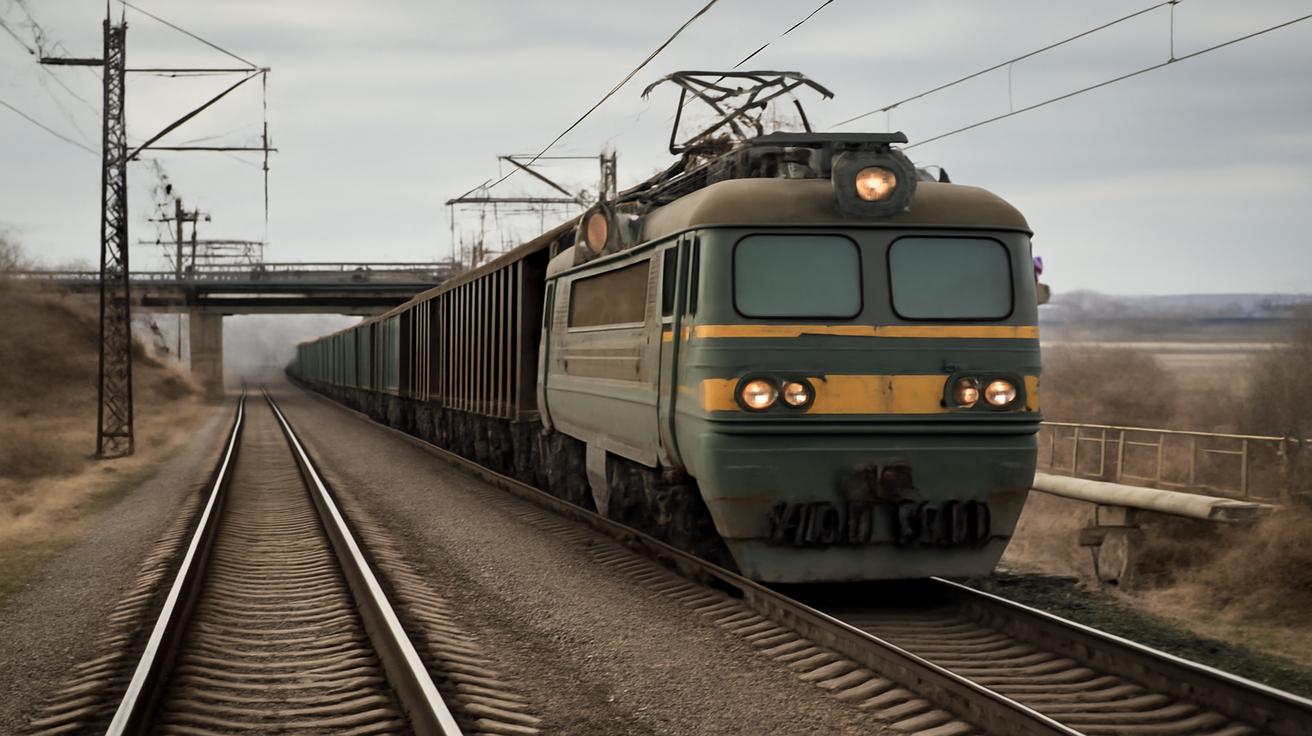
The news flashes around the world talked about fighter jets first. A hundred French Rafales, possible game-changers in the sky above Eastern Europe. The numbers were dramatic, the headlines punchy, the debate instant. Yet, behind this thrum of aerial power and politics, a quieter story rumbled on steel wheels—one that might matter just as much to the survival, recovery, and soul of Ukraine: a €470 million deal to keep a single, crucial railway line alive.
A River of Steel Through a Wounded Country
If you stand near a Ukrainian rail line at dawn, before the day’s sounds properly wake, you’ll hear something that feels almost like breathing. The far-off hum of a diesel engine. The soft clank of metal on metal. The low, sighing whistle that slips through mist and early light, touching villages that have known too much fear and too many sirens.
Ukraine has one of the densest railway networks in Europe, a sprawling system that predates independence, predates the Soviet Union, and in some places even predates the twentieth century. These rails carried coal and grain, timber and steel, students and soldiers, lovers and families. Today, they also carry lifelines: fuel, humanitarian aid, evacuations, and the quiet determination of a country that refuses to stop moving.
When the full-scale invasion began in 2022, many predicted the network would collapse under missile strikes and occupation. Instead, the trains kept running. Stations became shelters. Platforms turned into improvised clinics. Conductors became guides to safety, their uniforms suddenly as symbolic as any military fatigues. For many Ukrainians, the sound of a train horn in the distance became a promise: we are still connected; we are still here.
But steel ages, bridges crack, and lines that have survived empires can struggle to survive war. Among them is one key artery—strategically vital, economically essential, and structurally endangered. It’s this rail corridor that lies at the heart of the €470 million deal that quietly accompanied the noise about Rafales. One part war story, one part engineering saga, one part act of faith in the future.
The Hidden Spine: Why One Rail Line Matters So Much
To outsiders, a single rail route may sound like a technical detail in a vast conflict. To Ukrainians working in logistics, agriculture, or industry, it’s closer to an exposed nerve. This corridor is one of the threads that knot together east and west, front line and rear, farm and port, mine and factory. It channels grain from interior fields toward export hubs, ferries fuel and construction materials, and, on some days, still delivers children returning from displacement to the towns they once called home.
In wartime, railways are less about romance and more about survival mathematics. Trucks can be destroyed individually; roads can be chewed apart by tank treads and craters. Planes are powerful but expensive, with limited cargo capacity and high political cost. By contrast, a single freight train can haul the equivalent of hundreds of lorries. It’s slower, yes, and tied to fixed tracks—but that predictability is exactly what lets an entire economy breathe.
Yet this line, critical as it is, has been straining under damage, overuse, and strategic pressure. Bridges built for peacetime loads now contend with continuous military and humanitarian traffic. Tunnels designed in another era must handle modern rolling stock and emergency rerouting as other lines fall under fire. Some sections have been patched so often they resemble scars more than infrastructure.
Engineers from Ukrzaliznytsia—the state railway operator—walk these tracks like doctors checking a fragile patient. They crouch to inspect hairline fractures. They listen to vibrations under passing wheels. They weigh, constantly, the risk of closure against the cost of collapse. And they know: if this line fails, the impact won’t be measured in minutes of delay, but in shortages, rising prices, interrupted evacuations, and strategic weakness.
The Deal in Numbers: A Different Kind of Defense
So when news emerged of a €470 million agreement tied to this railway, it felt, to those who watch the country’s pulse through logistics and trade, like a small miracle wrapped in paperwork.
Here’s how it roughly breaks down:
| Aspect | Details |
|---|---|
| Total value | €470 million |
| Primary goal | Secure and modernize a critical rail corridor |
| Key components | Track rehabilitation, bridge reinforcement, signaling upgrades, rolling stock support |
| Time horizon | Multi‑year, stretching from active conflict into reconstruction |
| Strategic impact | Maintain supply routes, support exports, enable recovery and reinvestment |
In a world of billions pledged and promised, €470 million can sound modest. But in infrastructure terms, it is transformative—especially when targeted so precisely. It doesn’t buy headlines like a hundred fighter jets. What it buys instead is time, resilience, and the quiet certainty that the country’s arteries won’t clot while the world’s attention drifts in and out.
Steel, Sleep, and Survival: Life Along the Line
To understand what this rail lifeline means, you have to picture the people whose days are mapped to its rhythm.
Take a small town that sits beside the tracks, one of countless dots you’ll pass if you ride the night train across Ukraine. Before the war, its station café served hot borshch to commuters and students tumbling off evening trains. Now, the same platform might see exhausted mothers shepherding children wrapped in donated blankets, elderly men carrying canvas bags with their entire lives folded inside, volunteers handing out tea at midnight in chipped mugs.
When trains arrive from the east, they may carry wounded soldiers on stretcher bunks, flickers of blue and white medical tape visible through the dim carriage light. When they head west, their cargo could be grain destined for distant ports, a reminder that even under bombardment, Ukraine remains one of the world’s breadbaskets.
All along this line, the war has reshaped daily rituals. Families learn to sleep with the faint tremor of passing freight; for some, it is a lullaby of continuity. Children count wagons for distraction when air‑raid sirens wail. At night, the distant growl of locomotives weaves with the rasp of generators and the hiss of stoves boiling water in darkened kitchens.
For railway workers, the stakes are brutally clear. They repair tracks under the risk of shelling, using portable floodlights that cast stark, theatrical shadows across the ballast stones. They ride open maintenance trolleys through landscapes pocked with craters, past forests where trees lean at odd angles, bark stripped by shrapnel. Their conversations are filled with words like axle load, switch failure, voltage—and also with rumors of new offensives, new sanctions, new aid packages.
Those workers know that a delayed military shipment can change a battle. They also know that a delayed grain shipment can change a village’s income for the year. In that narrow space between urgency and exhaustion, infrastructure becomes personal.
Between Rafales and Railcars: Two Faces of Support
When France floated the prospect of providing 100 Rafale fighter jets to Ukraine, the symbolism was immediate. Sleek supersonic aircraft scream power, deterrence, a kind of cinematic modernity. They are the sharp edge of survival. The €470 million rail deal, by contrast, moves at a slower story speed—but its plotline is just as consequential.
Jets may protect the sky; railways protect everything that moves beneath it. Fighter aircraft can shape the front line; freight trains shape the home front. The fighter is the shield; the rail line is the bloodstream.
Supporters of strong military aid argue that without air defense and strike capability, no infrastructure is safe. They’re not wrong—but the reverse is also true. Without functioning infrastructure, even the best-equipped army struggles to maintain supplies, rotate troops, or rebuild liberated areas.
This is where the dual architecture of support becomes clear. Combat systems answer the immediate threat of violence; rail investment answers the slower, but no less dangerous, threat of economic collapse and social fragmentation. One shouts; the other hums. Together, they sketch a future in which Ukraine is not just defended, but livable.
Engineering Hope: What €470 Million Actually Does
Step aside for a moment from geopolitics, and imagine the tactile reality this money will touch.
It begins with surveys: orange‑vested teams walking the line, handheld devices blinking as they measure subsidence, micro‑fractures, and track geometry. They note every leaning catenary mast, every corroded bolt, every culvert whose flow has been altered by the churn of war. Their maps look like medical scans—x‑rays of a patient in recovery.
Then come the interventions. Heavy rail cranes trundle in to replace damaged sections. New concrete sleepers, still smelling faintly of cement dust, are stacked like white bones under an overcast sky. Welders’ torches spit light into evening fog as they join rails into long, smooth ribbons that will reduce jolts and maintenance needs. Bridges are shored up with additional steelwork, their old rivets sharing the load with modern fastenings.
Signal boxes, some dating back decades, are replaced or upgraded with digital systems that can route trains more efficiently and respond faster to disruptions. Fiber‑optic cables are buried beside the track, connecting stations and control centers with data that may one day do more than manage conflict traffic—it may also support commerce, commuter flows, and regional integration when the guns finally fall silent.
Rolling stock, too, gets a share of attention. Funds help maintain locomotives working far beyond their original service life, support procurement of new or refurbished carriages, and adapt wagons for flexible use—today carrying humanitarian supplies, tomorrow construction materials for rebuilding cities.
None of this looks glamorous from a distance. But for the dispatcher who can now run more trains per day without risking collisions, for the farmer whose harvest will reach a border crossing before it spoils, for the medic whose cargo of bandages and antibiotics arrives on time after a track upgrade eliminates speed restrictions, it is nothing less than transformative.
Climate, Grain, and the Long After
There’s another layer to this story that rarely fits into breaking‑news headlines: the future beyond the war. Railways are, by their nature, long‑horizon infrastructure. Tracks laid today may still be in service in fifty or even a hundred years, resurfaced and upgraded but fundamentally following the same paths.
In a warming world, trains are also one of the most climate‑friendly ways to move heavy goods and large numbers of people. Every tonne of grain moved by rail instead of road is a small but real reduction in emissions. When you scale that up to millions of tonnes—Ukraine’s annual exports can reach such figures—the sums start to matter on a planetary level.
The €470 million deal, then, is not just about wartime logistics. It’s about making sure that when peace comes, Ukraine can rejoin and reshape the global economy without locking itself into a car‑and‑truck‑centric model that the rest of the world is already trying to escape. Electrification projects, where feasible, will reduce dependence on imported fuel. Modern signaling will increase capacity on existing lines instead of carving new scars across the landscape.
And then there is the grain. Ukrainian wheat, sunflower oil, and corn flow not just as commodities but as threads connecting distant lives. A loaf of bread in North Africa, cooking oil in Asia, feedstock in Europe—these, too, depend on whether a line deep inside Ukraine can keep running.
The Human Geography of Tracks and Ties
Walk along the verge of a Ukrainian rail line and you’ll notice how it has quietly orchestrated human settlement. Villages gather near stations like planets around small suns. Market days are set by train schedules. Storylines—who moved where, who left, who returned—are mapped along these rails.
In wartime, this geography shifts but does not vanish. Station buildings, with their flaking pastel paint and old wooden benches, become information hubs; notices about evacuations are taped next to timetables. Volunteer networks form around platform edges: people who know when refugees are most likely to arrive, which trains carry the wounded, when a rare convoy of building materials will roll in for a hastily planned reconstruction project.
In some places, the line skims close to front‑line regions, a steel boundary between contested territories and relative safety. There, conductors ride with windows darkened, announcements hushed. Soldiers lean against carriage doors, half asleep, boots dusty; a child, face pressed to glass, glimpses ruined houses sliding past in grainy silhouettes.
All of this—the fear, the endurance, the unexpected kindness of a shared bench—is held together by the simple fact that the trains still move. The €470 million is, on one level, a technical intervention. On another, it’s a pledge that this fragile choreography of survival won’t be abruptly halted by a failing bridge or a buckled track.
Beyond the War: Imagining the First Truly Peaceful Journey
Someday, a traveler will board a train on this line not because they are fleeing bombardment or returning after displacement, but because they are simply going home for a holiday, or off to university, or chasing a new job in a rebuilt city. The carriage will smell of coffee and packed lunches instead of tension and fatigue. Conversations will drift from football scores to wedding plans, not casualty lists.
That journey will depend on decisions made today, on the political will to see infrastructure as more than concrete and steel. It will depend on whether the world chooses to understand that war isn’t only fought with jets and missiles, but also with invoices for ballast stones, training courses for signal engineers, and long meetings about axle loads and bridge spans.
When that first truly peaceful journey comes, maybe someone will look out the window at a repaired bridge or a newly electrified stretch of track and not even know the story of how close it came to failure. Maybe the rails will just be part of the landscape again, like rivers and roads and power lines—quietly doing their work, carrying lives forward.
Yet for those who remember, the clatter of the wheels will sound like something more: proof that in the balance between spectacle and substance, someone chose to invest not only in the might of the sky, but in the humble, steadfast power of a rail lifeline on the ground.
Frequently Asked Questions
Why is this single rail line so important to Ukraine?
This corridor is a key east‑west artery for Ukraine, carrying fuel, grain, humanitarian aid, industrial goods, and sometimes evacuees and wounded soldiers. If it fails, the impact would ripple through logistics, exports, local economies, and military supply chains.
How does the €470 million deal relate to the Rafale jets?
Both are parts of broader support for Ukraine but serve different purposes. Rafale jets symbolize military strength and air protection, while the €470 million rail deal strengthens internal resilience, economic stability, and long‑term recovery capacity.
What exactly will the €470 million be used for?
The funds are aimed at modernizing and securing a crucial rail route: rehabilitating tracks, reinforcing bridges, upgrading signaling and communications, maintaining and improving rolling stock, and supporting some electrification and capacity enhancements.
Is this investment only useful during the war?
No. While it has immediate wartime benefits—keeping supplies and evacuations moving—it also lays the foundation for post‑war reconstruction, export growth, and lower‑carbon transport over the coming decades.
How does this rail project affect global food security?
Ukraine is a major exporter of grain and other agricultural products. Reliable rail connections are essential to move harvests from fields to ports and borders. By protecting this lifeline, the project helps stabilize food supplies and prices far beyond Ukraine’s borders.








Leave a Comment