
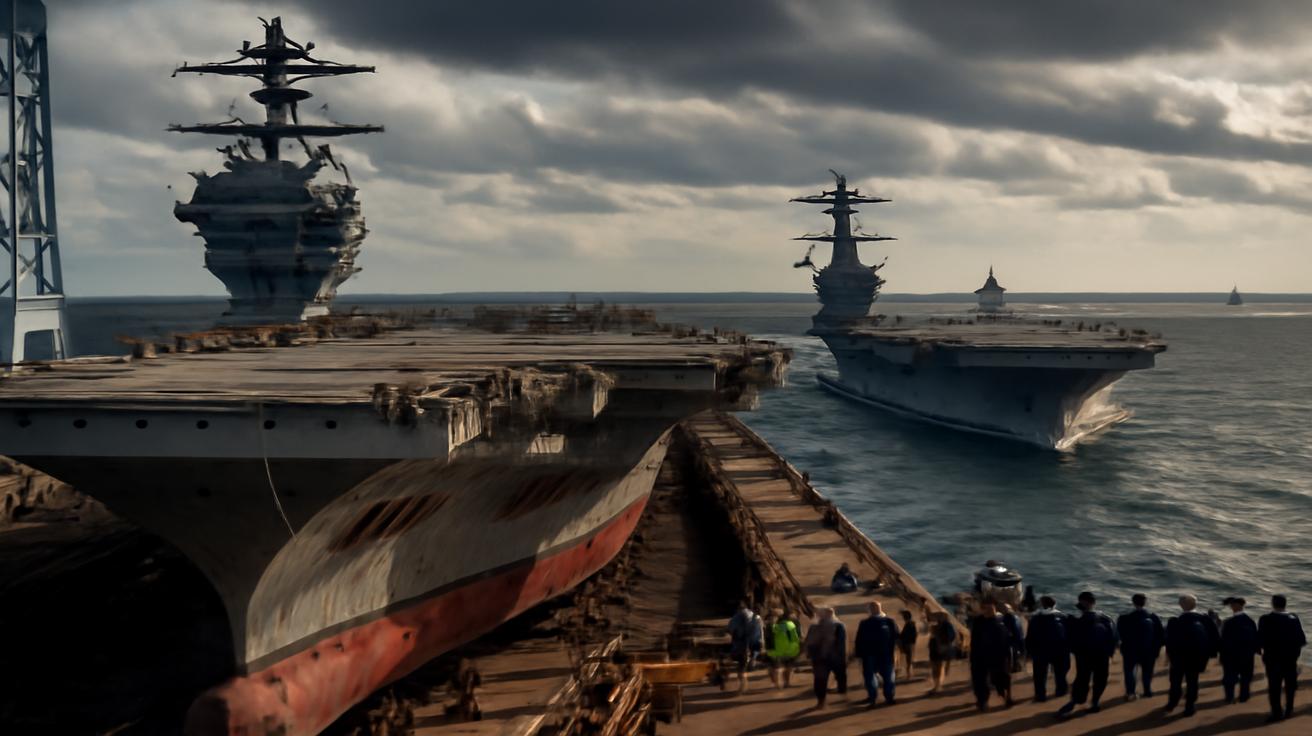
The ocean at dusk looks almost gentle from a distance—steel-blue water, a faint lavender band on the horizon, and a ship that seems improbably large and yet oddly quiet. Only up close do you feel it: the low, ever-present vibration of thousands of tons of moving metal, the tang of jet fuel riding the wind, the sudden thunder of engines as a fighter roars down the deck and vanishes into the darkening sky. This is where the USS Gerald R. Ford, the first of America’s newest class of aircraft carriers, has finally arrived—not in a training exercise or a trial run, but in the theater of real-world operations. And far from these waters, in cavernous dry docks lit by welding sparks and sodium lamps, her sibling—the future USS John F. Kennedy—is taking shape faster than originally planned.
A New Kind of Giant at Sea
On paper, the moment was always destined to come: the U.S. Navy’s first Ford-class carrier, the USS Gerald R. Ford (CVN-78), would eventually leave the realm of tests and trials and step into live deployments, operating alongside destroyers, cruisers, submarines, and allies across contested waters. But there’s a difference between “planned capability” and the echoing boom of a catapult launch reverberating off the hull as pilots take off on missions that actually matter.
With Ford now moving into genuine combat operations—supporting real tasking, not just exercises—the symbolism is difficult to ignore. After years of cost overruns, delays, and skeptical headlines, the Navy’s great “next-generation experiment” is no longer hypothetical. It’s here, and it’s working.
Back home, in the sprawling industrial heart of Newport News, Virginia, the response has been both practical and urgent: accelerate. The USS John F. Kennedy (CVN-79), the second Ford-class carrier, was always going to follow her older sister. But as global tensions sharpen and near-peer adversaries invest heavily in anti-ship missiles, hypersonic weapons, and their own naval forces, the calendar has grown tight. The U.S. Navy doesn’t just want Ford-class carriers at sea—it needs them, sooner rather than later. That urgency is now written into the Kennedy’s hull plates, into the long shifts of welders and fitters, into the timelines pushed and re-pushed to bring the ship online faster.
The Moment Ford Crossed an Invisible Line
There’s no single horn blast or ceremonial phrase that marks the moment a ship “enters combat,” especially in an era where conflict can be gray, distributed, and more about presence than full-scale war. But you can feel the shift onboard.
Sailors, once focused on drills and simulations, now talk in quieter tones about real-world tasking. Flight deck crews move with the same drilled precision as always, but there’s a new tension visible when they scan the sky or the waterline. Somewhere beyond the horizon, an adversary is watching, measuring, calculating. And the Ford, at last, is no longer a test case—it is a factor in those calculations.
This ship is different, physically and spiritually, from the Nimitz-class carriers that have dominated the seas since the 1970s. Where older carriers rely on steam-powered catapults to launch aircraft, the Ford uses EMALS—the Electromagnetic Aircraft Launch System. Instead of massive towers of steam and the hiss of pressure being vented, launch energy surges invisibly along magnetic rails, smooth and controlled. Pilots talk about the difference in feel: less violent lurch, more steady pull, easier on both aircraft and aircrew.
Below decks, advanced arresting gear replaces older hydraulic systems, using digital controls and electric motors to capture incoming jets with a tailored, precise tension. Advanced radar systems sweep the skies with greater sensitivity, tracking more targets at once. The ship’s dual nuclear reactors generate roughly 25% more power than the Nimitz-class, and that surplus is a bet on the future—energy not just for what’s installed today, but for systems that may come later: directed-energy weapons, more powerful sensors, new generations of drones and electronic warfare suites.
For years, critics described Ford in terms of what it wasn’t doing—planes not launching, elevators not working, systems still in test. Now, those same features are stressed and proven in real seas, real weather, real tension. The invisible line between “prototype” and “warship” has been crossed.
The Silent Pressure on the Shipyards
Far from the sea spray and deck-edge noise, the drive to accelerate the next carrier feels different. In the Newport News shipyard, it smells like cutting oil and hot steel, and sounds like the staccato crackle of welding arcs, the groan of cranes, and the shouted directions of crews coordinating moves involving components that weigh as much as office buildings.
The future USS John F. Kennedy (CVN-79) doesn’t look like a warship yet to a casual observer—she’s an evolving lattice of steel and compartments, blocks fused together into something roughly carrier-shaped. But to the people working 10-, 12-, and sometimes 14-hour shifts, she is already a living presence. When the Navy said, “We need her sooner,” that wasn’t just a line item in a budget document. It became an acceleration in every daily schedule posted in foreman offices, in every logistics update for materials arriving by rail and truck, in every weekend when the yard lights stayed on.
Aircraft carriers are not simply built; they are assembled like giant, floating cities. Modular construction means enormous pre-outfitted sections—some the size of apartment complexes—are lowered into place and welded with microscopic precision. The Kennedy’s “island,” the tower rising above the flight deck, has to be fitted with radar arrays, antennas, navigation systems, and command centers that will one day coordinate hundreds of aircraft movements and thousands of personnel.
As Ford proves herself at sea, every successful sortie, every day of smooth deck operations, every system that works just as engineers promised gives shipbuilders and planners another reason to press harder on the Kennedy’s timeline. The Navy can point offshore and say: She’s doing exactly what we built her for. Now let’s get her sister joining her sooner.
Why Speed Matters in the Ford–Kennedy Era
Behind the romantic imagery of carriers at sunset and jets arcing into a purple sky lies a colder calculus: capacity and timing. In a world of renewed great-power competition, with the Pacific and high North Atlantic as contested spaces, the U.S. Navy’s ability to field advanced carriers is part deterrent, part insurance policy.
Each Ford-class carrier doesn’t operate alone—it is the centerpiece of a carrier strike group, a floating hub of air power, surveillance, and command that projects not just firepower but also reassurance to allies. When one ship enters deployment, another is in maintenance, another in training, and another under construction. That cycle only works if new ships arrive when they’re supposed to—or, now, sooner.
The Kennedy’s acceleration isn’t just about an arbitrary date; it’s about closing gaps and ensuring that the Navy’s most capable platforms don’t exist as one-of-a-kind showpieces. A lone advanced carrier is impressive. A class of them, deployed around the globe, is strategy. The more quickly Kennedy transitions from shipyard project to sea trial, from pier to blue water, the faster that strategy hardens into reality.
To make the accelerated timeline real, the Navy and the shipyard have pushed for greater use of digital design tools, improved supply-chain forecasting, and lessons learned from Ford’s construction. Missteps and delays on the first ship become “do not repeat” markers for the second. What took a dozen refits or workarounds aboard Ford can be built “right the first time” on Kennedy. On the waterfront, efficiency is not just an economic perk—it’s another way of translating urgency into steel.
A Glimpse into the Ford-Class Evolution
From the outside, the Ford-class carriers share the unmistakable silhouette of their predecessors: a flat-topped, 1,092-foot runway, an island rising on the starboard side, planes arrayed in neat but somehow chaotic patterns across acres of non-skid deck. But the changes within this new class are profound in how they shift operations, manpower, and long-term capability.
The Navy’s ambition for this class was to increase sortie rates—how many aircraft can launch and recover over a given period—while reducing crew size and lifecycle costs. Automation plays a quiet but powerful role. Elevators for weapons and munitions, improved material handling systems, and more advanced maintenance monitoring all combine to do more with fewer people.
For sailors, this means a different kind of life at sea. Fewer bodies packed into berthing spaces, more modern work centers, more digital systems to manage. For the Navy, it means ships that cost an extraordinary amount upfront but pay back some of that investment in decades of reduced operating expenses.
The Kennedy will not be a carbon copy of Ford. She is the second iteration, the first chance to embed “lessons learned” at build-time rather than retrofit-time. Tiny changes in pipe routing, compartment layout, or cable runs can save hundreds of labor hours over the life of the ship. Incremental improvements in software, power distribution, and integration of future systems mean Kennedy is already, in some ways, a step beyond her older sister—even as she races to catch up to her in operational status.
| Feature | USS Gerald R. Ford (CVN-78) | USS John F. Kennedy (CVN-79) |
|---|---|---|
| Class | First-in-class Ford-class carrier | Second Ford-class carrier |
| Status | Deployed, entering combat operations | Under construction, schedule accelerated |
| Launch System | EMALS (Electromagnetic catapults) | EMALS with design refinements from Ford experience |
| Arresting Gear | Advanced Arresting Gear (AAG) | AAG with updated components and integration |
| Power Generation | Next-gen nuclear reactors, surplus power margin | Same core design, optimized for future systems |
| Crew & Automation | Reduced crew vs. Nimitz, high automation baseline | Further refined layouts and automated workflows |
On the Flight Deck, Time Compresses
Out on Ford’s flight deck, where the ship’s purpose becomes most visible, time is measured in seconds and meters. A jet taxis into position. The deck crew—green, yellow, red, purple shirts—move like a single organism, each color-coded role part of a choreography honed by repetition and enforced by necessity. A missed signal, an unseen hazard, and the consequences are immediate and unforgiving.
The air smells like burnt kerosene and salt. The non-skid surface underfoot is rough and unforgiving, slicked at times by rain or sea spray, always vibrating slightly. The ship moves, but everything about the deck crew’s posture tries to deny that motion, to create artificial stability in a world that won’t stop heaving.
When the catapult fires, it’s a sensory overload: the jet lurching forward, vapor blowing sideways, the roar punching into your chest and skull. In the Ford-class world, that catapult launch is driven by a controlled electromagnetic pulse, dialed in by software and sensors. Fewer violent spikes of force, less stress on the airframe, more consistent performance in cold mornings and blistering afternoons.
This translated, in the Navy’s vision, into more sorties per day. More planes into the air, for longer, with less maintenance downtime. As Ford moves through its first combat-oriented missions, those theoretical sortie counts become hard numbers in situational reports. At the same time, analysts and designers are watching closely, taking notes—because every jet that leaves Ford’s deck teaches them something about how Kennedy should be built, supplied, and eventually operated.
Somewhere, a designer at a computer station zooms into a 3D model of Kennedy’s hangar bay and adjusts a walkway by a few inches, because a report from Ford shows that crews need more clearance when moving munitions carts. Small changes, but multiplied across a ship’s lifetime, the sum is huge.
The Human Thread Between Two Carriers
It’s easy, in discussions about multi-billion-dollar ships and global strategy, to drift into abstractions: tonnage, sortie rates, power margins, timelines. But the real connective tissue between Ford and Kennedy is human. Sailors who qualified on Ford’s systems may later rotate to Kennedy as senior watchstanders or training leads. Engineers who struggled through the first-of-class kinks on Ford are now embedded in the Kennedy program, determined not to watch the sequel repeat the same plot.
Walking through the shipyard, you might meet a welder who points to a massive, half-finished bulkhead and says, “That’s going to be part of the hangar bay,” then adds quietly, “My cousin’s on Ford right now.” The sense of personal stake—of building not just machines, but the future workplace and shield of family and friends—is hard to quantify, but it’s there in the extra grind of a weld, the steadying hand on a guide rope, the Saturday shifts.
On Ford, meanwhile, junior sailors might stand on the fantail during a rare quiet moment, feeling the throb of the reactors deep below and thinking about the ship that’s coming behind them: the Kennedy, with a familiar profile but a distinct personality, another floating city that will share their legacy. Ford is the pathfinder. Kennedy will be the proof that a class is truly forming.
In both places—in the steel cathedral of the shipyard and the rolling steel island at sea—the same quiet question hangs in the air: Are we ready for what’s coming? The acceleration of Kennedy’s schedule is the institutional answer: We can’t afford not to be.
A Future Written in Wake and Welding Sparks
By the time the Kennedy slides from dry dock into open water, the world may look different again. New conflicts may have flared; old ones may have cooled. Technology will have inched—or leapt—ahead. But the logic of the Ford-class carriers will remain: a belief that advantage at sea is still, in large part, about what you can put on and over the horizon, how fast, and for how long.
Out where the Ford now sails, the nights are vast and star-streaked, the kind of darkness you never see from a city. In that darkness, radar sweeps, datalinks hum, watchstanders stare at green-tinted screens and raw ocean. The ship leaves a barely visible trail of white turbulence behind her, a temporary scar on the water’s skin.
In Newport News, sparks fall in bright showers from a steel edge as another weld line on Kennedy is completed. The smell is sharp and metallic, the air thick with the whine of grinders and the heavy thud of plates shifted into place. Around a table, planners pore over updated schedules, integrating the latest directive: move this milestone up, compress that window, confirm that supplier. Every day shaved off the build time is another day closer to two Ford-class carriers at sea together.
Somewhere between those two images—the ship at sea, the ship under construction—lies the U.S. Navy’s bet on the future. The Ford has finally stepped into the role for which she was built, her catapults hurling aircraft into missions that carry real stakes. The Kennedy, following hard and fast, is being willed into existence on an accelerated timetable, a second, sharper edge on a blade meant to deter, to reassure, and, if needed, to fight.
Carriers are, in many ways, floating stories: of national priorities, of industrial might, of individual lives spent in service above black water hundreds of miles from land. As the U.S. accelerates construction of the USS John F. Kennedy while the USS Gerald R. Ford enters combat operations, those stories are converging into a single, unfolding narrative—a narrative written in steel and salt and the unbroken horizon line of a sea that still, despite everything, responds only to those who can reach across it.
FAQ
Why is the U.S. accelerating construction of the USS John F. Kennedy?
The acceleration reflects strategic urgency. As global competition intensifies and the USS Gerald R. Ford proves its capabilities in real operations, the Navy wants a second Ford-class carrier at sea sooner to strengthen deterrence, provide additional carrier presence, and reduce gaps in deployment cycles.
What makes the Ford-class carriers different from the Nimitz-class?
Ford-class carriers feature electromagnetic catapults (EMALS), advanced arresting gear, more powerful nuclear reactors, increased automation, reduced crew requirements, and improved sortie generation capacity. They are designed to support future systems—like directed-energy weapons and advanced drones—thanks to greater power and space margins.
Is the USS Gerald R. Ford already engaged in active combat?
The Ford has moved beyond testing and into operational deployments, conducting missions in real-world theaters. “Entering combat” often means participating in operations where there is genuine risk and strategic consequence, even if not a formally declared war.
How does Ford’s performance affect the construction of Kennedy?
Lessons learned from Ford—both successes and early challenges—are directly feeding into Kennedy’s construction. Design tweaks, improved integration of systems, and better workflow planning in the shipyard help accelerate the build and reduce costly rework.
Will Kennedy be more advanced than Ford?
While the two ships share the same core design, Kennedy benefits from incremental improvements, refined layouts, and second-generation integration of key systems. In practice, this makes Kennedy a more mature version of the same class, even though Ford remains the technological pathfinder.
How long does it usually take to build an aircraft carrier?
From initial construction to commissioning, building a nuclear-powered carrier typically takes around eight to ten years, depending on funding, technical challenges, and design maturity. Accelerating Kennedy’s timeline means compressing parts of that process without compromising safety or quality.
Why are aircraft carriers still important in modern warfare?
Carriers remain crucial because they provide mobile, sovereign airfields that can project power, conduct surveillance, support allies, and respond rapidly to crises without relying on bases in other countries. Even in an age of missiles and cyber warfare, the ability to control airspace over distant seas is a central element of naval power.






Leave a Comment