
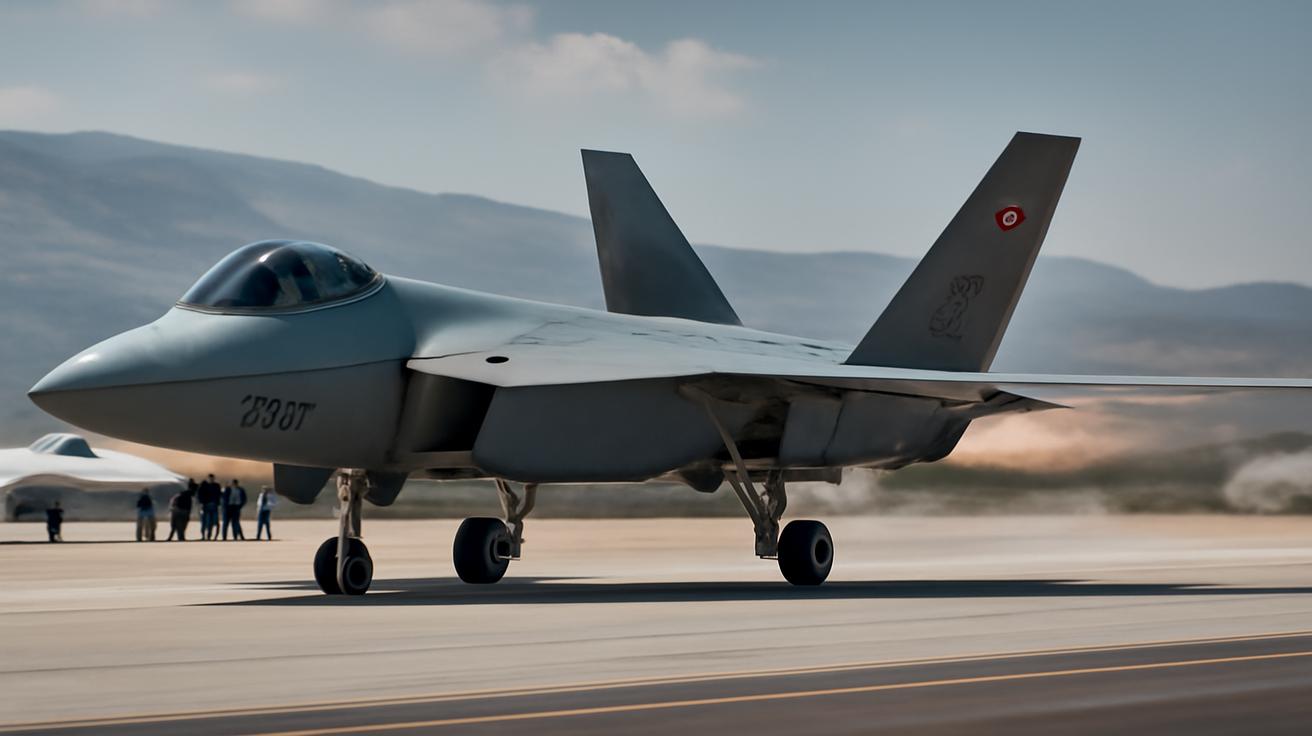
The air above central Anatolia has a particular kind of stillness to it—dry, bright, almost metallic. On some days it feels like nothing moves, as if the sky itself is holding its breath. Then, without warning, that quiet is broken by a rising snarl of jet engines, and a sleek, angular shape rips through the blue. For a few seconds, everything below—cars on the highway, farmers in their fields, engineers watching from the tarmac—tilts its head back and stares. The plane is new, sharp-edged, and unmistakably ambitious. It is Turkey’s KAAN fighter, and this time, there are two of them.
A Second Shadow in the Sky
The first time KAAN left the runway, it was a statement. The second time, with a second prototype, it feels like a challenge.
On the test fields near Ankara, the second prototype of the KAAN taxiing out feels less like an experiment and more like a rehearsal. There’s a sense of practiced rhythm now: ground crews moving with the confidence of routine, engineers tracking every vibration and signal, political observers reading every gesture like a line in a new geopolitical script.
This new prototype isn’t just a copy of the first. It represents refinements—adjusted lines, tweaked systems, rearranged internals after hundreds of hours of simulations and ground tests. It’s the difference between a concept and a commitment. With each test, Turkey is quietly confirming something to itself and loudly signaling something to everyone else: It intends to sit in the same conversation as the world’s top air powers.
The United States, watching from half a world away, can’t really ignore it. Not when the silhouette of KAAN, from certain angles, carries a whisper of another jet: the F-35, America’s crown jewel of fifth-generation combat aircraft. The message isn’t subtle. Turkey once helped build the F-35. Now it’s building something that could one day compete with it.
The Unfinished Story of the F-35 and Turkey
To understand why the rollout of a second KAAN prototype feels so charged, you have to rewind a few years—to when Turkey and the F-35 were supposed to have a long, smooth future together.
Turkey wasn’t just a customer for the F-35; it was a partner. Turkish factories built parts. Turkish pilots trained on simulators. The first jets were already painted in Turkish colors, waiting to be delivered. Then came the S-400, the Russian-made air-defense system that Ankara insisted on buying despite loud American objections.
Washington argued that you couldn’t operate Russian radar systems designed to hunt Western aircraft alongside the most advanced Western fighter ever built. It was like inviting a safecracker to live in your bank vault. The standoff dragged on, then broke hard: Turkey was kicked out of the F-35 program.
In the diplomatic language of communiqués, such events are described as “regrettable” or “concerning.” In the language of Turkey’s defense establishment, it meant something more primal: You cannot depend on others for your sharpest weapons. If the door to the F-35 slammed shut, then Turkey would start building something of its own.
That “something” was already on drawing boards and in CAD files, but the rupture gave it urgency, political energy, and money. KAAN, once a long-range aspiration, became the project that could rewrite Turkey’s place in the hierarchy of air power.
Inside the KAAN: Steel, Software, and Strategy
From the outside, KAAN is all facets and angles, a sculpture in gray specifically shaped to cheat radar. Edges blend smoothly, control surfaces lie flush, and the canopy’s gentle gold tint hints at internal stealth treatments and sensor shielding. The goal, like the F-35 or F-22, is obvious: meet the sky not like a bird, but like a ghost.
But the magic of a fighter jet these days isn’t in the metal alone. It’s in the invisible architecture humming inside—lines of code, streams of data, and constantly updated awareness. KAAN is being built as what military planners call a “network-centric” platform: a flying node in a web of satellites, drones, ground radars, and other aircraft.
On paper, that puts it in the same league as the F-35, where the jet isn’t just an attacker, but a sensor hub: listening, watching, sharing, and shaping the battlefield. KAAN is designed to carry a powerful AESA radar, advanced electronic warfare suites, and a cockpit oriented around data fusion—turning chaos into something a pilot can see at a glance.
Of course, world-class systems on paper are one thing. Proving them in the air is something else entirely. That’s where this second prototype comes in. The first prototype shows the jet can fly. The second begins to show whether it can think—whether the avionics, the sensors, the stealth coatings, and the flight controls will behave not just individually, but together.
| Feature | KAAN (Prototype Target) | F-35 (Baseline) |
|---|---|---|
| Generation | 5th generation, stealth, network-centric | 5th generation, stealth, network-centric |
| Role | Air superiority & multi-role | Multi-role strike & air defense |
| Status | Prototyping & flight testing | In full operational service |
| Stealth Focus | Reduced radar cross-section, evolving coatings | Mature stealth design & materials |
| Ecosystem | Part of Turkey’s growing indigenous defense network | Integrated into NATO-wide systems |
Look at this table not as a scoreboard but as a snapshot in time. The F-35 is a finished sentence. KAAN is still being written—but the handwriting is getting bolder with every new prototype.
Rolling Out the Second Prototype: A Message in Metal
When the second KAAN prototype rolled into view, cameras clicked, officials smiled, and social media feeds filled up with slow-motion footage of the jet glinting in the afternoon sun. On the surface, it looked like a high-tech photo opportunity. Underneath, it was targeted messaging.
For domestic audiences, the message was pride and momentum. Turkey, long a buyer of other nations’ hardware, now had a homegrown project that looked, sounded, and moved like the elite machines it used to import. The second prototype made it harder to dismiss KAAN as a one-off symbol or a political prop. Two airframes meant a program—something alive, iterative, and expensive.
For Washington, and for other NATO capitals, it was a reminder: Turkey might have been pushed away from one table, but it was building another. The timing, tone, and visibility of each KAAN milestone are not accidental. They happen in the shadow of ongoing negotiations about F-16 upgrades, regional disputes, new alliances, and shifting energy routes.
Every video of KAAN taking off is about more than thrust and lift. It is Turkey saying, “We won’t be left waiting outside the hangar.” And every additional prototype makes that statement harder to roll back or ignore.
Turkey’s “Plan B” Becomes Plan A
When Turkey was ejected from the F-35 program, its short-term answer was to extend the life of its F-16 fleet and secure upgrades. But the long-term plan was always more radical: to swap dependence for independence.
KAAN sits at the heart of that transition. It isn’t alone—there are Turkish drones flying in multiple warzones, indigenous missile systems, naval projects, and satellite ambitions. But KAAN is the most visible, the most technically demanding, and the easiest for the world to recognize as a measuring stick. If Turkey can pull off a fifth-generation fighter, it tells everyone something about what else it might soon be capable of.
A Rival to the F-35, or Something Else Entirely?
Calling KAAN an “F-35 rival” makes for a punchy headline, but it’s also a bit of a simplification. Rivalry suggests a fair race, starting at the same time, with the same rules. The reality is messier.
The F-35 is already in service across multiple countries, flying real missions, logging real combat hours, and enduring real criticism. It is a known quantity with known problems, from cost spirals to maintenance headaches, even as it remains the only mass-produced fifth-generation fighter available for export at scale.
KAAN, by contrast, is at the other end of the lifecycle. It lives in the hopeful space between prototype and production, between claims and proof. Comparing the two today is like comparing a veteran to a promising rookie still in training camp.
But rivalry isn’t only about matching specifications. It’s also about options. The F-35’s power doesn’t just come from what it can do in the sky—it comes from the fact that for many countries, there is no similar Western aircraft they can buy if relations sour or budgets strain.
If KAAN matures, Turkey might offer it to select partners who either cannot get the F-35, do not want the level of dependence it implies, or are looking for alternatives aligned with their own regional politics. In that sense, KAAN doesn’t need to beat the F-35 in every metric to be a rival. It just needs to exist as an influential second choice.
Who Might One Day Fly KAAN?
It’s far too early to draw up a real export map, but the outlines of potential interest are already visible. Countries that have historically bought Turkish drones, armored vehicles, or naval equipment might be curious about a future in which their air force isn’t limited to US or Russian suppliers.
If KAAN reaches operational maturity and if Turkey can offer it with attractive financing or technology-sharing terms, it could appeal to states trying to balance between great powers, or seeking to quietly reposition themselves away from a single dominant supplier.
All of this is speculative—for now. But speculation itself is a form of soft power. The more plausible KAAN becomes, the more other countries begin to picture their own flags painted on that angular gray fuselage.
Strain, Ambition, and the Long Road Ahead
Behind the sleek promotional videos and triumphant rollout ceremonies, the reality is grittier. Building a cutting-edge fighter jet is one of the most difficult industrial tasks a nation can undertake. It demands not just money and talent but patience and resilience. And it almost always takes longer, and costs more, than anyone wants to admit.
Turkey faces classic hurdles: securing reliable engines, mastering stealth materials that can survive the heat and stress of flight, integrating complex avionics, and building a supply chain that can keep production moving even under political or economic strain. Each prototype is a victory but also a catalog of new problems discovered, new compromises required, and new design changes demanded.
Yet this is also where the project becomes more than a weapons program. It becomes a school—an incubator of local expertise in software, metallurgy, electronics, and systems integration. The engineers huddled over telemetry screens today will be the people who, ten or twenty years from now, design and build systems nobody has named yet.
Turning Up the Heat on Washington
So what does all this feel like from Washington’s side? It’s complicated.
On one hand, Turkey remains a NATO ally, strategically positioned, militarily capable, and too important to casually sideline. On the other hand, the trust between Ankara and Washington has been visibly eroded over years of disputes—over Syria, over defense purchases, over political rhetoric.
Every successful KAAN test flight subtly shifts leverage. Turkey can point to its growing autonomy and say, in effect, “We have options now. If you won’t sell us what we want, we’ll build it—and maybe sell it ourselves.” That is not a short-term threat; it is a long-term recalibration.
The rollout of a second prototype intensifies this pressure. It signals that KAAN is not a paper tiger. It adds credibility to Turkey’s stance in every negotiation over air defense, fighter sales, sanctions, and technology transfers. The more real KAAN becomes, the less persuasive the old assumption that the United States holds all the best cards in advanced fighter aviation.
A New Shape in the Global Sky
Stand on that Anatolian tarmac again in your mind. The second prototype has just landed. The engines whine down to a tired whirr. Ground crews rush in, the heat shimmer rising off the body of the jet, distorting the air so it looks almost like water. A handful of officials clap reluctantly at first, then harder as the canopy opens and the pilot climbs out, silhouetted against the sky.
Somewhere in an office in Washington, this landing appears not as a vivid sensory moment but as a dry line in a briefing: “Turkey rolls out second KAAN prototype; more tests expected in coming months.” Yet beneath that line sits a web of implications.
- A NATO ally, once dependent, is shifting toward defense independence.
- The monopoly of US-made fifth-generation fighter exports faces its first plausible non-Russian, non-Chinese challenger on the horizon.
- Future crises—even those far from Turkish borders—might be shaped by jets that did not exist a decade ago, built by a country few expected to join the elite aviation club this quickly.
Whether KAAN ultimately fulfills its lofty promises or not, its very presence reshapes the story. It proves that the age of fighter-jet power is no longer reserved for just a couple of superpowers and their closest partners. Ambitious, industrially savvy middle powers are stepping into the arena, bringing their own designs, their own alliances, and their own expectations.
For now, KAAN is still in its youth: all potential, all projection, its true performance waiting to be discovered in the long, unglamorous grind of testing. But each new prototype, each successful takeoff and landing, burns its outline a little more clearly into the future.
High above the plateau, the sky is quiet again. But it doesn’t feel quite as still as it once did. Somewhere down there in the haze, another airframe is being riveted together, another software patch uploaded, another sensor tuned. And somewhere in Washington, planners are adding a new variable to their equations—a second shadow in the sky, shaped like a question mark, and named KAAN.
Frequently Asked Questions
Is KAAN already operational as a combat aircraft?
No. KAAN is currently in the prototype and flight-testing phase. The rollout of the second prototype marks an important milestone, but it will take years of testing, refinement, and certification before it can be considered fully operational in a combat role.
How does KAAN compare to the F-35 right now?
At this stage, the F-35 is a fully fielded, combat-tested platform, while KAAN is still in development. Conceptually, both are fifth-generation, stealthy, network-centric fighters, but the F-35 has a significant lead in maturity, integration, and operational experience. KAAN’s true capabilities will only be clear once it completes testing and enters service.
Why is Turkey developing KAAN instead of just buying more jets from other countries?
Turkey’s exclusion from the F-35 program and broader concerns about reliance on foreign suppliers pushed Ankara to emphasize defense independence. KAAN is part of a wider strategy to build indigenous capabilities, reduce vulnerability to export restrictions, and strengthen Turkey’s bargaining power on the global stage.
Could KAAN be exported to other countries in the future?
Potentially, yes. Turkey has signaled that it envisions KAAN as an export-capable platform. However, export decisions will depend on the jet’s performance, production capacity, political relationships, and international regulations once it reaches a more mature stage.
Does KAAN threaten the United States’ position in global fighter sales?
In the near term, not directly. The F-35 still dominates the market for advanced fighters. Over the longer term, if KAAN proves reliable, cost-competitive, and politically attractive to certain buyers, it could offer an alternative in specific regions. That possibility alone adds pressure and complexity to US–Turkey relations and to the global arms market.








Leave a Comment