
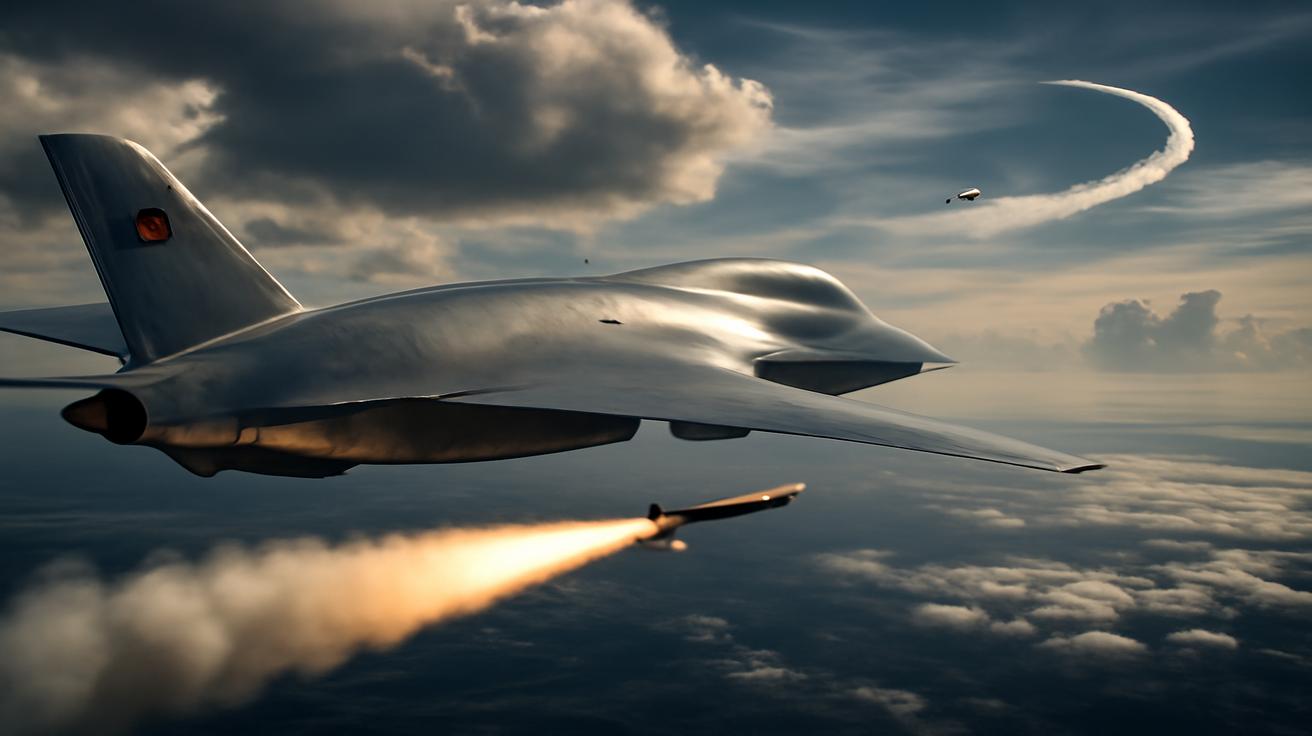
The sea looks strangely calm from five kilometers up. Through the drone’s forward camera, the Black Sea is a sheet of hammered metal, sunlight glancing off each ripple like flickering sparks. On the ground, in a command truck buzzing with quiet tension, a Turkish pilot who will never touch a cockpit throttle leans closer to his screen. His hands rest lightly on the control console. Somewhere high ahead of the drone, a target he cannot see is about to slice through the sky at supersonic speed. A voice crackles over comms, clipped and steady: “Target inbound. Stand by for engagement.”
The Day the Unthinkable Became Routine
There are days when history announces itself with fanfare—new flags on the moon, parades, televised speeches. And then there are days like this one, when history hides inside a grainy infrared image and the quiet click of a “confirm” button.
On this day, Turkey’s Kızılelma unmanned combat aerial vehicle—sleek, angular, and ghost-grey against the high-altitude blue—did something no drone had done before. It shot down a moving supersonic target. Not a slow, lumbering drone or a subsonic aircraft, but a fast-attack, missile-like target streaking across the sky, flying faster than sound. An engagement profile that, until now, belonged firmly in the realm of manned fighter jets and their human pilots.
Yet if you had been standing on the test range shoreline, you might not have suspected that aviation history was unfolding just beyond the horizon. The waves dragged pebbles and foam with the same old rhythm. Seagulls argued over scraps near the breakwater. The test personnel stood clustered around screens and telemetry feeds, heads bowed to tablets and consoles instead of lifted to the sky.
The drama here lives not in roaring engines and contrails but in silent radio packets, data streams, and thermals dancing across a sensor feed. And in the narrowing gap between the roles we once reserved only for human pilots and what we are now willing to entrust to algorithms, actuators, and cold composite wings.
How a Supersonic Shadow Becomes a Target
To understand what Turkey achieved, picture the challenge. A supersonic target is a blur with intent—a weapon surrogate designed to mimic the speed and behavior of incoming missiles or fast-flying aircraft. It appears on radar as a fleeting echo and on infrared sensors as a screaming-hot streak. It crosses engagement envelopes in seconds, leaving defenders almost no room for error.
Most drones today are designed for persistent surveillance, loitering, and precise strikes against static or slow-moving ground targets. Some can intercept aerial threats, but a moving supersonic target is another species of problem altogether. It demands rapid detection, real-time tracking, lightning-fast decision loops, and flight control systems that can throw a drone’s body through the air with fighter-like agility.
Enter Kızılelma, Turkey’s flagship unmanned combat aircraft, conceived not as a humble eye-in-the-sky, but as something closer to a robotic wingman. It’s designed to work beside crewed fighters, share targeting information, fly into contested airspace, and survive. On test day, the aircraft didn’t just fly; it thought, reacted, and hunted—in digital terms, at least—as the supersonic target cut into its environment like a dagger.
Engineers had spent months rehearsing for this stretch of time that might be measured in milliseconds—the tiny window in which the drone’s sensors must detect, classify, predict, and respond. Deep in a control room, lines of code were being tested not against simulators, but against the unforgiving physics of a real threat profile.
The Moment That Changed the Flight Path
When the target appeared, it didn’t arrive with fireworks. It entered as a new, rapidly shifting blip in the sensor field—temperature, motion, angle of approach. On displays, automated trackers snapped onto it. A faint trace arced across digital maps, plotting its projected path, velocity, and altitude.
Inside the drone’s onboard systems, something nearly invisible—and profoundly new—unfolded. Algorithms fused radar returns with electro-optical data. They resolved noise from signal, distinguished threat from background clutter, and began calculating a course to intercept. This wasn’t just a matter of pointing a missile at a point in space. It was the dance of prediction: anticipating not where the target was, but where it would be fractions of a second in the future.
Command authorization came from human hands, but the execution of the intercept was left to the drone’s own brain. Control surfaces adjusted. The airframe tilted, rolled, and bit into a new heading. Thrust spooled. The drone accelerated, closing the distance, its digital mind juggling a swirl of changing variables—wind, target maneuvering, sensor noise—all at speeds no human could track unaided.
Out over the haze-dim horizon, the supersonic target tore forward, a manufactured threat meant to mimic the worst of what might one day come for a city, a ship, or a military base. The drone’s guidance system believed it had one shot. There would be no leisurely second pass.
The onboard weapon system fired.
In the video replay that would later circle defense forums and social media, the explosive bloom seemed almost modest—a flash, a burst of debris, threads of vapor dissolving into the sky. But in that single expanding blossom of fire and fragments, a century of aviation assumptions shuddered and shifted.
Why This Test Felt Different
We’ve seen drones take out vehicles in dusty valleys and track insurgents through night-vision monochrome. We’ve read about unmanned systems intercepting other drones or harassing slow-moving aircraft. So what made this supersonic takedown feel like a line crossed?
It’s partly about speed. Supersonic threats compress time. The faster something moves, the smaller the decision window. Where a subsonic drone offers defenders seconds or even minutes to coordinate a response, a supersonic missile can cross from horizon to impact in less time than it takes to pour coffee. The fact that an unmanned aircraft—not a manned fighter—handled this engagement means that drones are moving firmly into one of the most demanding, unforgiving arenas of modern combat: high-speed air defense and interception.
But it’s also about symbolism. Turkey’s experiment didn’t play out in the closed laboratories of a superpower accustomed to dominating the skies. It unfolded in a country that, within living memory, relied heavily on imported aircraft and external political permission for its air capabilities. Now, Turkey wasn’t just flying its own drones—it was pushing them into tasks that only a handful of advanced air forces have attempted with unmanned platforms.
There’s a quiet message written between the frames of that footage: mastery of the sky is no longer the exclusive domain of manned fighter cockpits, nor is cutting-edge aerospace innovation monopolized by the traditional giants.
The Technology Under the Skin
Strip away the poetry of that moment and you’re left with an intricate mesh of technologies, each one calibrated to the point where failure margins are razor-thin.
At the heart of the achievement lies sensor fusion—the ability of the drone to stitch together fragments of reality from different “eyes” into a cohesive picture. Radar may see the supersonic target as a streak of motion; infrared may see it as a bright, surging ember; optical systems might catch a faint glint against the sky. On their own, each of these is incomplete, muffled, or noisy. Together, they form a story the drone can act on.
Then there’s guidance and control. The Kızılelma’s flight computer must constantly juggle aerodynamic loads, engine performance, projectile trajectory, and the target’s own evasive possibilities. It must adapt in real time, without freezing or fumbling in the face of incomplete data. Mistime a maneuver by a hair, and the weapon will streak through empty air.
What makes this remarkable is not that it happened once under pristine test conditions. It’s that Turkish engineers believed in their systems enough to attempt such a test at all, knowing a failed intercept would be recorded, scrutinized, and perhaps ridiculed. They were gaming out a future in which human pilots will increasingly rely on autonomous wingmen that not only follow but fight with independent initiative.
| Key Aspect | Traditional Manned Fighter | Kızılelma UCAV in Supersonic Test |
|---|---|---|
| Pilot | Human in cockpit, high physical strain | Remote human supervision, onboard autonomy handles split-second reactions |
| Decision Window | Constrained by human reaction time and g‑forces | Augmented by algorithms and high-speed computation |
| Risk to Life | Direct threat to pilot in high-risk intercepts | No crew onboard; risk shifted to hardware and data |
| Operational Endurance | Limited by pilot fatigue and life support | Limited mainly by fuel, maintenance, and communications |
A New Kind of Sky Culture
In Turkey, aviation has long been more than steel and fuel—it’s part of a broader story of self-definition. The same country that once watched foreign fighter jets patrol its skies now produces its own families of drones, exports them, and sees their silhouettes shape conflicts far from its borders.
In workshops and design labs in Istanbul, Ankara, and other cities, a new generation of engineers grew up not on the mythic image of a single, heroic pilot, but on swarms of silently circling UAVs. For them, the notion that the most decisive actor in a dogfight might be a block of software rather than a human set of nerves is less a shock than an inevitability.
When Turkey’s first drones began flying operational missions, skeptics dismissed them as niche tools—good for reconnaissance and asymmetric warfare, perhaps, but not at the sharpest edge of air combat. As the systems evolved, they moved from watching to striking, from striking to coordinating, and now from coordinating to intercepting supersonic threats in the thin air where fighter aces used to reign.
This test, tucked away in its quiet corner of the Black Sea, hints at a future air culture where pilots may no longer always lead the charge. Instead, they will manage networks, orchestrate groups of drones, and rely on algorithmic companions that can do things the human body simply cannot—pulling brutal turns without blacking out, maintaining perfect focus without fatigue, and staying aloft long after a human would falter.
Between Awe and Unease
There is a strange duality to watching the footage: pride and discomfort live side by side. On one hand, it is hard not to feel a certain awe at the sheer elegance of the engineering. An unmanned aircraft, guided in part by code, hunts down a dart of supersonic metal in the vastness of the sky and unthreads it from existence. It’s a demonstration of human ingenuity bending physics to its will.
On the other hand, each step on this path complicates our moral weather. If a drone can autonomously intercept a supersonic missile today, what will it be able to do in ten years? Will we one day watch, with the same sense of muted thrill, as algorithms decide whether another aircraft is a threat, and whether to eliminate it—without waiting for a human nod?
Turkey’s achievement doesn’t answer those questions; it sharpens them. It shows that we are not drifting slowly toward a future of autonomous combat—we are accelerating into it. Each successful test pushes the Overton window of what is considered normal, acceptable, and strategically necessary.
Standing at the edge of a windswept runway after the test, with the drone back on solid ground and its skin streaked with the subtle grime of spent flight, one might feel both a sense of national triumph and a quiet, more private unease. We are building machines that can do, in milliseconds and at Mach speeds, what once took flesh-and-blood pilots years of training and the risk of their lives. The sky is becoming both safer for pilots and more haunted by unblinking, inhuman attention.
Where the Flight Path Leads Next
Turkey’s supersonic intercept is not the end, but the beginning of a longer arc. Future tests will likely pile new layers onto this milestone: more complex maneuvers, multiple simultaneous targets, operations in dense electronic warfare environments where jamming, spoofing, and cyberattacks try to blind or confuse the autonomous brain.
Defense planners in Ankara and beyond will be watching closely. A drone that can reliably shoot down supersonic threats could become a guardian for naval task groups, critical infrastructure, or forward bases. It could fly dangerous patrols where sending a manned fighter would be politically fraught or militarily risky. Swarms of such drones might one day form a moving shield, a cloud of high-speed sentinels ready to slash at incoming threats before they ever see the silhouettes of cities on the horizon.
For other nations, Turkey’s breakthrough will be a jolt—a reminder that the race to define the next era of air combat is no longer staffed solely by long-established aerospace powers. Mid-sized nations with focused investments, homegrown tech sectors, and a willingness to test boundaries can now write their own audacious chapters.
But if you strip away the flags and doctrines, what lingers is something quieter: the image of that lone drone against an enormous sky, performing its lethal geometry. No cockpit canopy. No oxygen mask. No heartbeat. Just wings, code, and intent.
In the command truck, when the supersonic target vanished in that brief ignition of light, there was a ripple of restrained celebration. Hands unclenched from consoles. Shoulders dropped. Engineers exchanged quick glances that mixed relief, satisfaction, and the dawning realization that they would now be expected to do even more.
The tape would be replayed again and again. Every pixel of that exploding target would be combed through for lessons, for flaws, for the tiniest hint of what to improve. Outside, the sea would keep heaving against the shore as if nothing at all had changed. But above it, in invisible corridors of air and code, a new chapter had begun.
The first drone to shoot down a moving supersonic target did more than pass a test. It redrew a map—one measured not in coastlines and borders, but in possibilities. And somewhere, far above the slow pulse of the waves, the sky quietly made room for a new kind of hunter.
FAQ
What exactly did Turkey’s drone accomplish?
Turkey’s Kızılelma unmanned combat aerial vehicle successfully intercepted and destroyed a moving supersonic target, something traditionally reserved for manned fighter jets. This demonstrated that an unmanned platform could handle the speed, complexity, and precision required to take down a fast, missile-like threat.
Why is intercepting a supersonic target such a big deal?
Supersonic targets move faster than sound, giving defenders only seconds to detect, track, and engage them. Successfully intercepting one requires extremely responsive sensors, guidance systems, and control algorithms. For a drone to manage this places it in the most demanding tier of modern air combat tasks.
Was the drone acting completely autonomously?
The engagement used a mix of human oversight and onboard autonomy. Humans authorized and supervised the mission, while the drone’s systems handled rapid tracking, maneuvering, and precise timing that would be difficult for a human pilot to manage alone in such a compressed time window.
How does this change the role of human pilots?
Rather than replacing pilots outright, systems like Kızılelma are shifting their role. Human pilots are increasingly becoming mission managers and coordinators, directing teams of autonomous or semi-autonomous drones that can take on high-risk, high-speed tasks without endangering a crew.
What might this technology be used for in the future?
Potential uses include defending ships or bases from high-speed missiles, escorting manned fighters in contested airspace, patrolling sensitive borders, and forming layers of aerial defense around critical infrastructure. Over time, similar systems could operate in coordinated swarms, sharing data and responding to threats collaboratively.
Are there ethical concerns with this kind of drone capability?
Yes. As drones grow more capable of making rapid engagement decisions, questions arise about accountability, the risk of unintended escalation, and the degree of autonomy we are comfortable giving lethal systems. Each technical milestone, like this supersonic intercept, makes these ethical debates more urgent.
What does this mean for global aviation and defense?
Turkey’s success signals that advanced air combat capabilities are no longer the exclusive domain of a few long-established powers. More nations can now develop sophisticated unmanned systems, influencing regional balances of power and accelerating a global shift toward mixed fleets of manned and unmanned aircraft.








Leave a Comment