
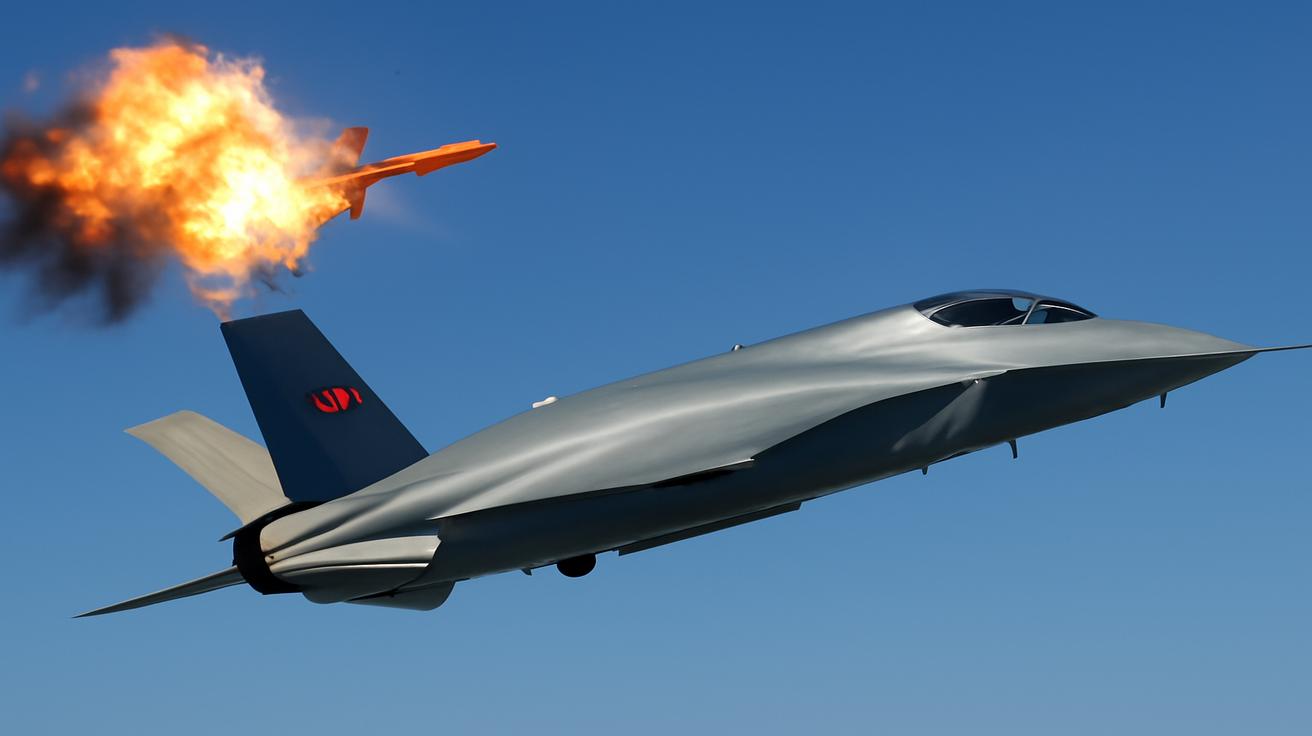
The Black Sea wind was up that morning, combing long silver streaks through the clouds, when a small, pale shape rose quietly from the Anatolian plain and pointed its nose toward history. No roaring afterburner, no cockpit canopy glinting in the sun—just a slender, unmanned aircraft, its wings catching the light as it climbed. A Turkish drone, guided from a control station miles away, was about to do something no drone had ever done before: hunt down and destroy a moving supersonic target in mid-air.
The Day the Sky Blinked
On the screens inside the control room, the sky didn’t look blue at all. It was a wash of greens and blacks, dotted with symbols and numbers, altitude tapes and weapon cues. Somewhere beyond those pixels, the drone—Turkey’s indigenously developed Bayraktar Kızılelma’s cousin in spirit, the combat-proven Bayraktar Akıncı or a similar high-altitude UAV—was climbing, its cameras and sensors tuned to an invisible opponent.
The target was no ordinary object. It was a supersonic aerial target drone, a stand-in for a hostile missile or fast-moving fighter, screaming through the upper atmosphere faster than the speed of sound. Normally, such threats are left to manned jets or ground-based missile batteries. Hitting one with an unmanned aircraft is like threading a needle on the back of a galloping horse… while the horse is blindfolded and the needle is on fire.
But on that day, Turkish engineers, flight-test crews, and defense officials were betting that years of design and code, thousands of test hours, and more than a little national pride would be enough. What they were really testing wasn’t just a weapon—it was a story about where air power is going, about who controls the sky when the sky fills with machines.
Somewhere far ahead of the drone, the supersonic target streaked along its programmed route. Its radar cross-section was small, its speed brutal, its maneuver unpredictable. The drone’s radar and electro-optical sensors tracked it in bursts: a flicker here, a lock-on there, then a transient smear as the target dashed out of one sensor’s field and into another’s.
In the control station, operators adjusted their controls with small, economical movements, more like gamers than old-school fighter jocks. But beneath the calm, hearts raced. Engineers clustered behind them, watching every readout. Outside, the air over the test range lay quiet, its own secret packed into the blue: a target, a hunter, and a moment none of them would ever forget.
The Quiet Revolution of a No-Pilot Cockpit
To understand why this single interception matters so much, you have to zoom out—way out—from that control room. For decades, aviation history has been written in the arcs of manned aircraft: the roar of the F-16, the needle-nosed drama of MiGs, the stealthy lines of the F-35. Pilots were the irreducible core of air combat. Machines extended human senses, but humans made the calls in the sky.
Now, the cockpit is moving to the ground. Pilots still exist, but they wear headsets instead of oxygen masks, their fingers resting on keyboards and joysticks instead of throttles and sticks bathed in cockpit light. In Turkey, this transformation has unfolded quickly, almost breathlessly. Over the last decade and a half, the country has quietly carved its name into the unmanned aviation landscape, from the smaller Bayraktar TB2 drones that have flown in conflicts from the Caucasus to North Africa, to larger platforms that look more like crewed aircraft than remote-controlled planes.
The world watched those drones carry out precision strikes and intelligence missions, but what happened over that Anatolian test range went a step further. Shooting down a moving supersonic target from a drone is not merely a tactical box checked; it’s a sign that the boundary between missile and aircraft, between interceptor and sensor platform, is blurring.
In a sense, this is a quiet revolution. There is no dramatic dogfight in the classic sense—no pilot scanning the horizon, no G-forces pressing a body into the seat. The struggle unspools through software: algorithms predicting where a supersonic object will be in fractions of a second, guidance logic correcting tiny errors mid-flight, control systems managing the dance between the drone’s movement and its weapon’s trajectory.
And yet, for all of its math and code, the moment of engagement still feels primal. Somewhere overhead, invisible to the eye, two objects hurtle toward a point that only exists for an instant: where the interceptor meets the target, and the sky, for a heartbeat, flares white.
The Anatomy of an Impossible Shot
For a drone to hit a moving supersonic target, everything has to happen almost faster than thought. The radar has to see. The processor has to understand. The weapon has to react. There’s no space here for hesitation, no lazy second chances.
Think of it like this: a supersonic target moving at, say, Mach 1.5 covers hundreds of meters every second. By the time a radar pulse leaves the drone, bounces off that target, and returns, the object has already shifted position. The system has to predict where the target will be, not just where it is. That means advanced fire-control algorithms, data fusion from multiple sensors, and weapons with guidance brains of their own.
When Turkey’s drone locked onto its supersonic quarry, it was playing three games at once. It had to keep flying its own optimal path, staying within safe parameters for altitude, speed, and maneuver. It had to maintain a lock and prediction track on the target, filtering out noise and deception. And when it released its weapon—likely a radar- or electro-optically guided missile or smart munition—it had to hand off the hunt with near-perfect timing, so that the weapon could carry the final sprint to impact.
The success wasn’t an accident or a lucky shot. It was the convergence of mechanical engineering, aerodynamics, signal processing, and a great deal of software. It was also the result of a national decision: to invest in unmanned systems not as a side project, but as a central pillar of defense and aerospace strategy.
Why This Shot Changes the Future of the Sky
In military terms, the achievement is clear: a drone can now engage fast, high-value airborne threats that once demanded expensive manned interceptors or complex layered defenses. But the deeper shift is psychological and strategic. It signals that unmanned aircraft are no longer just observers or slow, patient strikers; they are stepping into the role of quick-reaction air defenders and air superiority tools.
This is especially relevant in a world where airspaces are filling up with cruise missiles, standoff weapons, and agile, manned or unmanned platforms. Traditional air defense systems are powerful but rigid, rooted to the ground, limited by line-of-sight and geography. A drone, on the other hand, can roam. It can push the defensive line further out, closer to where threats originate, and it can loiter there, waiting.
In the context of Turkey’s geography—a crossroads nation brushing against Europe, the Middle East, and the Black Sea—this flexibility is not academic. It’s strategic oxygen. Long coastlines, contested air borders, and proximity to active conflict zones make rapid, adaptable air defense more than a theoretical interest.
Beyond Turkey, other nations are likely taking careful notes. A successful supersonic intercept demonstrates that drones can shoulder missions once thought too complex for remote pilots and autonomous systems. It implies that future theaters of conflict may see swarms of unmanned interceptors forming moving, thinking shields—patrolling above fleets, guarding cities, trailing high-value assets like airborne early-warning aircraft or tankers.
It also points toward a new kind of partnership in the sky: manned fighters accompanied by “loyal wingman” drones capable of independent engagement, or entirely unmanned defensive networks that respond to incoming threats with minimal human intervention.
From Workshop Dreams to Supersonic Reality
The road to that supersonic kill began not in the clouds, but in workshops lit by fluorescent tubes, in quiet offices where design sketches piled up beside coffee cups, in laboratories where radar dishes hummed under test signals. The story is as much about people as it is about machines.
Engineers tested airframes in wind tunnels, chasing the fine balance between endurance and agility. Software developers wrote and rewrote targeting code, running simulations of supersonic intercepts until their virtual skies were crowded with imaginary missiles. Technicians assembled composite structures by hand, layer by patient layer.
On the test ranges, early flights were cautious: slow climbs, gentle turns, then higher, faster sorties as trust grew between data and reality. Each mission logged another stack of information: how the wings flexed under crosswinds, how the radar behaved at different angles, how the control surfaces responded when the air thinned at altitude.
There were failures, of course—moments when a sensor blinked at the wrong time, when a software routine misbehaved, when a test had to be aborted and the drone brought home early. In aerospace, failure is not a scandal but a teacher. Each glitch became a line in a report, each report another brick on the road to that perfect intercept.
When the supersonic target finally streaked into the test range on that decisive day, the drone carried not just a missile, but thousands of accumulated human decisions: every parameter tuned, every threshold chosen, every line of code debated in meeting rooms where the air smelled faintly of solder and stress.
The Human Pulse Behind the Algorithms
On paper, unmanned systems sound cold, almost clinical. They are described in acronyms, performance numbers, payload weights, ranges. But look behind the acronyms, and you find young operators whose nervous rituals before a mission are oddly similar to those of old-school fighter pilots: a shared joke, a quiet breath, the tactile comfort of hands resting on familiar controls.
During that historic intercept, the operator guiding the drone watched the target’s icon move across a digital sky. It might have been just another test, but something in the room shifted when the weapon release command was given. Voices dropped. Heads leaned closer to the monitors.
The seconds between release and impact stretch out strangely in memory. The weapon, once dropped into that thin, high air, races along its invisible path. Guidance fins whisper against the wind. Software tracks minute deviations, nudging it gently back on course. The target, indifferent and supersonic, barrels ahead.
And then—silence, followed by a brief, bright confirmation on the screen: impact. In the sky, the target is torn into flaming fragments, its supersonic arrogance extinguished in an instant of fire and vapor. In the control room, the tension snaps, replaced with a rippling wave of relief, disbelief, laughter, applause.
History, we like to imagine, is made with fanfare and speeches. But often it arrives as a small, blinking message on a monitor, a clean label on a test log: “Target destroyed.” The people in that room would later explain the intercept in the cool language of flight-test documentation, but for a few moments, they were simply humans who had pushed at the edges of possibility and watched the boundary move.
How This Drone Shot Compares
To place this achievement in perspective, it helps to line it up against what unmanned systems have done so far. Until now, drones have mostly focused on surveillance, ground attack, and slow-moving or stationary targets. Engaging fast, maneuvering aerial threats at supersonic speed is a different league.
| Capability | Conventional Drones | Turkish Supersonic Intercept Drone |
|---|---|---|
| Primary Role | Surveillance, ground strike | Air defense, high-speed target interception |
| Typical Targets | Static or slow-moving ground assets | Moving supersonic aerial threats |
| Required Precision | High, but with more time to react | Extreme, with split-second solutions |
| Operational Impact | Support to manned air and artillery operations | Expands drones into air superiority and missile defense |
| Technological Complexity | Advanced but focused on ISR and strike | Cutting-edge sensor fusion, fire control, and guidance |
Seeing it laid out this way, the leap becomes clear. Where earlier drone generations were the watchful eyes and long arms of modern militaries, this new class is something else: a shield, a hunter of hunters.
The Sky We’re Flying Into
What happens next? Once a line has been crossed—once a drone has proved it can kill a supersonic target—the imagination of planners and engineers rarely retreats. The next iterations almost write themselves: better radars, smarter missiles, greater autonomy, tighter integration with broader air-defense networks.
Picture, a few years from now, a coastline bristling not with fixed launchers alone, but with patrolling unmanned aircraft, quietly sweeping wide arcs over open water. When a hostile missile or fast jet appears at the edge of detection range, one of these drones turns, angles in, and launches an interceptor. Human approval may still be in the loop, but the detection, tracking, and engagement sequence will unfold with a speed that no unaided crew could match.
On another day, high over contested terrain, a manned fighter flies with a pack of drone wingmen. While the human pilot focuses on mission objectives, one of the wingmen picks up the whisper of an incoming threat. It doesn’t panic, doesn’t blink. It simply calculates, maneuvers, and fires—drawing a bright line through the sky where the incoming threat used to be.
These scenarios are not science fiction anymore. They are extensions of what has already been done in that Anatolian sky. They also raise uncomfortable questions: How much decision-making do we hand over to machines? How do we ensure safety in crowded airspaces filled with both civilian and military platforms? What happens when multiple nations deploy similar systems, each trusting their own algorithms just a little more each year?
For now, the historic intercept stands as both a technical milestone and a marker on a longer, twistier path. The air above us is becoming a more autonomous, more algorithmically contested space. The line between nature and machine, sky and code, is growing thinner.
A New Chapter in Aviation Lore
Years from now, when this test is folded into the broader tapestry of aviation history, it may sit quietly alongside other pivotal firsts: the first powered flight at Kitty Hawk, the breaking of the sound barrier, the debut of the stealth bomber. Each of those moments felt extraordinary in its time, yet quickly became the new baseline for what the sky could hold.
Turkey’s first drone to shoot down a moving supersonic target might be remembered not for the specific model of aircraft or missile involved, but for what it signaled: that unmanned aviation had stepped fully into a realm once guarded by manned interceptors and complex missile batteries.
Somewhere out on the test range, the wreckage of that supersonic target has long since cooled. Its twisted fragments are just scrap now, their brief, violent history written in scorch marks and torn metal. The drone that killed it has probably flown again, maybe in quieter roles, its sensors scanning the same sky that once rang with the shockwave of a supersonic passing.
Above it all, the air goes on being air—thin, blue, indifferent. Birds trace their own ancient paths along thermal currents. Clouds pile in white, slow-moving continents over the land. And threading through that ageless theater, more and more, fly machines with no pilots onboard, their stories written not in dogfights and contrails, but in quiet rooms where someone whispers, “Weapon away,” and waits to see if the sky will blink.
FAQ
What exactly did Turkey achieve with this drone test?
Turkey successfully used an unmanned aerial vehicle to detect, track, and shoot down a moving supersonic aerial target. This marks the first known case of a drone destroying such a fast airborne threat, a role traditionally reserved for manned fighter jets or ground-based air-defense missiles.
Why is intercepting a supersonic target such a big deal?
Supersonic targets move at enormous speeds, covering hundreds of meters per second. Tracking them, predicting their future position, and guiding a weapon to meet them requires highly advanced sensors, software, and fire-control systems. Doing this from a drone proves that unmanned aircraft can handle some of the most demanding missions in air combat and defense.
Does this mean drones will replace fighter jets?
Not immediately, and perhaps not completely. Manned fighters still excel at complex, dynamic missions and decision-making in chaotic environments. However, this achievement shows that drones will increasingly share or assume roles once limited to crewed jets, especially in high-risk or repetitive interception and defense tasks.
How could this change future air defenses?
It opens the door to flexible, roaming air-defense layers built around unmanned aircraft. Instead of relying solely on fixed radars and ground launchers, militaries could deploy patrolling drones that detect and engage threats further from their borders or critical assets, creating more agile and resilient defensive systems.
Are there risks in giving drones this level of capability?
Yes. As drones gain more autonomy and lethal capability, questions arise about control, accountability, and safety. Ensuring that humans remain meaningfully in the decision loop, preventing accidents in crowded airspace, and avoiding unintended escalation when autonomous systems interact are all challenges that will need careful policy, legal, and technical solutions.








Leave a Comment