
The room smells faintly of burnt metal and cold coffee. On a dimly lit test stand in the New Mexico desert, a prototype rocket engine roars to life, painting the night in a trembling pillar of blue‑white flame. But the people in the control room are quieter than you’d expect. No frantic shouting, no last‑second guesswork. On a cluster of screens, streams of data cascade in real time—temperatures, pressures, vibrations—while a silent mind in the background watches everything at once. It doesn’t blink. It doesn’t panic. It simply learns. This is not just a rocket test. It’s a conversation between human engineers and artificial intelligence about how we will leave Earth—first for Mars, and then for the empty, glittering dark that lies beyond.
Listening to Fire: How AI Reads the Language of Engines
Every rocket engine speaks in numbers before it ever speaks in flame. Combustion chamber pressure tells you how fiercely the propellants are reacting. Turbopump speeds hint at whether fuel is flowing freely or on the edge of disaster. Temperatures trace the thin line between efficient burn and meltdown. For decades, engineers have chased these numbers across spreadsheets, oscilloscopes, and simulation outputs.
But rocket engines are chaotic creatures. The swirl of fuel and oxidizer, shock waves, turbulence, acoustic vibrations—everything interacts with everything else. Try to map it all by hand, and the problem quickly balloons into something that feels less like engineering and more like weather forecasting inside a hurricane.
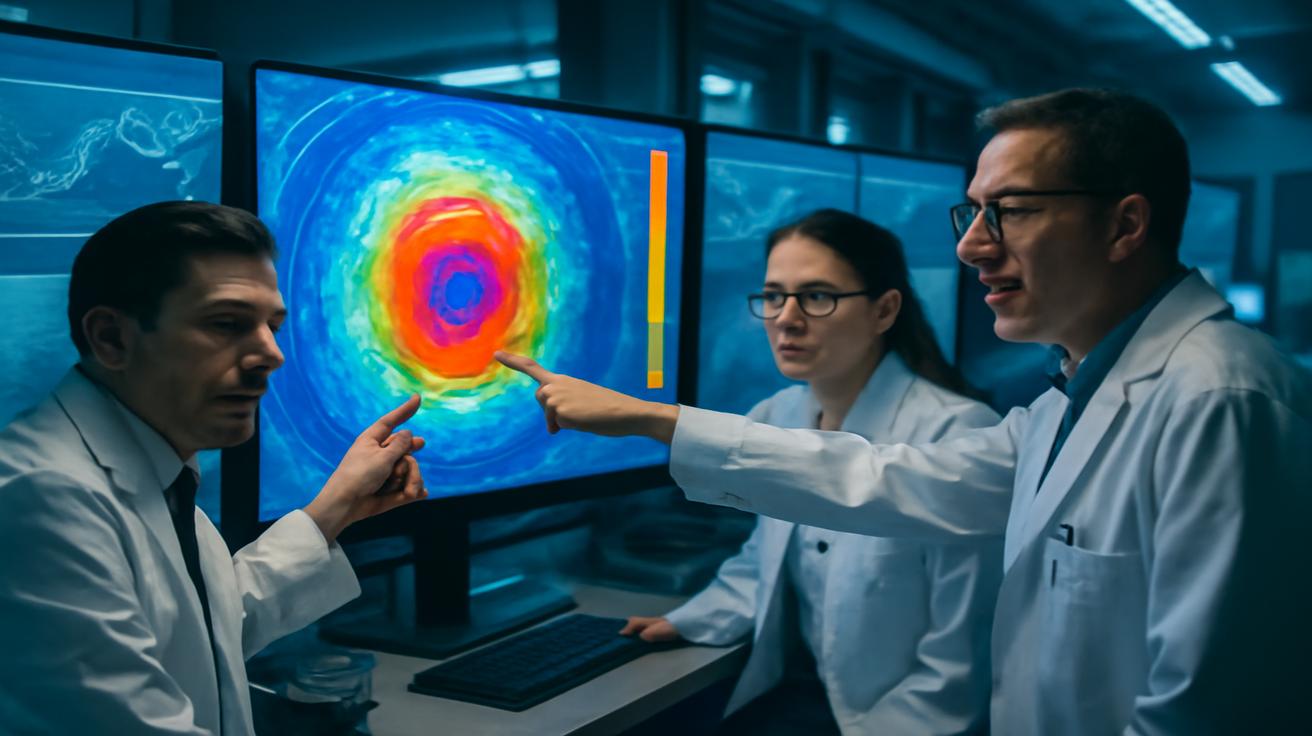
That’s where AI slips in, not with a thunderclap, but with pattern‑finding patience. Modern machine learning systems digest oceans of test data: thousands of engine firings, millions of sensor readings, countless slight variations in design. Instead of looking at a single pressure graph, AI looks at all of them, all at once, across time and across engines. It starts to recognize the subtle, early whispers of instability—a barely detectable flutter in a pressure sensor, a strange rhythm in the vibration spectrum, a minuscule deviation in flow.
In the past, an engine might have to fail—catastrophically, loudly, expensively—before engineers really understood what went wrong. Now, AI can flag the danger while the engine is still healthy. It can quietly suggest, “Increase injector diameter here,” or “Reduce chamber pressure there,” before the hardware ever sees those limits. It is, in a very real sense, learning to listen to the language of fire long before it becomes a scream.
The New Alchemists: Generative Design for Rocket Propulsion
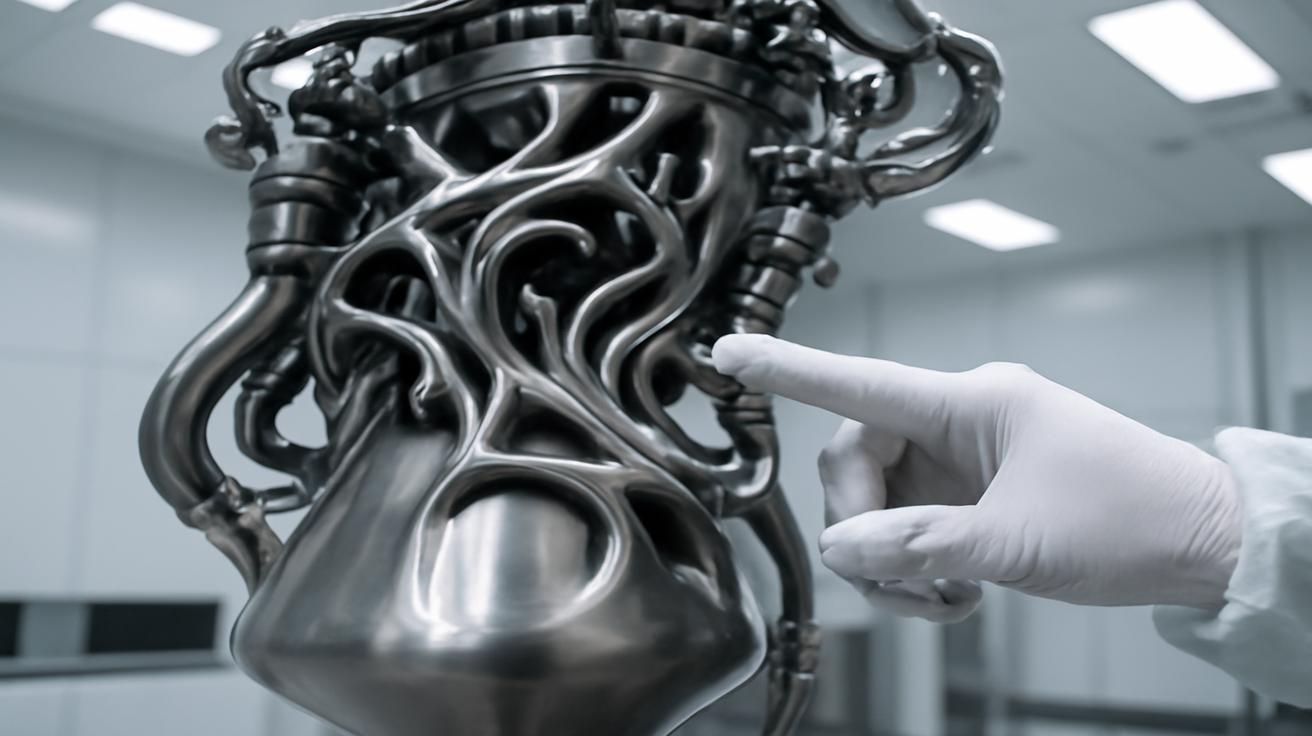
Step into a modern rocket lab, and you’ll notice something odd on the computer screens. The parts being designed no longer look like straightforward pieces of metal. They look… organic. Curving, lattice‑like structures; branching channels that resemble the veins in a leaf; injector plates that mirror the geometry of coral or bone. These are not parts that a human drew from scratch. They’re what happens when AI is turned loose on physics.
Generative design and AI‑driven optimization allow engineers to sketch the boundaries of a problem—this much thrust, this type of fuel, this maximum temperature, this weight limit—and then let algorithms explore millions of possible solutions. Instead of nudging a design step by step, AI leaps. It mutates shapes, hollowing where the stress is low, thickening where pressure bites hardest, carving out internal cooling channels that snake and spiral in ways no conventional engineer would think to try.
The results can feel like artifacts from an alien civilization: impossible to manufacture with old methods, yet perfectly suited to the violent ballet of combustion. 3D printing and advanced manufacturing catch up on the hardware side, allowing these AI‑born forms to be realized in metal—complex cooling networks printed in a single piece, injectors that atomize propellant with uncanny efficiency, nozzles that warp and curve to handle wide ranges of pressure.
In this quiet partnership, the human role doesn’t disappear; it transforms. Engineers become editors and explorers, shaping the rules of the design space, interrogating AI’s creations, and asking: “Can we build this? Can we test it? Does it make sense?” The AI dreams a thousand rocket engines; humans decide which few deserve a shot at reality.
Simulated Skies: AI as a Time Machine for Rocket Testing
Rocket testing has always been brutally simple: build it, fire it, see what breaks. Each test is expensive, dangerous, and—despite the drama—painfully slow. You can’t fire an engine a thousand times in an afternoon. You can’t crash a spaceship ten thousand times into the Martian atmosphere just to see what might happen.
But you can in simulation. And with AI, those simulations become less like static, mathematical playgrounds and more like experimental universes. Traditional computational fluid dynamics (CFD) and finite element analysis are powerful yet computationally hungry. AI steps in as an acceleration layer, learning from high‑fidelity simulations and real tests to create fast, approximate models that are still accurate enough to guide design decisions.
Suddenly you don’t have to guess whether a novel nozzle geometry will reduce turbulence in the exhaust; you can simulate hundreds of variations in hours. You don’t have to wonder how a new fuel mixture will behave at high altitude; AI‑enhanced models can map out performance across entire trajectories, from liftoff to vacuum. For entry into Martian skies, AI can run countless scenarios of varying dust content, wind shear, and atmospheric density, long before any real spacecraft grazes that thin salmon‑colored air.
Think of it as a time machine for trial and error. Every virtual failure teaches the models. Every simulated plume, every digital crack in a combustion chamber, every near‑miss in an imaginary landing adds to a growing library of knowledge. By the time hardware reaches the test stand, it’s already the survivor of thousands of invisible, AI‑mediated experiments. The desert night feels less like a coin toss, more like the final exam after a million quiet rehearsals.
Mars in the Rearview: AI and the New Frontier of Exotic Propulsion
Mars is not the end of the story; it’s the beginning of the long chapter where “far” starts to mean something else entirely. Once we begin thinking about journeys that last years instead of months, that stretch beyond the warmth of the inner solar system, traditional chemical rockets begin to look like sprint shoes in a world that needs hiking boots.
That’s where AI smuggles ambition into the design of more exotic propulsion systems: nuclear thermal rockets, electric propulsion, solar sails, even concepts like fusion drives and antimatter engines that still live mostly in theory. At this edge, the equations grow vicious, the unknowns multiply, and experiments become spectacularly hard to conduct. You can’t casually build a nuclear thermal rocket and fire it in your backyard, and you certainly can’t test a fusion engine on a whim.
AI becomes the patient negotiator between theory and reality. It can help sift through dense physics models to find promising operating regimes—temperatures, pressures, fuel configurations—where performance soars without tearing materials apart. In plasma engines, AI can stabilize and optimize electromagnetic fields that would be impossible to tune manually in real time. For nuclear systems, it can balance competing constraints like radiation, shielding mass, and thermal efficiency, weaving them into designs that push the edge while remaining just on the side of possible.
Even solar sails and beamed propulsion, which use photons instead of propellant, benefit from AI guidance. Trajectories become multi‑body puzzles, affected by sunlight angles, planetary gravity, and sail orientation. AI can thread these needles, mapping out low‑energy paths that sip momentum from the solar system itself in subtle, whisper‑thin thrusts. In a sense, AI is learning how to ride starlight.
A Glimpse Into the Propulsion Playground
The diversity of propulsion ideas now being explored—each with its own complexity and data—makes AI not just useful, but almost mandatory. Below is a simplified overview of some major propulsion types and how AI is reshaping their evolution:
| Propulsion Type | Main Advantage | Key Challenge | How AI Helps |
|---|---|---|---|
| Chemical Rockets | High thrust for liftoff | Limited efficiency; extreme conditions | Optimizes injector design, cooling, and stability; predicts failures early |
| Nuclear Thermal | Higher efficiency for deep space | Radiation, materials, political constraints | Explores safe operating regimes; accelerates thermal and structural modeling |
| Electric / Ion | Very efficient, long‑duration thrust | Low thrust; complex plasma behavior | Optimizes plasma control, power management, and lifetime |
| Solar Sails | No propellant needed | Delicate navigation, large structures | Plans efficient trajectories; dynamically adjusts sail orientation |
| Fusion / Advanced Concepts | Potential game‑changing performance | Unproven tech, extreme physics | Searches vast design spaces; aligns theory with lab results |
Engines That Think: AI in Real‑Time Control and Autonomy
Imagine a rocket engine that not only responds to commands, but also understands itself. It knows how hot it is, how old it feels, where its weakest weld is, and how hard it can safely push on a particular day. This is the promise of AI‑enhanced control systems and digital twins—near‑real‑time, high‑fidelity models that shadow every heartbeat of a physical engine.
Traditionally, rocket engines are controlled by systems that follow rigid rules: if pressure exceeds this threshold, shut down; if temperature rises too quickly, throttle back. AI allows for subtler decisions, informed not only by thresholds but by context. Maybe a slight pressure spike is harmless in some situations but catastrophic in others; maybe a hotter‑than‑expected turbopump is fine if its vibration profile remains clean and fuel flow stays smooth.
By continuously comparing sensor data with its digital twin, an AI controller can infer how fatigued the hardware really is. It can stretch performance for a one‑time critical burn, or nurse a marginal component gently through the final leg of a journey. For reusable boosters—the kind that land themselves on spindly legs on a tiny pad in the middle of the ocean—AI can learn the quirks of each individual vehicle, tailoring throttle profiles and guidance to its unique wear pattern.
Now extend that autonomy beyond Earth orbit. A spacecraft bound for Mars cannot wait for instructions when a valve sticks or a thruster misbehaves. Radio signals can take minutes to cross the growing gulf; by the time Mission Control says “do this,” the moment has passed. Autonomous AI systems onboard can diagnose, adjust, and adapt, sometimes in milliseconds, shaping propellant flows and choosing alternate burn strategies on the fly. In the silence between planets, spacecraft will have to be not just powerful, but self‑aware enough to keep themselves alive.
Ethics, Trust, and the Human Hand on the Throttle
The more we lean on AI to design, test, and operate rocket propulsion, the more a quiet unease creeps in alongside the excitement. After all, rockets leave little room for partial trust. What does it mean to sign off on a mission to Mars when no human truly understands every line of the AI’s reasoning behind a particular design? How do we certify safety in a world where decision‑making is partly opaque, where cause and effect vanish into the dense interior of a neural network?
Engineers are responding with new tools—not just more powerful AI, but more explainable AI. Approaches that highlight which features of the data drove a particular prediction; systems that can show, not just tell, why they think an engine is at risk. There’s a growing recognition that validation and verification for AI‑driven propulsion systems must be as rigorous, if not more so, than for traditional software and hardware. That means layered safety nets: AI proposes, humans review; AI controls in real time, but only within well‑understood envelopes; independent systems cross‑check decisions.
Ultimately, trust will be earned the old‑fashioned way: by performance. By engines that run thousands of times without incident, by trajectories that match predictions down to the second, by autonomous systems that save missions instead of endangering them. As we edge toward Mars and beyond, the future will likely be neither purely human nor purely machine, but a negotiated partnership where each does what it does best—the intuition, ethics, and long‑term vision of human beings paired with the pattern‑sensing, tireless calculations of AI.
From Dust to Distant Stars
Some night, years from now, you might stand in a desert or on a rocky coastline, watching as a point of brilliant light claws its way into the sky. The thunder rolls in late, hurling itself into your chest seconds after the rocket is already a star, then a streak, then a memory. Perhaps that vehicle will be carrying the first settlers headed for a Martian sunrise, or an uncrewed probe aimed at the icy oceans of Europa or the haze of Titan. Deep inside its engines, inside the algorithms that shaped every curve of its nozzles and timed every microsecond of its burns, AI will have left its fingerprints.
Yet the story will still be ours. The data that trained those models came from human curiosity, from decades of tests and failures and odd little successes. The questions that guided the search—how far can we go, how safely, how sustainably—were human questions. In a sense, artificial intelligence is just another tool we’ve carved from our longing to see what’s over the horizon.
As the rocket fades, the sky above will look the same: a black ocean sprinkled with old light. But knowing that somewhere out there, a vessel is threading its way between planets under the guidance of intelligence—both human and artificial—changes how the stars feel. Less like distant decorations, more like destinations. Towards Mars and beyond, AI is not just reinventing rocket propulsion; it is rewriting the tempo of our departure, turning slow, tentative steps into something closer to a steady, confident stride.
Frequently Asked Questions
How exactly does AI improve rocket engine safety?
AI analyzes massive amounts of sensor data from tests and flights to detect subtle patterns that precede failures—pressure fluctuations, vibration harmonics, temperature trends. By recognizing these early warning signs, AI can recommend design changes, trigger preventative maintenance, or even adjust engine operation in real time to avoid catastrophic damage.
Is AI actually designing rocket engines on its own?
AI doesn’t design engines in isolation; it assists human engineers. Through generative design and optimization, AI proposes many candidate geometries or parameter sets that satisfy specified constraints. Humans then review, refine, test, and ultimately approve designs. It’s a collaboration where AI explores the design space, and engineers provide judgment and context.
Will AI replace rocket engineers?
AI is changing the role of rocket engineers, not erasing it. Engineers increasingly focus on defining problems, interpreting AI outputs, making safety decisions, and integrating complex systems. Creative insight, ethical judgment, and mission‑level thinking remain deeply human responsibilities, even as AI handles more of the repetitive analysis and optimization work.
How is AI involved in missions to Mars specifically?
For Mars missions, AI is used to optimize launch and transfer trajectories, refine entry, descent, and landing profiles, and manage onboard propulsion systems autonomously. It can model the Martian atmosphere for safer landings, plan fuel usage for surface ascent vehicles, and continuously monitor engine health during the long cruise between planets.
What propulsion breakthroughs could AI enable beyond Mars?
AI could accelerate the development of advanced systems such as nuclear thermal rockets, high‑power electric propulsion, and even experimental fusion‑based concepts. By rapidly exploring design spaces, stabilizing complex plasmas, and integrating multidisciplinary constraints, AI may help turn theoretical propulsion ideas into practical hardware suitable for journeys to the outer planets and, eventually, interstellar precursor missions.



Leave a Comment