
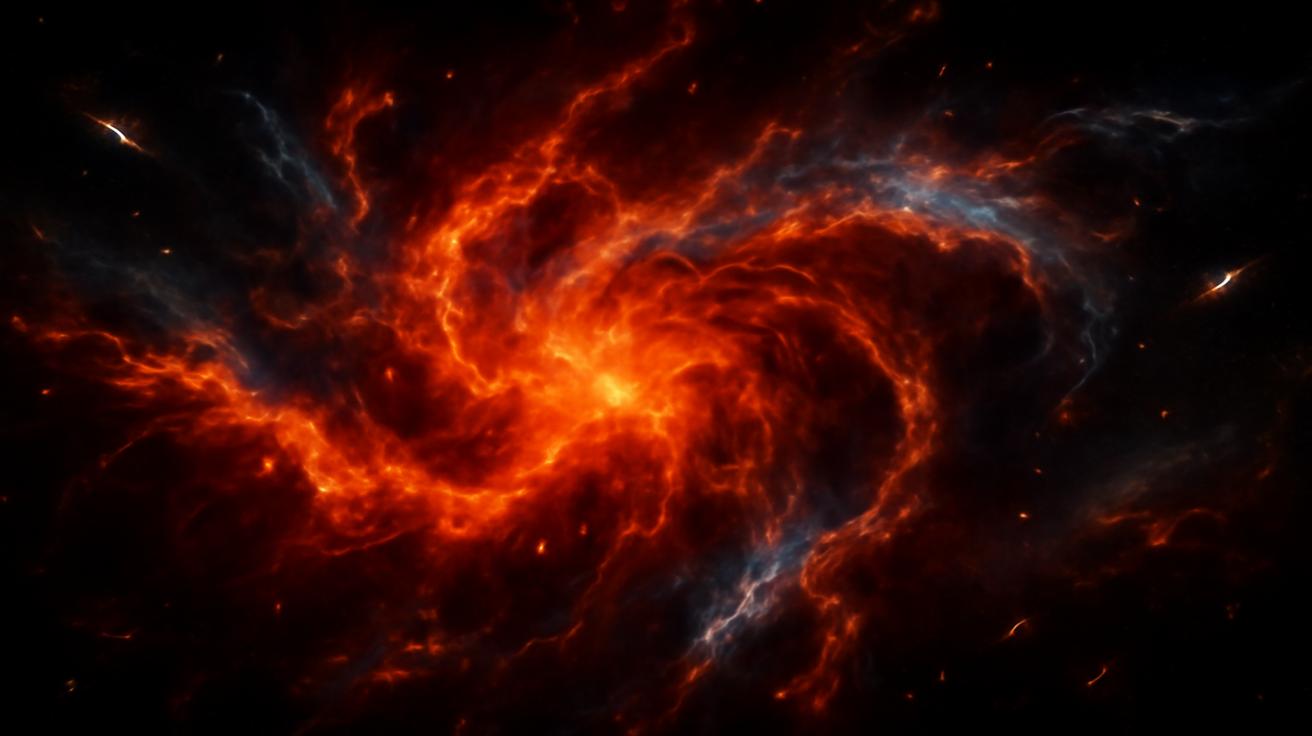
The first thing you notice is the heat. Not a gentle summer warmth, not even the dry blast of desert wind. This is heat that tears atoms apart, a wild, invisible fire so fierce it should not exist where it does—out on the faint horizon of time, when the universe was still a cosmic toddler. And yet, that is precisely what astronomers have found: clouds of gas so violently hot, so brutally energized, they seem almost too strong to be real. The discovery has left scientists blinking at their data, wondering if the early universe has been hiding a much more turbulent story than anyone imagined.
The Day the Data Refused to Behave
It began, as so many scientific surprises do, with a quiet expectation of boredom. Astronomers were looking at the distant universe, peering back more than 11 billion years in time. They were using some of the most sensitive observatories on Earth—massive radio dishes and optical telescopes that can read the thin whisper of light from galaxies so far away they appear as smudges, like fingerprints on the window of the cosmos.
Their goal wasn’t to find anything dramatic. They were studying gas—plain, ordinary, intergalactic gas—that drifts between galaxies. This stuff, mostly hydrogen with a sprinkling of helium and trace elements, is supposed to be cool, thin, almost lazy in its behavior. It’s the universe’s background material, the scaffolding from which galaxies eventually condense.
But the measurements refused to play along. In the spectrum—those delicate barcodes of light that reveal the fingerprints of atoms—something was off. The gas wasn’t behaving like the calm, cool medium they expected. Instead, the line shapes, their widths and subtle distortions, whispered a quiet but unmistakable message: this gas was boiling hot.
We’re not talking about a few thousand degrees. We’re talking about temperatures of millions of degrees—more like the seething outer layers of a star than the tranquil emptiness between galaxies. To be sure, astronomers cross-checked the data, adjusted their models, hunted for errors. But the signal only grew more stubborn. Somewhere in the early universe, invisible furnaces were roaring, and no one was sure how they were built.
What Does “Boiling Gas” in Space Even Mean?
When we say gas in space is “boiling,” we don’t mean it’s bubbling in a pot—there’s no pot, and there’s overwhelmingly little matter. A spoonful of this “boiling” intergalactic gas might contain far fewer atoms than a single breath of air on Earth. But each of those atoms is racing, slamming through the void at terrifying speeds, energized by something powerful enough to turn empty space into a cauldron.
Boiling, here, is a metaphor for extreme temperature. In physics, temperature is a measure of motion—how fast particles are moving, how violently they collide. In this ancient gas, electrons and nuclei are accelerated to such high energies that they tear away from each other, forming plasma: matter stripped to its electric bones.
To detect this plasma across billions of light-years, astronomers don’t look directly at it. They watch what it does to other light. When the glow from even more distant galaxies or quasars passes through these patches of hot gas, some wavelengths are absorbed or scattered. That leaves imprints on the spectrum—tiny scars that reveal the presence and temperature of the intervening material.
In this case, those spectral scars told a story that sounded almost like a cosmic exaggeration: this gas wasn’t merely warm, it was superheated beyond expectations. The early universe, it seemed, hadn’t been the sleepy, gentle place many models assumed. It was running a fever.
Table: How “Too Strong to Be Real” This Gas Really Is
To get a sense of just how extreme this early-universe gas is, it helps to compare it to more familiar temperatures.
| Object / Environment | Approx. Temperature | Context |
|---|---|---|
| Room on Earth | ~300 K (27°C) | Everyday human comfort zone |
| Surface of the Sun | ~5,800 K | Blazing stellar photosphere |
| Solar corona (outer atmosphere) | 1–3 million K | Superheated, thin plasma around the Sun |
| Typical intergalactic gas (nearby universe) | 10,000–100,000 K | Mildly warm, thin cosmic medium |
| Boiling gas in the early universe (this discovery) | Millions of K | Too hot for standard early-galaxy models |
Engines of Fury: What Could Heat the Void?
The obvious question is: what lit the match? Space doesn’t heat up on its own. Something has to pour energy into this gas, accelerating its particles, shocking it into a plasma state. The wild part is that we do have suspects—but none of them seemed capable of putting on quite this kind of show so early in cosmic history.
Galaxies Behaving Badly
One possibility is that young galaxies were far more explosive than we thought. In the early universe, star formation was running hot—thousands of new suns igniting in tight clusters, pouring out radiation, winds, and, eventually, supernovae. Each massive star lived fast and died violently, blasting shockwaves into surrounding gas.
Imagine a galaxy as a factory of detonations: supernova after supernova, carving bubbles of hot gas, merging, colliding, and spilling out into intergalactic space. Over time, these eruptions can push material out of the galaxy’s gravitational grip, building great halos and filaments of disturbed, heated gas. But could even the angriest of these stellar factories raise temperatures to the levels we’re seeing?
Current models suggest they try—but fall short. Supernovae and stellar winds can certainly heat gas, but to maintain such extreme temperatures over huge regions, and at such an early time, something else may need to join the dance.
Black Holes with a Temper
This is where the universe’s most dramatic engines enter the story: supermassive black holes. Almost every sizable galaxy, even in the early universe, appears to host one of these dark giants at its center. When they feed—swallowing gas and dust—things get loud. The matter swirling around them in an accretion disk is heated to ferocious temperatures, unleashing jets and winds that can rip through a galaxy.
These jets can punch directly into the surrounding intergalactic medium, stirring and heating gas across colossal distances. If, in the early universe, black holes were more active, more voracious, and growing faster than we assumed, they might be able to pump enough energy into the void to create the boiling gas we now see.
But that explanation comes with its own puzzle: why were these black holes so powerful, so early? Their growth seems almost too fast, like toddlers suddenly turning into weightlifters overnight. This finding loops back into a bigger mystery in cosmology: how did the first massive black holes grow so quickly after the Big Bang?
Listening to the Ghost of a Young Universe
Looking at this boiling gas is essentially time travel. The light astronomers are observing left its source more than 11 billion years ago, long before Earth formed, before the Sun, before even our galaxy took shape. Each photon has crossed a universe in motion—expanding, cooling, clustering—and then ended its journey inside a detector, where human eyes and minds can finally interpret its story.
The story we expected was relatively straightforward: after the Big Bang, the universe cooled, neutral atoms formed, and over hundreds of millions of years, the first stars and galaxies flickered to life. As they ignited, their radiation slowly reheated and reionized the gas between them, turning the cosmos from dark and neutral to bright and ionized. This period, called “cosmic reionization,” was supposed to be intense but somewhat orderly.
What the boiling gas suggests is that this era may have been far more chaotic than our tidy graphs implied. Instead of a smooth, gradual reheating, perhaps there were roaring pockets of violence: zones where galaxies and black holes overachieved, injecting titanic energy into their surroundings. The universe’s adolescence may have been a patchwork of extremes—calm in some regions, utterly feral in others.
From our vantage point today, we are listening to the faint echo of those wild years. Every new observation acts like another microphone pressed to the universe’s walls, picking up vibrations we didn’t know were there. The boiling gas is one such vibration—a hiss of heat where we expected a whisper.
Why This Changes More Than a Temperature Reading
At first glance, this might sound like a detail for specialists. So the gas was hotter. So what? But in cosmology, temperature is destiny. The heat of the intergalactic medium shapes how galaxies grow, how matter clumps, how quickly gas cools and can fall into dark matter halos to form stars.
If the gas is too hot, it resists collapse. It stays puffed out, like dough that refuses to be kneaded. That means fewer stars form in smaller halos, pushing galaxy formation toward bigger, deeper gravitational wells. In other words, hotter gas reshapes the entire map of where galaxies can form and how massive they can become.
This, in turn, loops into our understanding of dark matter—the invisible framework that holds galaxies together. Cosmological simulations that track billions of dark matter particles and gas cells rely on assumptions about how hot the gas is at various cosmic times. Change the heating, and you may need to re-run the universe.
The discovery of unexpectedly boiling gas in the early universe is like finding a major, previously unknown heat source in the climate history of Earth. Suddenly, the patterns we see today might need a new explanation. The balance between gravity pulling things together and energy blowing them apart becomes more finely tuned, more precarious, more interesting.
Too Strong to Be Real—or Exactly as Wild as It Should Be?
When the first analyses came in, some astronomers muttered that it looked “too strong to be real.” That phrase, half joke and half caution, is a familiar one in science. Sometimes the universe serves up an illusion: an instrumental quirk, a statistical fluke, a miscalibrated sensor masquerading as a grand discovery.
So the teams did what careful scientists always do. They dug deeper, cross-matched data from different telescopes, used different observing techniques, and ran independent models. Layer by layer, they tried to peel away the possibility of error. Each time, the heat remained.
And with each failed attempt to dismiss it, the alternative grew more likely: this wasn’t an illusion. This was a message.
It’s not the first time the cosmos has appeared “too strong.” The early detection of huge galaxies only a few hundred million years after the Big Bang, the existence of supermassive black holes when there supposedly hadn’t been enough time to grow them, the surprising brightness of very distant galaxies seen by next-generation space telescopes—together, these discoveries are sketching a more intense, accelerated early universe than the one in our textbooks.
Maybe the problem isn’t that this boiling gas is too strong to be real. Maybe our expectations have been too tame.
Standing Under a Sky We Barely Know
The next time you step outside on a clear night, look up and imagine this: above you, beyond the soft disk of the Milky Way and the quiet glitter of stars, the sky is still filled with the ghost-light of that violent youth. Every point of starlight, every smudge of galaxy, is a survivor of eras when space itself was being cooked and stirred like a cosmic storm.
The air around you feels cool, gentle, breathable. But out there, between galaxies, on distances too large to picture but real enough to measure, ancient heat lingers. The gas is cooler now, expanded, thinned by time. Yet its history is written in the distribution of galaxies, in the way clusters form, in the pattern of filaments that span the cosmos like invisible rivers.
We are late arrivals to this universe, waking up in a house that has only just finished smoldering. By catching sight of boiling gas so far away, we’re discovering scorch marks we didn’t know were there. We are learning that the universe, like any good story, behaved worse in its youth than we might have guessed.
And that is part of the wonder. The more precisely we measure the cosmos, the more it resists being reduced to a simple plot. Instead of smoothing into predictability, it keeps flashing moments of drama: early giants, furious black holes, and clouds of gas burning at impossible temperatures. Our theories chase behind, patching, revising, humbly adjusting.
For now, astronomers will keep pointing their instruments at these distant furnaces, trying to map where they lie, how common they are, and what, exactly, stoked them. They will refine models of galaxy formation, tweak simulations of dark matter, and argue over whether black holes or starbursts—or some as-yet-unimagined culprit—did most of the heating.
Meanwhile, those boiling clouds continue to shine only in the subtlest of ways, invisible to human eyes but blazing in the language of physics. Their message has crossed almost the entire age of the universe to reach us. It says: I was hotter than you thought. I was wilder. I was strong enough to change everything around me.
It turns out, the early universe wasn’t too strong to be real. It was simply more real than we dared to predict.
FAQ
What exactly did astronomers discover?
Astronomers found extremely hot, “boiling” gas in the early universe—intergalactic material heated to millions of degrees, far hotter than most models predicted for that era. This gas lies between galaxies and was detected indirectly through its impact on light from even more distant objects.
How can they measure the temperature of gas so far away?
They use spectroscopy: splitting incoming light into a spectrum and analyzing the absorption features imprinted by gas along the way. The width and shape of these spectral lines reveal the temperature and motion of the gas, even across billions of light-years.
Why is this discovery important for understanding the universe?
The temperature of intergalactic gas affects how galaxies form and evolve. Hotter gas resists gravitational collapse, altering when and where stars and galaxies can grow. Discovering unexpectedly hot gas suggests that early cosmic environments were more energetic and turbulent than our standard models assumed.
What might be heating this early-universe gas?
Likely culprits include intense star formation and supernova explosions in young galaxies, as well as powerful outflows and jets from actively feeding supermassive black holes. The surprising intensity of the heating suggests these processes were more extreme or more efficient than previously thought.
Does this mean our current cosmological models are wrong?
Not entirely wrong, but probably incomplete. The basic framework of cosmology still works very well, but details about how and when gas is heated, how quickly black holes grow, and how galaxies interact with their surroundings may need revision to account for this unexpectedly boiling early universe.







Leave a Comment