
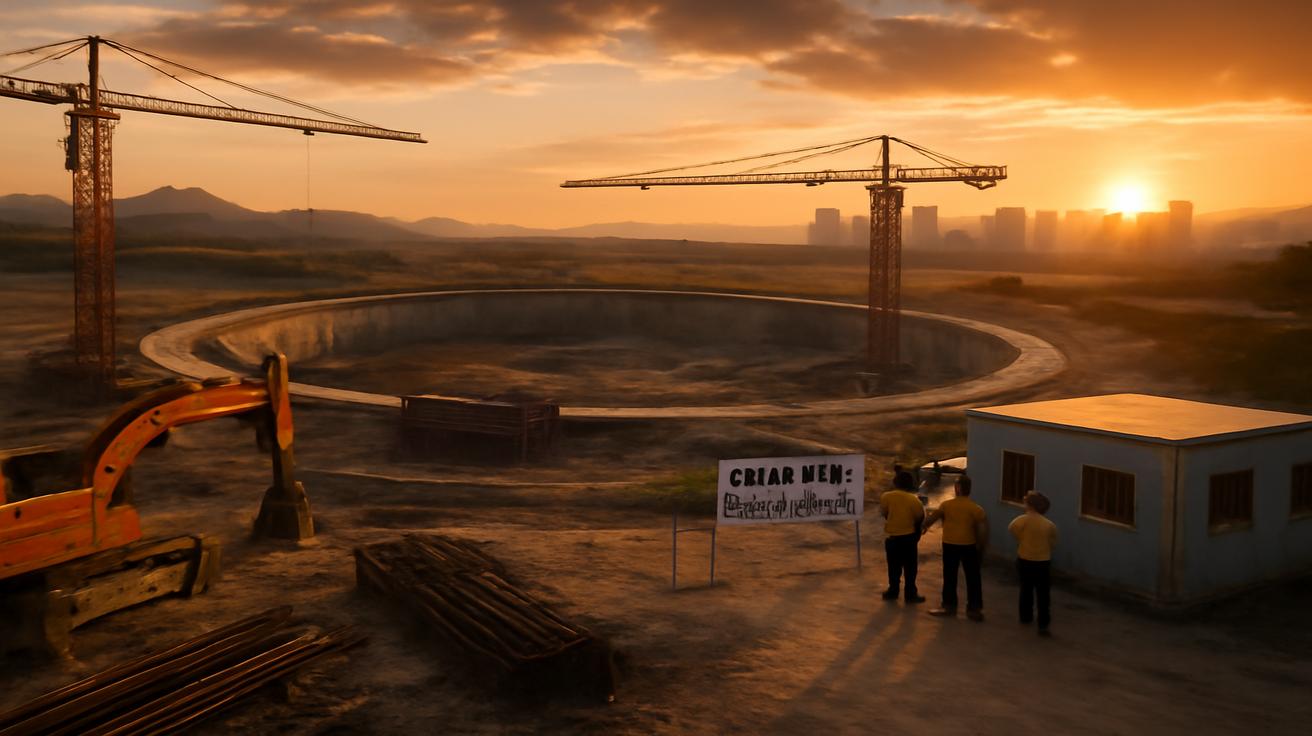
The desert wind at Qinhuangdao tastes faintly of salt and dust, rolling off the Bohai Sea and across acres of scrubby land that were once imagined as the front porch of humanity’s next giant leap. A decade ago, planners and physicists walked this soil with maps fluttering in their hands, tracing invisible circles in the air. Here, they said, beneath this quiet landscape, the world’s largest particle accelerator would hum—a 100‑kilometer ring of superconducting magnets and ultra-high vacuum, big enough to swallow the entire Large Hadron Collider inside with room to spare. It would be China’s answer to Europe’s scientific crown jewel. It would be the next frontier. It would, in many ways, be the future.
The dream of a giant ring in the ground
To understand why this halt feels so momentous, you have to start with the promise wrapped inside those chalk circles on the ground. Particle accelerators are, at their heart, story machines. They slam bits of matter together at incomprehensible energies, peel back the debris, and let us read what the universe is truly made of.
In 2012, the world celebrated when scientists at the Large Hadron Collider (LHC) in Switzerland and France discovered the Higgs boson, the long-sought particle that explains why other particles have mass. It was a triumph that echoed far outside physics labs. But almost as soon as champagne corks hit the ground, a harder question surfaced: what’s next?
One answer, especially inside Chinese physics circles, was: go bigger. The proposal was known as the Circular Electron Positron Collider (CEPC), to be followed, later, by a super‑powerful proton collider in the same tunnel. Where the LHC’s ring is 27 kilometers long, the CEPC’s would stretch roughly 100 kilometers. Where the LHC grazes the limits of today’s technology, the CEPC promised to redefine them.
At conferences in Beijing and Beijing-adjacent cities, the mood was almost electric. Trajectories for beams were plotted. Magnet designs were sketched. Estimated discovery potentials were drawn up on whiteboards. China was positioning itself not just as a manufacturing superpower, but as a fundamental-science leader—host to the next flagship experiment of humanity’s curiosity.
A race written in budgets, not bragging rights
But colossal dreams have colossal price tags, and this is where the story slips its gears. By the late 2010s, rough estimates for the CEPC’s first phase coalesced in an uncomfortable range: on the order of 30 to 40 billion yuan, often quoted as roughly 5–6 billion US dollars or more, before inevitable overruns and the later, much more expensive proton phase. These numbers softened and sharpened as design studies evolved, but one thing was clear—the project would be among the most expensive scientific instruments in history.
Anyone paying attention could sense the tension. Chinese funding agencies were quietly weighing tradeoffs: a monumental collider, or a constellation of smaller—but still world-class—facilities spread across fields from quantum information to space science to fusion? The country’s economic growth was slowing, demographic clouds were forming, and political leadership was sending consistent messages about “high-quality development” versus simple expansion at all costs.
Meanwhile, across the Eurasian landmass, Europe was hatching its own mega-plan: the Future Circular Collider (FCC), a proposed 91‑ to 100‑kilometer behemoth under the countryside near Geneva. The narrative in headlines was irresistible: Europe vs. China, in a quiet, high-tech race to build the next machine that would pry open the universe. But behind the scenes, the race was less about rivalry than timing—and money.
When officials and scientists talk about these machines now, they don’t describe a race so much as an arms-length staring contest with the cost of advanced civilization. Can we still afford, as a species, to bury tens of billions of dollars’ worth of magnets and power systems under the earth in pursuit of the smallest constituents of reality?
Too expensive, even here
There’s a certain irony that hangs in the air when you hear the words: “too expensive even for China.” This is a country that has poured concrete and steel into some of the most ambitious infrastructure projects on Earth—high-speed railways that trace the map like veins of mercury, vast bridges leaping over estuaries, whole cities rising from farmland in a decade. To say that something is too expensive here is a statement with real gravitational pull.
Yet that’s precisely what has happened with the CEPC and its proton-collider successor, at least for now. Quietly, without the drama of a single headline-grabbing cancellation announcement, the project has been slowed, paused, redirected—choose your euphemism. The result is the same: China has stepped back from leading the charge to build the world’s next great collider.
It wasn’t just about money in the narrow sense. It was about opportunity cost. Every yuan tunneled under Qinhuangdao would be a yuan not spent on fusion reactors in Hefei, quantum communication satellites launched from Jiuquan, or the deep-sea observatories off Hainan. China is in a phase of scientific expansion, but it is also ranking and filtering that expansion with unusual discipline.
Still, cost threads through everything. Operating such a machine over decades demands not only construction funds but an ongoing river of electricity, maintenance, staffing, and upgrades. In a world nervously watching climate targets and energy transitions, the optics of turning gigawatts into particle collisions can be a challenge, even when the actual energy footprint is dwarfed by other industries.
The physics that got put on hold
Inside the global physics community, the reaction has been a mix of disappointment, resignation, and a kind of pragmatic creativity. Many had pinned their hopes on the CEPC as the “Higgs factory” of the 21st century—a machine dedicated not to discovering the Higgs, but to dissecting it with almost obsessive precision.
By smashing electrons and positrons together at carefully chosen energies, the CEPC would have produced clean, controlled collisions rich in Higgs bosons, Z bosons, and W bosons. Physicists dreamed of measuring the Higgs’ properties so precisely that even the slightest deviation from theory would stand out like a bright thread in a tapestry—a potential sign of new physics lurking beyond our current models.
But that program has not simply evaporated; it has been scattered and reshaped. Other facilities—Japan’s proposed International Linear Collider, Europe’s FCC, upgrades at the LHC, and even entirely different detector strategies—are now being re-weighted in the global imagination. China itself is not backing away from particle physics; its existing accelerators, like the Beijing Electron–Positron Collider and the Jiangmen Underground Neutrino Observatory (JUNO), still push at the seams of the Standard Model.
Yet there’s an unmistakable sense of a door quietly closing. The plan to out‑ring Europe, to host a 100‑kilometer symbol of scientific primacy, has faded into the shimmer of what-ifs.
Crunching the cost of a dream
If you zoom out from the technical jargon and political nuance, the CEPC story becomes a parable about how societies value curiosity. Particle accelerators have always been lightning rods for budget debates. In the early 1990s, the United States famously canceled its own mega-collider, the Superconducting Super Collider (SSC), after spending billions of dollars and digging dozens of kilometers of tunnel in Texas. That decision, still argued about in physics halls, helped shift the center of high-energy physics to Europe.
China’s hesitation over the CEPC is not as abrupt, but the echoes are there. It forces a stark arithmetic: how many hospitals, rural broadband networks, or climate adaptation programs is one collider “worth”? It’s an unfair question—scientific investments often pay off in unexpected ways, from new medical imaging technologies to breakthrough computing techniques—but it’s a question that finance ministers and political leadership cannot avoid.
To feel the texture of this tradeoff, consider a simplified comparison:
| Project Type | Approximate Scale of Investment | Primary Payoff Horizon |
|---|---|---|
| Mega Collider (e.g., CEPC) | Billions of US dollars over decades | Long-term, fundamental knowledge; indirect tech spinoffs |
| Nationwide Infrastructure Upgrade | Similar magnitude | Medium-term, economic productivity and quality of life |
| Strategic Tech Programs (AI, Quantum, Space) | Spread across many smaller projects | Short- to medium-term, direct economic and security impact |
On a mobile screen, that table reduces to rows of quiet comparisons; line by line, you can feel the pressure shaping national priorities. It is not that a collider loses the argument outright. It’s that it must now shout above a crowded room of urgent needs: public health, aging populations, climate resilience, industrial modernization.
Europe keeps running, but with heavier feet
Over in Geneva, the mood is not exactly triumphant. Europe’s Future Circular Collider faces many of the same existential questions as China’s CEPC did. Its cost estimates are high, its timelines sprawl decades into the future, and its architects must convince not just scientists, but 30‑plus countries that a machine to probe invisible forces is as worthy as a thousand visible programs on Earth’s surface.
Still, China’s retreat sharpens the picture. If there is to be a single, next‑generation flagship collider on this planet, odds tilt toward it being European. That is both an opportunity and a burden. Europe gains space to lead, but it also loses a powerful partner that could have shared costs, talent, and political justification.
There is a quieter, more intimate impact, too. Young physicists who once imagined careers orbiting around a Chinese mega‑facility are recalculating. Some will gravitate to Europe, others to data science, to medical physics, or to the growing tech sector hungry for people who think in probabilities and uncertainties. You can feel the field itself adapting, like a river whose main branch has been dammed, sending water and talent into new channels.
What replaces the collider-shaped hole
Walk back across the scrubland in Qinhuangdao today and it feels, on the surface, unchanged. Birds stitch the sky. Trucks rumble on distant highways. The imagined ring lies only in old planning documents and in the minds of those who sketched it.
Yet the energy that once pooled around this project has not simply dissipated. Inside China’s research ecosystem, attention is tilting toward areas perceived as both foundational and strategically “useful”: advanced materials, next-generation batteries, quantum communications, AI chips, green energy systems, fast radio astronomy, deep-space probes, and more. At institutes in Beijing, Shanghai, Shenzhen, and Hefei, labs are lit late into the night chasing breakthroughs that straddle the border between pure curiosity and practical application.
Some would say this is a narrowing of ambition, a retreat from the purest form of blue-sky science represented by a 100‑kilometer tunnel. Others argue it is a maturation—a decision to thread fundamental insights through the loom of national needs. Both interpretations contain some truth.
The human stories behind the policy are complex. A young accelerator physicist might find themselves pivoting from collider magnet design to building ultra‑precise medical imaging systems. An experimentalist who once planned to calibrate Higgs detectors may now use their statistical skills to model climate extremes or optimize complex manufacturing processes. Those paths may lack the mythic aura of searching for new particles, but they are no less rooted in the same habits of mind: careful measurement, skepticism, patience.
Rethinking what “big science” means
This moment also forces a deeper question that extends beyond China and Europe alike: what should “big science” look like in the 21st century? The 20th century’s grandest machines—the Apollo rockets, the giant radiotelescopes, the LHC, nuclear reactors—were built in an age when growth seemed endless and resources, if not infinite, at least negotiable.
Now the constraints feel heavier. We are tracking, with increasing anxiety, not just our budgets but our planetary boundaries: carbon, biodiversity, water, pollution. In that context, a single, mammoth experiment draws scrutiny in new ways. Can we design scientific programs that are deeply collaborative, distributed across continents, modular and upgradeable rather than monolithic and fixed?
There are hints of an answer already in motion: global networks of telescopes that turn the Earth into one giant eye, open-data projects that allow thousands of small teams to mine a shared stream of observations, swarms of small satellites mapping our planet’s changing face. None of these individually carry the heft of a mega-collider. Together, they sketch a vision where humanity’s curiosity is expressed less as one colossal monument and more as a living, evolving web.
The universe will wait—patiently, implacably
Perhaps the most humbling truth in all this is that the universe does not care whether we build a collider today, in 2050, or in 2100. The laws we seek to uncover—the hidden symmetries, the dark energies, the particles that may or may not exist beyond our current theories—are under no deadline. We are.
We are bounded by political cycles, by economic booms and busts, by the patience of voters and the capacity of tax systems, by the warming of the oceans and the retreat of glaciers. The decision in China to halt the accelerator race with Europe is, among other things, an acknowledgment of those bounds.
Does that make it a failure of courage? Or a sober act of responsibility? The answer depends on where you stand. To the experimental physicist who has spent a career writing design reports, it can feel like the floor shifting underfoot. To a policymaker juggling education, healthcare, and climate adaptation budgets, it may feel like the only ethically defensible choice.
And yet, even in this pause, something essential remains. It lives in the questions that keep surfacing, stubborn as stars at dusk: What is dark matter really made of? Why is the Higgs field so strangely light? Are there hidden forces, hidden symmetries, hidden particles we’ve not yet glimpsed? Those questions will outlive a single project, a single country’s ambitions, even a single century’s economic calculations.
Someday, perhaps, the scrubland at Qinhuangdao—or a valley in Europe, or a plain in Africa, or a desert in Australia—will once again be walked by people drawing circles in the air. Their maps will be different. Their power sources may be fusion reactors or advanced renewables. Their budgets and technologies will belong to a world we can barely imagine now. But the impulse will be the same: to carve, beneath the soil, a ring where we ask the universe to speak in particles and flashes of light.
For now, though, the race that once seemed so breathless has slowed to a walk. China has set down the baton, at least temporarily. Europe holds it with an uncertain grip. The track stretches on, circling not just a field or a city, but the thin, fragile world we all share.
FAQ
Why did China halt its plan for the CEPC mega-collider?
China stepped back mainly because of the enormous cost and competing national priorities. Building and operating a 100‑kilometer collider would require many billions of dollars over decades, and policymakers weighed that against investments in other areas like health, infrastructure, climate resilience, and strategically important technologies.
Does this mean China is abandoning particle physics?
No. China continues to support major particle and astrophysics projects, including neutrino observatories, dark‑matter experiments, and existing accelerators. The shift is away from one ultra‑expensive flagship collider toward a broader portfolio of scientific and technological programs.
What was the scientific goal of the CEPC?
The CEPC was designed as a “Higgs factory”—a collider that would produce large numbers of Higgs bosons in very clean collisions. This would allow extremely precise measurements of the Higgs and other particles, potentially revealing subtle signs of new physics beyond the Standard Model.
How does Europe’s Future Circular Collider fit into this story?
Europe’s FCC is a similar-scale proposal for a ~100‑kilometer collider near Geneva. With China stepping back, Europe is now the leading candidate to host the next giant collider, but the FCC still faces its own funding, political, and technical challenges.
Will humanity build a next-generation mega-collider at all?
It’s uncertain. Many physicists believe a new flagship collider is eventually necessary to answer key questions about the Higgs boson, dark matter, and fundamental forces. Whether that happens in the next few decades depends on political will, international collaboration, technological advances that might reduce costs, and how societies choose to balance big science with other pressing needs.








Leave a Comment