
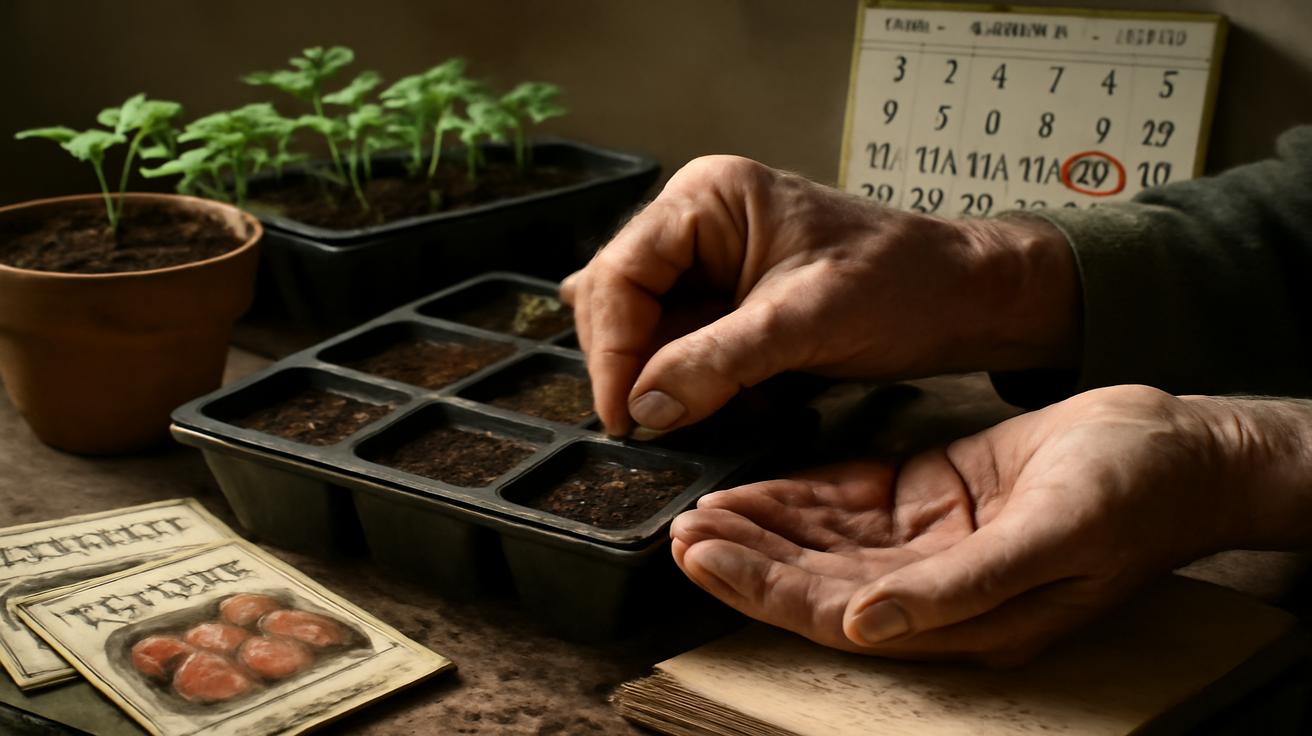
The old men on my grandfather’s street used to say you could tell who knew their tomatoes by the calendar date, not the size of their garden. “Anyone can plant,” old Mr. Keller would mutter, thumbs hooked into his suspenders, “but the wise ones sow on the right day.” There was a particular date, circled in red pencil on every kitchen calendar up and down the lane, that marked the true beginning of tomato season. They spoke of it in that half-serious, half-mythical way country people reserve for weather omens and fishing holes. And every year, as if by magic, their tomatoes blushed red days—sometimes weeks—before anyone else’s.
The Day the Seed Drawer Opened
The date never changed. It arrived quietly, somewhere between late winter grit and early spring hope, when the snow was mostly a memory but the soil was still cold to the touch. You would see it in small ways: the hardware store window switching from snow shovels to seed racks, the sun finally stretching itself into the evening, the air smelling a little less like ice and a little more like earth.
On that morning, the old-timers moved with the certainty of migratory birds. No debates, no guesswork, no checking long-range forecasts on their phones. They had the date, and that was enough. Coffee first—always coffee—then down to the basement, or out to the small glasshouse leaning against the southern side of the house, or into a cluttered shed that smelled of soil and machine oil.
That was the day the seed drawers opened. Little envelopes, corners softened from years of touching, emerged from biscuit tins and cigar boxes. Names in careful handwriting: Brandywine, Stupice, Mortgage Lifter, a family heirloom simply called “Nonna’s Red.” They were handled like treasure, like stories you could eat.
When I asked my grandfather why this particular date, why not sooner, why not later, he didn’t answer with charts or frost data. He just said, “Because it gives them just enough time to be ready, and not a day more. Any earlier, they sulk. Any later, you’re eating salad while your neighbor eats sauce.”
The Secret Timing Behind Their Legendary Head Start
Of course, there was more science beneath that shrug than he let on. The date they chose was precisely calibrated—though they’d never use that word—to the last frost in our region. It was six to eight weeks before those cold, dangerous nights finally loosened their grip. They knew from decades of watching: when the plum tree budded, when the blackbirds returned, when the soil moved from iron-hard to merely stubborn.
They were chasing a very specific goal: to set sturdy transplants into the ground the moment the soil warmed enough, not waiting for seedlings at home to catch up. They wanted plants that had already outgrown infancy, ready to root deep and reach up fast once they hit real earth. That’s how they always seemed to be ahead—slicing into their first sun-warmed tomato while everyone else was still posting pictures of flower clusters.
They never said “germination rate” or “optimal soil temperature.” Instead, they would press a palm into the seed tray and say, “Feels right.” But if you look closely at what they did, a pattern emerges that you can borrow for your own garden:
| Step | Old-Timer Rule of Thumb | What It Means in Practice |
|---|---|---|
| Pick the date | 6–8 weeks before last frost | Count backward from your average last frost date to find your own “magic” sowing day. |
| Prepare soil mix | Light, clean, and warm | Use a fine, sterile seed-starting mix slightly moistened—never soggy, never dry. |
| Sow depth | “Twice as deep as the seed is thick” | Tomato seeds go about 0.5–1 cm deep, gently covered and firmed. |
| Heat and light | Warm feet, bright skies | Warm the soil (20–24°C) and give maximum light as soon as they sprout. |
| Transplanting time | After frost, when nights stay mild | Wait until danger of frost has passed and soil feels cool, not cold, to your hand. |
This was the rhythm embedded in that old circled date. It wasn’t superstition; it was living memory, wrapped in ritual.
Preparing the Sacred Little Trays
The Smell of the First Warm Soil
On sowing day, the house smelled different. There was always a moment when someone opened a bag or a pail of potting mix, and a wave of earth rose into the kitchen, cutting straight through the lingering scent of winter dust. My grandmother would pretend to complain about the mess, but even she leaned in to breathe deeper.
They didn’t fuss with complicated equipment, just simple, repeatable habits. Trays or old wooden boxes lined with newspaper, individual cells rescued from past garden seasons, mismatched pots that once held chrysanthemums from the supermarket. The main thing was this: every container had good drainage, and every mix was loose and airy so tomato roots could wander easily.
Grandfather would pour the seed mix into a rusty metal basin, then sprinkle warm water with his hand like he was blessing it. He would squeeze a handful: “If it holds and just barely crumbles apart, that’s right.” Too wet, and he’d add more dry mix. Too dry, another dash from the kettle. This was science by feel—a skill that builds over seasons.
The Ritual of Tiny Seeds
The packets themselves were small, fragile things, but the seeds inside carried entire summers. He would tap a few into his palm, small as crumbs, pale as dust. “Handle them like promises,” he’d say, half joking, while nudging each one into its place.
He never scattered them wildly. Instead he pressed shallow rows with a fingertip or the edge of a pencil, dropping seeds with surprising precision. “Each one needs light, air, and room,” he’d murmur. “No one likes to start life in a crowd.” A thin veil of soil floated over them, no more. Heavy covering, he claimed, was how impatient people lost their best plants before they ever saw light.
Then came the part that felt almost like tucking in a child: a gentle misting of water, the trays labeled in looping script, a clear cover or plastic stretched over the top to hold in warmth. He would slide them onto a warm shelf above the boiler or onto a gently heated mat near the south-facing window, and then—most important of all—he would leave them alone.
“They don’t need your worry,” he told me once, catching me peeking under the cover for the third time that day. “They need time.”
Light, Heat, and the Art of Not Rushing
The First Green Loops
A few days later, the miracle began. The soil cracked in tiny seams, and pale loops pushed up, bent over like little question marks. The first time you see them, they always look fragile, as if a sigh could knock them over. But those old-timers knew: tomatoes are tougher than they look, especially when treated like future champions instead of delicate ornaments.
The seedlings were moved to the brightest place in the house the moment they broke the surface. No more cozy covering, no more coddling. Just light—every hour of it they could get. A sunny windowsill, a cheap fluorescent tube hung low, or a dedicated grow light: it didn’t matter, as long as those tiny leaves basked instead of reaching desperately toward a dim, faraway glow.
“Long and leggy means you lied to them,” Mr. Keller once said, flicking a spindly store-bought tomato with a fingernail. “You promised them sun and handed them a shadow.” The seedlings from his own dated sowing were squat, thick-stemmed, leaves broad and rich. They looked like they had opinions about the world.
The Subtle Art of Holding Back
This was another part of their quiet genius: they weren’t afraid to slow the plants down if the weather lagged behind. On extra-cold springs, they’d shift the trays to slightly cooler rooms so the seedlings grew steady and strong rather than soft and over-eager. “Better to have a patient plant than a disappointed one,” my grandfather would say.
They watered from below whenever possible, sliding trays into shallow pans of water and letting the roots pull up what they needed. Overhead splashing was reserved for careful top-ups, never enough to flatten the baby leaves. And always, always, they let the surface of the soil dry slightly between waterings, coaxing roots to dive deeper instead of loafing near the top.
All of this meant that by the time the neighbors were just starting their seeds—days or weeks later, urged on by the first truly warm afternoon—the old-timers’ tomatoes were already small but substantial plants. Not rushed, not forced. Just exactly on time.
From Kitchen Window to Open Ground
Hardening Off: The First Taste of Weather
Then came the bridge between sheltered life and real life: hardening off. If sowing day was marked with a red circle on the calendar, hardening-off week was marked on their faces—more time standing at the back door, more glances at the sky, more muttering about wind.
On the first mild day, the seedlings would be carried outside like honored guests, set on a bench or crate in a spot with bright, indirect light. Just an hour or two at first, then back inside. The next day, a little longer. After a few days, they’d know the feel of real breeze, the shifting dance of cloud and sun, the mild shock of cooler air on their leaves.
Sometimes a gust would knock one flat, and an old hand would lift it gently, pressing the soil back around its stem. “Good,” my grandfather would say. “Better to learn to bend now than snap later.” Within a week or so, the plants had the resilient look of those who’d actually met the elements and survived.
Planting Day: Deeper Than Before
When the danger of frost finally passed—not when the calendar said so, but when the soil, the air, and the old-timers all agreed—a quiet migration began. Trays were carried to tilled beds and waiting pots, to plots that had been manured and forked and rested. And here, again, their way with timing showed.
They always planted tomatoes deeper than they had grown in their pots, burying the stems until only the top leaves showed, or laying them sideways in shallow trenches to encourage roots along the entire buried length. “Every hair on that stem can become a root,” my grandfather would say. “Give them something to do.”
Into the planting hole went a scoop of compost, sometimes a whisper of crushed eggshell or a pinch of old, crumbled manure. The soil was drawn in gently, firmed with a hand that knew exactly how much pressure a young tomato could take. A deep drink of water. A final pat on the earth, as if closing a book.
And then they walked away.
Why Their Tomatoes Ripened First
From the outside, it might have looked like luck—that those old men and women always, somehow, harvested first. Bowls of bright, heavy fruit appeared on their porches while others still had green marbles on their vines. But it wasn’t a trick, and it certainly wasn’t only the variety of seeds they used.
Their secret was this: they aligned their sowing with the full life of the plant, from the first stirring of the seed right through to the last warm evening of summer. That circled date on the calendar was not a superstition; it was the starting pistol in a race they ran the same way every year, pacing themselves by the sky and the soil instead of by impatience.
By sowing six to eight weeks before the last frost, they guaranteed themselves transplants at the perfect moment—plants old enough to seize the season with vigor, young enough not to stall from stress. By handling seedlings with a blend of gentleness and tough love, they raised tomatoes that didn’t flinch when real weather hit them. By hardening off properly and planting deep into warm, well-prepared soil, they gave roots a head start that fruits later translated into earlier ripening.
In a world obsessed with shortcuts, with quick-harvest varieties and instant-garden solutions, their method feels almost radical in its simplicity: know your frost date, circle your sowing day, and then show up, year after year, with your hands and your patience.
Maybe, in your region, that magic day will be the second week of March, or late February, or the first days of April. It will depend on your own pattern of cold and thaw, of how long winter clings to your hills and streets. But once you find it—once you count backward from your last frost and pick your date with intention—you join a very old conversation. You step into a lineage of growers who learned, through trial and error and watchful eyes, that timing is not about hurry. It is about harmony.
And one summer evening, when you bite into your first tomato of the year while your neighbor’s are still blushing green, you may hear a faint echo of those old-timers in your mind. You’ll remember the feel of the seed in your palm on that particular day, months earlier, when it was still cold outside but the light had begun to change. You’ll swallow, wipe the juice from your chin, and think, “They were right. It all started on that date.”
Frequently Asked Questions About Tomato Sowing
How do I find my own “old-timer” sowing date?
Look up the average last frost date for your area, then count back 6–8 weeks. That gives you a reliable sowing window. If you have strong indoor light and warmth, lean toward 7–8 weeks; if your conditions are cooler or dimmer, 6 weeks is usually safer to avoid leggy plants.
Can I just sow earlier to get tomatoes even sooner?
Only up to a point. Sowing too early often produces tall, weak, root-bound plants that suffer when transplanted. Unless you can offer excellent light, warmth, and potting-up space, very early sowing can actually delay your first harvest instead of speeding it up.
What kind of soil mix should I use for sowing tomato seeds?
Use a fine, sterile seed-starting mix rather than heavy garden soil. It should feel light and crumbly, hold moisture without becoming soggy, and allow tiny roots to explore easily. You can buy a seed-starting mix or blend your own from sifted compost, coco coir or peat, and a little perlite or sand.
Do tomato seeds need light or darkness to germinate?
Tomato seeds don’t strictly require light to sprout, but they do need warmth. Keep them in a warm place (around 20–24°C). As soon as the first sprouts appear, move them into strong light so they don’t stretch and weaken.
How many hours of light do young tomato plants need?
Seedlings do best with 14–16 hours of bright light each day. On a windowsill, that can be hard to guarantee, especially in early spring, so many gardeners supplement with simple grow lights or fluorescent tubes hung close above the plants.
When is it safe to plant tomato seedlings outside?
Plant outside only after the risk of frost has passed and nights are consistently mild. The soil should feel cool, not icy, to your hand. Harden plants off for 7–10 days first by gradually exposing them to outdoor conditions.
Why do old-timers plant tomatoes deeper than they grew in the pot?
Tomatoes can form roots all along their buried stems. Planting them deeper—or laying them sideways in a trench and covering the stem—creates a stronger, more extensive root system, which helps the plant grow faster, anchor better, and cope with heat and drought.






Leave a Comment