
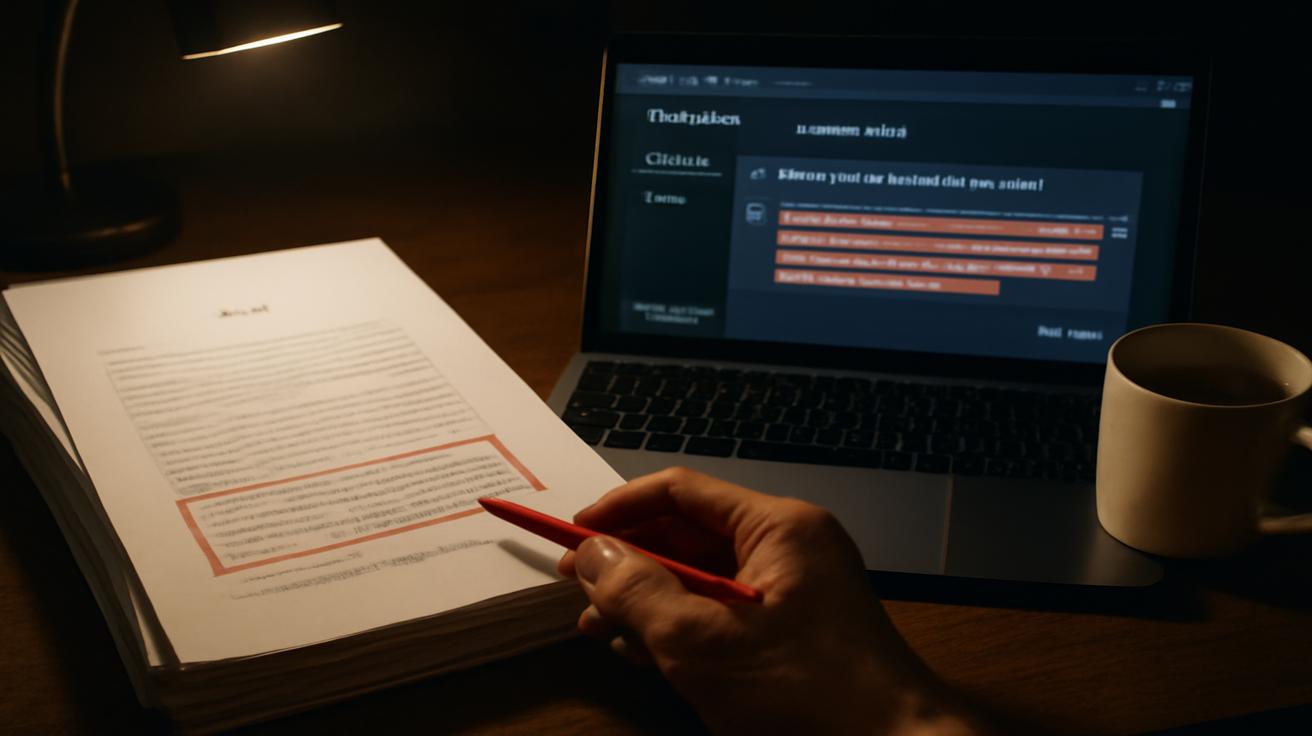
The email arrived in the middle of a quiet Tuesday, the kind that makes a campus feel half-asleep. Outside, the maples rattled in a dry autumn wind, and in the humanities building, Professor Elena Ruiz stared at a stack of essays that all sounded strangely alike. It wasn’t that they were good—exactly the opposite. They were too smooth, too polished, and somehow, eerily hollow. Not one misplaced comma. Not one clumsy sentence. Not one voice that felt like a real twenty-year-old, rushed and over-caffeinated and human.
The Day Professors Realized the Machines Were in the Room
By the time students came shuffling into classrooms with laptops and half-charged tablets, ChatGPT had already seeped into the seams of academic life. No big announcement. No new campus policy. Just a whisper: “Have you tried this thing? It writes essays for you.”
In the faculty lounge, the first signs sounded like anecdotes. A colleague mentions a student who turned in a ten-page paper with perfect structure but no citations. Another brings up an essay that references a book the student clearly never read. These stories first drew laughter, then suspicion, then that uneasy silence that settles in when a shared problem starts to feel too big to joke about.
Professors have always dealt with cheating—answers scribbled on palms, plagiarized paragraphs copied from obscure websites, bought term papers. But this new wave was different. It was quiet. Invisible. The same glowing screen that held a blank document also held an AI model ready to dress that emptiness in deceptively elegant prose in seconds.
For many instructors, especially those in writing-heavy disciplines, something shifted. It wasn’t just about grades or academic honesty policies. It was about trust—this fragile, unspoken agreement that when a professor reads a student’s words, they are, at the very least, written by that student’s own hand and mind.
The Trap: Designing Assignments for a Non-Human Reader
The first trap didn’t look like a trap at all.
It started with small experiments. In seminar rooms and Zoom classes, a few professors slipped in questions that felt just a little off. A phrase slightly misquoted. A citation to a paper that didn’t exist. An assignment prompt so oddly specific and localized that only someone who had been in that actual classroom—on that actual campus—could realistically respond with accuracy.
Elena’s approach was simple, almost playful. She added a final question to her essay prompt:
“In your conclusion, please briefly reference the class discussion we had about the ‘Lake Behind the Library’ and how it shaped your understanding of the text.”
There is no lake behind the library.
The students knew this—anyone who had walked across campus knew that behind the library was a concrete loading dock and a weedy stretch of staff parking. But ChatGPT, at least in its earlier iterations, knew only what the prompt suggested. It could paint a shimmering, reflective surface where none existed, populate it with willows and thoughtful undergraduates gazing into the water like characters in a coming-of-age novel.
When the essays came in, Elena flipped straight to the conclusions. She began marking, drawing small stars in the margins where she found sentences like:
“As we reflected by the lake behind the library, the calm water mirrored our shifting interpretations of the text…”
Or:
“The discussion we had by the lakeside emphasized the fluidity of meaning, just as the ripples on the water suggested…”
Each answer was graceful. Elegant. Entirely fabricated.
The students who had actually written their own essays responded differently. Some ignored the “lake” line entirely. Others made jokes about “the metaphorical lake behind the library.” One simply wrote: “We don’t have a lake behind the library, but our conversation in class on Tuesday made me reconsider…”
And there it was—a human fingerprint. Not perfect prose, not the lack of typos, but that small, grounded awareness of reality.
Subtle Clues: The Sound of a Machine Thinking
Once a few professors began quietly inserting traps, they started to notice patterns. ChatGPT, for all its power, had tells. Not just factual hallucinations, but a certain stylistic sameness that began to feel uncanny: the same transition phrases (“In conclusion,” “Furthermore,” “On the other hand”), the same even-handed tone, the same reluctance to take a sharp or risky stance.
In the warm hum of afternoon office hours, one professor laid out two essays on her desk, side by side. One was dense, messy, alive with half-formed arguments and awkward phrasing. The other flowed perfectly, like water on polished stone. Both had similar thesis points. Both met the rubric’s criteria.
Only one felt like a real student.
Professors began building small internal checklists, not official policies, more like gut-guided tools:
| Clue | Typical AI-Generated Signal | Typical Human-Student Signal |
|---|---|---|
| Voice & Style | Even, neutral tone; generic academic phrases; few personal quirks. | Inconsistent tone; personal asides; occasional slang or humor. |
| Detail & Specifics | Vague examples; surface-level interpretations; over-broad claims. | Highly specific references to class discussions, readings, or local context. |
| Errors | Almost no grammar mistakes, but strange factual errors or invented sources. | Typos, awkward sentences, but grounded in real experiences and sources. |
| Risk-taking | Balanced, cautious; avoids strong opinions or unusual interpretations. | Bold claims, sometimes poorly defended; personal stakes in the argument. |
Of course, none of these clues alone could prove anything. And that was the knot at the center of the problem: How do you accuse a student of using a tool that leaves no clear fingerprints, only hunches and stylistic patterns?
Some instructors reacted by building more elaborate traps: fictional references in prompts, hyper-specific in-class scenarios, assignments that required hand-written work completed under supervision. Others scheduled “oral defenses” of written work: short, low-stakes conversations where students were asked to walk through their thinking process, explain a quote, or expand a paragraph verbally.
The result? When a student couldn’t explain their own writing, couldn’t remember how they arrived at a point or why they chose a particular example, that gap became its own kind of evidence.
Inside the Quiet War Over Trust
The story of professors trapping students with subtle prompts sounds, at first blush, like a clever cat-and-mouse game. But underneath the ingenuity and the occasional dark humor, there’s something more fragile at stake.
In the slow echo of a nearly empty hallway after evening classes, you can hear it in the way faculty talk about their work. They don’t just want correct answers; they want to witness thinking. They want to see confusion turn into clarity, to watch a student wrestle with an idea and come out the other side with something imperfect but earned.
One philosophy professor described it this way to a colleague: “When a student uses ChatGPT to generate an essay, they’re not just cheating me. They’re robbing themselves of the moment of struggle that makes learning real. And I don’t know how to grade that absence.”
Students, for their part, are not cartoon villains rubbing their hands in the dark. Many are overwhelmed—working jobs, caring for siblings, navigating anxiety, watching their notifications pile up on cracked phone screens. When a machine says, “I can do this for you,” it can feel less like a temptation and more like survival.
In late-night dorm conversations, some students describe ChatGPT as “just another tool,” like Grammarly or a calculator. Others admit quietly, often only to close friends, that they feel guilty turning in work they didn’t really write. They worry about getting caught, yes, but also about this creeping sense that they’re slipping through college without actually growing.
That’s the uncomfortable heart of this quiet war: The trap assignments and clever prompts are not just about catching cheaters. They’re a desperate attempt to pull students back into an honest relationship with their own learning in a world where shortcuts have become astonishingly, seductively good.
The Ethics of Setting a Trap
Not all professors are comfortable with the idea of tricking their students—even for what they see as a good cause.
Is it fair to deliberately plant a fake detail in a prompt and then use it as a kind of tripwire? Does it erode trust, the very thing educators are trying to protect? When a student is caught in one of these traps, are they learning a lesson, or just learning to use the tool more carefully next time?
In department meetings and email threads, the debate runs hot and uneven. Some argue that subtle prompt traps are no different from exam proctoring or plagiarism detection software—just another form of academic security. Others feel a quiet unease, a sense that something important is lost when a classroom becomes an environment where the teacher is actively trying to expose their students.
A literature professor in one such debate put it plainly: “I want my students to feel like I’m on their side. That I’m here to help them think, not to spy on them. But I also don’t want to grade AI poetry and pretend it’s theirs. I don’t know where that leaves me.”
And that, more than any dramatic cheating scandal, may be the story of this moment: a generation of educators walking a narrow, unsteady path between protection and surveillance, trust and verification, optimism and doubt.
Learning to Live With the Machines
As the months pass, the tone of the conversation shifts. The question stops being, “How do we stop students from using AI?” and slowly becomes, “How do we live with it?”
Some professors lean into the trap strategies, making assignments that AI can’t easily handle: personal reflection essays tied to real experiences, multi-step projects that require drafts and in-class brainstorming, group work with rotating responsibilities, handwritten notes and diagrams.
Others take a more radical route: they invite ChatGPT into the classroom openly.
In one seminar, students are asked to prompt the AI to generate an essay on a topic, then spend an entire session tearing it apart. Where is it shallow? Where is it wrong? Where does it sound persuasive but offer no real evidence? Students learn to see the system’s limitations, and in the process, many become more critical of their own writing and thinking.
Some courses now explicitly allow AI as a tool—but require students to document exactly how they used it. They must paste in prompts, annotate AI-generated paragraphs, and clearly distinguish their own contributions from the machine’s. The focus shifts from detection to transparency.
In these classes, the trap isn’t about catching dishonesty. It’s about revealing process. Professors can still tell when a student leans too heavily on the AI, but instead of secret surveillance, there is a shared language and an agreed-upon line.
The Hidden Cost of Perfect Answers
Walk across campus and you can feel it in the small rituals. The way a student sits alone at a picnic table, staring at their laptop, fingers hovering over the keys, wondering: Do I ask the machine to help? How much is too much? What counts as “my own work” anymore?
There is a sensory contrast in this moment that is hard to ignore. The world outside is stubbornly analog—wind in the trees, the smell of wet pavement after an unexpected rain, the distant thud of a basketball on the cracked court behind the dorms. Inside the library, the light is cold and bright, bookshelves silent, laptops glowing like bright rectangles of elsewhere.
Perfect answers come easy now. What’s harder is the imperfect work of actually learning—fumbling through explanations, revising messy drafts, arguing with a text until it yields a new understanding. That work is slow, confusing, and often uncomfortable. It does not produce clean, polished paragraphs on the first try.
And yet, if you ask almost any professor why they still stay up late grading, why they still stand in front of a room semester after semester, they’ll tell you: it’s because of those imperfect moments. The ones where a student finally sees something in a poem or a dataset or a historical document that they couldn’t see before. The spark of recognition in their eyes. The way they sit up a little straighter when they realize, suddenly, that they are capable of thinking in ways they didn’t know were possible.
No AI model can experience that for them.
The Future of the Trap—and What Comes After
The traps, clever as they are, are stopgaps. They are Band-Aids on a deeper wound: the widening gap between what education promises and what tools like ChatGPT make possible.
Over time, the traps will get more sophisticated—and so will the students’ strategies. AI models will get better at faking local knowledge, at mimicking a student’s voice if given a writing sample, at weaving in personal anecdotes on command. The line between human and machine-written content will blur further, and the old detection tricks will lose their edge.
What will remain are the things that are hardest to fake: lived experience, emotional risk, embodied presence, real-time conversation, the slow accumulation of insight that shows up not just in a single essay, but across a semester’s worth of work.
On a rainy afternoon, Elena sits with a new stack of essays in front of her. She has stopped using the “lake behind the library” trick. Instead, her prompt now asks students to connect the week’s reading to something they noticed in their own lives—a conversation with a roommate, a job shift, a moment alone waiting for the bus.
The essays are rougher now. More typos. More uneven sentences. But also, scattered among them, are lines that feel electric in their honesty. A student connecting a poem about exile to the experience of moving away from home for the first time. Another wrestling with an author’s argument about responsibility while describing the pressure of sending money back to family.
No trap is needed to know these are real. They carry the weight of specificity, the texture of a life actually lived.
As AI weaves itself deeper into every corner of higher education, the professors who once turned to trick prompts and invisible test questions may find themselves less interested in catching students out and more focused on inviting them in—to the messy, vulnerable, demanding work of thinking for themselves.
The machines can produce a decent essay. They can simulate insight. They can wrap emptiness in impressive language.
But they cannot feel the low-level panic of a deadline, the flutter of understanding when a hard idea finally lands, or the quiet pride of turning in a piece of writing that may be flawed, but is unmistakably, undeniably your own.
Frequently Asked Questions
How are professors actually trapping students who use ChatGPT?
Many professors insert subtle details into assignment prompts that an AI is likely to treat as real, but that students in the actual class would recognize as false or strange—like references to a non-existent “lake behind the library” or a fabricated article title. They then look at how students respond to those details to see who is engaging with reality and who is echoing the prompt uncritically.
Is using ChatGPT for schoolwork always considered cheating?
It depends on the institution and the specific class. Some professors fully ban AI-generated writing, while others allow it as a support tool—as long as students are transparent about how they used it. The grey area lies in undisclosed use, especially when the AI is producing entire assignments that students submit as their own work.
Can AI-detection tools reliably catch ChatGPT-generated essays?
Current AI-detection tools are imperfect and can produce both false positives and false negatives. That’s why many professors lean more on patterns, oral follow-ups, and assignment design rather than solely relying on detection software. In most cases, these tools are treated as signals, not definitive proof.
What kinds of assignments are hardest for AI to fake convincingly?
Assignments that require personal reflection, direct connection to class discussions, local or campus-specific knowledge, or multi-step processes with drafts and in-class components are much harder for AI to simulate convincingly. Projects that blend lived experience with course concepts make it easier for professors to see genuine student thinking.
How can students use AI ethically in their studies?
Students who want to use AI ethically can treat it as a brainstorming partner or editing assistant rather than a ghostwriter. That might mean using it to generate ideas, clarify confusing concepts, or suggest improvements to a draft they already wrote. Crucially, they should follow their instructor’s stated policies and, when allowed, be transparent about when and how AI was involved in their work.








Leave a Comment