
The sea ice stretches out in every direction, a white stillness that seems to swallow sound. Somewhere beneath it, a camera the size of a shoebox glides a few meters above the seafloor, its lights knifing through the near‑black water. On the ship above, a handful of scientists lean toward a bank of monitors, sipping lukewarm coffee, the air humming with quiet machinery and tired conversation. The screens show a slow parade of stones, sediment, and the occasional ghostly jelly drifting across. And then, suddenly, the familiar monotony breaks. One of the researchers straightens. “Wait. Go back. What was that?”
A Discovery Hiding in Plain Ice
At first, they think it’s a glitch. The camera has passed over a shallow depression in the seafloor, a neat bowl scooped out of gravel, with a single pale fish guarding the center like a sentinel. The team has seen fish nests before, in other oceans, in other latitudes. It’s an interesting note, not a revelation.
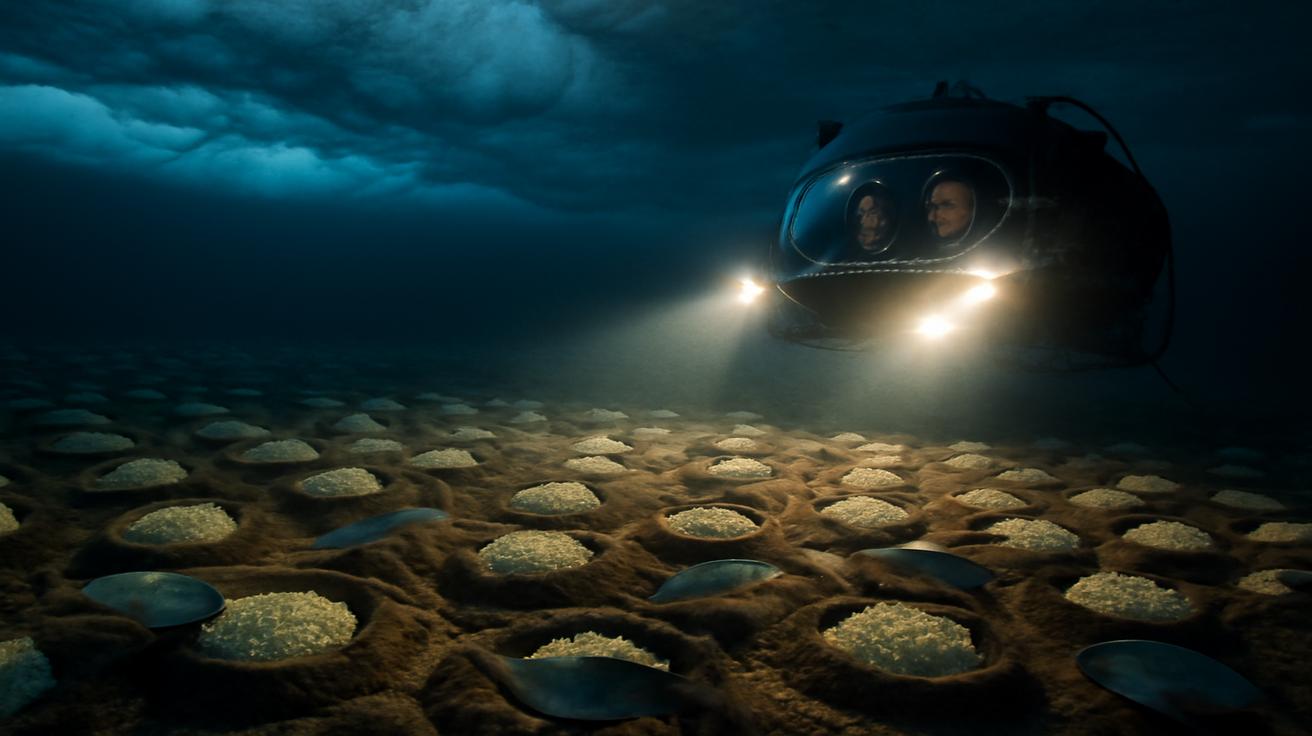
But as the camera continues, another nest appears. Then another. And another. The seafloor begins to look like the surface of the moon, pocked by hundreds of circular craters, each occupied by the same kind of fish—icefish, translucent and strange, with blood that runs almost clear and bodies designed to survive in water cold enough to kill most life in minutes.
Someone asks the numbers person on the team to start counting. Another opens a notebook. The ship rocks gently, pushed by a wind that scrapes across the Weddell Sea. On the screen, the tiny world below plays out in real time: nest after nest after nest, the pattern so regular it begins to feel uncanny. The realization comes slowly, as the count climbs from dozens to hundreds, then into the thousands.
What looks like a random stretch of Antarctic seafloor is actually a sprawling city of fish—an enormous breeding colony hiding beneath a lid of ice, unknown to the world until a ship happened to pass overhead with a camera in the right place, at the right time, in the right year.
The Hidden City Beneath the Ice
Try to imagine what the seafloor looks like down there, roughly a kilometer below your feet. The water is just above the freezing point, dense and dark. The ship’s camera illuminates a wide gravel plain scattered with pebbles the size of your palm. In between those stones, carved into the ground like dimples in the skin of the Earth, are the nests: each about as wide as a hula hoop and shallow as a cereal bowl.
Inside, tucked into the gravel, lie clusters of pearly eggs—hundreds of them per nest. Hovering just above or resting along the rim, a single fish keeps watch, its large eyes catching the faint artificial light of the camera. These are icefish, adapted to the Antarctic in ways that would seem like science fiction if we hadn’t already met them in real life. Their blood holds no red hemoglobin pigments, because the icy water around them holds more oxygen than warmer seas. Their bodies are pale and almost ghostlike, as if carved from milk glass.
As the camera drifts, the nests multiply. They stop being individual curiosities and start feeling like neighborhoods—clusters of life patterned across the bottom like a living mosaic. On the monitors, the scientists put aside their coffee and lean in. The minutes stretch. The count grows.
A few hours into the survey, one thing becomes clear: this is not just an aggregation. It’s an ecosystem built around reproduction, a place where almost every square meter of seafloor is claimed by one simple purpose—raising the next generation of icefish in one of the harshest environments on the planet.
The Moment The Numbers Got Weird
You can feel the mood on board the research vessel shift the way a room changes before a summer storm. At first, the team is just intrigued. Large fish colonies are interesting, but not rare. Then someone starts sketching rough estimates based on the length of the camera tracks and the density of the nests in each frame.
They realize that, at the rate they’re going, they are gliding over roughly one nest every few meters. The area of the colony stretches far beyond the footprint they’d planned to survey. They adjust their track and keep going.
Now the talk turns from “that’s a lot of nests” to “this can’t be right.” Calculations get repeated, then triple‑checked. There’s a quiet tension—the push and pull between disbelief and the hard edge of data. The final estimate will be extraordinary: on the order of tens of millions of active nests spread across hundreds of square kilometers of seafloor. A breeding colony so expansive it rivals some of the largest gatherings of birds on Earth, but held out of sight under ice and darkness.
The most astonishing part is not that the nests exist, but that they’ve existed for who knows how long, entirely unknown. For all our satellite eyes in the sky and research stations perched on the ice, much of Antarctic life still lives beyond our line of sight, tucked into the darkness below.
Life at the Edge of What’s Possible
The fish at the heart of this discovery belong to the notothenioids, a group that has evolved in the deep freeze of Antarctic waters for millions of years. They’ve turned apparent disadvantage into a toolkit for survival. Anti‑freeze proteins thread through their bodies, keeping ice crystals from shredding their tissues. Their metabolism moves at a deliberate pace, trading speed for endurance in waters that hover just above ice.
In this colony, each icefish invests enormous effort into its nest. First, a patch of seafloor is cleared of larger stones, leaving just the right size gravel for eggs to settle into. Then comes the long vigil. Some fish watch over their brood for months, fanning the eggs with their fins, keeping them clean and oxygenated. Eggs in these latitudes don’t rush; they take their time to develop in the cold, pulling out the process over a slow‑burn Antarctic year.
The nests aren’t just isolated family homes. They link together into a network that attracts other life. Starfish, worms, invertebrates, and scavengers patrol the edges of this underwater suburbia, looking for opportunity. The colony concentrates nutrients in one place: eggs, fish bodies, wasted energy, all fueling a local web of life that ripples outward. If you map it out, it looks less like a series of dots and more like a living engine, quietly running under the ice.
From above, the surface of the Weddell Sea reveals none of this. It reads as a blank slate, a white and blue desert of frozen water. But the ice acts less like a lid and more like a ceiling, sheltering an entire world underneath—a world that scientists, until this survey, did not know how to see.
Chasing Shadows in the Polar Night
The discovery didn’t come from a flashy expedition with a single goal. It emerged from routine: an oceanographic mission mapping currents, temperatures, and seafloor features. The team used a towed camera system, slowly sweeping the seafloor, collecting hour after hour of footage, most of it the kind of data that ends up in archives, studied in pieces months or years later.
It’s almost poetic that something so dramatic was found by accident. There was no headline‑seeking race to discover a new species, no daring plunge by a submersible into a newly opened ice crack. Instead, there was patience, a slowly gliding camera, and a willingness to look closely at what appeared, at first glance, to be ordinary.
The sea was far from calm. Antarctic fieldwork is a negotiation with weather—howling winds, buckling ice, and the ever‑present risk of equipment icing over or lines snapping in the cold. But below the waves, the colony persisted, unbothered by storms. Every nest, every icefish, went about its quiet work as the human world above wrestled with logistics and deadlines.
That tension—the messy, noisy effort of science versus the slow, almost indifferent continuity of nature—is part of what makes this discovery feel so humbling. The fish did not suddenly appear because we looked. They were always there, in their millions, carving out lives in water most of us will never touch.
A Nursery the Size of a Small Country
To understand the scale, it helps to think in terms of places we know. Imagine a city spread out beneath the ice, not upward in skyscrapers but outward in identical single‑story homes. Every “house” is a nest, each with a resident adult and a cluster of eggs. Instead of cars, currents flow along invisible streets, bringing oxygen‑rich water over the nests, whisking away wastes and dead matter.
Below is a simple table that helps visualize this hidden metropolis in human terms:
| Aspect | Colony Under Antarctic Ice | Everyday Comparison |
|---|---|---|
| Number of nests | Many millions | As if every household in a large country was a fish nest |
| Area covered | Hundreds of km² of seafloor | Comparable to a major metropolitan region spread flat |
| Temperature | Around -1.8°C seawater | Barely above the freezing point of saltwater |
| Key residents | Antarctic icefish and their eggs | Like a city made up almost entirely of nurseries |
| Ecological role | Massive breeding ground and food source | Similar to the world’s largest bird colonies or salmon runs |
Each of those nests represents not just a few eggs, but a serious investment for the parent fish: time spent guarding instead of feeding, energy spent fanning and cleaning instead of roaming. Multiply that by millions, and the colony becomes a pulse of life that could feed seals, whales, and other predators, directly or indirectly, across the Southern Ocean.
Ecologists suspect that places like this—if they exist elsewhere—may be structural pillars in the food web. Remove them, disturb them, or let them wither, and you don’t just lose fish. You weaken the invisible scaffolding that holds together a much larger, more complicated community.
Why This Discovery Matters Far Beyond the Weddell Sea
On the face of it, millions of fish nests in a remote, ice‑choked corner of the world might seem like a charming scientific footnote. But discoveries like this ripple outward. They challenge our assumptions about how much we know and how accurately we’ve mapped life on Earth.
For conservationists, this colony instantly becomes something rare and fragile. It is both robust—operating on a massive scale—and vulnerable—locked into a narrow band of environmental conditions. The water temperature, salinity, and circulation patterns that make it hospitable are all intertwined with Antarctic ice and the global climate system. Change those, and you may change the fate of the colony.
For fisheries managers, the colony raises questions about where commercial fishing should and shouldn’t happen in the Southern Ocean. If these breeding grounds support wider populations of fish that migrate or drift beyond the ice, then protecting the nursery could help stabilize ecosystems far from the Weddell Sea itself. It’s one thing to weigh abstraction; it’s quite another to imagine millions of nests and know they are, right now, each holding the future of a species in their fragile orbs of life.
For the rest of us, this is a story about humility. About the realization that beneath even the most forbidding landscapes—the ones we casually label “barren” or “empty”—there might be cities of life whose existence we haven’t yet guessed at. It suggests that the ocean is not a solved map, but a living manuscript still being written, one camera tow at a time.
Seeing the Unseen Ocean
The technology used in this discovery is, in many ways, workmanlike: cameras on cables, sensors logging temperature and depth, sonar tracing the contours of the seafloor. There is no single breathtaking gadget, no shiny robot hero. Instead, it’s a story about persistence and attention.
Yet, the implications for how we study the ocean are large. If one accident of timing and location can reveal a fish metropolis of this size, what else might be hiding in the dark corners of other seas? Deep‑water coral forests? Vast gatherings of invertebrates huddled along invisible chemical gradients? Migratory highways we’ve only seen the edges of?
Antarctica has always sat at the edge of our imagination—a blank white patch at the bottom of maps, then a symbol of remoteness, then a theater for climate worry and scientific heroism. This fish colony folds another layer onto that image: Antarctica not just as frozen frontier, but as a cradle for life, quietly doing its work in the shadows.
Back on the research vessel, long after the first surprise, the mood shifts from adrenaline to a kind of reverent routine. The team schedules more tows. They log every nest, every patch of ground that looks different, every variation in density. They file requests for more time, more resources, more analysis. The discovery has moved from moment to project, from “Did we really see that?” to “What does this mean, exactly, and how do we share it?”
In the evenings, when the work pauses and the ship’s lights throw a halo into the polar night, it’s easy to picture what lies directly below. Not emptiness. Not silence. But a living expanse of watchful fish, currents whispering through a city of nests, each one a tiny beacon of persistence in a vast, freezing dark.
Questions & Answers About the Antarctic Fish Nest Discovery
How were the fish nests discovered under the Antarctic ice?
They were found accidentally during a routine research cruise in the Weddell Sea. Scientists were towing a camera system near the seafloor to study ocean conditions when they noticed repeated circular depressions filled with eggs and guarded by icefish. As they kept surveying, they realized those nests stretched across an enormous area.
What kind of fish built these nests?
The nests belong to Antarctic icefish, a group adapted to extremely cold waters. These fish have antifreeze proteins in their blood and lack the usual red hemoglobin pigment, making their blood almost transparent. They clear patches of gravel on the seafloor and guard their eggs for long periods.
Why is this discovery considered so important?
The sheer scale of the colony—millions of nests across hundreds of square kilometers—makes it one of the largest known breeding aggregations of fish on Earth. It likely plays a key role in the Antarctic food web, supporting predators and influencing ecosystem dynamics far beyond the immediate area.
Does climate change threaten this fish colony?
Indirectly, yes. The colony depends on very specific conditions: cold, oxygen‑rich water, stable circulation, and sea‑ice patterns that help shape local habitats. Climate‑driven changes in ocean temperature, currents, and ice cover could alter those conditions over time, potentially affecting the colony’s health and persistence.
Can people ever see this colony in person?
Most people will never physically visit the site; it lies deep beneath sea ice in a remote part of Antarctica. However, footage and images from cameras and submersibles allow us to “visit” it virtually—watching the nests, the guarding fish, and the seafloor communities that thrive in this hidden world.
Are there likely to be more undiscovered colonies like this?
It’s very possible. Much of the deep and polar ocean remains poorly studied. The discovery suggests that other large breeding grounds, or similarly dense gatherings of life, might exist in places we have never surveyed with enough detail or for long enough periods.
What happens next for the scientists studying this phenomenon?
Future work will focus on mapping the full extent of the colony, understanding how stable it is from year to year, and tracing how it connects to the broader Antarctic ecosystem. Researchers and policymakers will also discuss how best to protect such a unique and vulnerable habitat from potential disturbances.







Leave a Comment