
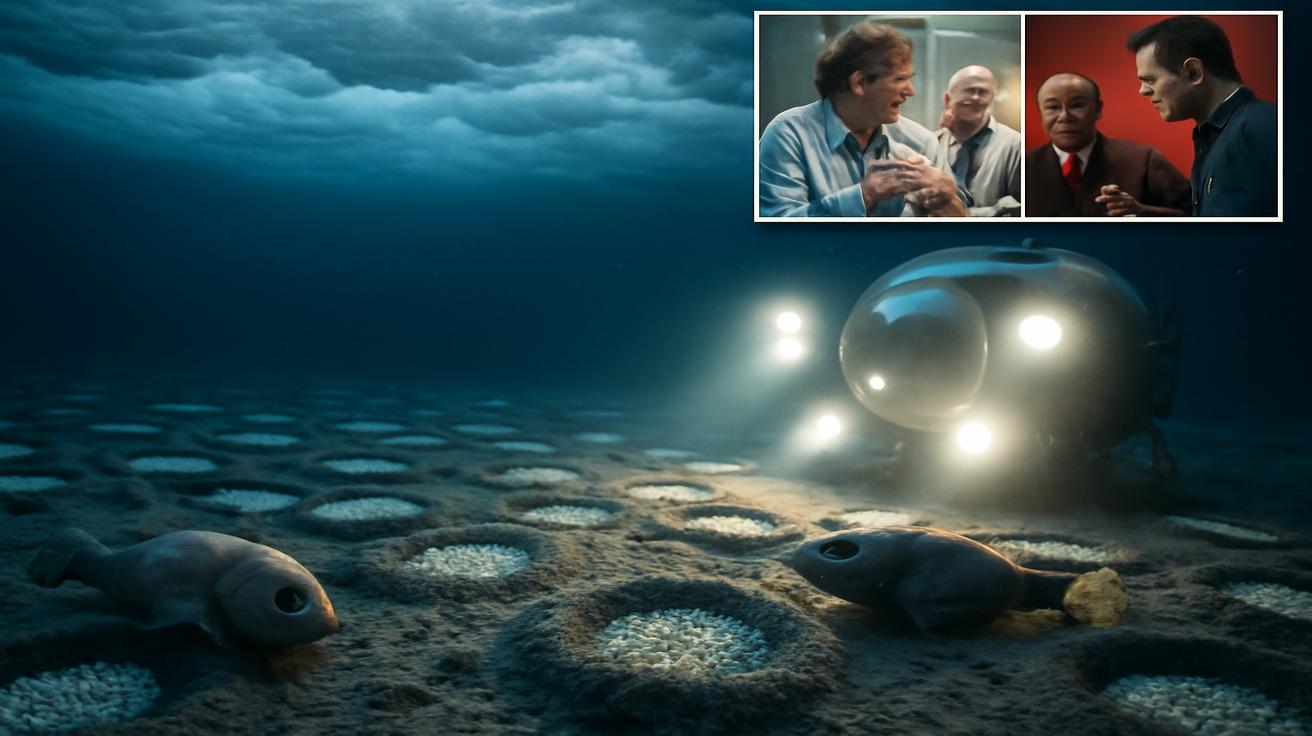
The camera dropped through a borehole the width of a dinner plate, vanishing into the blue-black world beneath the Antarctic ice. On the surface, the wind scraped across the snowfields with a sound like sandpaper on bone. On the ship’s monitor, the screen flickered, then steadied. For a moment, there was only darkness and drifting snow-like particles of ice. Then the beam of light swept across the seafloor—and the scientists on deck stopped breathing.
There, in the camera’s cone of light, lay a perfect circle of pebbles. In the center, a pale, watchful fish hovered over a clutch of translucent eggs. The camera moved on. Another nest. And another. And another. Within minutes, the team realized they were looking at not just a handful of nests but a vast, sprawling city of them—thousands upon thousands, stretching beyond the area their camera could see. Somewhere above their heads, the Antarctic ice groaned softly. Beneath it, an invisible drama of life, risk, and controversy was just beginning.
A hidden metropolis of icefish
For decades, Antarctic waters have been shorthand in scientific papers for “remote” and “largely unexplored.” This patch of the Weddell Sea, choked by thick sea ice and battered by storms, had repelled most attempts to see what lay below. The German research icebreaker RV Polarstern ventured into this region equipped with a towed camera system, expecting to map seafloor habitats, maybe glimpse a few invertebrates and the odd fish slipping past like a gray ghost.
Instead, the cameras revealed the largest known fish breeding colony on Earth: millions of icefish nests, each one carefully built from small stones. These are not glamorous fish. They are pale and almost translucent, with blood that runs clear instead of red because it lacks hemoglobin. In the cold, oxygen-rich waters of Antarctica, they manage without it, their bodies a series of evolutionary compromises to survive at temperatures that would kill most other species.
The discovery felt like stepping into a secret city mid-season, every home occupied, every resident busy with the quiet work of staying alive. Many nests had a single adult, fanning fins over eggs to keep them supplied with oxygen. Others were bare, just pebbled bowls in the mud, either yet to be filled or already abandoned. The sheer scale of it all was dizzying: nest after nest, spaced a few fish-lengths apart, like houses lining invisible streets.
On the ship, the excitement was palpable. Scientists crowded around the monitors, voices low, a little stunned. The ocean is full of unknowns, but it rarely gives up its secrets in such grand, cinematic fashion. Photos were taken. Sketches were made. Statements were prepared. This, everyone knew instantly, would be a headline discovery—a moment that would redefine how we think about life in the Antarctic deep.
The storm after the wonder
When news of the nesting colony broke, it ricocheted around the world. The footage was mesmerizing: fish guarding eggs in icy darkness, an entire ecosystem humming beneath frozen seas. The story hit that sweet spot of mystery and hope, proof that even in a warming, thinning world, nature still holds hidden marvels.
But almost as quickly, another wave followed—this one far less celebratory. Critics began to ask pointed questions. How many times had the cameras passed over these nests? Were the lights and noise disturbing the fish? How many ice cores and boreholes were punched through the ice above this delicate nursery, and what risks did that bring? Were scientists, in their rush to document and publish, trampling through some of the most vulnerable life on Earth for the sake of career-making discoveries?
Marine conservationists, ethicists, and some climate activists didn’t like the answers they were hearing—or the lack of them. The narrative shifted from “astonishing discovery” to “at what cost?” It’s a now-familiar arc in modern science: awe tangled with unease, wonder shadowed by worry that even the act of looking can do harm.
Life in a world that shouldn’t exist
To understand why emotions ran so high, you have to imagine what it means to build a nest in the Antarctic deep. The ice overhead acts like a ceiling of stone-cold glass, sealing out most of the world’s noise and warmth. Sunlight barely matters down here. Instead, life is tuned to slow pulses: the grinding advance and retreat of sea ice, the drift of plankton blooms from far-away surface waters, the sluggish movement of currents that carry just enough oxygen and nutrients for survival.
Icefish nests are small acts of defiance against this harshness. To build one, a fish must find stones in a place where stones are rare. It must clear an area, arrange the pebbles, and lay eggs in a bowl meant to protect them from predators and currents alike. Then comes the waiting. Months of guarding, of fanning, of spending energy in a place where energy is the tightest of economies. If something goes wrong—a change in water chemistry, a surge in current, a disturbance overhead—the whole effort can fail.
In that context, dropping heavy instruments, trawls, or cameras into this hidden city starts to look less like innocent curiosity and more like stomping through a nursery in muddy boots. Even when the research is carefully designed to avoid contact with the nests, the fear persists: what if the floodlights disorient the parents? What if the noise of the ship far above, amplified through the ice, is a constant low-grade stressor for them? What if repeated visits create a kind of ecological paparazzi effect—harmless in one moment, damaging in the long, cumulative arc?
The scientists working in these conditions are quick to emphasize the precautions they take: non-contact imaging, narrow corridors of observation, strict controls on sampling. Yet the heart of the critique isn’t just about this one expedition. It’s about a deeper unease with how science behaves when it finally breaks into Earth’s last hard-to-reach refuges.
Science, glory, and the thin ice of ethics
Modern research is not a quiet, monkish pursuit. It’s a competitive arena where careers rise and fall on the strength of big findings, impactful papers, and attention-grabbing stories. No one on the RV Polarstern denied that discovering the world’s largest known fish breeding colony would look very good on any CV. Some critics argue that this pressure for prestige, funding, and recognition nudges even the most well-meaning scientists into risky territory.
This is where the accusations of “chasing glory” sharpen. The language may feel harsh, but the concern is simple: when the reward structure of science celebrates the new and spectacular above all, will anyone be truly incentivized to say, “We shouldn’t go there yet. It’s too fragile”?
Ethicists point out that Antarctica is supposed to be different—a continent governed not by national ownership but by an international treaty system with peace and science at its core. It is, in theory, a sanctuary. Yet even there, research expeditions run into familiar patterns: competition for access to the most remote sites, pressure to justify expensive ship time with “breakthrough” results, and an ever-ticking clock of grant cycles and publication deadlines.
On the other side, many polar scientists push back against the accusation that they are risking fragile life for glory. They argue that without detailed, on-the-ground—and under-the-ice—data, it is almost impossible to make meaningful conservation decisions. How can you protect something you can barely describe, let alone understand? To them, the real danger lies in ignorance: in leaving these underwater cities entirely unmapped, unmonitored, and therefore unprotected in a fast-changing climate and an increasingly resource-hungry world.
The thin line between knowing and harming
It’s tempting to imagine a world in which science can gather all the information it needs without ever touching or disturbing anything—a kind of perfect, ghostly observation. But the Antarctic reality laughs at that fantasy. To get there, you need large ships burning fuel, heavy equipment, steel and plastic and electronics. To see under the ice, you must drill, lower cameras, send sound waves into the dark. Every action, however small, has a footprint.
So the question becomes: what level of disturbance is acceptable in the name of learning enough to keep this place safe? A tiny one? A vanishingly small one? And who decides what “tiny” means, sitting thousands of kilometers away in offices, reading reports about a world they’ll never personally feel in their lungs and bones?
Numbers, nests, and what’s at stake
The discovery of this mega-colony of icefish nests didn’t just impress the scientific community with its sheer scale; it also forced a reckoning with what “significance” means in a warming ocean. Tens of millions of nests suggest an enormous spawning event, a key engine for the local food web. Juvenile icefish feed larger predators; the eggs and vulnerable adults likely support scavengers and opportunistic hunters. This is not some obscure curiosity—this is infrastructure, the reproductive heart of a species, maybe several.
The following simplified table captures how vastly different the perspectives on the colony can be, depending on who is looking and why:
| Perspective | What They See | Main Concern |
|---|---|---|
| Polar scientists | A unique chance to understand a key Antarctic ecosystem in detail. | Gathering enough data to argue for strong protection measures. |
| Conservation groups | A fragile breeding ground at risk from any disturbance. | Preventing both research and industry from damaging the site. |
| Fishing interests | Potential indicator of rich biological productivity. | Balancing harvest opportunities with regulatory limits. |
| Global public | A mesmerizing story about life thriving in extreme cold. | Ensuring Antarctica remains wild, intact, and unspoiled. |
What makes this discovery politically charged is that it can be used to argue for wildly different futures. For conservation groups, the nests are powerful evidence that this area should be off-limits to fishing and highly regulated for any human activity. For some states and fishing interests, they are a sign that the region is biologically productive—and therefore economically tempting.
In the middle stand the researchers, pointing to their hard-won data as proof that the ecosystem matters, that it should be factored into international negotiations over marine protected areas. Their critics respond: if your work is truly “for protection,” why do we only learn of it after the fact, when the cameras have already swept across the nursery, when cores have been drilled and instruments lowered?
The quiet harm of good intentions
In environmental ethics, there is a growing awareness that harm doesn’t always look like oil spills or bulldozers. Sometimes it looks like a research vessel, bristling with sensors and cameras, gliding through ice that has never seen a hull, while below an entire community of animals goes about its unrecorded, unconsulted business.
Even the language we use—“discovery,” “first-ever footage,” “unprecedented access”—can be a warning sign. Access for whom? Discovered by whom? To the icefish, nothing has changed. They have been building nests for far longer than we have been taking notes. It is our sudden arrival, our sudden attention, that is unprecedented.
None of this means we should stop looking. It does mean we need sharper questions at the planning stage, not apologies afterward. Could satellite data or remote sensing narrow down target areas before ships go in? Could we agree, internationally, that certain particularly fragile sites—once identified—be placed under strict “look but don’t touch” regimes, with limited visits and shared, open-access data to cut down on duplication?
Rethinking glory in a melting world
In quieter conversations, some polar scientists admit that the glory narrative isn’t helping them either. They don’t always want their work framed as a quest for firsts and extremes. Many would prefer a slower, more careful science, one that rewards long-term monitoring and collaborative datasets as much as stunning photos of never-before-seen creatures.
It is hard to build such a culture when funding bodies and media cycles crave novelty. Yet if there was ever a place that demanded a different tempo, it is Antarctica. It moves on scales of ice ages and ocean currents, of centuries and millennia. The fish nests under the Weddell Sea ice represent decades, possibly hundreds of generations of careful adaptation. To rush in and rush out—for headlines, for a career jump—feels, at best, out of tune.
Reimagining scientific “glory” here might mean celebrating restraint as much as daring. Praising the team that decides not to sample a vulnerable patch of seafloor. Valuing the paper that says “we left this site undisturbed and here is why” as highly as the one that announces a new species or the “largest colony ever found.” It might mean building ethical review processes for remote expeditions that are as rigorous and culturally embedded as those for medical research on humans.
Listening under the ice
Back at the nesting grounds, none of these debates matter in any immediate sense. The fish do what they have always done: move pebbles with precise flicks of their fins, fan their eggs, hold position in slow, glacial currents. Above them, ice thickens and thins with the season. Storms roar and pass. In the future, warmer waters may creep into their world, currents may shift, acidity may increase. The human impact that most threatens them might not be a single ship’s visit at all, but the collective heat of billions of lives lived far to the north.
And yet, how we behave here—how gentle or clumsy, how humble or triumphant—still matters. Not just for the icefish, but for what kind of species we are choosing to be. Are we the kind that bursts into a quiet room, takes photographs of everything, then leaves the door swinging open behind us? Or the kind that knocks, steps softly, and leaves a note for those who will come after, saying: this is what we saw; this is what we chose not to touch.
Beyond the borehole: a shared responsibility
The controversy swirling around the Antarctic nests is not just a niche academic quarrel. It is part of a larger, uncomfortable realization: there are fewer and fewer places on Earth where we have not yet left our fingerprints. The deep ocean, polar ice, isolated mountaintops—they are both the frontiers of science and the last refuges of unobserved life.
We can’t go back to not knowing about the icefish city beneath the Weddell Sea. The hole has been drilled; the data exist; the world has seen the footage. The real question now is what we do with that knowledge. Do we let it become one more notch in a belt of human triumphs, or do we treat it like a fragile compass, nudging us toward a new way of moving in places that do not belong to us alone?
Imagine, for a moment, that the next time a research vessel approaches such a site, there is an unspoken code shared by scientists, policymakers, and publics alike: we are here on borrowed time and borrowed space. Our right to know does not outweigh their right to exist, undisturbed. Our curiosity is powerful and beautiful—but it is not innocent.
Under the ice, the nests will fill, hatch, and empty, whether or not we are watching. The fish will fan their eggs in the dark, trusting nothing except the physics of water and stone. What happens next is up to us: to decide if seeing them once is enough to change how we behave, or just one more scene in an endlessly scrolling feed of marvels we marvel at and then forget.
Frequently Asked Questions
Why is the discovery of Antarctic fish nests so important?
The nesting colony represents the largest known fish breeding area on Earth, revealing a critical reproductive hub in the Antarctic ecosystem. It changes how scientists understand food webs, species resilience, and the biological richness of regions once thought relatively barren.
How might research activity harm these fragile nests?
Potential impacts include physical disturbance of the seafloor by equipment, stress from light and noise, and cumulative effects of repeated visits. Even without direct contact, the presence of ships, drilling of boreholes, and deployment of instruments can alter a highly sensitive environment.
Are scientists really “chasing glory” in Antarctica?
Most researchers are motivated by curiosity and a desire to protect fragile ecosystems, but they operate within a system that rewards big, newsworthy discoveries. Critics argue that this pressure can unintentionally prioritize high-impact findings over minimal-impact methods.
Can we protect areas like the icefish nesting grounds?
Yes, in principle. International bodies governing Antarctic waters can designate marine protected areas with strict rules on fishing, research, and other activities. The challenge lies in achieving consensus among nations and balancing scientific access with ecological caution.
Is it better not to study such fragile ecosystems at all?
Most experts say no. Without data, it’s extremely difficult to argue for legal protection or understand how climate change is affecting these systems. The key is designing research that minimizes disturbance, shares data widely to avoid redundant expeditions, and builds ethics into every stage of planning.








Leave a Comment