
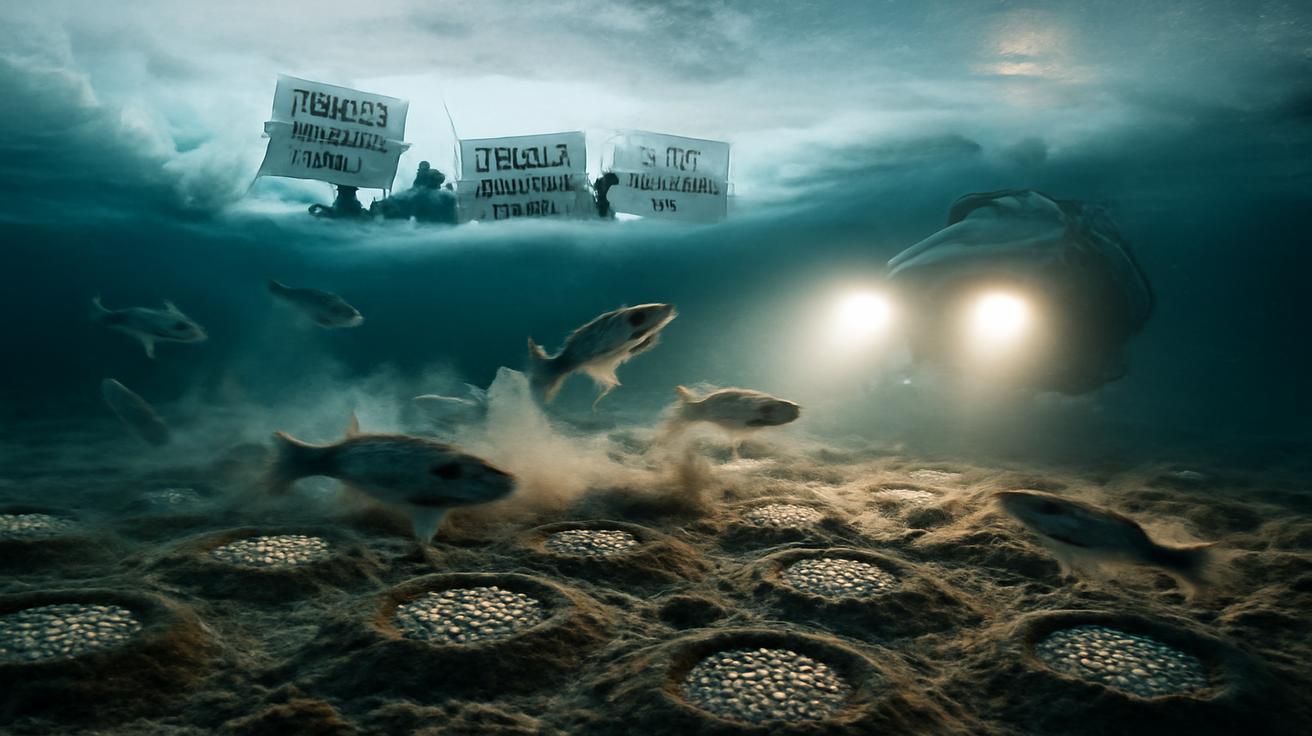
The ship’s floodlights cut a pale tunnel through the Antarctic night, falling on a world that should have been empty. Instead, the cameras showed circles—hundreds of them at first, then thousands—soft hollows in the seafloor, rimmed with stones and guarded by dark, watchful fish. Inside each circle: a pale mass of eggs, shivering gently in the near-freezing current. The scientists on board fell silent. Even through the static and the cold and the distance of a fiber-optic cable, you could feel the sense of trespass, as if a curtain had been pulled back on a secret no human was meant to see.
The Hidden City Under the Ice
It started as a routine survey, the kind of slow, careful mapping that defines ocean science in a place as remote as the Weddell Sea. The team had lowered a camera system—what they called a “fish cam,” though the name hardly captured its complexity—through a small lead in the pack ice. The plan was simple: tow it along the seafloor and record whatever appeared.
At first, there were the usual signs of a deep, icy desert. Soft sediments. Occasional starfish and brittle, spidery life. Then the first nest appeared: a neat depression in the silt, a single fish hovering above it like a moon over a crater. The scientists took notice. A second nest appeared, then a third, and a fourth. After twenty minutes the video feed stopped feeling like a casual encounter and became something else: a census of an underwater metropolis.
The fish were icefish—pale, almost translucent creatures, their blood clear instead of red, adapted to the brutal cold. They hovered over their nests, their bodies gently fanning the eggs with constant, parental precision. On the monitors, the nests formed a honeycomb pattern, each one carefully spaced from its neighbors, each one a tiny enclave of vulnerability on the otherwise empty bottom.
There weren’t just dozens. Not just hundreds. When the team crunched the numbers later, extrapolating the density they saw across the area they surveyed, the tally rose to an estimated 60 million active nests. Sixty million breeding pairs. Sixty million cradles of future life, hidden beneath a roof of ice and blizzard.
In the moment, aboard the ship, it didn’t feel like a dataset. It felt like stumbling into a cathedral mid-prayer. The water, the darkness, the sheer number of nests: it all pressed in, wordless and immense. One researcher later described it as a “heartquake”—a lurching awareness that the world was stranger and more elaborate than anyone had guessed.
Pristine or Probed: When Awe Turns to Accusation
Word of the discovery traveled fast. In an age hungry for signs that wildness still exists, here was something almost mythic: the largest known fish breeding colony on Earth, hidden under Antarctic ice, untouched by fishing fleets and oil rigs and coastal lights. A last sanctuary, people called it—a place where life had been left alone.
But within weeks, the admiration had a shadow. Alongside the wonder came an uncomfortable question: If this place was so pristine, what right did humans have to be there at all?
The research team had done what scientists do. Once they realized the scale of what they’d found, they came back. They towed more cameras. They dropped instruments—a lattice of sensors to record temperature, currents, oxygen levels, and the constant coming and going of the fish themselves. They documented, measured, counted.
For many, that seemed entirely reasonable, even urgent. How else could we protect something we didn’t understand? But environmental advocates and some fellow scientists pushed back. They saw not just a survey, but an incursion. Their question was blunt: when we call a place “pristine,” do we mean “untouched by industry” or “untouched by us, full stop”?
The controversy sharpened online. Images of the nests were shared with reverence, but also with anger; comment threads ignited with accusations that researchers were “exploiting” the discovery, turning a living sanctuary into a natural laboratory. Aerial shots of the icebreaker moving through sea ice became symbols in themselves—white hull cutting through a white world, the ship’s wake a visible reminder of disturbance.
The Fine Line Between Studying and Disturbing
On paper, the disturbances seemed minimal. The camera sled skimmed just above the bottom, a careful watcher. The moored instruments hung in midwater. The team emphasized their low-impact methods: no trawling, no extraction of large numbers of fish, no drilling into the seafloor. Only a handful of specimens were collected for genetic and physiological study, they said; the rest was observation at a distance.
But the debate wasn’t really about the hardware. It was about philosophy—and trust. Some critics argued that even a careful presence has consequences. The noise of the ship’s engines travels through water for kilometers. Lights change how animals behave. The mere act of entering a previously isolated space can set off chains of reaction you never see. To them, the discovery felt like the prelude to a familiar story: first we measure, then we monitor, then someone, somewhere, decides to use what we’ve learned.
From the deck of the research vessel, that storyline sounded unfair. The scientists on board had pushed for the discovery site to be fast-tracked for protection. They shared their data with conservation bodies. They argued—in reports, at conferences, in interviews—that the nesting grounds should be recognized as a marine protected area, shielded from fishing and mineral exploration before any such ventures could even be proposed.
Yet the criticism kept coming, sharper each time images from subsequent expeditions appeared: ships returning to the same patch of ice, lowering more equipment into the darkness. Somewhere in the tension, an uncomfortable question settled: at what point does careful curiosity become a kind of extraction in its own right?
The Last Sanctuary Myth
“Pristine” is a seductive word. It promises something that has slipped out of reach almost everywhere else: ecosystems functioning on their own terms, slowly and precisely, without our fingerprints. The idea of a last Antarctic sanctuary—this sprawling city of icefish nests beneath a shield of ice—became an instant symbol of that longing.
But the reality is more complicated. Even sheltered beneath ice, this ecosystem does not exist apart from us. The currents that wash over the nests are warmer than they were a century ago. The sea ice roof is thinner, more fragile, its seasonal rhythms changing as the planet heats. Carbon we burned on distant highways now dissolves into the water above the nests, altering its chemistry.
In that sense, the sanctuary was never truly untouched. Our influence arrived long before any research vessel, carried on atmospheric winds and ocean swell. The fish might never encounter a net or a drill, yet their survival is now entangled with decisions made thousands of kilometers away. Still, the place is as close as we have to a working, wild system—a baseline against which to measure everything we’ve altered.
That’s where the paradox comes in. To argue convincingly for the protection of such a place, we need evidence: maps, population estimates, ecological roles, vulnerabilities. To get that evidence, we must go there. And going there, in turn, risks disturbing what we hope to defend. One misjudged decision—too many visits, too much gear, a poor understanding of animal sensitivities—and we start to erode the very qualities that made the colony precious in the first place.
Scientists and conservationists sometimes frame this as a trade-off: accept small, controlled disturbances now, in the name of preventing much bigger disturbances later. Critics argue that this logic can slip too easily into justification—today’s “small” impacts become tomorrow’s routine, normalized presence, especially in a world hungry for new frontiers of exploration and, inevitably, exploitation.
What We’re Learning From the Hidden City
Amid the ethical tangle, one fact remains: the icefish colony is teaching us things we never knew about life in polar seas. Each nest—each circle of stone and egg and hovering parent—tells a story of planning and risk.
The icefish choose their nest sites carefully, favoring areas where slightly warmer deep water brushes the seafloor, offering microclimates just a fraction of a degree more hospitable in a world barely below freezing. The parents guard their eggs for months, sacrificing their own energy stores in a bet on the next generation’s survival. Where most fish scatter eggs and vanish, icefish linger, turning an empty seafloor into a patchwork of intention.
By tracking currents and temperatures over time, researchers are piecing together why the colony formed here and nowhere else—what combination of ocean physics and evolutionary chance created conditions for such an improbable congregation. These details matter. If the wrong current shifts with climate change, or oxygen levels dip, or ice cover patterns swing too far from the historic norm, the colony could fragment or collapse.
That’s the haunting insight the instruments are giving us: sanctuaries are not static. They are balances, held temporarily in place by forces we are now, unwittingly, re-sculpting. Understanding those forces may be the only way to argue clearly, and urgently, for policies that give places like this a fighting chance.
Ethics in the Cold: Rethinking How We Explore
In the wake of the scandal—articles accusing the researchers of “probing the last refuge,” protests calling for moratoriums on further expeditions—conversations have started to shift from blame to reimagining. Instead of asking only, “Did they do too much?” a more useful question emerges: “What would a truly ethical approach to such discoveries look like?”
Some suggest that we treat the most sensitive wild places as we would a sacred site: with rituals of restraint, layers of consent, and a built-in presumption against entry unless there is compelling cause. That might mean hard limits on the number of research visits allowed over a decade, mandatory impact assessments even for supposedly low-impact tools, and strict bans on certain technologies no matter how tempting the data they might provide.
Others propose a kind of “inverse frontier” ethic: the more remote and intact a place is, the less right we claim to be physically present within it. Instead, we pour our creativity into remote sensing—satellites, autonomous vehicles, machine learning to draw patterns from a few carefully gathered data points rather than dense, repeated sampling.
For the Antarctic fish colony, that could mean a pivot away from big, crewed vessels and toward small, under-ice drones launched once, then left to roam silently, feeding back information without the noise and light of a ship overhead. It could also mean a global commitment, baked into treaty law, to treat discoveries not as new opportunities to expand our footprint but as flashing beacons: here is what we stand to lose if we do not slow down.
Numbers Beneath the Ice: A Snapshot
Even as debate swirls, a few fundamental facts about this hidden world are emerging. They are stark enough to fit in a single glance.
| Feature | Details |
|---|---|
| Estimated number of active nests | ~60 million |
| Depth of nesting area | Approximately 400–500 meters |
| Water temperature near seafloor | Around −1.5°C to 0°C |
| Nesting species | Antarctic icefish (a species with clear, hemoglobin-free blood) |
| Primary threats | Climate change, potential future fishing, and cumulative human disturbance |
These numbers are not just dry points in a report. They are coordinates on an ethical map. They remind us how much life can concentrate in an overlooked corner of the planet, and how tightly that life now depends on what we choose to do far beyond the horizon of ice.
Listening to the Quiet Places
If there is a scandal at the heart of this story, it may not be that scientists dared to lower their cameras into a hidden nursery. It may be that we are so late in learning how to listen lightly—so used to barging into wild systems with nets and engines and drilling rigs—that even our gentlest approaches still carry the weight of that history.
Stand for a moment on the imagined seafloor, in the dark among the nests. Above, nearly half a kilometer of water presses down. A roof of ice shifts and sighs with the tides. The only lights are the slow glints of bioluminescence and the faint shimmer of distant snow filtered through blue. You can hear the crackle of small crustaceans, the soft hiss of silt in the current.
Between the nests, icefish glide, guarding and tending. Their fins move with a patience that seems almost ceremonial. Each egg cluster is a promise made to a future ocean, to a world that might be kinder or harsher than the one their ancestors knew. They have no concept of research permits or treaties or “sanctuaries.” They only know that the water is, for now, just right enough.
Whether we deserve to watch them is a question that will not be settled quickly. But the colony forces us to confront it. It asks us to decide what kind of species we want to be in the remaining places where wildness still organizes itself freely—in the unlit deep, under ice, in deserts, in forests that have not yet been carved into checkered maps of timber and road.
Perhaps the most radical thing we can do, in facing that question, is to embrace limits. To accept that there are some places where our curiosity must be tempered by a deliberate smallness, where the data we don’t collect is part of the protection we offer. To admit that not every hidden city needs to be thoroughly mapped to prove its worth.
The thousands—millions—of fish nests beneath Antarctic ice are not just a marvel or a scandal. They are a mirror. In their fragile abundance, they reflect both the intensity of life’s persistence and the intensity of our gaze. How we respond now—how gently we step, how willing we are to let some mysteries remain partly veiled—will say as much about us as any scientific paper ever could.
FAQ
Why is the Antarctic fish nesting site considered so special?
Because of its sheer scale and apparent intactness. It’s the largest known fish nesting colony on Earth, with tens of millions of active nests in a region that has, so far, seen very little direct industrial impact. That makes it a rare example of a relatively undisturbed marine ecosystem.
How did scientists discover the nests in the first place?
Researchers towing a camera system along the seafloor in the Weddell Sea noticed repeated circular depressions with guarding fish and egg clusters. As they continued the survey, they realized those nests extended across a vast area, leading to the estimate of roughly 60 million active nests.
Are the scientists actually harming the fish or their nests?
The research methods are designed to be low-impact—mainly visual surveys and fixed instruments suspended in the water. Direct damage to nests appears minimal. The concern from critics is more about cumulative disturbance: ship noise, repeated visits, lighting, and the precedent of increasing human activity in such a sensitive, once-isolated area.
Why are some people calling this a scandal?
Because the site is being described as one of the last pristine marine sanctuaries, yet humans are now repeatedly entering and studying it. Some argue that even well-intentioned scientific work can undermine the very “untouched” quality that makes the place valuable, and that stronger ethical limits should have been applied.
Can this area be legally protected from fishing or exploitation?
Yes, in principle. The Antarctic region is governed by international agreements, including frameworks that allow for creating marine protected areas. Data from these studies are already being used to argue for formal protection that would restrict fishing and other extractive activities in and around the nesting grounds.
Is climate change a threat to this hidden fish colony?
Very much so. The colony depends on specific temperature, current, and ice-cover conditions. Warming waters, changing circulation patterns, and shifts in sea ice could alter the habitat enough to reduce nesting success or force the colony to contract or relocate—if suitable habitat even exists elsewhere.
What does this discovery mean for how we do science in wild places?
It’s provoking a broader conversation about scientific responsibility. Many are calling for stricter guidelines on research in remote, intact ecosystems—fewer visits, more reliance on remote sensing, and a stronger presumption in favor of non-intrusion, even when curiosity and potential knowledge gains are high.







Leave a Comment