
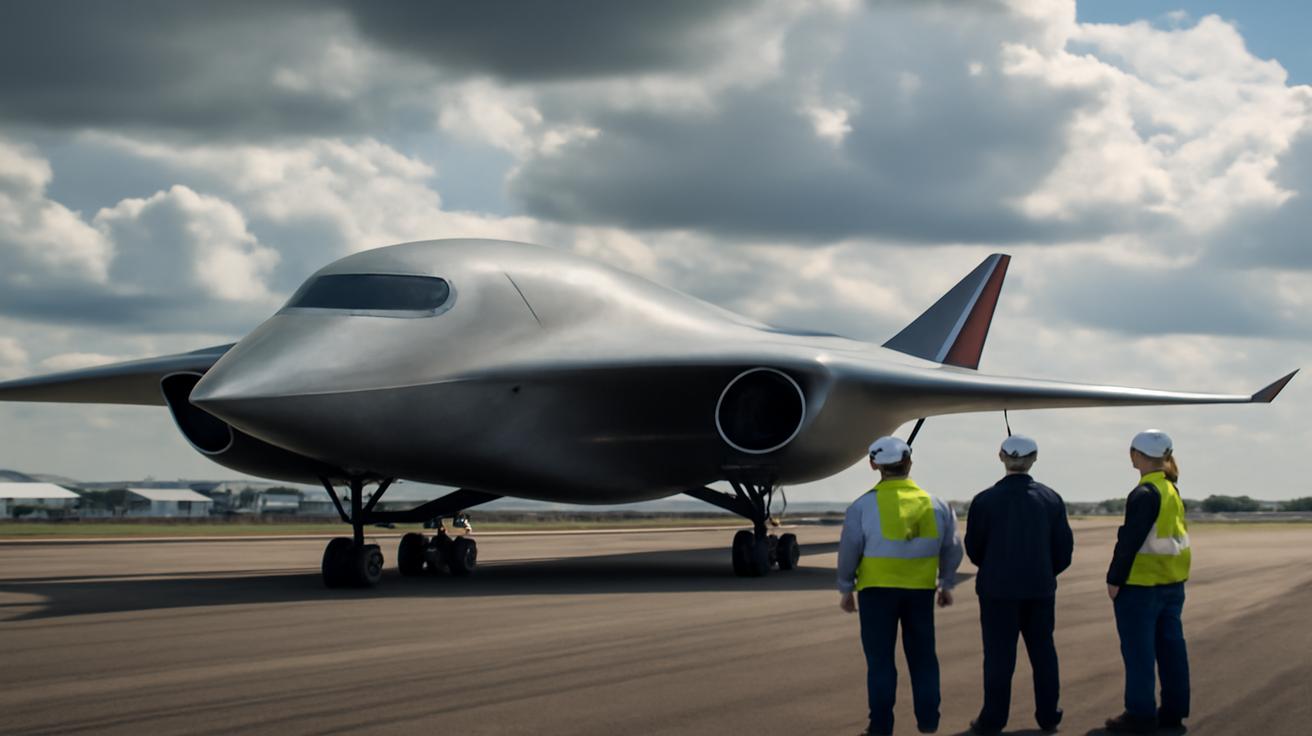
The morning they rolled the strange white aircraft out of its hangar on the Atlantic coast, the air on the French runway felt oddly expectant. A thin ocean mist hung low over the tarmac, softening the edges of concrete, steel, and glass. Technicians in orange vests moved around the craft in crisp, practiced motions. Yet many of them still paused—just for a second—to look up at the thing actually sitting there in front of them, as if their eyes needed reassurance: yes, it’s real. Because nothing about this aircraft, called Cassio, looks quite the way we’ve been taught an airplane should look. And nothing about what it promises—using up to eleven times less energy than a conventional plane—sounds like it belongs in our age of noisy runways and carbon-heavy skies.
A Plane That Sounds Like a Whisper
Walk closer and the familiar cues of aviation start to dissolve. Cassio’s fuselage is compact and clean, its lines more like a glider than a fuel-guzzling workhorse. The propellers sit in places your brain doesn’t fully expect, and the wing looks unusually slender, like a bird bred for distance rather than speed. There’s no oily breath of jet fuel, no hot shimmer of exhaust hanging over the pavement. When its electric fans spin up, the sound is closer to a large household appliance than a roaring engine—more hum than thunder.
This isn’t science fiction, though it has worn that label skeptically in boardrooms and online comment sections. It’s a hybrid-electric aircraft developed by a French company that decided to take a blunt, almost audacious stance: what if the way to decarbonize flight isn’t to build a new kind of airport or invent a mythical fuel, but to start with something much simpler—use dramatically less energy in the first place?
“Eleven times less” is the number that keeps hovering in the air, almost as light as the mist over the runway. Eleven times less energy than a traditional plane of similar mission, they say. Eleven times fewer kilowatt-hours pulled from grids, burned in engines, or converted from batteries. On paper, it reads like a mistake, a decimal point in the wrong place. On the tarmac, with Cassio gleaming pale under a thinning sky, it feels less like a typo and more like a dare.
The Old Problem in a New Sky
Flying has always felt like cheating gravity, and every cheat comes with a price. You don’t feel the cost when you look out the oval window and see a quilt of fields below you; you feel it later, in the numbers: aviation contributing roughly 2–3% of global CO₂ emissions, yet growing faster than the systems that aim to contain it. Each ticket hides the invisible weight of burned kerosene, each flight a tab we’re all still pretending we’ll settle “later.”
For years, solutions have mostly sounded the same: slightly more efficient turbines, cleaner fuels, marginal aerodynamic tweaks, or hopeful promises of hydrogen on the hazy horizon. But the physics of pushing heavy tubes of metal through thin air at high speeds is stubborn. Gains are incremental. Every percentage point of efficiency is celebrated like a rare bird sighting.
So when a team in France started talking openly about slashing energy use by an order of magnitude, people listened—but also frowned. Because to get there, you can’t just tune an engine. You have to rethink the whole dance between air, machine, and energy from the ground up. And that’s what makes this “impossible” airplane so unsettling, so electrifying. It doesn’t just suggest a greener way to fly; it quietly accuses the way we’ve been flying for decades of being clumsy, overpowered, and wasteful.
How Do You Use Eleven Times Less Energy?
On a quiet afternoon, step inside Cassio and the first impression is how ordinary the cabin feels. Seats, harnesses, windows framing strips of sky and land—it’s recognizable, reassuring. The revolution, it turns out, is largely hidden in the bones of the aircraft and the choreography of its power systems.
Traditional planes treat energy like a sledgehammer: burn fuel, spin a big prop or turn a turbine, and push hard through the sky. Cassio approaches flight more like a tightrope walker using a fan and the wind itself. It doesn’t carry a giant battery pack the way some pure-electric prototypes do. Instead, it uses a hybrid system that combines a smaller combustion engine with electric motors, tightly managed by software so that each takes over when it’s most efficient.
To understand how this leads to such staggering energy savings, imagine the different phases of a short flight:
- Takeoff and Climb: Electric motors provide strong, instant torque, allowing powerful lift without the sluggish spooling of traditional engines. The propellers are positioned and shaped to grab as much “clean” air as possible, avoiding the chaotic swirling wake that wastes energy.
- Cruise: Once at altitude, the power demand drops. The combustion engine can run in its most efficient range, or in some profiles even rest while the electric system handles the lighter load. The aircraft’s slender design and optimized wing cut drag dramatically, meaning far less power is needed to simply stay aloft and move forward.
- Descent and Landing: Here, gravity helps. Throttles can pull back, and in some cases, regenerative systems can recover a bit of energy, much like an electric car coasting downhill.
The magic is not in any single trick, but in all of them working together. Cassio’s structure is lighter. The aerodynamics are honed for low drag. The hybrid architecture means the engine is never grossly overpowered relative to the task at hand. And critically, the mission profile—short regional hops, training, medical flights—is matched to what this kind of hybrid-electric setup does best.
When engineers talk about the “11× factor,” they’re comparing the total energy required for a mission—fuel plus electricity—to the energy demand of a modern equivalent burning only fuel. Some of that savings is from burning less fuel. Some comes from using electricity far more efficiently than a combustion engine can. And some comes from simply needing less thrust because the aircraft itself is so carefully tuned to slip through the sky rather than muscle through it.
The Numbers Behind the Whisper
If we reduce this engineering ballet to a few plain figures, the scope starts to crystallize. Imagine a typical regional plane that might need around 1,100 units of energy (in any convenient measure) to complete a short mission. A Cassio-type hybrid aircraft, with its aerodynamic thrift and electric assistance, could pull off the same mission using closer to 100 units. The exact numbers vary with weight, weather, and route—but the order of magnitude holds.
| Feature | Conventional Plane | Hybrid-Electric Cassio |
|---|---|---|
| Energy use per mission | High (baseline 1×) | Up to 11× lower |
| Primary power source | Combustion fuel only | Hybrid: fuel + electric |
| Noise on takeoff | Loud, turbine/prop roar | Significantly quieter hum |
| Typical mission type | Regional transport, GA | Regional, training, medevac, short hops |
| Maintenance profile | High engine wear, complex systems | Fewer moving parts in electric drive |
These aren’t just marginal gains. We’re talking about turning the energy profile of a short flight into something that starts to look, in scale, like a modest road trip instead of a full-blown fossil-fuel feast. For the first time, the idea of truly low-carbon regional aviation doesn’t feel like an empty marketing line, but a plausible line item in an emissions inventory.
The Feel of a Different Future
Now imagine what this actually feels like from the inside. You’re sitting in the cabin on a cool spring morning, nose pointed toward a small island off the coast. Instead of the chest-thumping growl of a traditional engine roaring to life, you hear a rising electric whine—clean, almost surgical. The aircraft starts to roll, gathering speed. The vibration you expect never quite arrives; the sound remains controlled, a restrained whoosh rather than an assault.
The runway drops away, and with it the subtle guilt that sometimes tags along with takeoff. You know, because the airline or operator has actually told you, that this short hop uses a fraction of the energy that older craft would. You know that the plane’s hybrid system is sipping fuel only when it truly needs it, leaning on battery power when conditions are perfect for electric lift. You watch the land fan out beneath you and feel, maybe for the first time in a long time, that flying doesn’t have to be a climate confession.
Outside the window, a flock of birds wheels over the fields. You can almost imagine them acknowledging this human-made cousin: not yet as silent, not yet as light, but closer than the roaring machines that used to tear overhead. The idea that human flight could someday blend more gently into the soundscape of wind and wingbeats stops being a fantasy and starts feeling like a design brief.
From Niche to Network
Cassio and aircraft like it are starting small. They won’t replace widebody jets crossing oceans anytime soon. Their first real territory is the invisible web of short-haul flights that crisscross regions: 200–600 kilometer hops linking small cities, islands, remote communities. Charter operators. Flight schools. Air ambulances that need to get in and out of short runways on rough days.
But there is power in the small. Each of those missions now carries an outsized emissions burden because the planes flying them are often old, noisy, and inefficient. When you swap those aircraft for ones that use a tenth of the energy, the math at the edges of our aviation system begins to change dramatically. Regional airports that today struggle with noise complaints and fuel costs can start to imagine themselves as quiet, low-impact hubs. Local residents hear a different sound overhead—and perhaps feel differently about it.
When enough of these small edges shift, the center of gravity moves. Manufacturers get bolder. Regulators update rules that were written for fossil-heavy skies. Young pilots train on aircraft that feel more like flying electric vehicles than vintage farm machinery. And passengers learn a new sensation: walking out of a small plane without the faint smell of burned fuel clinging to their clothes.
The Hard Parts We Can’t Ignore
Of course, the story of this “impossible” French airplane isn’t all ocean mist and hopeful metaphors. Physics always demands payment. Hybrid-electric systems still carry batteries, and batteries are heavy. They require mining, processing, and careful recycling to avoid simply shifting environmental burdens from the sky to the ground. The lighter you make a plane, the more you tend to lean on advanced materials whose own manufacturing footprints can be intense.
Charging infrastructure at small airports doesn’t sprout overnight. Power grids in rural regions may not be ready to handle banks of fast chargers feeding planes between rapid-fire missions. Even the simple act of training mechanics to work safely with high-voltage systems is a multi-year effort.
Then there’s regulation. Aviation safety rules are written in ink, not pencil, and for good reason. Proving that a new type of propulsion system is safe in the sky, over people and cities, is slow, meticulous work. Every “impossible” innovation has to be made tediously, almost boringly possible on paper before it earns the right to lift off with passengers on board.
And yet, here again, the radical energy efficiency of a plane like Cassio offers a peculiar advantage. Because it needs so much less energy to fly, the size of the battery pack or fuel reserves can be smaller. That means less weight, fewer cells to manage, less charging infrastructure per mission. The whole scale of the problem shrinks to something more tractable. Instead of needing miracles in battery density, we “only” need solid engineering, smart routing, and careful grid planning.
The skeptics aren’t wrong to ask tough questions. They are, in many ways, the invisible co-authors of every new generation of aircraft. But as test flights accumulate, as noise measurements and fuel logs and real-world maintenance data pile up, the category of “impossible” narrows. It doesn’t vanish—long-haul electric flight is still perched at the very edge of the imaginable—but it retreats from the short distances where hybrid craft are already proving a point: you can change the energy math of flight now, not in some speculative 2050.
Why This Matters Beyond the Runway
Standing under Cassio’s wing, watching mechanics move like careful choreographers around the landing gear, another realization settles in: this aircraft is not just a machine. It’s a signal. A physical, humming, airworthy proof that the story we tell ourselves about what’s “possible” in climate solutions may be badly out of date.
For years, we’ve quietly accepted that some sectors—aviation, shipping, heavy industry—are just “hard to abate,” phrases that become excuses. We mentally file them under later, after we’ve fixed electricity and cars and buildings. But the climate clock doesn’t care about our sequencing. It ticks the same whether the emissions come from a coal plant or a regional jet.
By carving out a slice of aviation that can run on an order of magnitude less energy, this strange French plane alters more than a flight plan. It alters expectations. It suggests that being realistic about climate doesn’t mean being resigned to marginal gains. It hints that when engineers, pilots, regulators, and communities decide to treat “impossible” as a design challenge rather than a verdict, the sky—for once—is not a metaphor, but the place where that choice literally takes off.
Frequently Asked Questions
How can a plane really use 11 times less energy?
The “11× less” figure comes from combining multiple factors: extremely efficient aerodynamics, lighter structure, and a hybrid-electric powertrain that uses each energy source only in its most efficient range. Instead of relying entirely on a large combustion engine, the aircraft blends battery-powered electric motors with a smaller engine, dramatically reducing total energy needed for typical short missions.
Is this aircraft fully electric?
No. It is hybrid-electric, meaning it uses both an internal combustion engine and electric motors. This avoids the need for extremely large, heavy batteries while still capturing most of the efficiency and noise benefits of electric propulsion, especially during takeoff and climb.
What kinds of flights is it designed for?
The plane is intended for regional routes and special missions: short-haul passenger flights, pilot training, air taxi operations, and medical or emergency services that operate over distances of a few hundred kilometers.
Will this replace large commercial jets?
Not in the near term. Hybrid-electric aircraft like this are best suited for smaller payloads and shorter routes. However, they can significantly decarbonize regional aviation and act as testbeds for technologies that may later scale up to larger aircraft.
How much quieter is it compared to normal planes?
Hybrid-electric takeoffs and climbs are notably quieter because electric motors produce less mechanical noise and vibration than traditional engines. While exact decibel reductions depend on configuration and conditions, communities around airports can expect a much softer sound profile compared to conventional aircraft of similar size.
What about battery disposal and resource use?
The batteries used in hybrid aircraft still require careful management, recycling, and thoughtful sourcing of materials. The advantage here is that, because the plane is so efficient, it needs far less battery capacity than a fully electric design, reducing material demands and simplifying end-of-life handling.
When will passengers be able to fly on planes like this?
Timelines depend on certification and regulatory approval, which are deliberately rigorous in aviation. Test flights and demonstration missions are already underway, and early commercial operations on select regional routes are expected within the next few years, with wider adoption following as operators and regulators gain confidence.








Leave a Comment