
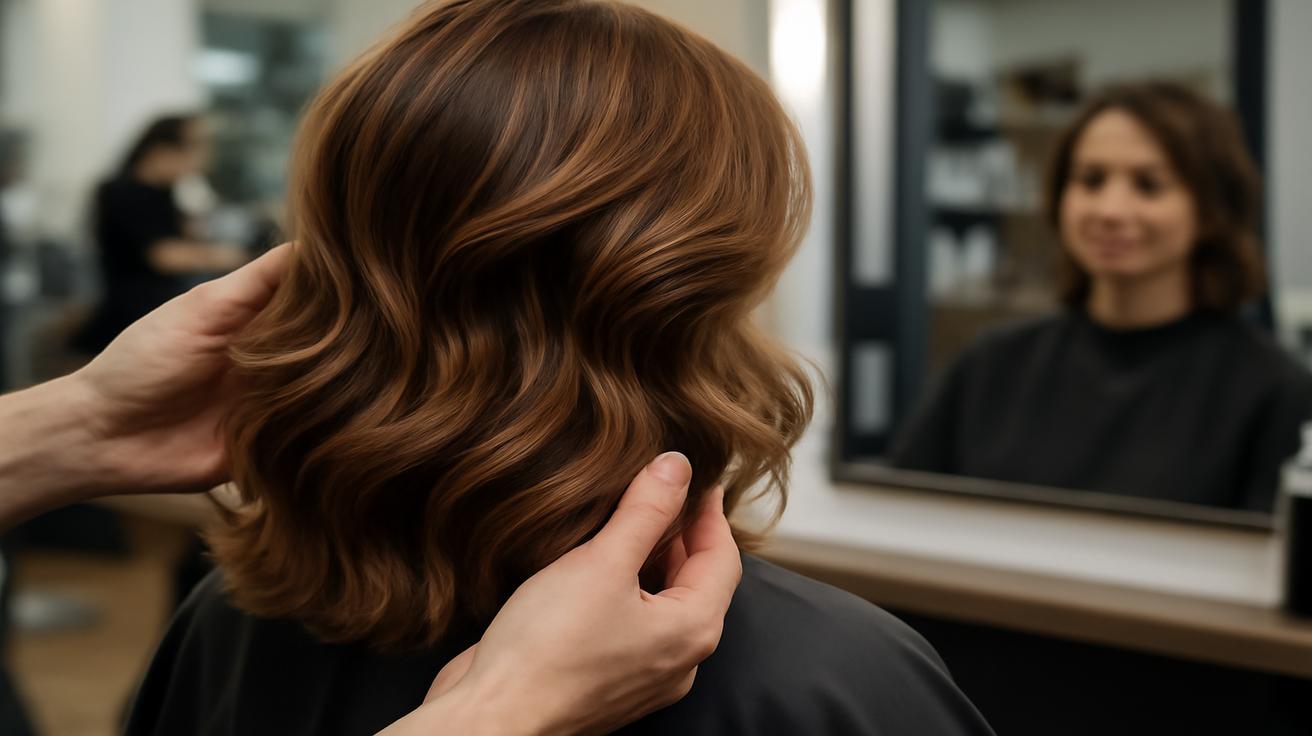
The first thing you notice is movement. Not the dramatic swing of a makeover montage, but something softer, subtler—like tall grass giving way to a breeze. The hair doesn’t sit; it drifts. It has that rare quality you can’t quite name at first, some unforced rhythm that makes you look twice and think, Oh. That’s what it’s supposed to do.
We’ve all met the other kind of haircut: the one that looks sharp at the salon and suspiciously helmet-like two days later. The ends stack in a hard line. The layers form a staircase instead of a river. You can see where the scissors started and stopped, like pencil marks on a blueprint. It’s neat, yes. But it’s also a little…stiff.
This is the story of the opposite kind of cut—the kind that doesn’t fight your hair’s nature, but listens to it. A haircut that creates natural flow instead of stiff lines. Not a specific trend with a catchy, here-today-gone-tomorrow name, but a way of thinking about hair: organic rather than architectural, responsive rather than rigid.
The Moment You Realize Your Hair Has a Personality
There’s a moment when it hits you that your hair has opinions. It’s usually at home in your bathroom, not under flattering salon lights.
You wash, you towel dry, you reach for the brush. That new cut, so clean and tidy in the mirror at the salon, is now refusing to lie flat on one side. A piece at the crown stands upright in quiet rebellion. The ends that were once a crisp, perfect line are now flipping out in every direction except the one they were clearly “designed” for.
This is how a stiff, over-structured haircut reveals itself: it only works under very specific, highly controlled conditions. Blow-dried this way. Product applied exactly there. Styled in a direction that might not match how you actually live or move or sleep.
A cut that creates natural flow does something different. It acknowledges that your hair will be slept on awkwardly, pulled into messy buns, tucked into collars, and shaken loose at concerts and on windy walks. It calculates for cowlicks and hurricanes of humidity. It makes room for imperfection, and that room is where the beauty hides.
Imagine waking up, running your hands through your hair, and finding—not perfection—but cooperation. The strands don’t all march in formation, but they seem to agree on the general direction. There’s bend and curve, but not chaos. The outline is soft, blurred like a watercolor instead of drawn with a ruler.
That is natural flow: not a style you paste on, but a conversation between the cut and your hair’s personality.
How Hair Actually Wants to Move
To understand why some haircuts look stiff while others move with an easy grace, you have to think less like a designer and more like a naturalist. Hair, like a river or a field or a tree line, has patterns built in. Follow them, and everything feels right. Fight them, and you get turbulence.
Every head of hair has a few key “clues” about how it wants to move:
- Growth direction: Some hair grows forward, some backward, some straight up like wild grass. That’s why your fringe either falls into your eyes or refuses to stay there.
- Cowlicks and swirls: The tiny whirlpools at your crown or hairline are not flaws; they’re maps. Ignore them and your cut will always be battling a hidden current.
- Texture pattern: Straight, wavy, curly, coily—each has its own way of collapsing and expanding, shrinking and stretching when dry.
- Density and weight: Finer hair likes encouragement to look fuller; thick hair craves release so it can move instead of puffing out.
A stiff haircut treats hair like material that will obey geometry. A flowing haircut treats hair like a living landscape. The stylist studies your whirl at the crown the way a hiker would study a contour map. They notice where your waves bunch up, where your curls spring, where fine hair clings to the scalp.
Then, instead of forcing it into a rigid outline—perfectly straight lines, heavy blunt ends, razor-sharp angles—they carve in small, almost invisible variations. Tiny shifts in length. Softly diffused edges. Layers that don’t shout “LAYERS” from across the room, but quietly change how weight is distributed.
The result is movement that doesn’t feel styled into existence. It looks like the hair always belonged that way—as if someone simply edited out the heaviness, the drag, the parts that weighed the whole picture down.
The Quiet Techniques Behind a Flowing Haircut
The craft behind a naturally flowing haircut is less about big, showy moments and more about slow, thoughtful choices. Picture a sculptor who doesn’t slam a chisel into marble, but gently chips away, pausing to see how the light hits each new plane.
Here are some of the quieter techniques that often create that sense of movement:
- Soft, internal layering: Instead of obvious, choppy layers, the stylist removes weight from the inside of the haircut. It’s like hollowing out a heavy log—still solid, but lighter, so it moves.
- Slide cutting and point cutting: Scissors move along the hair shaft or snip into the ends at an angle, breaking up hard lines so the edges feather instead of forming a wall.
- Curvature-based cutting: The hair is cut in the direction it grows and bends, following its natural curl or wave pattern instead of against it.
- Dry refinement: Many stylists will do a first rough cut wet, then refine on dry hair, when texture and movement reveal themselves fully.
- Customized length mapping: Instead of “Shoulder length for everyone,” they map length along the jawline, cheekbones, and collarbones so the hair breaks and falls at flattering, natural-looking points.
It feels almost like an ecosystem being balanced. Remove too much weight in the wrong place and the hair flies away, disconnected. Not enough, and it sits like a heavy blanket. The sweet spot is where air can slip between strands, but the silhouette still feels intentional.
Flow isn’t the absence of structure; it’s structure disguised as ease.
The Difference You Feel, Not Just See
There’s also a physical sensation when you get this kind of cut. The first time you shake your head after leaving the salon, the hair doesn’t thud—it rebounds. Your neck feels lighter. You feel air move around your scalp more easily.
That’s the secret: movement isn’t just visual beauty, it’s comfort. It’s your hair existing as something you wear, not something that weighs on you.
When the Mirror Shows a Story Instead of an Outline
Haircuts that create natural flow tend to age well, like paths slowly worn into the ground. In the weeks after your appointment, you’ll notice small details emerging that weren’t obvious on day one.
The way a strand naturally tucks behind your ear without creating a ridge. The soft kick-out at the ends when your hair brushes your collar. The gentle curve framing your cheek when you laugh. A stiff haircut would fight those moments; a flowing cut amplifies them.
Think of the difference between two landscapes:
- One is freshly bulldozed, straight-edged, ruled by angles—nothing dares move unless someone tells it to.
- The other has paths, but they’ve been walked into being. Grass leans where people sit. Flowers gather where the light is best. It’s tended, not forced.
Your hair is the second landscape when flow is the priority. It doesn’t erase your natural quirks; it edits them into something intentional. That stubborn bit that always flicked out? Now it’s a playful little wave that gives the cut character. The part that refused to stay centered? The stylist used it as the anchor for the entire shape.
Suddenly the mirror doesn’t show a rigid “after” photo, but an ongoing story. Your hair isn’t trapped in the moment you left the salon; it’s allowed to live, and still look like itself.
A Cut You Don’t Have to Perform For
One of the clearest signs you’ve found a haircut with true flow is how much less you feel you need to do. You don’t have to perform elaborate rituals each morning to coax it into cooperation. You can let it air dry more often. You can skip a day of styling without feeling like the human version of a before picture.
It won’t be perfect every day—nothing genuinely alive ever is—but it will usually be “good enough” with remarkably little effort. And every once in a while, it will surprise you by falling into place so effortlessly that you’ll pause and think, Did I accidentally become one of those people whose hair just does that?
The secret is that you didn’t become one of those people. You always were. You just finally got a haircut that understood your terrain.
Talking to Your Stylist Like You’re Telling a Nature Story
Getting this kind of haircut often starts with a different kind of conversation. Instead of saying, “I want it to hit exactly here and be very straight,” you begin describing how you want it to feel and move.
Here’s a simple way to shift how you talk about your hair, in a language that makes sense to stylists who love movement and flow:
| If you usually say… | Try saying this instead… |
|---|---|
| “I want it blunt and super straight.” | “I like a clean look, but I want the ends to move and not form a hard line.” |
| “Layers, but not too many.” | “Can we add soft, invisible layers that take out weight so it moves more, without looking choppy?” |
| “Make it really thick at the bottom.” | “I like fullness at the ends, but I still want them to have some flow and not feel heavy.” |
| “I don’t want any frizz.” | “I’d love to keep my natural texture but in a way that looks intentional and softly defined.” |
| “Make it look like the photo.” | “I like the movement and shape in this photo—can we adapt that to how my hair naturally falls?” |
This shift frees your stylist to think less about imitating a picture and more about collaborating with your hair as it actually exists on your head. It invites them to pay attention not only to length and shape, but to the story your hair is already trying to tell.
Bring photos that show movement—wind-tousled bobs, curls with airy space between them, waves that look like they were dried on a beach, not under a dryer. Point at the pieces that attract you: “I like how this falls over the eye,” “I love that little bend at the collarbone,” “This looks lived-in, not sprayed into place.”
The more you talk in verbs—fall, bend, lift, drift—instead of only nouns—bob, fringe, layer—the closer you get to a cut designed for flow.
Clues You’re in the Right Chair
Stylists who specialize in natural movement tend to do a few things that feel different:
- They ask how you usually wear your hair: air-dried, heat-styled, tied back, or free.
- They study your hair before it’s washed, looking at its default state.
- They may move around you while cutting, checking how the shape shifts from profile to back to front.
- They touch your hair a lot, feeling density and weight instead of only looking at length.
- They sometimes cut with your hair falling around your face, not scraped back into tension.
In other words, they treat your hair like terrain they’re about to hike, not a flat diagram they’ll draw over. That curiosity is what builds a cut that flows with real life, not just with the comb.
Living With Hair That Moves Like It Belongs to You
Once you have a haircut that favors flow over stiffness, your relationship with your hair subtly shifts. You stop demanding that it be perfectly obedient and start noticing what it does beautifully when given just a little guidance.
You might find yourself:
- Scrunching in a bit of cream and letting it air dry, trusting the shape to show up.
- Wearing it down more often because it no longer feels like a heavy curtain.
- Allowing some flyaways to exist, recognizing them as part of the softness instead of a flaw.
- Stretching more days between haircuts because the shape grows out gracefully instead of collapsing.
The styling routine becomes less like battle armor and more like tending a garden: a bit of water here, a bit of trimming there, a touch of gentle persuasion in the morning—and then you let it be. You don’t need to tame every strand; you just nudge the general direction.
In a world that often rewards sharpness—sharp angles, sharp lines, sharp definitions—there’s something quietly radical about choosing a softer outline. About letting movement, even a little mess, be part of what makes you feel most like yourself.
The Beauty of Not Being Perfectly Drawn
When your haircut embraces natural flow, something curious happens to how you see yourself. Less time is spent chasing an exact, unchanging image, and more time is spent noticing how you look in motion: laughing with friends, walking across a street, leaning in close to whisper something important.
In those moments, no one is examining the ends of your hair to see if they form a straight, unwavering line. They see the way a lock falls forward when you tilt your head. The way a curl lifts when you turn toward the light. They see life, not lines.
This haircut, the one that flows instead of stacking into stillness, doesn’t ask you to be perfect. It just asks you to be in motion.
FAQ
How do I ask my stylist for a haircut with more natural flow?
Describe how you want your hair to move, not just how you want it to look. Use phrases like “soft, blended layers,” “no hard lines at the ends,” and “I want it to air dry nicely with some natural movement.” Show photos that highlight movement and texture, and mention that you’re okay with a more lived-in, less rigid finish.
Can fine or thin hair still have natural flow?
Yes. Flow for fine hair is about light, strategic layering and avoiding heavy, blunt lines that emphasize thinness. A good stylist will remove just enough weight to keep the hair from hanging flat, while keeping the edges soft so the hair appears fuller and more dynamic.
What about very curly or coily hair—does this idea still apply?
Absolutely. Curly and coily hair already has built-in movement. A flowing cut respects the curl pattern, often using techniques like curl-by-curl cutting or shaping the silhouette on dry hair. The goal is to create shape and balance while preserving bounce and space between curls, instead of forcing a strict outline.
Do I need lots of products to maintain a flowing haircut?
Usually, no. One of the benefits of a movement-focused cut is that it does more of the work for you. A simple routine—like a lightweight leave-in, a curl cream or texture spray if needed, and minimal heat—is often enough. The cut should look reasonably good even on “lazy” days.
How often should I get it trimmed to keep the flow?
That depends on your hair type and length, but many people find every 8–12 weeks works well. Because the edges and layers are softer and more blended, this kind of cut tends to grow out more gracefully than very blunt or highly structured styles, so you may not need trims as frequently.
Will a flowing haircut still look polished for work or formal events?
Yes. Natural flow doesn’t mean messy. It means the lines are softer and movement is built in. You can always smooth it with a blow-dryer or iron for special occasions, but even then, the subtle layering and weight balance will keep it from looking rigid or helmet-like.
How do I know if my current cut is too stiff?
Signs include: it only looks right with lots of heat styling, the ends form a solid “block” when straight, it feels heavy or bulky at the bottom, and it loses its shape quickly when exposed to humidity or movement. If your hair seems to fight the cut whenever you live your normal life, it’s likely too stiff and could benefit from more flow-focused shaping.





Leave a Comment