
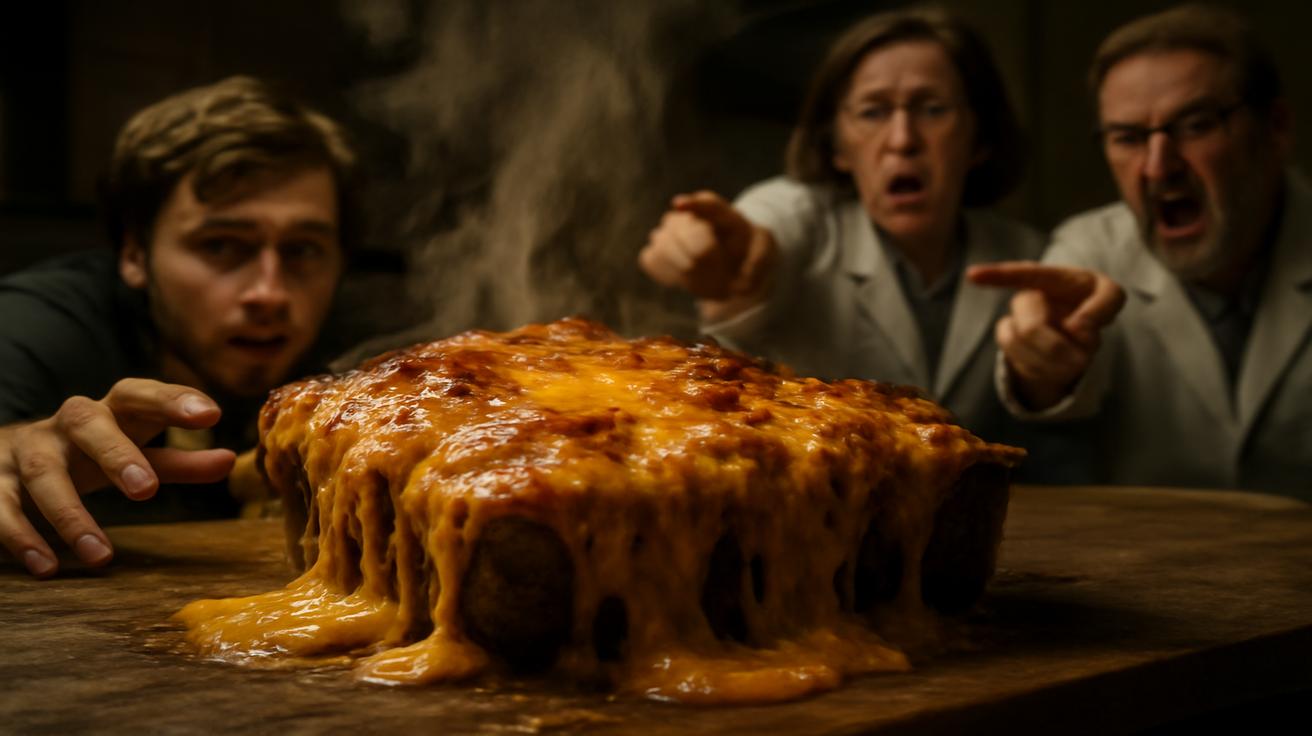
The first time I met the cheesebomb casserole, it was a Tuesday so bleak the sky felt like a low ceiling. The kind of day when the emails never stop, the news scrolls like a slow-motion car crash, and your bones buzz with a vague, background loneliness. I wasn’t looking for enlightenment. I was looking for something molten and obscene to put in my mouth. That’s when the algorithm, in its infinite, unholy wisdom, delivered the recipe: “THE ULTIMATE COMFORT CHEESEBOMB CASSEROLE – 5 INGREDIENTS, 20 MINUTES, ONE PAN.”
The Seduction of a Melting Monstrosity
The photo was ridiculous. A glass baking dish brimming with elbow macaroni drowned in cheese the color of cartoon suns. Rivers of orange fat glistened under a crust of blistered cheddar, each bubble frozen mid-burst. Someone was pulling a spoon through the middle, and the cheese stretched in a slow, indecent ribbon—long enough that you could practically hear the sound it would make as it snapped.
You know the sound. That soft, elastic sigh of melted dairy giving up and giving in.
There was nothing subtle about it. This wasn’t the gentle, crackling top of a homemade gratin or the nuanced tang of an aged Comté. This was a nuclear cheese event. A dairy landslide. A thick, viscous promise that whatever hurt in you would quiet—for at least the length of a Netflix episode.
The recipe itself read like a love letter to every corner we cut when no one is watching: boxed macaroni, canned soup, pre-shredded cheese, frozen tater tots, more cheese, something called “cheese sauce,” and then—because why stop—crumbled chips on top. There were optional add-ins: bacon bits, ranch seasoning, shredded rotisserie chicken “for protein.”
Protein, as if that word could sanctify the rest.
By the time I’d scrolled to the bottom, my rational brain—armed with years of nutrition advice, climate guilt, and a vague understanding that I am not 19 anymore—was already losing the argument. The casserole had me. It wasn’t asking for effort, or skill, or even self-respect. Just an oven-proof dish and a willingness to delay the consequences until tomorrow.
The Lonely Glow of the Refrigerator Light
There is a particular kind of quiet that follows you into the kitchen at 8:37 p.m. on a weeknight. It’s not the peaceful quiet of intentional solitude; it’s the void left when your life has been reduced to a calendar of obligations and you find yourself in the leftover hours, not quite sure what to do with them.
The refrigerator hums. You open the door and stare into that pale blue light as if it might offer a revelation. It doesn’t, of course. It offers wilted lettuce, half an onion in plastic wrap, and a jar of something you meant to turn into dinner two Sundays ago when you were still optimistic about your ability to be the kind of person who “meal preps.”
On nights like this, the cheesebomb casserole doesn’t just look good—it feels like rescue. Not from hunger; you could solve hunger with toast and eggs. It promises rescue from the ache of eating alone, from the invisible weight of being the only one who will notice whether you chop garlic or give up and shake powdered onion into the pan.
It’s not really about flavor. Oh, it tastes “good,” sure—salty, creamy, familiar. But it’s more about texture and temperature: the blanket-thick sauce, the soft collapse of noodles, the blistered crust you crack through with your spoon, the steam that fogs your glasses. It’s about the way the first bite hits your brain like a tranquilizer dart, all that fat and salt detonating in the reward centers that evolved to help us survive lean times, not discount supermarket aisles.
This is why the cheesebomb casserole seduces the lonely: it offers all the sensory signals of being cared for without requiring you to admit that what you really want is not cheese, but company. It lets you rebrand your craving for connection as a craving for calories. That’s less embarrassing to say out loud, even to yourself.
The Nutritionists Are Screaming into the Void
Somewhere, in a clean, well-lit office with potted plants and a whiteboard, a nutritionist is looking at a photo of this casserole and inhaling sharply through their teeth.
They count the layers like a crime scene investigator: processed cheese, refined carbs, saturated fat, sodium levels that would give a cardiologist palpitations. They know—on a cellular, science-backed level—what this does inside the body: the insulin spikes, the inflammatory cascade, the way a meal like this can tangle with sleep, mood, and long-term health if it becomes a Tuesday ritual instead of a rare event.
But the nutritionist is yelling into a storm. Because the cheesebomb casserole isn’t really competing with kale. It’s competing with time, exhaustion, and the cunning machinery of modern food marketing. It’s up against the fact that ultra-processed foods are designed not only to taste good, but to light up our brains with an almost pharmaceutical precision.
And they are cheap. That matters.
We live in a world where a bag of pre-shredded cheese, a box of pasta, and a can of soup are often more affordable and more accessible than fresh produce, lean proteins, or anything that requires more than 20 uninterrupted minutes and a functioning attention span. The cheesebomb casserole is not a failure of willpower; it’s the inevitable end product of an industrial food system that has learned how to monetize human frailty.
Nutritionists know all this. They also know that scolding doesn’t work. “Everything in moderation” sounds smug when you’re staring down a week of double shifts and the only thing you can face cooking is something you can dump in a pan and forget in the oven. When your brain is fried, you don’t want a balanced plate—you want surrender.
So yes, the cheesebomb enrages nutritionists. But what really burns is this: the casserole is winning not because it’s better, but because it’s easier. And in the arithmetic of an overextended life, easier so often equates to inevitable.
The Grocery Aisle Where Comfort Is Manufactured
Walk with me down the fluorescent canyons of the supermarket on a Tuesday evening. Everyone here looks tired. The carts clack against the linoleum, squeaking wheels complaining in the same pitch as the children begging for snacks.
This is where comfort is packaged, branded, and sold. Listen closely and you can almost hear the whisper beneath the slogans on the boxes:
“You’ve done enough today. Let us handle it.”
“You deserve this.”
“No one has to know.”
Entire shelves are devoted to the kinds of things that want to be casserole: instant mixes, jarred sauces, cheese blends, par-baked breads that can transform, in 25 minutes or less, into something bubbling and beige in your oven. You know, instinctively, that most of this is not the food your body thrives on. But that’s not the question you’re asking tonight. The question is simpler: What can I bear?
What can I bear to cook, to clean, to chew, to face?
The cheesebomb casserole fits perfectly into this landscape because it matches the emotional script. It says, “You have been brave enough just to get through this day. Here is your medal: a pan full of melted certainty.”
Certainty is the real ingredient. You know exactly how this will taste, how it will feel, how it will sit in your stomach. There are no surprises, no potential for failure. Try a new salad recipe and it might be soggy, bitter, underdressed. Try a cheesebomb casserole with enough processed inputs and it will be the same every time, a standard-issue hug from the food industry.
And so you stand in front of the shelves, pretending to debate brands when what you are really choosing is the story you want to tell yourself about this night. Are you the person who buys quinoa and leafy greens, the person who is “on track”? Or are you the person who throws the 5-cheese blend and the family-size soup can into the cart and decides to live with the consequences later?
Most of us are both people, depending on the day. The grocery store doesn’t care. It stocks comfort in every register-friendly form, waiting for the moment your willpower blinks.
The Hidden Cost on the Tuesday Night Receipt
Here’s where it gets uncomfortable: the real cost of the cheesebomb casserole is rarely the line on the receipt. It’s what we trade for that illusion of comfort.
We trade sleep, sometimes, when the salt and fat rattle around in our bodies like a late-night drumline. We trade energy, waking up the next morning feeling foggier than we’d like to admit. We trade a little more trust in ourselves every time we promise, “Next week I’ll cook properly,” and then, inevitably, end up back in the baked cheese trench.
But mostly, we trade attention. The cheesebomb is a way of not paying attention—to what we’re eating, to what we’re feeling, to the ways our lives don’t quite match the stories we tell about them. It’s a delicious distraction, and like all good distractions, it works.
We eat in front of screens, the fork making short, hypnotic trips from pan to mouth. We barely taste the last half, but we keep going because stopping would mean being alone again with the quiet. The casserole offers a mission: finish this. Stay busy. Stay filled. Don’t look past the edge of the dish.
This doesn’t make the cheesebomb evil. It makes it effective. It has become a tool woven into the survival kit of modern life: along with streaming services, doomscrolling, and buying things that arrive in cardboard on our doorsteps. Tiny, controllable pleasures in a world that feels increasingly uncontrollable.
Are We Hungry, or Are We Hurt?
Underneath the molten cheese and crispy topping is a question we rarely ask ourselves on a Tuesday night: what kind of hunger is this, actually?
The body’s hunger is straightforward. It says: I need fuel. It might nudge you toward fat, salt, sugar, because those are efficient sources of energy. But the hunger that sends us ferreting around for casseroles at 9 p.m. after a long, lonely day is usually not just physical. It’s something more diffuse.
We’re hungry for softness in a world that keeps asking us to be sharp. We’re hungry for warmth after a day of fluorescent lighting and frigid email tone. We’re hungry for some tiny pocket of experience we can control and predict when everything else feels precarious.
The cheesebomb casserole answers all those hungers at once, or at least it feels like it does. It is soft, warm, predictable, and abundantly there—enough for seconds, enough for leftovers, enough to reheat tomorrow so you don’t have to think about it again.
It’s not that there’s anything wrong with wanting those things. The problem is that we’ve outsourced the job of meeting those needs to something that can’t actually do it. Food can soothe, but it can’t fix. It can quiet, but it can’t comfort in the deep, steady way we’re actually craving. It can’t answer back when you say, “Today was hard.”
But it can simulate the feeling of being taken care of. It can wrap your tongue and your gut in creamy reassurance and whisper, for a moment, “You are safe here.”
We buy that illusion of comfort at the price of dealing with the real work of being human in a complicated, lonely world. And on some nights, honestly, that’s a fair deal. The trouble begins when the casserole stops being an occasional truce and becomes our primary coping strategy.
What Happens When We Step Away from the Pan
Imagine, just for a moment, a different Tuesday night. You open the fridge, feel that same familiar loneliness press up against your ribs, and you recognize it—not as hunger exactly, but as a kind of weather in your chest.
You could still make something warm and cheesy. But maybe instead of surrendering to the full catastrophe of the cheesebomb, you negotiate. Real cheese, but less. Pasta, but with a handful of frozen vegetables tossed in. You take ten extra minutes to sauté an onion until it smells like a kitchen where someone cares about the people who eat here—even if that someone is you, and the people is just you.
You put the phone down while you eat. You taste the second bite as carefully as the first. You let the quiet sit there without rushing to stuff it full of noise or dairy. Maybe you text a friend, not a photo of the food, but a simple, “Hey, today was a lot. How are you?” You trade a little bit of the illusion of comfort for something messier, but more real.
This isn’t a redemption arc for vegetables. It’s not a moral fable where the cheesebomb is the villain and the salad is the hero. It’s simpler than that: it’s about noticing what we’re actually trying to buy when we load up the pan and slide it into the oven.
Comfort is not a casserole. Comfort is a web: of routines that don’t leave us flattened by the end of the day, of people who remember our voices, of small, chosen rituals that remind us we are not just open mouths in front of glowing screens.
Sometimes that ritual is stirring a pot of soup that took longer than we had, chopping vegetables to the rhythm of our own breathing. Sometimes it really is a bubbling dish of something indulgent, shared with people who will help you eat it and laugh about how over-the-top it is. The problem is not cheese. The problem is when cheese becomes the closest thing we have to a conversation.
A Quick Look at What We Think We’re Buying
When we reach for the cheesebomb casserole, there’s more in play than ingredients. Here’s a snapshot of the trade we’re making.
| What We Reach For | What We Think It Gives Us | What It Actually Delivers |
|---|---|---|
| Melted cheese and carbs | Emotional warmth, safety | Short-lived pleasure, physical warmth |
| “5-ingredient” recipes | Ease, relief from decision fatigue | Convenience, often at the cost of nutrition |
| Huge portions | Abundance, reassurance we won’t “run out” | Over-fullness, leftovers we may or may not want |
| Ultra-processed shortcuts | Time saved for “real life” | Health debit pushed quietly into the future |
| Eating in front of a screen | Distraction from stress and loneliness | Numbness, but little real relief |
Living with the Cheesebomb, Not for It
The truth is, the cheesebomb casserole is not going anywhere. It will keep sliding into our feeds and onto our plates because it solves a real problem, even if only temporarily. It makes unbearable evenings feel bearable. It fills the space where community used to live.
Maybe the work is not to banish it, but to shrink its job description.
Let it be what it honestly is: an outrageous, occasional thrill. A dish you make once in a while when you have friends over and you all marvel at the excess together. A recipe you text your cousin with a disclaimer, “This is ridiculous; we’re making it anyway.” Let it be something you anticipate and then recover from, not something you drift into every time life gets hard.
On the other nights, when the loneliness presses in and the fridge light flicks on and you feel that familiar pull toward something bubbling and beige, pause for a moment. Ask, out loud if you have to: “Am I hungry, or am I hurt?”
If you’re hungry, feed yourself with as much kindness as you can manage—which might still be a shortcut, but maybe one notch gentler than the disaster pan. If you’re hurt, consider reaching for something that bites back a little less quietly: a walk around the block, a call to someone whose laugh you remember, a few minutes with a notebook where you tell the blank page the truth about your day.
Comfort on a Tuesday night is not an illusion. We just keep looking for it in dishes that were only ever meant to be delicious, not deliverance. The cheesebomb casserole can fill your stomach. Only you, and the web of small choices that shape your days, can fill your life.
FAQ
Is it really that bad to eat a “cheesebomb casserole” once in a while?
Occasionally, no. Your body can handle indulgent meals now and then. The concern is when this kind of ultra-rich, ultra-processed dish becomes a default coping mechanism multiple times a week, displacing more nourishing foods and other forms of genuine comfort.
Why do I crave heavy, cheesy foods when I’m stressed or lonely?
Fat, salt, and carbs trigger powerful reward responses in the brain, releasing feel-good chemicals that temporarily reduce stress and emotional discomfort. Over time, your brain learns to associate these foods with quick relief, so you start to crave them whenever difficult feelings arise.
How can I get “comfort food” without going all-in on a disaster casserole?
You can keep the spirit of comfort while dialing down the intensity: use real cheese but in smaller amounts, add vegetables or beans, swap some processed ingredients for whole foods, and pay attention while you eat. Even small tweaks can shift how your body feels afterward.
What’s the difference between physical hunger and emotional hunger?
Physical hunger builds gradually, is satisfied by a range of foods, and eases once you’ve eaten. Emotional hunger often appears suddenly, fixates on very specific foods (like something cheesy or sugary), and can persist even when you’re physically full. Learning to notice which one you’re feeling can change how you respond.
How do I start breaking the habit of using food as my main source of comfort?
Begin by adding, not subtracting: add one non-food comfort ritual to your evenings—a walk, a call, a book, a hot shower—before or after you eat. Over time, these alternatives can share the workload with food. The goal isn’t perfection; it’s having more than one way to feel okay on a hard Tuesday night.








Leave a Comment