
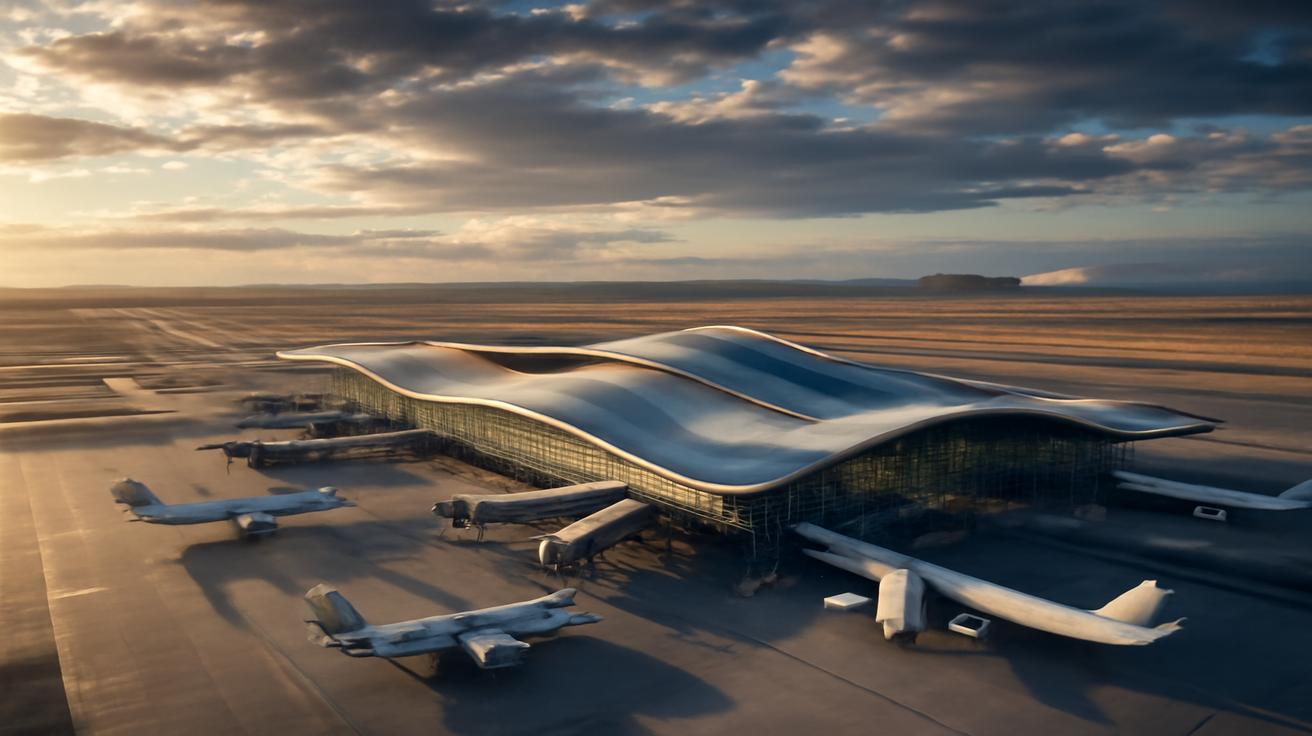
The first thing you notice is the sky. An enormous African sky, high and thin and bluer than you remember it being anywhere else. Below it, the plateau stretches in ochre and gold, the air shimmering over fields and new roads. Then, on the horizon, something rises that doesn’t quite belong to the past image of Ethiopia many people still carry in their minds: glass, steel, runways in sharp, geometric lines. It looks less like an airport and more like a declaration. This, you realize, is where a country is attempting to bend the world’s flight paths closer to its own heart.
The Plateau That Wants to Rewire the Sky
Stand on the outskirts of Addis Ababa at dawn and you can feel the altitude in your lungs. At more than 2,300 meters above sea level, Ethiopia’s capital city is closer to the clouds than most. The air is cool and thin; the sun lifts quickly over the Entoto hills, washing the plains in a hard, clean light. From here, the idea that this corner of East Africa could become the centre of global aviation feels, at first, like a bold fiction.
Yet the numbers and geography say otherwise. Draw arcs across the globe from North America to India, from Europe to Southern Africa, from the Middle East to Latin America, and your pencil keeps grazing the Ethiopian plateau. Addis Ababa already lies naturally astride some of the world’s most heavily traveled corridors. What it does not yet have is the infrastructure to fully claim that position.
That is what the proposed $12.7 billion mega-airport—planned not far from the current Bole International Airport—aims to change. It is not just an expansion; it is an attempt to redraw the invisible map that guides where the world’s aircraft pause, refuel, and exchange passengers. If it succeeds, a huge portion of tomorrow’s connections between continents may be stitched together here, in the thin, bright air of central Ethiopia.
The $12.7 Billion Bet on the Future
Airports reveal a society’s ambitions as clearly as its monuments. A small, functional terminal whispers of regional practicality. A mega-airport, built from scratch at vast expense, speaks in a very different register: of confidence, of hunger, of a bet that the future will arrive often and land here.
The vision behind Ethiopia’s new airport project is large even by global standards. Designed to serve tens of millions of passengers a year—numbers that could eventually rival or even surpass many of today’s established hubs in the Gulf and Europe—it imagines not just longer runways, but an entirely new choreography of movement.
Think of it as building a city within a city, but one that lives on schedules, tailwinds, and the traveler’s quiet hope that they will make their connection. Passenger terminals become small ecosystems of light, glass, scent. Wide, sunlit halls give way to quieter lounges where people from Lagos nap beside travelers from Guangzhou. Cafés steam with the smell of freshly ground Ethiopian coffee; screens flicker with boarding gates for destinations scattered across three, four, five continents.
Ethiopian planners are not hiding their aspiration: they want a hub that can go head-to-head with the likes of Dubai, Doha, and Istanbul. To do that, they are designing an airport that aims to be both expansive and efficient, a place where aircraft can turn around quickly and people can move easily—from Europe to Southern Africa, from the Americas to the Middle East and Asia—with Addis Ababa as the pivot.
A Hub in the Highlands
The idea of a hub is simple: instead of operating thousands of point-to-point routes, an airline concentrates traffic in one central location, connecting streams of passengers through a single, powerful node. But not every node is born equal. Geography matters. Weather matters. Political stability matters. And in Ethiopia’s case, altitude also matters.
Addis Ababa’s high elevation offers a curious mix of advantages and challenges. The cooler temperatures help with aircraft performance and passenger comfort, but the thin air demands longer runways and careful engineering. Designing a mega-airport here is like tailoring a suit that must fit several conflicting requirements: huge volumes of traffic, harsh midday sunlight, occasional bouts of rain, and air that is literally missing some of the oxygen found at sea level.
Engineers respond with longer strips of tarmac and smart terminal layouts; architects answer with high ceilings, natural ventilation, and big-panel glass that diffuses rather than magnifies the light. And all of it has to work as a machine. Planes touching down from Johannesburg, Delhi, Frankfurt, and Riyadh must taxi, unload, refuel, reload, and take off again in a dance so tightly choreographed that flight delays in one continent can ripple across to another.
In that sense, the Addis Ababa mega-airport is not just hardware; it is also a vast, invisible software of schedules, air-traffic control, logistics systems, and human expertise. For Ethiopia, the project is an opportunity to train thousands of people—pilots, engineers, air-traffic controllers, hospitality workers—into a workforce whose skills will be in demand globally.
Ethiopian Airlines: The Quiet Giant Behind the Runways
Behind every mega-airport lies a carrier that needs it. In Ethiopia’s case, that carrier is no newcomer. Ethiopian Airlines has been flying since the mid-20th century, growing steadily from a small regional operator into one of Africa’s most successful and consistently profitable airlines.
Today, its long, green-yellow-red livery is a familiar sight from São Paulo to Seoul. The airline connects more African cities than almost any other carrier, and its web of long-haul routes already stretches densely across Europe, Asia, and the Middle East. If you’ve ever flown from West Africa to China, from Nairobi to Washington, from Cape Town to Beirut, there is a good chance your routing options have quietly run through Addis Ababa.
The current Bole International Airport, despite recent expansions, is increasingly strained by this growth. Terminals get crowded at peak hours; aircraft jostle for space. It is like watching a teenager outgrow a childhood bedroom—in every corner, there is a sense that the infrastructure is desperately trying to keep pace with an airline that has learned to think big across continents.
The $12.7 billion project is, in part, Ethiopian Airlines’ answer to its own success. A larger, more efficient home base would allow the airline to add new routes, increase frequencies, and offer smoother connections. Instead of being a strong African carrier with a decent global footprint, it could evolve into a full-scale global connector—one of those names, like Emirates or Turkish Airlines, that travelers simply accept as natural bridges between far-flung corners of the world.
How a Mega-Airport Changes the Map
For travelers, the impact of a new hub is often measured in hours shaved off travel time and the number of stops needed to get from A to B. But the deeper shift is more subtle: the way certain cities become familiar—by name, by echo, by the announcements drifting through cabin speakers—even to people who never leave the airport.
Today, global aviation revolves around a handful of super-hubs: Dubai, Doha, Istanbul, Frankfurt, London, Singapore. These are the crossroads of modern movement. To insert Addis Ababa into that network at comparable scale is to tilt some of the world’s air traffic southward and eastward, towards the Horn of Africa.
You might feel it in small, personal ways. A traveler from São Paulo heading to Nairobi might discover that the fastest, most affordable route now changes planes in Addis, not Europe or the Gulf. An entrepreneur from Lagos flying to Mumbai might find that the schedule that best fits their meetings runs via Ethiopia. A family in Stockholm visiting relatives in Harare could catch an overnight connection that touches the African plateau at dawn, rather than wandering through a European capital at midnight.
Multiply those choices by millions of passengers a year and a slow gravitational shift begins. Money that once flowed through duty-free stores and airport hotels in other hubs now circulates in Ethiopia. Airline alliances recalculate optimal routings. Cargo carriers re-evaluate where to build warehouses and cold-chain facilities. Over time, the map of “obvious” places to connect begins to include Addis Ababa—and, by extension, Ethiopia—as naturally as it once included only the usual suspects in Europe and the Gulf.
| Feature | Current Addis (Bole) | Planned Mega-Airport |
|---|---|---|
| Annual Passenger Capacity | Around 20–25 million (post-expansion) | Designed for several tens of millions, scalable beyond |
| Number of Runways | 2 | Multiple parallel runways for simultaneous operations |
| Role | Regional hub with growing intercontinental reach | Global mega-hub positioned between continents |
| Primary Airline | Ethiopian Airlines | Ethiopian Airlines and partner carriers |
| Location Context | Embedded inside city fabric | New greenfield site with room to expand |
Between Opportunity and Fragility
From a distance, mega-projects gleam with certainty. Up close, they are woven from risk as well as ambition. To shift the center of global aviation, Ethiopia must balance more than engineering diagrams and funding models; it must also navigate the fragile realities of politics, economy, and environment.
There is, first, the question of cost. A $12.7 billion airport is an immense investment for any country, and especially for a nation still working through challenges ranging from poverty reduction to infrastructure gaps in rural areas. The bet rests on the belief that aviation can be an engine: attracting investment, tourism, logistics operations, and high-skilled jobs, and radiating them outward into the wider economy.
Then, there is the matter of competition. The Gulf hubs are not standing still. Europe still commands a dense, lucrative set of routes. New airports are rising in Asia and in other parts of Africa. To become not just another big airport but a central, indispensable piece of the global network, Addis Ababa will have to offer something compelling: efficient connections, reliable operations, appealing stopovers, and pricing that works for airlines and passengers alike.
And threading through all of this is the environment. Airports are paradoxical symbols in an age of climate concern: engines of mobility built on the burning of fossil fuels. Ethiopia has positioned itself as a country with strong renewable energy potential—hydropower, wind, solar. That could give the new airport a chance to lead on cleaner ground operations, sustainable building design, and, eventually, integration with lower-emission aviation technologies as they mature.
What It Feels Like to Land in the Future
Try to imagine stepping off a plane at the finished mega-airport some years from now. The doors open and a high, airy terminal swallows you. The floors shine but don’t echo; the ceiling arcs like a stretched wing, fitted with panels that catch the sunlight and cut its glare to a soft, golden wash. You can smell coffee—real Ethiopian coffee, dark and fragrant—drifting from a café where a barista in a crisp uniform works a gleaming espresso machine.
On the big screens, the destinations roll by: Lagos, Accra, Johannesburg, Nairobi, Cairo. Then: London, Paris, Frankfurt, Stockholm. Further: Delhi, Mumbai, Guangzhou, Tokyo. And across the oceans: São Paulo, Toronto, Washington, maybe one day even cities like Santiago or Melbourne. The names do not cluster around any single region. They scatter, like the flight paths looping across a globe.
People move in loose streams. A woman in a blue suit walks briskly, dragging a small roller bag, glancing once at a gate marked for Harare. A group of students in sweatshirts cluster around a charging station, their boarding passes destined for Beijing and Shanghai. A family wrapped in shawls and bright prints steps tentatively through passport control, their eyes adjusting to the lights, to the strangeness of being between worlds.
It feels, in other words, like any major global hub: anonymous yet strangely intimate; nowhere and everywhere. But outside, when you look up through the glass, the light is unmistakably Ethiopian. The hills in the distance are the hills of the Horn of Africa. The voices around you include accents from across the continent, not just from faraway capitals. For decades, travelers from Africa have been forced to cross oceans and continents—often northward—just to connect to neighboring regions. In this place, the center of gravity feels closer to home.
Why the Centre Might Shift Here
So, could a single mega-airport really shift the centre of global aviation? Not in the sense of erasing London or Dubai from the map. But in the quieter way that gravity works: by providing another powerful mass for traffic to orbit around, redistributing flows that once had only a few options.
Ethiopia’s advantage sits at the intersection of location, airline strength, and continent-scale need. Africa is the last major region where aviation is still underdeveloped relative to population and potential. Many routes are expensive, infrequent, or circuitous. As investment, trade, and digital connectivity grow, so too will the demand for people and goods to move more freely, quickly, and affordably.
A mega-hub in Addis Ababa places that connective tissue on African soil, run by an African carrier with deep experience in operating across the continent’s patchwork of markets and regulations. For travelers outside Africa, Addis offers a new way to jump between hemispheres and time zones. For those within Africa, it promises simpler, more direct connections inward and outward.
If the project meets its promise, then in the decades to come, graphs of global aviation traffic may start to bulge a little over the Horn of Africa. Flight simulators training pilots in faraway schools will mark Addis Ababa as a standard waypoint. Business travelers will say “I’ll connect in Addis” with the same casualness they now reserve for Istanbul or Doha. And in the quiet moment after touchdown, when the wheels kiss the highland tarmac and the engines reverse their thrust, the passengers inside may not realize that they are, in their small way, participating in a slow and remarkable re-centering of the world’s routes.
In the end, airports are about trust: trust that a runway will be there at dawn, that luggage will arrive more or less where we do, that the tidal movements of aircraft overhead are governed by something steadier than chance. Ethiopia, with its $12.7 billion vision on the plateau, is asking the world to extend that trust a little further south, a little further into Africa.
Under that high, brilliant sky, the answer will be written not just in concrete and steel, but in the millions of footsteps and flight paths that may soon pass through a place that, once, was merely a point on the map—and could yet become one of the map’s quiet centers.
Frequently Asked Questions
Why is Ethiopia building a new mega-airport?
Ethiopia is planning the new $12.7 billion mega-airport to relieve congestion at Addis Ababa’s current Bole International Airport and to position the country as a major global aviation hub. The new facility is intended to handle far higher passenger and cargo volumes and to support the continued expansion of Ethiopian Airlines.
Where will the new airport be located?
The mega-airport is planned on a greenfield site outside the dense core of Addis Ababa, on the Ethiopian plateau. This gives planners room to build multiple runways, large terminals, and future expansions that are difficult to accommodate within the existing urban fabric around Bole International Airport.
How could this airport change global flight routes?
Because of Ethiopia’s strategic position between Africa, Europe, the Middle East, Asia, and the Americas, a large, efficient hub in Addis Ababa could attract more connecting traffic. Airlines and travelers may choose routings via Addis that are shorter, cheaper, or better timed, gradually shifting some global traffic away from traditional hubs in Europe and the Gulf.
What role does Ethiopian Airlines play in this project?
Ethiopian Airlines is the main driver behind the mega-airport plan. As one of Africa’s strongest and fastest-growing carriers, it needs a larger, more capable base to expand its network. The new hub would allow the airline to add routes, increase frequencies, and strengthen its role as a connector between Africa and the rest of the world.
Will the new airport replace Bole International Airport?
The long-term intention is that the new mega-airport will take over most, if not all, of the major international hub operations currently handled by Bole International Airport. Bole may still retain roles in domestic flights, backup operations, or specialized services, depending on how authorities choose to use it once the new hub is operational.
How might this benefit African travelers specifically?
A strong hub in Addis Ababa can make it easier and more affordable for African travelers to connect both within the continent and to global destinations. Instead of routing through distant hubs, many journeys could be made via a central African platform, reducing travel times and, potentially, ticket costs.
What about environmental concerns with such a large airport?
Like all major aviation projects, Ethiopia’s mega-airport raises environmental questions, especially related to emissions. However, Ethiopia’s strong renewable energy potential offers opportunities to power airport operations more sustainably, improve building efficiency, and prepare for cleaner aviation technologies as they emerge, mitigating some of the environmental impact over time.








Leave a Comment