
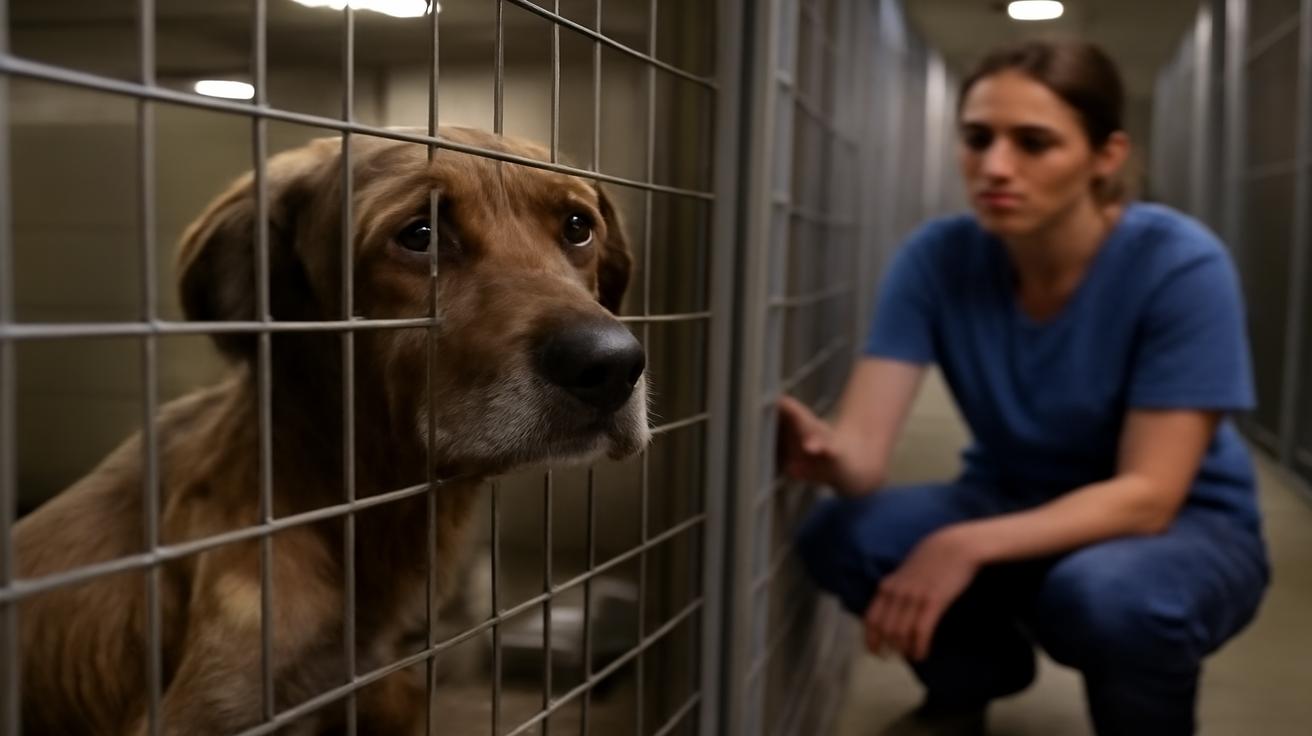
The dog’s name, at least on the paperwork, was Brady. In the kennel he answered to other things—“Buddy,” “Big Man,” “Sweet Potato”—depending on which staff member was on cleaning duty. But the name that made his whole body vibrate, from nose to tail, was the one whispered by the young woman with the tired eyes the day she brought him in: “I’ll be right back, baby.”
The Day of the Promise
On the morning Brady arrived, the shelter smelled of damp concrete and bleach, the familiar wet-towel scent of a place that tries very hard to be cleaner than the world that delivers animals to its door. It was late autumn, the kind of cold that leaves a metallic taste in the air and turns every exhale into a small, private cloud.
The couple stood at the front desk, silhouetted against the glass doors. The woman’s coat was too thin for the weather; the man held the leash, knuckles white. Brady, a blocky-headed tan mix with a white lightning-strike on his chest, leaned his weight toward the exit every few seconds, as if some invisible current pulled him back toward the parking lot.
“It’s just temporary,” the man said, more to himself than to the volunteer behind the counter. “We got evicted. New place doesn’t take dogs. But the landlord said maybe, if we can show he’s fixed and, you know, trained and all that. Two weeks, tops. We’ll be back.”
The woman nodded hard, eyes shining. She kept dropping her hand to Brady’s head, fingertips tracing the same groove between his ears. Everything about her—her voice, her posture, the way she bent at the waist to press her forehead to his—said this parting was a logistical problem, not an ending. The staff had seen the other kind too, the brisk drop-offs, the over-explained excuses. This was not that. This hurt.
“We’ll put a note on his file,” said Lena, the intake coordinator. “Owner intends to reclaim. Just call us with updates, okay? We’ll hold him as long as we safely can.”
Brady’s tags clinked as the leash changed hands. It was such a small sound, but it cut right through the thrum of barking from the back. The woman kissed his muzzle. “Two weeks, Brady. I promise. We’re coming back for you.”
They left in a rush, as if staying even one minute longer would make it impossible to go at all. Brady planted his paws, watching the door after it clicked shut. Somewhere outside, a car door slammed. An engine turned over. He didn’t move until the sound faded completely.
Life in the In-Between
The first night in the shelter is always the loudest. Brady was no exception. When lights-out came and the row of kennels sank into a low, restless hush, he barked—a frantic, high note that bounced off the cinder block and steel. Some dogs settle after a while; they fold their worry under their paws and sleep. Brady paced. The stainless-steel bowls clattered every time he turned too sharply.
Lena came in early the next morning with coffee and the thin, papery light of sunrise behind her. The building was cool and shadowy, the way it always is before the dryers and dishwashers roar to life. Brady’s kennel was second from the end on the left, across from a senior beagle who slept so deeply he snored through the chaos.
“Hey, Big Man,” she murmured, sliding a treat through the bars. He ate it so delicately, as if he thought crumbs on the concrete might be held against him later.
On his intake sheet, she’d written: “Friendly, seems house-trained, good with handling. Strong bond with owner. Owner intends to reclaim.” In the corner of the page, she’d added a tiny asterisk—her own quiet code for:
This one might keep you up at night.
The shelter ran on routines. Morning cleaning: hose, scrub, squeegee. Breakfast: measured scoops, a rattle of kibble like rain on tin. Then walks, as many as the volunteers could manage between phone calls and paperwork and the slow, sad conveyor belt of new arrivals.
In that assembly line of need, Brady carved out a special place. He knew the sound of Lena’s boots before she turned the corner. He learned the jangle of keys meant either food or fresh air. He began to sit, unprompted, when anyone lingered within leash distance, his whole body coiled around one simple question: “Are you here for me?”
The first week, the staff talked about his people in the present tense.
“Did they call yet?” asked Miguel, the kennel tech, rinsing soap from a plastic bed.
“Not yet,” said Lena. “Give it time. Moving is a mess.”
“They seemed like they really loved him,” offered Jess, a volunteer, as she folded a stack of donated blankets. “They’ll be back.”
They said it out loud for Brady, really, as if he could hear the faith in their voices and use it to hold his world together a little longer.
The Waiting That Changes Shape
By the second week, Brady had memorized the rhythms of the place. He knew when the mail truck rattled past the back fence, when the afternoon sun would stretch a warm bar of light across the far corner of his kennel, when the staff would start locking doors and counting heads for the night.
What he didn’t know: why the door he watched most—the one at the end of the hallway that led back to the front lobby—never opened for him.
Every time the lobby chime pinged, a bright electronic note, the sound threaded through the building. Dogs who’d learned that noise meant visitors leapt up, nails skittering on plastic floors. Brady was always first.
He’d stand tall, ears forward, eyes locked on the hallway. Somewhere out there, a conversation would rise and fall. Sometimes a laugh, sometimes that careful, soothing tone people use when they’re trying to make something hard sound simple.
Footsteps would echo. A staff member would appear, maybe with a leash, maybe just with another armful of supplies. She’d pass his kennel with an apologetic smile. “Not yet, buddy,” she’d whisper.
The calendar by the break room coffee maker bloomed with colored notes: vaccine reminders, surgery dates, adoption events. Next to Brady’s name, Lena had written a hopeful bracket of days: “Hold for owner—reclaim expected.” The end of the bracket slid forward a little each time she changed the page.
At first, the promise the couple had made felt like something solid, an anchor. Two weeks, they’d said. Maybe three. People get delayed. Life snarls. But time has a way of hollowing certainty. By the fourth week, that promise felt more like an echo than a plan.
Behind the Scenes of “We’ll Be Back”
The shelter staff knew the patterns. They’d seen the spectrum of “We’ll be back” cases: the ones who returned within days, tearful and sheepish, clutching new leases or vet receipts; the ones who called, again and again, fighting impossible odds for more time; and the ones who left a phone number that dissolved when you dialed it, disconnected or full mailbox or a stranger on the other end saying, “You’ve got the wrong person.”
Still, each dog was an individual story, not a statistic, especially to the people who fed and walked and soothed them. The staff didn’t get to keep their hearts in storage just because the outcomes were often the same.
One rain-heavy Tuesday, with thunder muttering over the low roofs of the industrial park, the shelter director called a staff meeting. They gathered in the break room, the air thick with the smell of microwaved leftovers and wet fur.
“We need to talk about Brady,” she said, sliding into the chair at the head of the table. “It’s been six weeks. No call back. Phone number on file goes straight to voicemail.”
Lena stared at the rim of her coffee cup. “He’s not like the others,” she said quietly. “They didn’t want to let him go. This was supposed to be a pause button, not a stop.”
“I know,” the director said. “But we’re running out of kennel space. We have dogs backed up on the waitlist. We either move him to the adoption floor officially, or…” She didn’t finish the sentence. She didn’t have to. The unspoken alternative hung in the air: transfer to a different facility, behavioral evaluation with an eye on risk, hard choices when space and resources hit their limit.
They talked through options. Could they foster him out temporarily? Could they feature him in the next social media post? Could they, somehow, do right by both the dog and the people who might still be trying to get their lives together?
In the end, they circled back to the same place: Brady needed a plan that didn’t depend on someone who hadn’t walked through the door in a month and a half.
Quietly, tenderly, they moved his file from “Owner Reclaim Hold” to “Available for Adoption.” A new photo was taken—Brady in the patch of sunlight at the far end of the play yard, ears perked, a neon tennis ball between his paws.
The caption Lena wrote for the shelter’s website tried to balance hope and honesty: “Brady is a loyal, affectionate dog who’s been patiently waiting for his people to come back. Life had other plans, so now he’s looking for a new forever home.”
The Call No One Wanted to Make
It was almost two months to the day since Brady’s intake when the phone rang on a slow Thursday afternoon. The lobby hummed with the low chatter of a couple filling out adoption paperwork for a pair of bonded cats. The rain had finally broken; fat drops streaked the front windows, turning the parking lot into a blurred watercolor.
“County Housing Assistance,” said the voice on the line when Lena answered. “We’re calling about two former tenants, a Daniel Harper and a Renee Flores. Our case records indicate they listed your shelter as a contact regarding a dog, Brady?”
Lena’s heart gave a small, sharp kick. She glanced toward the hallway, where Brady was likely dozing, nose tucked under his tail. “Yes,” she said. “They brought him in. We’ve been hoping to hear from them.”
There was a pause on the line, the kind that contains more than static.
“I’m…sorry,” the caller said slowly. “I’m afraid I don’t have good news. They were part of a relocation program after an apartment building fire about six weeks ago. There was a gas leak. The explosion was severe.” Another pause. “Both of them were among the fatalities.”
The room seemed to tilt. The buzz of the lobby blurred into a distant hum. Lena’s free hand tightened around the edge of the desk, fingertips pressing into the worn laminate.
“Are you certain?” she managed.
“Yes. We were going through their files to make sure all their community contacts were informed. Your shelter’s number was circled. There’s a note here: ‘Dog at shelter—Brady. Call when settled.’”
Something hot and bright pricked behind Lena’s eyes. That small circle of ink on a piece of paper, in some gray filing cabinet miles away, felt like a message in a bottle that had washed ashore too late.
“Thank you for letting us know,” she said, voice thin. “We have Brady. He’s safe.”
She hung up and sat there for a moment, the phone still in her hand, listening to her own uneven breathing. Then she walked down the hallway, each step heavier than the last.
Crushing News in a Kennel Row
Brady lifted his head when she appeared. He knew the sound of her footsteps, the soft swish of her jacket, the particular way she said his name.
“Hey, Brady,” she whispered, sinking to a crouch outside his kennel. He came forward at once, tail wagging, chest pressed to the bars. Up close, she could see the silver starting at the edge of his muzzle, the way his eyes softened when he made eye contact, as if he were trying to read the air around her.
How do you explain to a dog that the people he’s been waiting for aren’t just late—they’re gone?
Of course, you don’t. You can’t. The news lands differently in a human heart than in a canine one. For Brady, everything important still boiled down to the concrete things: the touch of a hand, the opening of a door, the presence or absence of the bodies he loved.
But for the staff—for Lena, for Miguel, for the director who had to balance budgets with broken hearts—the revelation was a blow that rearranged the story they’d been telling themselves. The couple at the desk that cold morning hadn’t just disappeared, careless or indifferent. They had been trying. Life, in its worst way, had cut the thread.
That night, after the last adopter left and the shelter doors locked with their familiar hollow clack, the staff gathered again in the break room. No one microwaved anything this time. The air felt too fragile for the aggressive cheerfulness of reheated leftovers.
“They died,” Lena said simply. “They were going to call us. They never got the chance.”
Silence settled like dust.
“So all this time…” Miguel began, then trailed off. He’d been the one to whisper “Tomorrow, buddy” to Brady on nights when the dog’s anxiety flared. He’d pictured the couple somewhere in a cluttered apartment, arguing with landlords, scraping together deposits, eventually walking back through the shelter doors, triumphant and teary.
“All this time,” the director finished, “Brady was already an orphan, and none of us knew.”
What It Means to Stay
The next morning, the sun broke clear and hard over the low buildings, turning every puddle in the parking lot into a small, blinding mirror. Brady went out to the play yard as usual, nails clicking on the concrete, nose flaring at the cold air.
Lena watched him for a long moment through the chain-link fence. He did what dogs do: shook out his coat, chased a ball, paused to breathe in the invisible stories carried on the wind. The news that had flattened the humans in the building hadn’t rearranged his world in the same way, not yet. His waiting had always been based on a simple, durable algorithm: The people I love are gone. They come back. Until they do, I will hold this space.
But now the staff’s job had changed. They were no longer custodians of an in-between moment, holding a place for a future that might yet arrive. They were, very suddenly, the ones who knew the ending of a chapter Brady didn’t even realize he was in.
“We owe him more than just a kennel,” the director said later that day, looking over his file. “We owe him a life that’s not defined by the waiting.”
They updated his profile, quietly. The line about his owners coming back was removed. In its place, they wrote: “Brady has known love and loss, and he’s ready for a new beginning with someone who won’t let him down.”
The Weight of a Promise
In the world of animal shelters, stories like Brady’s thread through the daily churn of intake and adoption. Each one leaves a trace: a note in a file, a photo pinned to a corkboard, a dog bed donated “in memory of.” Some tales resolve neatly; many don’t. The staff learn to live in the space between what they can control and what they can’t.
But every so often, a case crystallizes something larger, a kind of quiet moral: promises to animals are never made in a vacuum. They’re tethered to the fragile, unpredictable business of being human.
For Brady’s people, the vow—“We’ll be back for you”—wasn’t a lie, or a careless phrase tossed off in a moment of guilt. It was a plan, a line of intention scratched into the future. Circled phone numbers. Notes in case files. Maybe, somewhere in the debris of that apartment building, there were dog toys and empty food bowls that still smelled faintly of him.
For the shelter, their promise became a question they had to answer: How long do we hold space for people who might never walk back through the door? At what point does waiting for a past become unfair to a dog’s future?
There are no neat formulas for that calculus. Each decision is a blend of policy and instinct, compassion and constraint. The staff carry the outcomes with them—on late-night shifts, in the quiet moments after lights-out, in the way they look a new owner in the eye and say, “Are you sure you’re ready for this?”
Brady, in his own way, carried something too: the ghost of a home he’d lost without understanding why, and the capacity, still miraculously intact, to trust again.
A Table of One Dog’s Journey
For those who move between the human narrative and the animal’s day-to-day reality, it can help to see a story like Brady’s as a series of concrete stages. Each one demands something different from the people around him.
| Stage | What Brady Experienced | What the Staff Faced |
|---|---|---|
| Intake & Promise | Confusion, separation from familiar people, first night stress. | Balancing empathy with procedure; deciding how long to hold. |
| Early Waiting | High alert for familiar voices and scents whenever doors opened. | Maintaining hope, managing limited space, fielding new intakes. |
| Extended Stay | Adjusting to routines, stress simmering beneath learned behaviors. | Deciding when to move from “reclaim hold” to “available.” |
| Crushing News | Unaware of the loss, still focused on daily interactions. | Grieving the owners, reframing Brady’s story, emotional fatigue. |
| New Beginning | Potential for a new bond, carrying old attachments into new life. | Finding the right adopter, honoring the past while building a future. |
Somewhere beyond the timeframe of this story, Brady’s path bends again. Maybe it’s the couple who came “just to look” and left with a leash in hand and dog hair already clinging to their sleeves. Maybe it’s the quiet man who recently lost his own aging dog and finds, in Brady’s steady gaze, a reason to rearrange his furniture and his days.
Whoever they are, they won’t know the full history at first—the circled phone number, the apartment fire, the promise that never found its way back to the shelter doors. They’ll know only the dog in front of them: the way he leans his weight against their leg as if to say, “I choose you,” the soft huff he makes as he settles into a new bed that will, soon, smell like home.
And in that living room, on some ordinary evening when the world outside is its usual, unruly self, a small, quiet redemption will unfold. Not because it erases what came before, but because it answers it with something steady and real: a promise kept, this time, simply by staying.
Frequently Asked Questions
Do dogs really wait for their previous owners?
Many dogs show clear signs of waiting behavior after being surrendered or separated from their families. They may focus intensely on doors, react strongly to familiar sounds like car keys or certain voices, or become excited whenever someone passes their kennel. While we can’t know exactly what they’re thinking, their behavior often suggests they’re expecting a familiar person to return.
How long will a shelter hold a dog for an owner to reclaim?
Reclaim hold times vary by location and shelter policy. Municipal shelters may hold strays only a few days by law, while private rescues often have more flexibility. In owner-surrender situations with a clear plan, shelters sometimes extend holds when space allows, but they must also consider overall capacity and the needs of other animals.
What should someone do if they must temporarily give up their dog?
If separation is truly temporary, it’s best to:
- Be completely honest with the shelter or rescue about your situation and timeline.
- Provide multiple, updated contact numbers and backup contacts.
- Stay in regular touch so the shelter knows you’re still working toward reclaiming.
- Explore foster options with trusted friends or family if possible.
Why can’t shelters keep every dog indefinitely “just in case” an owner returns?
Shelters operate with limited space, staff, and budgets. Holding one dog indefinitely may mean turning others away or increasing stress and illness in overcrowded conditions. Staff must balance compassion for individual animals with responsibility for all the animals in their care, which sometimes means moving a dog forward into adoption rather than continuing to wait.
How can someone help dogs like Brady without adopting?
There are many ways to support dogs in similar situations:
- Volunteer to walk, socialize, or foster shelter dogs.
- Donate money, supplies, or services to local shelters and rescues.
- Share adoptable animals’ profiles on social media to help them find homes.
- Advocate for pet-friendly housing and policies that keep families and animals together.
Even small actions can change the trajectory of a dog’s story from endless waiting to a real, lasting home.


Leave a Comment