
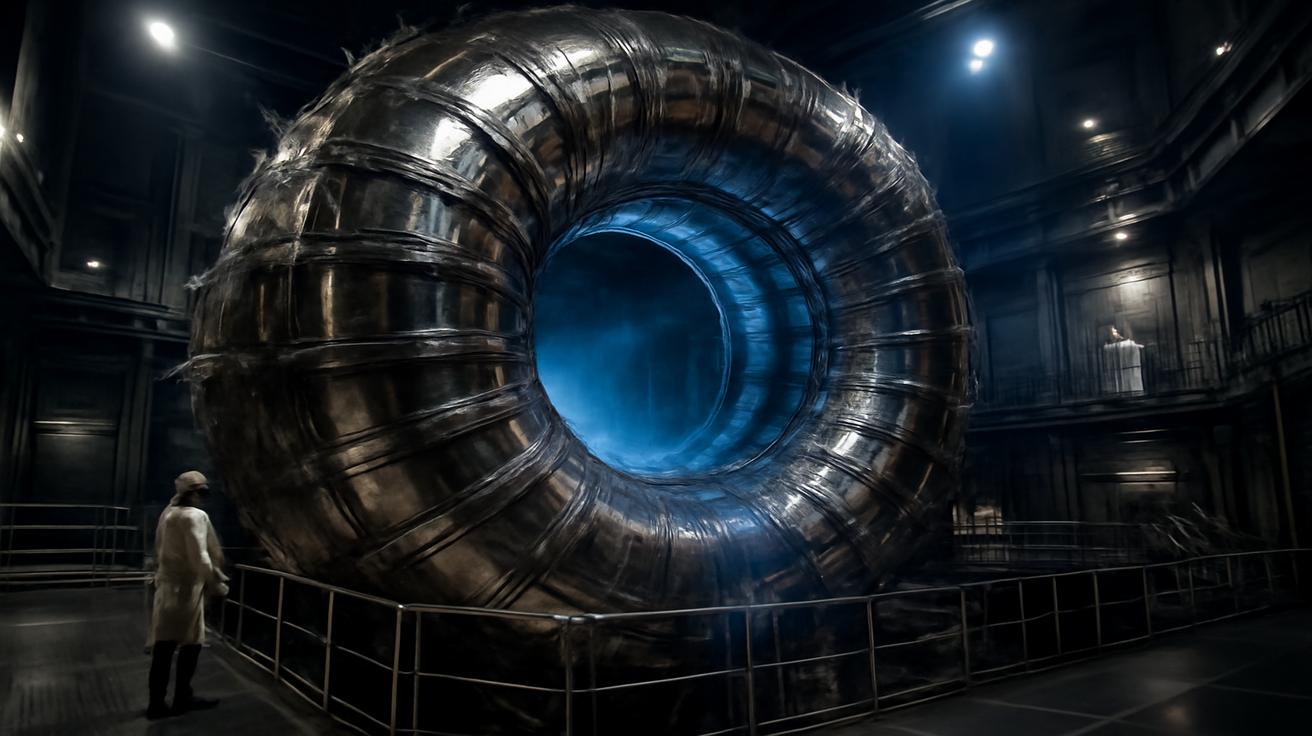
The first thing you notice is the silence. For something capable of hoisting an aircraft carrier out of the ocean, you expect a roar, a hum, a metallic shriek. Instead, there’s only the soft exhale of cooling systems and the muffled footsteps of engineers moving carefully across the polished floor. Somewhere beneath your feet, hidden inside a vast ring of steel and cable in southern France, the world’s most powerful magnet is quietly waiting. Not to pull warships from the sea, but to pull humanity a little closer to a future where energy is as abundant as sunlight and as clean as mountain air.
A magnet the size of a miracle
It lives in a building that feels part cathedral, part spaceship hangar. High ceilings, rows of control panels, thick concrete walls that look as if they could shrug off a meteor strike. The magnet is the heart of this place: a colossal coil of carefully engineered metals and superconducting materials, chilled to temperatures colder than deep space so that electricity can flow through it with almost no resistance.
“Imagine,” one engineer says, resting a hand on a steel railing as if bracing against the weight of the idea, “that you could lift an aircraft carrier as easily as a toy.” It’s not exactly how the magnet is tested—no one is bringing in a 100,000-ton warship to dangle from it—but the numbers work out. The sheer force produced by its magnetic field is beyond everyday intuition, measured not in the tiny magnets that hold grocery lists to refrigerators, but in units that sound more like science fiction: tens of teslas, enough to pull on matter in a way that borders on the surreal.
Yet the true power of this giant isn’t in brute strength; it’s in precision. This magnet has one job: to tame the wild heart of a star.
Understanding the invisible force
Strip away the mystique, and a magnet is simply a way of telling charged particles where to go. Electrons, ions, the charged fragments of atoms—they all feel a gentle nudge when they pass through a magnetic field. The stronger the field, the more stern that nudge becomes, until particles that would normally race outward in straight lines begin to spiral, twist, and follow invisible paths in space.
On your fridge, that field is tiny but enough to keep paper notes from sliding to the floor. In a hospital MRI machine, powerful magnets tens of thousands of times stronger than Earth’s magnetic field peer through flesh and bone. Here in France, at the cutting edge of fusion research, the magnets are far stronger still—so strong they can shape plasma at temperatures hotter than the center of the sun. Without them, the whole dream of fusion energy would collapse the moment it began.
That’s why this magnet matters. It isn’t a party trick. It’s a tool for holding the hottest substance humans have ever created, without letting it touch anything at all.
| Magnetic System | Approx. Field Strength | Everyday Comparison |
|---|---|---|
| Fridge Magnet | 0.005–0.01 T | Holds a note on your refrigerator |
| Earth’s Magnetic Field | 0.00003–0.00006 T | Guides compasses, shields from solar wind |
| Medical MRI Scanner | 1.5–3 T | Detailed images of the human body |
| Large Fusion Magnet in France | Tens of T (local fields) | Strong enough, in principle, to lift an aircraft carrier |
France, fusion, and a bet on the future
Drive through the countryside of southern France and the landscape gives little hint that a future energy revolution is being quietly assembled nearby. Vineyards roll across the hills; lavender fields wash the air with purple and perfume; small stone villages glow honey-colored at dusk. Then, suddenly, you reach a cluster of monumental buildings, cranes arcing overhead, and roads filled with oversized transport vehicles carrying components that look more like art installations than machine parts.
This is one of the centers of global fusion research, a place where thousands of scientists, engineers, and technicians from around the world have converged to do something humanity has never done before: build a machine that can trap and harness a sustained star-like fire on Earth.
At the heart of this ambition are magnets—huge, precisely engineered loops of metal and superconducting cable, each one shaped and positioned so that, together, they form a kind of magnetic bottle. Inside that bottle, light atomic nuclei—usually isotopes of hydrogen—are heated until they become plasma, a seething, electrically charged gas. Under the right conditions, those nuclei fuse, releasing vast amounts of energy.
The concept is simple to say and almost impossibly difficult to execute. Materials strain under stress. Temperatures soar beyond anything metals were ever meant to endure. Tiny instabilities in the plasma can ripple into huge disruptions. But if it works, the prize is staggering: clean, virtually limitless energy produced without greenhouse gases, without long-lived radioactive waste, and without the risk of runaway chain reactions.
Why such a powerful magnet is needed
To understand why the magnet here is so powerful, it helps to picture what it’s up against. Inside a fusion device, the plasma is not just hot; it’s unimaginably hot—tens of millions of degrees, hot enough to strip electrons from atoms and set them whirling at tremendous speeds. No physical container can touch that. Any solid wall would vaporize long before you got close.
So instead, researchers use magnetic fields to create an invisible cage. The charged particles in the plasma follow the curves of the magnetic field lines, looping around and around, confined away from the walls. The stronger and more finely shaped the magnetic field, the better the confinement. Better confinement means longer-lasting plasmas, more fusion reactions, and eventually a device that produces more energy than it consumes.
The magnet in France isn’t just brawny. It’s exquisitely sculpted. Its coils must be aligned to within tiny fractions of a millimeter. Temperatures inside its superconducting cables must be kept only a few degrees above absolute zero. The forces acting on the coils when they are energized are colossal—like trying to hold several fully loaded passenger jets together with perfect stillness and no room for error.
Engineers talk about these forces with a mixture of pride and tension. A powerful magnet is not a gentle thing. If something goes wrong, the energy stored in its field can unravel in an instant. Every bolt, support, and weld is part of a quiet, continuous negotiation with that invisible power.
From aircraft carriers to kitchen lights
So what does lifting an aircraft carrier have to do with you flipping on a kitchen light thirty years from now? The connection is surprisingly direct. The magnet’s ability to control extreme forces in a controlled space is a rehearsal for controlling the most extreme energy source we know how to access: fusion.
Think about a single fusion plant humming away somewhere on the coast. Instead of long trains of coal, or tankers of liquefied gas, or vast fields of spinning turbines and mirrored dishes, you have a compact complex pulsing with invisible fire. Inside, magnets like the one in France shape plasma into a doughnut of star-stuff, held aloft in a magnetic halo. Every second, countless atomic nuclei merge, releasing energy that becomes steam, then electricity—flowing quietly into the grid and out to homes, schools, hospitals, and late-night cafés.
That electricity wouldn’t care if the wind is blowing or the sky is clear. It wouldn’t depend on season, or daylight, or geopolitics. A fusion plant could, in principle, run day and night with a tiny amount of fuel derived from water and lithium, materials we have in enormous abundance. Humanity’s energy anxiety—the fear that there will not be enough, that the cost will be too high, that the climate bill will come due with unpayable interest—would begin to ease.
But before that future hums into being, the magnets have to prove they can do their part. They must show they can shape and steady the plasma long enough, reliably enough, to make fusion viable not just in principle, but in practice.
The human side of a superhuman machine
Walk through the control rooms and workshops around the magnet hall, and the story shifts from raw physics to people. On one screen, intricate simulations pulse in false-color blues and reds, showing how magnetic fields twist within the fusion chamber. On another, temperature readings scroll like silent rain down the monitor. In a nearby office, a team debates an obscure mechanical detail—how a particular joint will flex after thousands of magnet cycles, what kind of vibration sensors should be embedded in the structure.
Many of the people here have devoted their entire careers to a machine that will not reach full operation for years. They measure time not in news cycles but in experimental campaigns, upgrades, and international milestones. For some, retirement will come before fusion power ever supplies a single home. They work anyway, because building something that might change the trajectory of civilization is, in its own way, enough.
They swap stories about the first time they stepped into the cavernous hall where the magnet sits, the surreal impression of standing next to a device designed to grapple with forces that mostly exist in stars and nebulas. They laugh about minor disasters—crates arriving upside down, bolts ordered in the wrong unit system. On the walls, there are often photos from earlier milestones: the day the first colossal coil arrived by truck, nearly brushing village rooftops as it crept through; the moment the final segment of a magnet was lowered into place, inches at a time, as dozens of eyes tracked its position.
For outside observers, the headline is the magnet’s strength. For those who live with it daily, the real story is its subtlety: getting it to hold exactly the right field, at exactly the right moment, while everything inside and around it strains not to fall apart.
Why this matters beyond science
It’s tempting to think of a magnet this powerful as a scientific stunt—something built simply because we can, a monument to human cleverness. But its purpose is relentlessly practical. Around the world, energy demand is rising, just as the consequences of burning fossil fuels grow harder to ignore. Glaciers shrink. Seas creep higher. Weather grows stranger, harsher. The need for clean, dependable energy is not an abstract future problem; it’s a pressure point in the present.
Solar panels and wind turbines have raced ahead, becoming cheaper and more widespread each year. Batteries are improving. Grids are getting smarter. But many energy experts suspect that, in the long run, we will need something more: a dense, controllable, always-available source of clean power that can provide the backbone of global energy supply. Fusion is one of the very few candidates that could fill that role. If it works.
The magnet in France is, in many ways, a down payment on that possibility. It’s a prototype for the kinds of magnetic systems that future commercial fusion plants will rely on. Every bolt tightened, every simulation validated, every tiny sensor reading logged is a step toward turning fusion from a promise into a product—something a city planner, a utility manager, or a farmer can rely on without thinking about tokamaks or plasma instabilities or superconducting cable.
There is a quiet optimism that comes from standing near this machine. Not because success is guaranteed—it is not—but because humans have chosen to attempt something so wildly ambitious, and to do it together, across borders and languages and cultures. In a century often defined by division and short-term thinking, building a magnet big enough to hold a star in place for the sake of clean energy feels like a different sort of statement.
Listening to the future in the hum of a coil
If you linger long enough in the hall where the magnet lives, you begin to notice details that weren’t obvious at first. The braiding of cables as thick as your wrist. The way light from high windows glints off curved metal surfaces, tracing the path of invisible forces. The faint, ever-present whisper of cooling systems keeping miles of superconducting wire just barely above absolute zero.
Somewhere in that quiet, it’s possible to imagine the future this machine is reaching for. A world where switching on the lights does not carry with it an invisible cost to the atmosphere. Where powering a factory or a hospital does not require a trade-off with a distant coastline or a disappearing ice sheet. Where the phrase “energy poverty” slowly exits the vocabulary because power is no longer the bottleneck that keeps communities in the dark.
Of course, fusion alone cannot solve all the world’s problems. No magnet, however powerful, can bend human politics or erase inequality. But tools matter. The technologies we build determine the options we have. A world with proven, practical fusion energy is a different world than one without it. The magnet in France is a piece of that difference, a vast metal circle that asks, in its own silent language: What if our energy came from something as abundant as the stars?
Outside, the sun sets in streaks of orange and violet over the French countryside. Vine rows darken. Wind ruffles the edges of a distant pond. Somewhere inside the concrete shell behind you, the most powerful magnet on Earth is still and cold, waiting for its next pulse, its next chance to hold a piece of starfire steady. The air smells of cut grass and faint machine oil. For a moment, the whole scene feels like a bridge—between the ancient warmth of the sun and a new, human-made way to call that warmth down to Earth.
Frequently Asked Questions
Why is the world’s most powerful magnet in France?
France hosts one of the largest international fusion research efforts, making it a natural home for ultra-powerful magnets. The location provides stable infrastructure, strong scientific institutions, and political support for a decades-long project focused on future energy security.
Can this magnet really lift an aircraft carrier?
In practical terms, no one is going to hoist a warship with it. The comparison is a way to express the sheer power of the magnetic field. The forces it can generate, if applied in the right way, are on the same order as those needed to lift an object as massive as an aircraft carrier.
What is the magnet actually used for?
Its main role is to confine and control ultra-hot plasma in fusion experiments. By shaping powerful magnetic fields, it keeps charged particles away from the walls of the fusion device, allowing scientists to study and eventually harness fusion energy safely and efficiently.
Is fusion energy safe?
Fusion does not carry the same risks as traditional nuclear fission. There is no chain reaction, the fuel is extremely limited inside the vessel, and any disturbance tends to shut the reaction down rather than accelerate it. While there are engineering and material challenges, the inherent physics of fusion are comparatively safe.
When will fusion power start supplying electricity to homes?
Timelines are uncertain, but many experts hope that demonstration fusion power plants could appear in the coming decades, with broader deployment later in the century. The magnet in France is part of the groundwork needed to turn that hope into a realistic engineering pathway.







Leave a Comment