
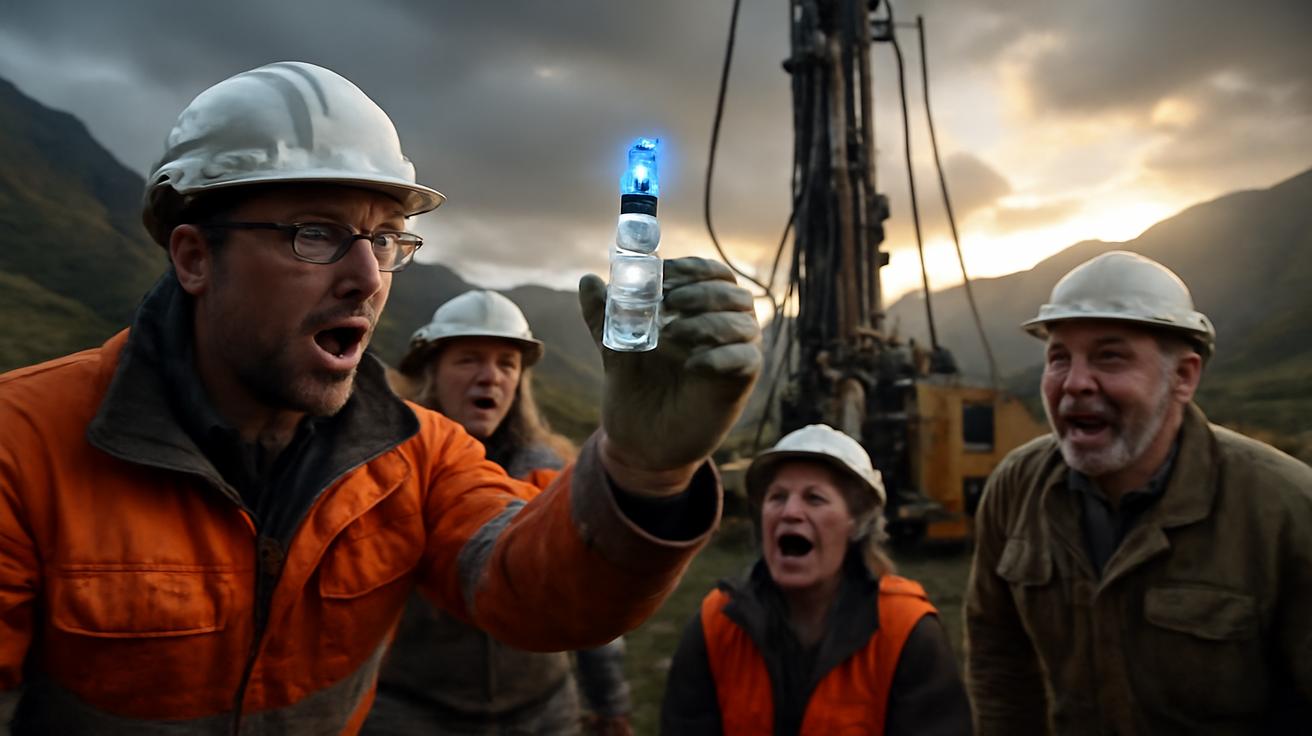
The morning the ground in northeastern France quietly rewrote the future of energy, nothing looked different. Frost clung to the hedgerows. A pale sun tried to burn its way through the low clouds. In the village of Folschviller, life moved with the same unhurried rhythm it had for decades—coffee cups clinking in small kitchens, buses sighing at stops, tractors edging along narrow roads. No one could have guessed that, a few hundred meters below their feet, a discovery was about to shake up the global race for clean power.
Whispers from an Old Coal Country
The story begins in a place that, on paper, should have been finished with energy. This corner of Lorraine is coal country—spent and scarred. Mines once tunneled deep under the fields and forests here, swallowing men in the dark and exhaling power and steel and smoke. When the last shafts closed, they left behind a familiar modern relic: unemployment lines, shuttered canteens, grass slowly reclaiming slag heaps. The energy era had passed, people said. The future lay in cities and solar farms, offshore wind and distant data centers.
But geology does not follow human timelines. It moves at its own pace, writing secrets into layers of rock that wait, patient and silent, for curious minds. What drew scientists back to Lorraine was not coal nostalgia, but an odd, persistent puzzle: strange emissions in old boreholes, unexpected gas signatures, whispers of something unusual in the subsurface.
It started as a research project, almost routine. A team of geologists and geochemists set up in this familiar but overlooked landscape, drilling not for treasure, but for understanding. They combed through dusty mine plans, pored over seismic lines, and read the rock like a biography written in stone. On paper, the rocks seemed ordinary—old, fractured, water-bearing. The kind you might expect to shelve and forget.
Then came the samples.
The Moment the Data Changed
In labs far from Lorraine’s misty fields, the numbers crept in—calm, black, unassuming. One sample, then another, then a pattern. Hydrogen, again and again, in concentrations that refused to be written off as lab error or background noise. The scientists checked their instruments, recalibrated, sampled again. This was not a trick of contamination. The gas was real, and it was abundant.
Hydrogen isn’t rare in itself. It is, after all, the most common element in the universe. But free, naturally occurring hydrogen underground—what researchers now call “white hydrogen,” to distinguish it from hydrogen produced industrially—is another matter entirely. Until recently, most people assumed it simply did not exist in usable quantities. Hydrogen, we were told, needed to be made: from natural gas (“grey”), from gas with carbon capture (“blue”), or from water using renewable electricity (“green”).
Nature, meanwhile, had been quietly making its own.
The samples from Lorraine told a startling story: the subsurface here was suffused with hydrogen, chemically generated by reactions in ancient rocks, potentially replenishing itself over time. The more the team drilled and measured, the less dismissible it became. The numbers pointed to something that quickly escaped the language of laboratories and spilled into headlines: “The world’s largest deposit.”
A New Color in the Energy Rainbow
“White hydrogen” sounds like a branding gimmick until you trace its consequences on the ground. Unlike green hydrogen, which demands vast fields of solar panels or wind turbines and industrial electrolyzers, white hydrogen forms naturally—born from the slow friction between rock, water, heat, and time. In places like Lorraine, iron-rich rocks deep in the crust react with water molecules, stripping away oxygen and releasing hydrogen gas. Trapped in porous geological layers, it can gather in concentrations—if the caprock above is tight enough—like pockets of natural gas.
Geologically, Lorraine is an unlikely kind of miracle: part graveyard of the fossil-fuel age, part cradle of something that might replace it. Old coal basins here overlie the crystalline basement of the Earth’s crust, cut by fractures and warmed modestly by geothermal heat. Through those breaks, water seeps downward, whispers with minerals, and surfaces again—bearing not just salts and heat, but hydrogen.
To stand in a field above these forces is to feel a subtle vertigo. On the surface, the wind shoves damp air through beech trees. Tractors trace their rectangles. Dogs bark. Underground, in the slow dark, entirely different stories are unfolding: molecules rearranging, reactions ticking away year after year, small accumulations becoming something large enough to notice—if, and only if, someone looks closely enough.
How Big Is “Millions of Tonnes”?
“Millions of tonnes” is a slippery phrase. It sounds bulky, but how does it translate to the world we know—the buses, factories, data centers, steel mills that hunger for energy?
Imagine, for a moment, that a sizeable portion of this white hydrogen could be accessed reliably. Hydrogen is an energy carrier, not a fuel you burn in a fireplace, but in practical terms, a few million tonnes of it is the equivalent of many years’ worth of industrial consumption for a mid-sized country. It could power heavy trucks and trains, feed chemical plants, balance power grids on still, sunless days. And because hydrogen emits only water when used in fuel cells, it dangles the promise of energy without carbon’s lingering ghost.
In France’s case, the comparison is startling. The country is accustomed to seeing energy through the blue-and-white glow of nuclear reactors. Hydrogen barely figures in the national imagination—yet. But a domestic, potentially long-lived resource beneath its own soil forces a new question: what if some of the clean energy needed for the transition is not just offshore or imported, but literally waiting in the basement?
| Energy Source | Carbon Emissions at Use | How It’s Produced |
|---|---|---|
| Grey Hydrogen | High (from fossil fuels) | Reforming natural gas without capturing CO₂ |
| Green Hydrogen | Very low (if powered by renewables) | Electrolysis of water using renewable electricity |
| White Hydrogen | Very low (mostly water at point of use) | Formed naturally underground by geological processes |
Listening to the Earth, Differently
For the scientists working in Lorraine, the discovery feels less like a jackpot and more like a language lesson. The Earth has been speaking in hydrogen for a long time; we simply weren’t listening. For decades, hydrogen detected in boreholes was often treated as an annoyance—just another gas to log and move past on the way to finding oil, gas, or minerals. Only in the last few years has the global scientific community begun to reframe it as something else: a primary target.
Tiny clues were always there. In Mali, a strange, persistent gas leak that villagers once set alight turned out to be nearly pure hydrogen. In the United States, old wells occasionally burped unexpected H₂. In Eastern Europe, faint flows seeped up along faults. They were curiosities, recorded in technical papers, presented at small conferences, then filed away.
Lorraine’s “shock discovery” doesn’t come out of nowhere; it arrives as the first loud chord in a song geologists are just learning to hear. The region, with its rich mining history and detailed geological records, provides a kind of Rosetta stone for decoding hydrogen’s underground behavior. How does it migrate? Where does it accumulate? Which rocks act as kitchens, and which as reservoirs? Every core sample, every gas reading is a new noun, a new verb in this emerging grammar of natural hydrogen.
And the language matters, because finding hydrogen is one thing; understanding whether you can extract it consistently, safely, and economically is another. Nature is generous, but not always convenient.
Between Wonder and Caution
It is tempting to cast Lorraine as a simple redemption story: a mining region that once fueled the Industrial Revolution now reborn as a cradle of clean energy. There is a satisfying symmetry in the idea—a region long associated with smoke and soot rising as a symbol of decarbonization. In the cafes of nearby towns, it is easy to overhear a quiet, careful hope: more jobs, perhaps; pride, certainly; the possibility that the world might speak of Lorraine as something other than a footnote in coal’s long goodbye.
But beneath the optimism runs a current of caution, and rightly so. The scars of the last energy boom remain visible on the landscape: subsidence cracks, acidified streams, communities that rode the rollercoaster of boom and bust. Locals who watched smokestacks rise and fall once already know how promises can sour when markets shift or resources deplete.
This time, the questions arrive earlier: How will hydrogen be extracted? Will it require drilling on farmland, under villages, through cherished forests? What noise, what traffic, what risks of contamination might come with it? How stable are the reservoirs? If the hydrogen is replenishing, how quickly does it refill, and can we harvest it without disrupting other subterranean systems—from groundwater to microseismic activity?
In village halls and regional council meetings, the conversation is beginning to turn not just on the scale of the deposit, but on the rules that will govern its future. Permits, environmental impact assessments, strict monitoring—all of these sound dry on paper, but to the people who live here, they are the difference between a respectful partnership with the land and yet another extractive raid.
An Old Industry Meets a New Element
Curiously, the skill set needed to pursue white hydrogen is not new at all. It lives in the muscle memory of people who once tracked oil and gas: geophysicists reading echoes from the deep, drillers who can steer bit by bit through rock, engineers who can coax fragile gases out of tiny fractures and up to the surface without blowing the whole mess skyward.
In Lorraine, some of those people never left. Their children and grandchildren watched them carry home hard hats and hang up boots thick with dust. Now, they find their experience cautiously courted again. Hydrogen extraction uses many of the same techniques as hydrocarbons, but with crucial differences: safety standards tuned to a smaller, lighter molecule; infrastructure adapted for non-polluting leaks (hydrogen vanishes into the atmosphere, leaving no oily stain but raising other questions about atmospheric chemistry and safety around ignition).
To stand at a test site is to see the familiar and the futuristic braided together. Steel rigs, hoses, valves, monitoring stations; laptops balanced on the tailgates of pickup trucks; satellite uplinks feeding real-time data into distant servers. The vocabulary—flow rates, pressures, permeability—could have been lifted from a half-century ago, yet the purpose is different: not to pull up ancient carbon, but to tap into something that might help us leave that era behind.
Global Ripples from a Quiet Corner of France
The news from Lorraine did not stay local for long. Energy analysts, who spend their days tracing the jittery flows of oil tankers and gas pipelines, were forced to redraw some mental maps. If sizable white hydrogen deposits exist in France, in a well-mapped, well-studied basin, what might lie under the less-explored corners of the world?
Geological conditions similar to Lorraine’s—fractured crystalline basement rocks, faulted basins, modest heat flow—exist across continents: from parts of West Africa to the American Midwest, from Central Asia to the fringes of Australia. Suddenly, a new kind of exploration rush seems not only possible but likely—a hydrogen gold rush, except this time the rush is for an invisible gas that, if handled wisely, could reduce the urgency of burning the very fuels that powered the last one.
“The world’s largest deposit” is a phrase with an expiration date. As more teams learn what to look for, the leaderboard will change. Another basin, perhaps in a country that has never been an energy exporter, may reveal an even bigger cache. That is part of the drama now unfolding: the sense that the rules of energy geopolitics—long chained to oil wells in the Middle East, gas fields in Siberia, coal seams in Australia and China—might be loosened by this new, widely scattered resource.
But geology is only the opening act. The middle of the story will be written by policy, technology, and public trust. France could, in theory, choose to move cautiously, treating Lorraine as a living laboratory. Or it could decide that the scale of the climate crisis justifies a faster, more aggressive push. Companies will circle. Investors will model returns. Environmental groups will dig into the data, searching for impacts hidden beneath the shiny rhetoric of “natural” and “clean.”
The Strange Comfort of the Slow Earth
For all the noise above ground—the panel discussions, policy papers, market forecasts—the rock beneath Lorraine moves on at its own pace. The hydrogen there did not appear overnight, and it will not vanish overnight either. In that is a strange comfort: the sense that the planet is not just a victim of our fossil-fueled excesses, but also, occasionally, a quiet collaborator in our attempts to move beyond them.
Of course, collaboration is not the same as carte blanche. The Earth has limits, some known, many not. We have seen what happens when we press too hard on a resource with too little humility. White hydrogen offers a second chance to do things differently: to map first, to measure, to pilot, to involve communities early and often; to decide, together, what kind of energy future feels not just powerful, but livable.
On a cold evening, as mist gathers in the hollows and streetlights flicker on in Folschviller, the village looks much as it did on the morning of the discovery. The same houses, the same quiet, the same dog barking at the same passing cyclist. But now, threaded through the routines of everyday life, is a new awareness: that below the damp fields and old mine roads, the crust is murmuring with possibility.
It is a soft sound, almost easy to miss. Yet if you listen closely—to the scientists at their cores, to the villagers at their windows, to the policy makers tracing new lines on old maps—you can hear it growing clearer: the rustle of a world learning to ask its oldest companion, the Earth itself, for help in starting over.
Frequently Asked Questions
What exactly is “white hydrogen”?
White hydrogen is naturally occurring hydrogen gas found in underground geological formations. Unlike “green” or “grey” hydrogen, which must be produced industrially, white hydrogen forms on its own through chemical reactions between rocks, water, and heat in the Earth’s crust.
How is white hydrogen different from green hydrogen?
Green hydrogen is made by splitting water with electricity from renewable sources. It requires infrastructure like solar farms, wind turbines, and electrolyzers. White hydrogen, in contrast, is already present underground; the main challenge is finding and extracting it safely and economically. Both are low-carbon at the point of use, but their production routes are very different.
Why is the Lorraine discovery considered so important?
The deposit discovered in Lorraine appears to be one of the largest known concentrations of natural hydrogen so far, potentially in the millions of tonnes. It shows that substantial white hydrogen resources can exist in places with detailed geological data, suggesting that similar deposits may be widespread globally.
Is extracting white hydrogen safe for the environment?
The environmental impact is still being studied. Many of the techniques resemble those used in oil and gas, but the goals and some of the risks differ. Proper regulation, careful site selection, monitoring of groundwater and seismic activity, and transparent community engagement will be crucial to minimize harm.
Could white hydrogen replace fossil fuels entirely?
It is unlikely to be a complete replacement on its own, but it could become a major piece of the clean-energy puzzle. White hydrogen may be especially valuable for sectors that are difficult to electrify directly, such as heavy industry, long-haul transport, and certain chemical processes.
Will regions like Lorraine benefit economically from this discovery?
They could, through new jobs, investment, and research activity. However, the extent of the benefit will depend on policy choices, how revenue is shared, how local communities are involved, and how strictly environmental protections are enforced.
When might white hydrogen from Lorraine reach the market?
Significant commercial production is unlikely to be immediate. First, more exploration, detailed assessment, pilot projects, and regulatory frameworks are needed. The coming decade will likely be a testing ground, with gradual scaling if the resource proves technically and economically viable.






Leave a Comment