
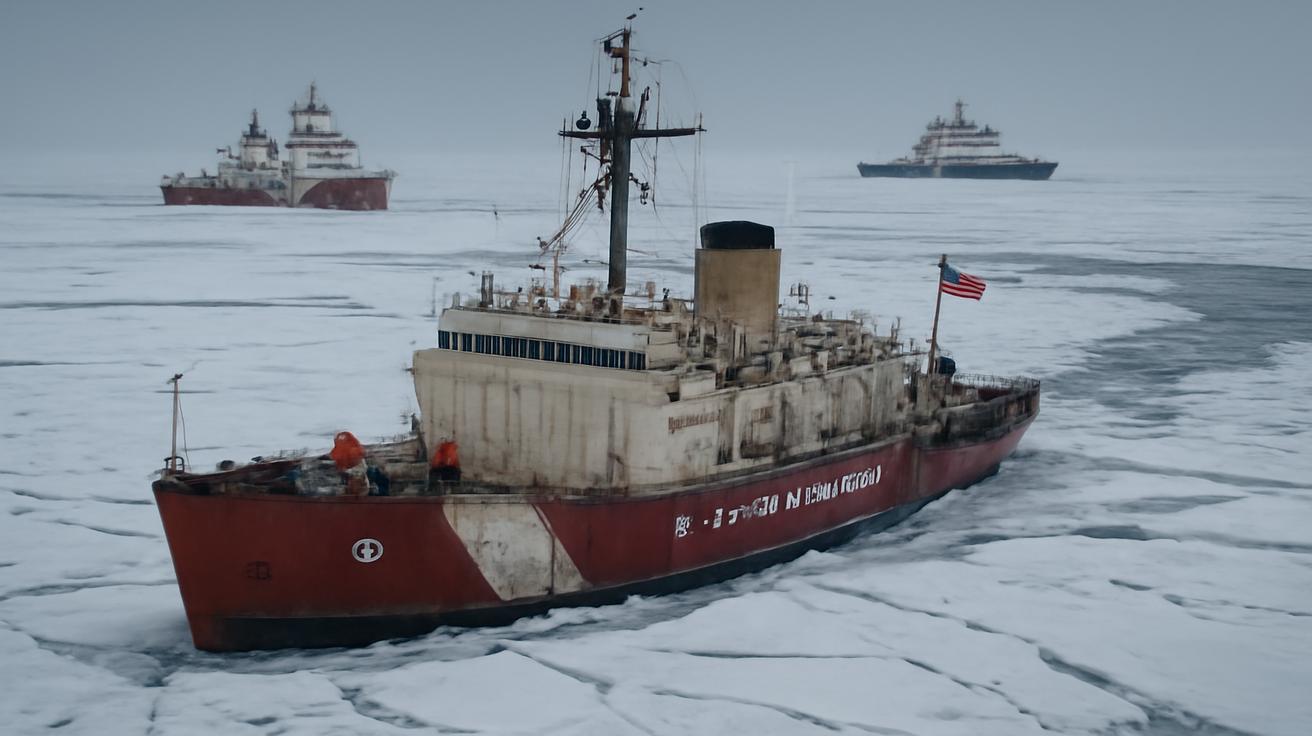
The first sound is not the shriek of metal or the roar of engines—it’s the hush. A vast, white stillness that seems to soak up every stray noise. Then, from somewhere beyond the horizon, comes a low, distant rumble, as if the planet itself is clearing its throat. Minutes later, the shape appears: a ship’s bow, thick as a cliff, shouldering its way through ice that groans and fractures in protest. Sheets of sea ice buckle, tilt, and shatter. A plume of snow and frost blooms around the hull as it crawls forward, carving a dark wound in the frozen surface. This is an icebreaker at work, and in the polar world, it might as well be a key in a locked door.
Why Icebreakers Matter More Than Most of Us Realize
To people far from the poles, icebreakers can sound like a niche curiosity—some specialized ships that poke around in icy places where few will ever go. But to the nations that depend on them, icebreakers are sovereignty, science, safety, and strategy rolled into one steel-bodied instrument.
Think of them as the snowplows of the ocean, except the snow is made of kilometers-wide slabs of ice, and the road they’re clearing might be the only way to deliver food, fuel, and medicine to entire communities. For the United States, icebreakers are the lifeline to Alaska’s remote coastal villages, to scientific stations nestled in Antarctic storms, to under-ice cables and navigation aids, and to the fragile ecosystems where climate change plays out in fast-forward.
They create pathways for resupply missions, escort commercial vessels through frozen seas, and serve as floating laboratories. They are also watchtowers—moving platforms that carry radar, drones, helicopters, and scientists whose job is to see what others might prefer to keep hidden.
And that’s where the story turns from quiet polar poetry into something far more pressing: in the realm of icebreakers, the United States has fallen badly behind. So far behind, in fact, that it’s now knocking on the doors of the two Western superpowers in the field—Canada and Finland—asking for help.
How the U.S. Fell Behind in the Land of Ice and Steel
If you picture the U.S. as a nation that leads in all things maritime and military, the reality of its icebreaker fleet hits like stepping into Arctic air without a coat. The U.S. Coast Guard operates just a handful of heavy and medium icebreakers, and only one heavy polar icebreaker—USCGC Polar Star—is still fully operational. She was launched in the 1970s, held together today by an almost old-fashioned blend of engineering ingenuity and sheer stubbornness.
Inside her aged hull, pipes corrode, engines groan, and spare parts sometimes have to be scavenged from her decommissioned sister ship, Polar Sea. Crews sail with welders, machinists, and electricians who know that their expertise may be the thin line between a successful mission and a ship stranded in some of the world’s harshest waters.
Meanwhile, other countries have been busy.
Russia, for instance, commands a fleet of dozens of icebreakers, including powerful nuclear-powered giants that look more like floating fortresses than ships. These vessels ply the Northern Sea Route, escorting cargo ships and asserting a quiet but unmistakable message: this is our domain. China, officially a “near-Arctic” state despite its geographic distance, has rapidly expanded its polar presence with multiple ice-capable vessels and ambitious science programs.
The U.S., by contrast, debated, postponed, and re-planned. Funding fluctuated, political will waxed and waned, and designs for a new Polar Security Cutter program crawled through years of delays and cost increases. While politicians argued and budgets stalled, the ice kept forming, the Arctic kept melting, and other nations pushed forward.
The result is a fleet gap that’s no longer just embarrassing—it’s strategically dangerous.
Calling in the Specialists: Canada and Finland Step onto the Stage
As the reality of the icebreaker shortfall hardened like new sea ice, Washington began to look outward. If it could not build quickly enough at home, perhaps it could lean on those who had spent decades perfecting the craft of cutting through polar seas. That search led, inevitably, to two names already etched deep into the Arctic story: Canada and Finland.
Canada: The Neighbor with Arctic in Its Bones
Canada is not merely a country that has icebreakers; it is a country shaped by ice. From the Northwest Passage to the high Arctic archipelago, its map is scribbled with frozen waterways and remote communities that can stay isolated for months at a time. Canadian Coast Guard icebreakers are not abstract symbols—they are the red-hulled guardians that bring fuel, mail, food, and medical supplies, that guide ships, support research, and quietly fly the flag in seas where the concept of “country” can feel abstract against the vastness of ice and sky.
For years, the United States has relied informally on Canadian icebreaking help in shared waters, especially in the Arctic. But now that need is more explicit. U.S. officials have explored cooperative agreements for shared operations, joint missions, and perhaps even leasing capacity during peak Arctic seasons. In an era where Arctic shipping, mining potential, and strategic posturing are all intensifying, Canada has become an essential partner in a domain the U.S. can no longer pretend to dominate alone.
Finland: The Quiet European Superpower of Ice
Thousands of kilometers from the Arctic Circle’s American frontier, Finland has quietly become one of the world’s great icebreaker workshops. Nowhere else on Earth is ice-capable shipbuilding such a refined craft or such a matter of national habit. The Baltic Sea routinely freezes; Finland’s ports depend on winter navigation; its designers have turned necessity into mastery.
Finnish shipyards and design bureaus have produced some of the most advanced icebreakers on the planet, from chunky workhorses that keep Baltic shipping lanes open to intricate, multipurpose vessels that can assist offshore energy projects, perform research, and perform rescue missions in brutal environments. If you trace your finger across a global map of modern icebreaking fleets, Finnish fingerprints are everywhere: vessels for Sweden, Canada, Russia, and others all lean on Finnish designs or technology.
For the United States, Finland represents something critical: speed and expertise. Instead of starting from scratch, U.S. planners have looked to Finnish design concepts and potential partnerships—ways to shorten development cycles, share best practices, or even buy or license designs that could be adapted for American needs.
The symbolism is striking. A global superpower, long used to setting standards, now finds itself asking for guidance on how to simply get through the ice.
When the Ice Becomes a Chessboard
It’s easy to get lost in the romance of the polar world—the dancing auroras, the blue-black water stitched with floes, the ghostly silhouettes of distant ridges. But beneath the beauty, the Arctic and Antarctic have become arenas of intense, if often quiet, competition.
Icebreakers are not just tools; they are statements. When a nation sends a heavy icebreaker north, it isn’t just to deliver cargo or collect data. It’s to say: We can be here. We will be here. And we can do so whenever we choose.
In the Arctic, retreating sea ice has opened new possibilities for seasonal shipping routes that cut days, even weeks, off traditional paths through the Suez or Panama canals. It has exposed undersea resources—oil, gas, minerals—that glimmer in the strategic imagination, even as the world tries to step away from fossil fuels. It has turned submarine patrol routes, under-ice communications cables, and search-and-rescue capabilities into matters of national priority.
Here, icebreakers are the queens and rooks on a polar chessboard: powerful, versatile pieces that determine which moves are possible. The lack of them doesn’t just limit commercial potential; it narrows diplomatic and military options. When a ship is trapped, when a satellite needs servicing support, when a research mission must be escorted, or when presence alone is a form of deterrence—a nation without icebreakers is a nation that must ask permission.
Scientists feel it, too. For oceanographers, glaciologists, and climate researchers, the poles are no longer remote curiosities. They are the control knobs of the global climate system. The more precisely we can measure ice melt, ocean circulation, and atmospheric changes there, the better we can understand the wild weather patterns in the latitudes most people call home.
Every ice-capable ship that can carry instruments, buoys, and labs into those regions becomes a lens into our planetary future. And every season that U.S. scientists must rely on foreign icebreakers to reach parts of the Arctic or Antarctic is a season where scientific independence blurs into dependency.
A Fleet on Paper vs. a Fleet in the Water
The United States is not oblivious to this bind. For years now, policymakers have talked about “recapitalizing” the polar fleet, about investing in new Polar Security Cutters that will finally give the Coast Guard the muscle it needs. Plans were drafted; contracts awarded; timelines sketched on hopeful diagrams.
But the gulf between a blueprint and a breaking hull can be vast.
These next-generation icebreakers are complex machines. Their engines must be powerful enough to smash through meters-thick ice while still maneuvering delicately close to wildlife, fragile coastlines, or dock facilities. Their hulls must be both brutal and precise: shaped to lift and crush ice, yet strong enough to withstand grinding forces for decades. Inside, they must balance the needs of crews who may spend months at sea, scientists who require sensitive instruments, and command staff who need secure communication and surveillance systems.
Rising costs and industrial bottlenecks have slowed progress. Shipyards already loaded with other projects struggle to add these behemoths to their queue. Specialized steel, heavy propulsion systems, and skilled labor don’t appear by magic. Years slip by while older ships grow more fragile.
This is where cooperation with Canada and Finland becomes more than diplomatic courtesy—it’s a survival strategy. Finnish design expertise could shave years off development; Canadian operational experience offers a living handbook of polar realities. Joint exercises, shared research cruises, and cross-decking of crew can keep skills alive even as hardware lags.
Still, the clock is ticking. Building an icebreaker is not like buying a plane or a truck. From keel laying to sea trials, the process takes years. Every delay now is a vulnerability stretched out into the next decade.
What’s Really at Stake When a Nation Can’t Break Its Own Ice
Step onto the bridge of an icebreaker in the early hours of an Arctic morning. The world outside is almost monochrome: blue, white, steel-gray. Inside, screens glow with radar returns, GPS paths, ice radar images, weather forecasts. The captain’s gaze flickers between them, then to the horizon—where ice heaves and the ship’s bow rises to slam down with a dull, echoing concussion that reverberates through your bones.
It is in this sensory, slightly unreal environment that the abstract language of “capacity” and “posture” becomes tangible. When a remote village’s only fuel shipment of the year rides behind you in a cargo ship that cannot move through ice on its own, the question of whether you have enough icebreakers stops being hypothetical. When a research team desperately needs to evacuate in worsening weather, or a distressed vessel sends a mayday in ice-choked waters, no amount of political rhetoric can substitute for the blunt fact of whether there is a capable ship close enough to help.
For the United States, calling on Canada or Finland or others for that help is not shameful; cooperation is the marrow of polar history. Explorers, scientists, Indigenous communities, and mariners have always known that in the ice, survival depends on collaboration.
The danger comes when dependence hardens into structural necessity—when a major power can no longer choose whether to act alone or together because it simply lacks the tools to act on its own. That tipping point is what alarms planners, Coast Guard veterans, and scientists watching the slow-motion crisis of the U.S. icebreaker fleet.
There is also the quieter, more intimate stake: the polar regions themselves. These are places where a single ship, used well or poorly, can leave marks—carbon, noise, pollution, disturbed wildlife—that last. Nations with long experience operating icebreakers, like Canada and Finland, have developed practices to try to balance access with care. For the U.S. to re-enter the polar arena in a serious way, it must not only catch up in hardware, but also in humility and stewardship.
A Glance at the Global Icebreaker Landscape
To understand how far the U.S. lags, it helps to see the bigger picture. Numbers never tell the whole story, but they offer a rough sketch of who can do what when the oceans freeze.
| Country/Region | Approx. Number of Icebreakers* | Notable Features |
|---|---|---|
| Russia | 40+ | Includes several nuclear-powered heavy icebreakers; dominant on Northern Sea Route. |
| Canada | A dozen+ (various types) | Extensive Arctic experience; vital for northern communities and research. |
| Finland | Fleet of Baltic icebreakers | World-class design and shipbuilding; keeps Baltic ports open in winter. |
| United States | Few active polar icebreakers | Relies heavily on aging Polar Star; new Polar Security Cutters in development. |
| Other Nations (e.g., Sweden, China) | Small but growing fleets | Increasing presence in polar research and logistics. |
*Numbers are approximate and include varying classes and capabilities; not all are heavy polar icebreakers.
In this rough snapshot, one pattern is unmistakable: the U.S. is nowhere near the top in dedicated icebreaking strength, despite its vast coastline, Arctic interests via Alaska, and heavy Antarctic commitments.
Looking Forward: Will the U.S. Learn from the Ice?
There is something humbling about ice. Whether you are a sailor on a small fishing vessel or a strategist in a windowless briefing room, ice refuses to obey wishful thinking. It thickens when it will, drifts where winds push it, fractures according to forces measured in thousands of tons. You cannot argue with it, only respect it—or be broken by it.
The United States now finds itself in a position that mirrors this stubborn lesson. The physics of steel and shipyards, of budgets and timelines, will not bend to rhetoric. Either the fleet is built, or it isn’t. Either there are enough icebreakers to escort, to rescue, to study, to deter—or there aren’t.
The emerging partnerships with Canada and Finland show that Washington understands at least part of this truth. It is willing to lean on those who know the ice best, to borrow experience and design rather than cling to outdated pride. In the near term, that collaboration may be what keeps vital missions going while new cutters inch toward the water.
But deeper down, there is a more reflective question waiting beneath the crust of policy talk: What kind of polar presence does the United States actually want to have?
Is it a presence that treats the Arctic and Antarctic as mere arenas for competition, places to plant flags and extract resources? Or one that recognizes these regions as fragile, interwoven systems whose health will echo in every coastline and climate zone on Earth?
In the end, the story of the U.S. icebreaker fleet is not just about steel and horsepower. It is about whether a powerful nation can admit it has fallen behind, ask for help wisely, and then commit to catching up in a way that honors the wild, shimmering worlds of ice it seeks to enter.
Somewhere, right now, an icebreaker’s hull is shuddering as it climbs a ridge of frozen sea and crashes down, cracking a path where none existed moments before. The sound rips through the still air, then fades again into the old, vast quiet.
Whether the United States can find its way back into that sound—on its own terms, with its own ships—may shape not only its place at the top of the world, but the fate of the warming planet those icy seas help to steady.
Frequently Asked Questions
Why are icebreakers so important for the United States?
Icebreakers allow the U.S. to supply remote Arctic and Antarctic stations, support Indigenous communities in Alaska, conduct polar scientific research, and maintain a strategic presence in regions that are increasingly important for security, shipping, and climate monitoring. Without them, many critical missions would be delayed, dependent on other nations, or simply impossible.
How many operational U.S. polar icebreakers are there right now?
The U.S. has very few operational polar icebreakers, and only one fully functioning heavy icebreaker, USCGC Polar Star. A medium icebreaker, Healy, supports Arctic research, but the fleet is far smaller and older than what experts say is needed.
What role do Canada and Finland play in helping the U.S.?
Canada provides operational support and partnership in the Arctic through joint missions, shared logistics, and experience in high-latitude navigation. Finland contributes world-leading icebreaker design and shipbuilding expertise that the U.S. can draw on to accelerate development of new vessels and avoid costly design mistakes.
How does falling behind in icebreakers affect U.S. security?
A limited icebreaker fleet reduces the U.S. ability to monitor and patrol its Arctic approaches, respond to emergencies, escort vessels, and participate fully in polar operations. It leaves more room for other powers—particularly Russia and China—to shape the future of Arctic routes, infrastructure, and norms while the U.S. struggles just to show up.
Are new U.S. icebreakers being built?
Yes. The U.S. has launched the Polar Security Cutter program to build new heavy icebreakers for the Coast Guard. However, these ships are complex, expensive, and time-consuming to construct. Delays and cost increases have slowed progress, which is why partnership with established icebreaker nations is so crucial in the interim.






Leave a Comment