
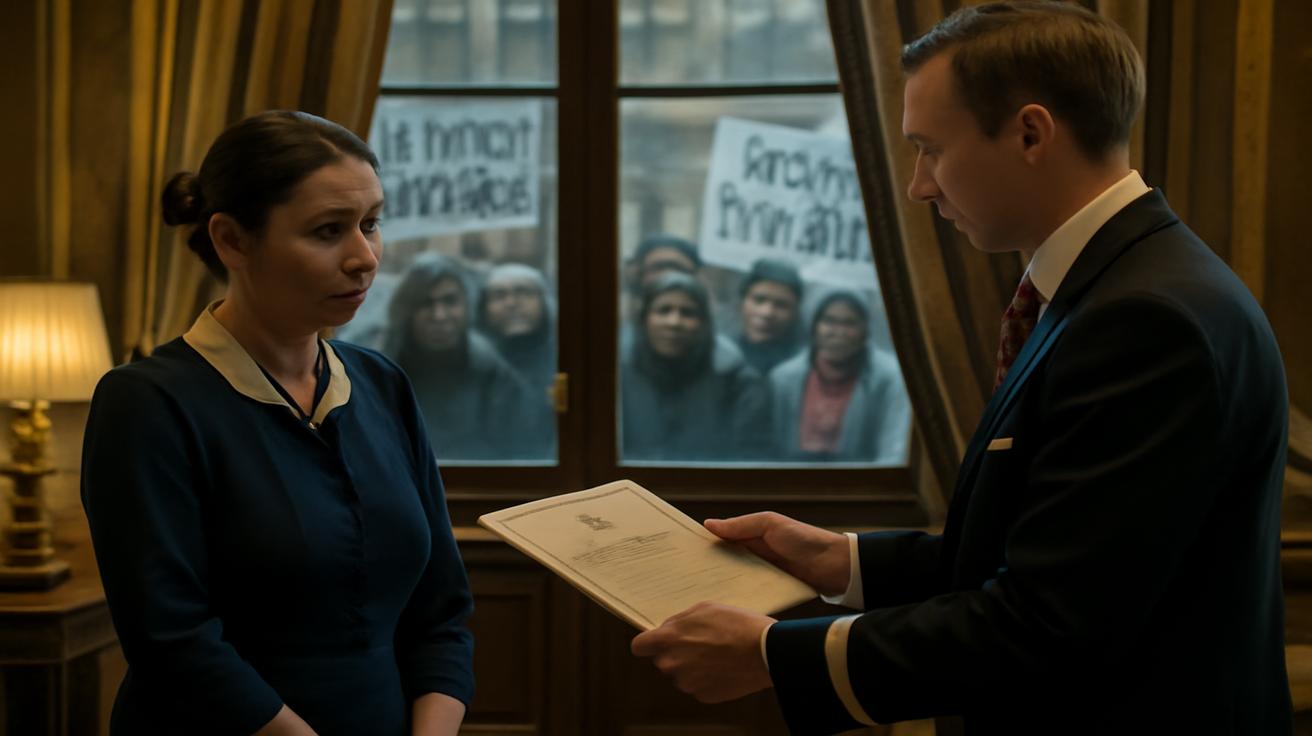
On a drizzly London morning, the kind that turns palace lawns into mirrors and blurs the edges of Buckingham Palace into a watercolor wash, a quiet story slipped into the news cycle and somehow made more noise than a full royal procession. A nanny – not a duchess, not a general, not a billionaire philanthropist – was being honoured with one of the rarest awards in the royal gift box. While social media still hummed with criticism and speculation about the Prince and Princess of Wales, somewhere behind tall gates and clipped hedges, a woman who has spent much of her life bending down to tie small shoes and soothe small storms was being asked to stand up and be seen.
A Medal for the Woman in the Background
The news, at first, sounded almost like a misprint. The Prince and Princess of Wales’s long‑serving nanny, a woman the public rarely hears speak and only occasionally glimpses shepherding young royals across palace courtyards, had been chosen to receive the Royal Victorian Order. In royal language, this is no small pat on the back. It is a personal thank‑you from the monarch, an honour bestowed not by committee or government, but directly, deliberately, by the King himself.
It is also, quietly, an extraordinary thing for a nanny.
For decades, royal watchers have tracked titles the way birders track migrating swans. Dukedoms, MBEs, OBEs, the gleam of medals on uniforms – these are all familiar parts of the royal ecosystem. But the Royal Victorian Order is different. It isn’t given because someone’s work aligns neatly with policy or political messaging. It exists for service to the monarch and the institution on a deeply personal level: the lady‑in‑waiting who manages impossible diaries, the valet who has been there for half a lifetime, the private secretary who knows the weight of every silence.
To see a nanny stepping into that circle is like suddenly noticing that someone who has always stood respectfully in the wings has been invited – just this once – onto the center of the stage.
The Quiet Architecture of Royal Childhood
If you listen carefully to the public conversation around royal children, it often hovers on the surface of things: who wore which coat, who looked shy on the balcony, who waved at which moment. But beneath every carefully choreographed family photo, there is an invisible architecture of care. A royal nanny exists in that hidden scaffolding – half guardian, half diplomat, part teacher, part emotional lightning rod.
Inside palace walls, days begin not with trumpets, but with the rustle of small feet and the familiar rituals of breakfast. Think of the simple, ordinary sounds: the scrape of spoons on cereal bowls, the muffled thump of a dropped toy, a laugh echoing down a hallway paneled with portraits of people who changed empires. For the children of the Prince and Princess of Wales, the woman at the edge of those moments is their nanny – a constant, calming presence trailing just one step behind their childhood.
People often imagine royal children living in a haze of formality, but in the day‑to‑day rhythm, they are still children first. They misplace shoes. They argue over who gets which crayon. They decide at the very last second that they no longer want to wear the carefully chosen outfit, and suddenly the schedule for the morning engagement is under siege from a four‑year‑old’s firm no. In those flashpoints, the nanny is both negotiator and safe harbor, absorbing the frustration and easing them back toward the day’s obligations.
When the family appears in public – on the steps of a hospital, at Trooping the Colour, on a foreign tarmac with flags whipping in the wind – the nanny is usually a few paces back, just out of the frame. Onlookers see the glamorous sweep of a coat, the tilt of a small head, the polished choreography of a royal walkabout. What they don’t see is the whispered reassurance offered moments before, or the practiced way a nanny can anticipate when a little hand will grow tired of waving and need to slide securely back into hers.
A Royal Honour in the Eye of a Storm
Under quieter circumstances, this award might have been met with a chorus of warm approval and a gentle flurry of human‑interest stories. But the timing of the announcement collided head‑on with a very different public mood. The Prince and Princess of Wales had already been walking through a storm – criticism over their communications, social media uproars, swirling conspiracy theories, the intense scrutiny that now seems permanently welded to their every move.
So when it emerged that their nanny had been elevated with a rare royal honour, a faction of the public response turned sharp, almost instantly. Critics asked: was this a distraction? A signal? A reward for loyalty in a time of turmoil? Each theory bloomed and branched in the comment sections, fed by the same restless energy that drives modern outrage cycles.
In the middle of that clamor sits a profoundly ordinary truth. Long before the controversy hashtags, this nanny was there. Long before the timeline of events that animated critics, she had helped guide small hands through alphabet books and first days of school, had supervised homework when the rest of the world only saw perfect photographs of first‑day uniforms and shy smiles.
The disconnect is jarring: on one side, a woman whose working life has unfolded in nurseries and school runs; on the other, a digital landscape eager to fold every royal development into a larger narrative of distrust or disapproval. Her honour became a kind of mirror, reflecting back not just attitudes toward the monarchy, but our collective impatience with any gesture that doesn’t immediately satisfy our appetite for transparency and accountability.
Service, Loyalty, and the Weight of the Invisible
To understand why this particular award carries such emotional charge, you have to step into the strange overlap between personal service and public symbolism. A Royal Victorian Order is not a lifetime achievement Oscar. It is more intimate than that. It whispers: I see you. I see what you did when only we were looking.
For a royal nanny, the ledger of her service is almost entirely private. She will never give a press conference about the night a frightened child refused to sleep after a frightening news story. She will not publish a memoir describing how the pressure of living halfway between ordinary family life and a nation’s expectations sometimes pressed down on the children like a too‑heavy cloak.
Her work happens in stolen, liminal spaces – five minutes between a piano lesson and bath time, half an hour between a state banquet and bedtime stories. She is expected to maintain a near monk‑like discretion while functioning as a kind of emotional backbone, one that cannot bend even when the headlines are harsh.
That weight – of being deeply involved, but also permanently peripheral; of loving children who belong in some very real sense to the world – is almost impossible to quantify. A medal can’t measure it perfectly, but it can at least acknowledge it.
Inside the Palace, Outside the Palace
Outside the palace rails, the air feels chilly with judgment. Inside, the mood can be very different. Royal households, for all their gold‑edged formality, are also workplaces, communities with their own rituals and loyalties. People retire after thirty, forty years of duty and talk about “family,” about Christmas gatherings, about the sense of being part of something that has outlived multiple lifetimes.
In that world, honouring a nanny for years of devoted service may feel natural, even overdue. She did the school runs when the cameras couldn’t follow. She soothed tantrums that would have become headlines had they occurred on a balcony. She absorbed the ordinary chaos of childhood so that the public story of “the children are doing well” could ring mostly true.
Yet as that internal logic played out – the King choosing to recognise someone who has cared for his grandchildren; the Prince and Princess of Wales quietly supporting the honouring of a woman who effectively co‑parents the public face of their family – the outside world was parsing the gesture with a different vocabulary: optics, narrative control, backlash management.
There is an uneasy truth here: very little that happens around the modern monarchy exists solely in private anymore. Even gratitude becomes a performance the moment it enters the public record. A pin on a lapel becomes a lightning rod.
The Human Story Behind a Royal Title
Strip away the titles for a moment – the Prince, the Princess, the formality that clings to the words “Their Royal Highnesses” – and a simpler story appears. Two parents, often away, sometimes subject to fierce public criticism, trying to raise three children in circumstances no parenting manual has ever truly prepared anyone for. In those conditions, a trusted nanny becomes less an employee and more an essential ally.
The modern royal nanny is no longer the stern Victorian figure of old cartoons. She is professionally trained, highly educated, usually multilingual, able to pivot from comforting a homesick child on an overseas tour to ensuring protocol is observed in the middle of a foreign palace. She must know the difference between a meltdown that is simply about too much sugar and too little sleep, and distress that hints at deeper anxiety triggered by seeing a parent splashed across front pages for the wrong reasons.
The Prince and Princess of Wales have spoken often enough about mental health, about the invisible work of emotional support, that it’s not hard to imagine how deeply they might value the person who helps keep their children emotionally anchored while they shoulder the shifting expectations of a nation.
Seen through that lens, the decision to honour their nanny is not a PR maneuver but a profoundly human one – a way of saying, out loud and on the record: “You mattered to us. You mattered to our children. You stood steady when nothing else did.”
The Clash Between Expectation and Reality
Still, the backlash tells its own revealing story. The modern public has grown used to reading everything the monarchy does as part of a strategic campaign – every photo, every appointment, every speech deconstructed for what it “really” means. Trust is thinner now. Deference has thinned even faster.
To some, honouring a nanny while questions swirl around broader royal decisions feels like polishing the silver while ignoring the leaking roof. Why, critics ask, should symbolic gestures keep rolling on as usual when answers feel slow, crisis management clumsy, transparency partial at best?
The tension is real. Institutions that have survived this long on ritual and continuity now exist in an age that asks for confession, vulnerability, and above all, explanation. It is not enough for the palace to say “this is a private recognition for private service” when the very existence of that service is part of a public, taxpayer‑supported machine.
And yet, there is another, quieter counter‑question, rarely asked out loud: in our rush to hold power to account, how often do we inadvertently trample over people who are simply adjacent to that power? The nanny does not decide palace policy. She does not draft press releases. She does not choose the timing of her award. She exists in that complicated category of people whose lives are shaped by decisions they never make, and whose efforts are suddenly turned into talking points by strangers they have never met.
A Small Honour in a Loud World
The story of this royal award will likely fade, overtaken by the next development, the next scandal, the next carefully staged photograph. The cycle will spin again, faster and faster. That is the nature of the news now. But somewhere in that blur, there will remain a quiet image: a woman standing very straight, perhaps a little nervous, perhaps remembering the first day she walked into a royal nursery and saw the soft chaos of toys and picture books and tiny socks.
She will think of how those children grew taller, learned to bow and curtsey, mastered the art of polite small talk with adults three times their age. She will remember scraped knees hidden beneath tailored shorts, microscope projects spread over desks the world assumes are only ever used for homework photographs, whispered questions at bedtime about why reporters ask such difficult questions of Mummy and Papa.
In that moment, the medal being pinned to her may feel surprisingly heavy. Not for its metal, but for everything it represents: the nights of broken sleep before an early‑morning photocall; the flights across time zones when she had to keep jet‑lagged children functioning under the glare of a thousand lenses; the long, ordinary afternoons spent just being there, a dependable heartbeat in a life that belongs, too often, to everyone else.
The controversy will have its say. The critics will frame the narrative. But the small, persistent, largely invisible work of caring for children in unusual circumstances will go on, in palaces and tower blocks and terraced houses alike. The difference here is not the love or the patience, but the spotlight that sometimes lands where it was never meant to.
In the end, perhaps the most radical thing about this royal honour is not that it was given, but that it forced us, briefly, to look directly at someone we usually allow to remain blurred at the edges. A nanny, honoured by a king, standing for a moment at the center of a story that too often forgets the people who hold it quietly together.
A Snapshot of a Royal Honour
For those trying to make sense of the scale and rarity of what has been given, it helps to see the basics set out clearly. The surface facts are simple; the emotions tangled around them are not.
| Recipient | Nanny to the Prince and Princess of Wales’s children |
| Royal Honour | Royal Victorian Order (RVO) |
| Granted By | His Majesty the King, personally |
| Reason | Distinguished personal service to the Royal Family, especially in caring for the Wales children |
| Context | Awarded amid heightened controversy and public criticism surrounding the Prince and Princess of Wales |
Looked at this way, the story fits easily within the long tradition of royal gratitude for long service. But stories are never just their bullet points. They are the weather that swirls around those facts, the scent of controversy or compassion we bring with us when we read them.
As the rain clears from the palace lawns, as headlines drift on to fresher outrages, one small certainty remains: a nanny who helped raise the next generation of a very public family has been, at last, formally thanked. Whether we see that as a misstep in messaging or as a rare glimpse of tenderness in an often‑unyielding institution may reveal as much about us as it does about the royal family itself.
FAQ
Why is it unusual for a royal nanny to receive the Royal Victorian Order?
The Royal Victorian Order is typically reserved for individuals who have given long, personal, and often high‑level service to the monarch or the royal household. While staff are sometimes honoured, a nanny receiving this recognition is rare because her work is intensely private and centered on the children, not public duties or policy.
Does this honour mean the nanny is now a public figure?
No. Even with the award, the nanny remains a private staff member. She is unlikely to give interviews or step into the media spotlight. The honour recognizes her service but does not change the expectation of discretion that surrounds her role.
Is this award connected to the recent controversies around the Prince and Princess of Wales?
Formally, the award is presented as recognition for years of personal service to the royal family. The timing has led some to question whether it is also part of managing public perception, but there is no official confirmation that it is linked to any specific controversy.
Who decides who receives the Royal Victorian Order?
Unlike many honours that are recommended by government or committees, the Royal Victorian Order is granted personally by the reigning monarch. It is one of the few honours systems where the King’s individual judgment plays the central role.
What does this tell us about the Prince and Princess of Wales as parents?
Honouring their nanny suggests they place a high value on the stability, care, and emotional support she provides their children. In the demanding and highly public life they lead, it signals recognition that raising grounded children is a shared effort – and that the person who stands beside them in that task deserves to be publicly thanked, even if the world reacts noisily when they do so.




Leave a Comment