
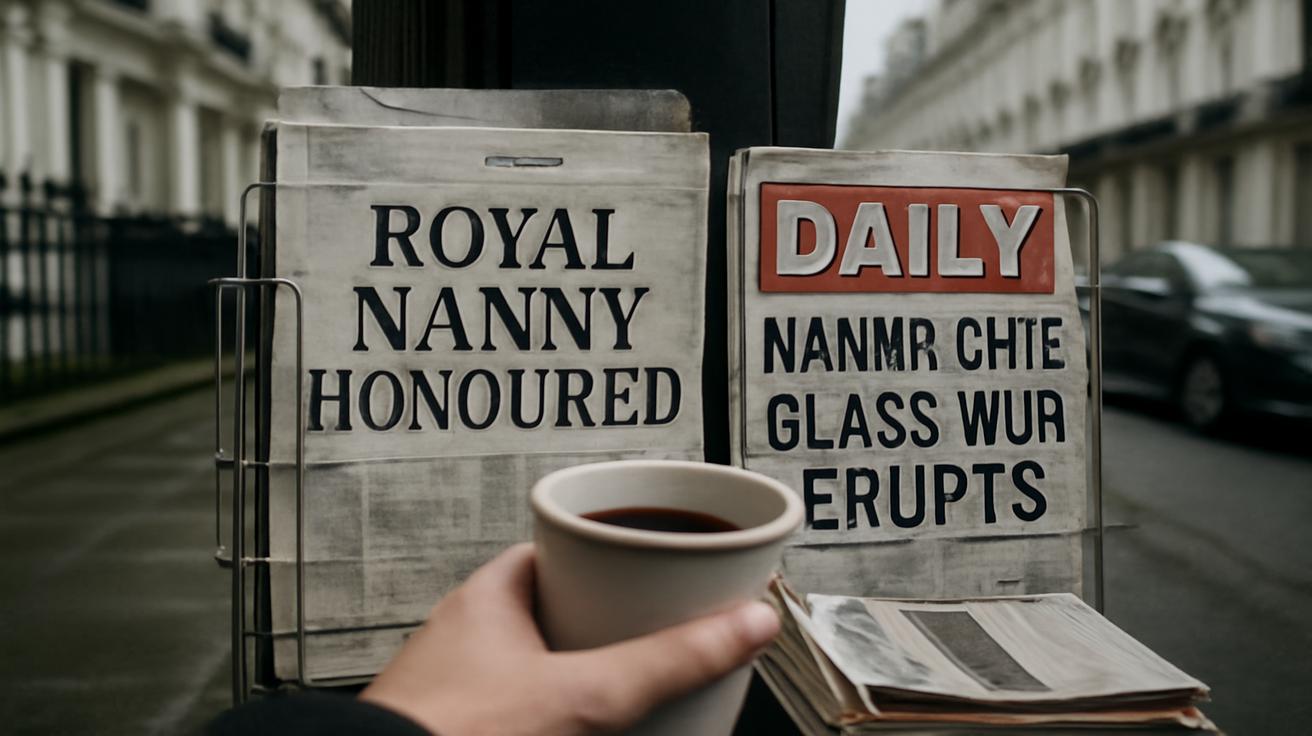
The story begins, as many modern royal tales now do, in the soft glow of a camera phone screen. A grainy video from a windy Scottish hillside, or perhaps a fleeting shot outside a palace gate, is shared and reshared. At the center of it all is not a prince or princess, not a gleaming tiara or sparkling gown, but a woman in a sensible coat, her posture straight, her expression composed and kind. She is Maria Teresa Turrion Borrallo, the nanny to the Prince and Princess of Wales’s children—now suddenly the subject of global fascination. Her name, once tucked away in the footnotes of royal reporting, has stepped into the light thanks to a rare honour: the Royal Victorian Order.
Walking Into a Story Already in Progress
To understand why this honour matters, you have to imagine the quiet choreography of royal life. It’s early morning at Adelaide Cottage in Windsor. Fog clings low to the grass. Birdsong slips between tall trees. In a kitchen filled with soft clatter—spoons, cereal bowls, the faint hiss of a kettle—three young royals appear, still wearing sleep in their eyes.
Somewhere between the clink of mugs and the rustle of school bags, there is a steady presence. She remembers who likes jam and who insists on honey. She knows which PE kit is buried at the bottom of which drawer. She can coax a tired child into a car seat with the gentle firmness that comes from years of practice. That presence is Maria, the woman quietly honoured by King Charles III for her service to the family of the Prince and Princess of Wales.
The Royal Victorian Order is not just another medal in a crowded honours system. It is personal. Created by Queen Victoria in 1896, it is given at the monarch’s discretion, often to those who serve the royal household with loyalty and discretion. It bypasses public nominations and political committees; in a world where almost everything is mediated through institutions, this is one of the few royal gestures that still feels hand-signed.
A Rare Honour for a Familiar Role
Nannies are not new to royal history. The corridors of palaces have echoed with the soft steps of governesses and nursemaids for centuries. Yet, there is a particular tension in seeing a nanny publicly honoured in 2024, when the air around royalty feels suddenly sharper, more charged with questions of power and privilege.
Maria—Spanish-born, rigorously trained at the elite Norland College in Bath—has long been a figure of quiet fascination. Norland nannies are instantly recognisable: tailored brown uniforms, distinctive hats, an air of brisk competence bordering on legendary. They are the kind of nannies who can change a nappy in a moving car, anticipate tantrums before they ignite, and teach impeccable table manners without raising their voices. They are also, undeniably, a symbol of class: a gold-standard childcare solution largely affordable only to the very wealthy.
When news broke that the Prince and Princess of Wales’s nanny had received the Royal Victorian Order, reactions were swift and layered. For some, it felt like a gentle, human moment: a hard-working woman being thanked by the family she’d helped raise. For others, it seemed like a troubling symbol—another example of an old institution rewarding the invisible labour that keeps its gilded wheels turning, without addressing why such labour remains so stratified, so tethered to class and access.
Behind the Palace Gates: The Work You Never See
You do not see Maria when Prince George straightens his tie nervously before his first day of school, but she is there in the way he knows how to hold his own backpack. You do not see her when Princess Charlotte curtsies at a formal event, but you can sense the hours spent gently turning etiquette into habit, not performance. You do not see her when Prince Louis, all mischief and quicksilver energy, bounds through a room, but you can feel the unseen boundaries that let curiosity roam without chaos.
The photographs that make it to the news are smooth and choreographed—tiny hands in bigger ones, perfectly timed smiles. Yet, the untidy stitching behind that fabric is where Maria lives: the long nights with unsettled babies, the patience required to manage royal schedules, the careful balance of being loving but not overstepping, present but never central.
It is this invisible constancy that the Royal Victorian Order quietly acknowledges. The award is a kind of royal whisper: we see you; we noticed; thank you. And in an era when the monarchy is constantly accused of being aloof, removed, overly symbolic, there’s something powerfully human about that simple recognition.
The Honour, Explained in Human Terms
On paper, the honour is straightforward. The Royal Victorian Order is divided into several ranks, with recipients often drawn from among staff members who have worked closely with the royal family: private secretaries, ladies-in-waiting, chauffeurs, dressers. Maria’s inclusion in this circle places her in a tradition of those whose lives are carefully woven into the private daily rhythms of royalty.
To the royal family, the award may be a natural gesture of gratitude. For many observers, however, it sits at the crossroads of something more complicated: admiration for devoted care work on one side, and a growing critique of class hierarchies on the other. The very idea of an “honoured nanny” feels emotionally resonant, but also politically loaded.
| Aspect | Royal Nanny | Typical UK Childcare |
|---|---|---|
| Training | Specialist colleges (e.g., Norland), extensive child development training | Varies widely: from highly qualified early years practitioners to informal carers |
| Cost | High, often live-in with additional benefits; accessible mainly to upper-income families | Nurseries, childminders, au pairs, grandparents—some state support but often a financial stretch |
| Visibility | Occasionally photographed, subject to media interest and public scrutiny | Largely invisible in public discourse despite being essential to many families |
| Status | Symbolically elevated through royal proximity and, in this case, formal honours | Professionally vital but often underpaid, undervalued, and rarely formally celebrated |
A Storm in the Social Landscape
Online, where nuance can be flattened in a single swipe, the news of Maria’s award hit an already simmering conversation about privilege. Comment threads filled quickly. Some users applauded the recognition: “At last, someone is honouring the people doing real work,” one commenter wrote. Others asked a sharper question: what does it say about British society that a nanny to the most privileged children in the country can be honoured by the Crown, while so many childcare workers struggle for fair pay, secure contracts, or even basic respect?
There is, in this reaction, a sense of dissonance. The royal nanny exists at a strange intersection of worlds: she is a worker, an employee, a carer—and yet she moves in rarefied, heavily protected spaces most people will never see. Her daily life is filled with the same basic tasks as any childcare provider: comforting a crying toddler, teaching please and thank you, wiping jam from cheeks. But she does all this under a microscope, surrounded by armed security, in homes that once housed monarchs whose portraits now gaze down from the walls.
So when she is honoured, it can feel to some like a celebration of care work, and to others like a reminder of who gets their labour elevated to the realm of royal gestures, and who remains anonymous in fluorescent-lit nurseries and crowded playgroups.
Care, Class, and the Quiet Inequality of Childhood
The question lurking beneath the headlines is larger than the monarchy. It asks us to think about who raises children in Britain today—and on what terms. For many families, childcare is an exhausting puzzle of logistics and compromise: patchwork schedules, grandparents drafted into daily duty, nursery fees that swallow almost as much as a mortgage payment. For early years educators, low wages and long hours are common. For parents, guilt is a constant background noise: too much work, too little time, always the feeling of never quite doing enough.
Against this backdrop, the tidy certainty of a Norland-trained, full-time royal nanny feels almost like another era entirely. The ornate old house, the neatly pressed uniform, the certainty that no shift will ever end with a panicked calculation of whether the childcare bill can still be paid this month.
Yet, if we strip away the layers of spectacle and status, we arrive at a surprisingly universal core: children need safe, consistent, loving care. The reality that some children receive that care in palaces while others experience it in overcrowded flats or underfunded nurseries is not the fault of any one nanny—or even any one family. But moments like Maria’s honour pull that divide into sharp focus, lit up by the flash of royal ceremony.
The Human Face Behind the Title
In photographs, Maria is never the main character. She appears at the edge of the frame: holding a small coat, steadying a young hand, watching from a courteous distance. The art of being a royal nanny is, in many ways, the art of being essential without being central, emotionally involved without seeking emotional ownership. It is a vocation that asks for a whole human heart, with the understanding that part of that heart will always, inevitably, belong to someone else’s story.
Imagine, for a moment, what it must be like to teach a child who will one day see their own face on currency, on stamps, in history books. How do you guide them through tantrums and scraped knees, through bedtime stories and alphabet practice, knowing that every ordinary moment is layered with an extraordinary future? Perhaps you do not think of that future at all. Perhaps you simply apply sunscreen, cut apples into slices, check shoelaces twice.
When Maria walks with the Wales children through the damp green of a Scottish estate or the clipped lawns of Windsor, the sensory details are the same as in any childhood: the crunch of gravel, the sting of cold wind on cheeks, the delicious squelch of mud under boots. History, for the child, is just the story adults tell. For the nanny, it is both backdrop and boundary.
A Personal Honour in a Public World
The Royal Victorian Order is often worn as a small, neat ribbon—unobtrusive to an untrained eye. Yet its meaning is profoundly intimate: recognition not for public achievement, but for personal service. When Maria’s name appeared among those honoured, it was a clear sign that within the privacy of their lives, the royal family sees her as more than an employee; she is trusted, valued, almost certainly loved.
That intimacy can be uncomfortable in a culture increasingly sceptical of hierarchy. Why, some ask, should the gratitude of a royal family matter more than the gratitude of any other employer? Why should this single nanny be elevated when thousands of others work as hard, for less money and no recognition, sometimes in conditions that are emotionally and physically punishing?
Yet for all the valid criticism, there is also something quietly radical in honouring the care work itself—naming it, lifting it out of the shadows. A royal order cannot fix systemic inequality. But it can, perhaps, remind people that behind every composed public figure, there are hands that helped them tie their first shoelaces, arms that held them when no one was watching.
Listening to the Echoes of a Larger Debate
Class debates in Britain are rarely just about money; they are about visibility, respect, and the stories a society tells itself about who matters. The fuss surrounding Maria’s honour falls into this broader pattern. For some, it confirms a familiar frustration: a royal family that continues to move in a bubble of private schools, country estates, and staff whose devotion is rewarded with medals rather than structural change.
For others, it offers an unexpected doorway into discussion. If people are willing to talk about the royal nanny, they might also be willing to talk about the nursery assistant working a twelve-hour shift on minimum wage, or the single parent juggling two jobs and still having to choose between childcare and heating. The spotlight is narrow, but it can cast a longer shadow, stretching out to illuminate more of the landscape.
There is something undeniably symbolic about the figure of a nanny. She embodies care that is paid for—love translated into a profession. She steps into the gap between parents and children, offering time and energy that parents cannot always spare. In the case of a royal nanny, that gap is widened by duty, public roles, global expectations. The Prince and Princess of Wales are not just parents; they are heirs, figureheads, ambassadors for a nation. Their children are, whether they like it or not, part of a living emblem.
Maria’s work takes place in that liminal space between family and institution, between private affection and public obligation. No wonder, then, that the honour she receives resonates so far beyond the palace walls.
What This Moment Might Yet Mean
Perhaps the most honest way to read this rare award is to hold two truths at once. On one side: a woman who has done her job with care and excellence, who has devoted years of her life to the wellbeing of three children growing up in the most unusual of circumstances, being thanked in the only formal language the monarchy really has—an order, a ribbon, a few carefully chosen words.
On the other side: a country in which childcare is both essential and precarious, where the people who look after children are often asked to carry enormous emotional weight with little financial or social recognition. A society under strain, increasingly alert to the ways class shapes every corner of daily life—from who can afford high-quality care to who is expected to provide it.
The story of the Prince and Princess of Wales’s nanny being honoured is not a simple feel-good anecdote, nor is it evidence of unforgivable elitism in isolation. It is, instead, a magnifying glass. Through it, you can see the details of one woman’s service, the deep bond between carer and child, the small graces of a life spent in the background. But if you pull the lens back, you see something larger: a system where the value of care is still unevenly distributed, and where recognition often follows power rather than pure need.
Some will look at Maria’s ribbon and see inspiration—a reminder that care work deserves to be celebrated. Others will see a challenge: if this is what we do for the nanny of a prince, what might we yet do for the invisible army of carers, educators, and parents holding up the rest of the country’s children?
Maybe the most hopeful outcome is not that we stop talking about Maria, but that we start talking, with the same intensity, about everyone like her—and everyone utterly unlike her—who wakes up before dawn to help a small person feel safe in the world.
FAQ
Who is the nanny to the Prince and Princess of Wales’s children?
The nanny is Maria Teresa Turrion Borrallo, a Spanish-born, Norland College–trained childcare professional who has been caring for Prince George, Princess Charlotte, and Prince Louis for years. She is known for her discretion, professionalism, and close, trusted relationship with the family.
What is the Royal Victorian Order and why is it significant?
The Royal Victorian Order is a dynastic order of knighthood established by Queen Victoria in 1896. It is awarded personally by the monarch, often to individuals who have given distinguished service to the royal family. Its significance lies in its personal nature: it reflects the monarch’s direct gratitude, rather than a recommendation from a political or public honours committee.
Why has this honour sparked a class debate?
The award has drawn attention because it highlights how a nanny in a royal household—already a symbol of privilege and elite childcare—can receive high recognition, while many childcare workers across the country face low wages, limited security, and little public acknowledgment. This contrast has fed into wider discussions about class, inequality, and whose labour is visibly valued in British society.
Are nannies traditionally honoured by the royal family?
Some staff members who work closely with the royal household, including nannies, have been honoured in the past, though it remains relatively rare and is not automatic. Such honours tend to reflect long-standing, trusted service and a significant role in the private lives of royal family members.
Does this honour change anything for other childcare workers?
Practically, it does not alter pay or conditions for other childcare workers. Symbolically, however, it has helped bring attention to the importance of care work. Whether that attention leads to broader changes—in policy, funding, or social recognition—will depend on how the public, the government, and institutions respond to the wider debate it has reignited.





Leave a Comment